prairie-with-blue-sky-and-clouds

What I Gained in Partial Hospitalization

Two or three days into my partial hospitalization program, it became clear to me that my peers were seeing positive results. At check-in, those closest to leaving would report feeling “good”, or “light”- two sensations that are unfamiliar to my depressed brain. I was glad that they were feeling better, and initially, it gave me a glimmer of hope for myself.

As the days passed, that hope dimmed; I wasn’t feeling much better at all. In fact, as my last day approached, I started feeling lower and lower. My thoughts about self-harm came back in full force, and when I tried to use the skills we’d been taught to combat them, I was unsuccessful. Morning check-in was even more excruciating than usual because I had to admit that I wasn’t doing well. The people who had come before me had felt better, so what was I doing wrong?

For one thing, I wasn’t doing anything “wrong”. The psychiatrist and both therapists for the program all agreed that the root cause of my depression is chemical. This doesn’t mean that coping skills are useless. They can help keep me safe and offer healthier alternatives to my go-to, maladaptive coping mechanisms. Over time, I can retrain my brain to help me get out of negative thought patterns or habits. However, coping skills are unlikely to do much to address the causative problem.

Secondly, there is no right pace for recovery. Comparing myself to others was only making me feel worse. That said, it’s only natural that we look to others to find out what to expect when we’re in an unfamiliar situation. I wish I had been able to temper my expectations when comparing myself to others in partial hospitalization.

Just because I didn’t leave partial walking on air doesn’t mean I “failed”. I still got a lot out of the experience.


Connection

Similar to my experience of being an inpatient at a mental hospital, one of the most valuable takeaways for me was the sense of connection I had with other patients. Hearing about other people’s perspectives on a shared experience helped me gain insight into my own thoughts and behaviors. Plus, it feels good to talk to people who understand your suffering and can empathize. I definitely came away from the ten-day program feeling less alone.

A sense of my own value

The first few days of my participation in the PHP, I was there for my family. I was there because other people wanted me to be, and I was willing to commit my time to a program like that in order to ease my family’s fears. A few days ago, though, I realized that I felt more like I was there for myself. It was a subtle shift, but it feels like a big step.

Acceptance

Throughout my inpatient hospitalization and partial hospitalization, I had several moments that stopped me in my tracks. The fact that I was at that level of care for my mental illness seemed surreal, and I couldn’t wrap my mind around the situation. I think that I have a better grasp on my symptoms and what I need to do to keep them under control. I also have a sense of acceptance that once I feel better, I’ll still need to manage my illness; I won’t be able to push returning symptoms under the rug. That’s how I ended up in the hospital.

Greater understanding of my patterns and behaviors

While the skills I learned may not address the root of my depression, they certainly help me shift my behavior towards healthy responses and actions. Perhaps the biggest behavioral takeaway for me is greater awareness of how I withdraw, isolate, and avoid addressing the issue of my depression with my loved ones.

Patience

No, I didn’t leave partial hospitalization feeling like my peers who had left before me. Everyone goes at their own pace, and everyone has unique circumstances and factors involved in their symptoms. All we can do is go day by day.
My Secret Fear about Depression

I have a secret fear that maybe this is what life is like for everyone. Maybe I’m expecting too much. Maybe other people can cope with life’s stressors better than I can. Maybe I should try harder. Maybe my depression is fake.

Spoiler alert: it’s not.

Part of what makes depression so terrible is that, by its very nature, it keeps you from getting help. It tells you you’re worthless, it makes you ashamed, and it robs you of motivation and energy. My depression tells me that I’m ungrateful and burdensome and that I should keep quiet about the things I’m struggling with. Well, y’know what? I’m sick of taking orders from The Lump.

I’m going to PHP group therapy, individual therapy, and I’m talking to my family and friends about my illness. I’ve even told a few acquaintances about my hospitalization. And, guess what? Everyone has responded with compassion and support. Not one person has said “You’re faking it. Just stop being sad.” The only time I ever hear that phrase is when it’s inside my own mind.

It’s time I show myself a little of the understanding and reassurance I receive from others. After all, I have a biochemical imbalance in my brain. It’s not my fault.

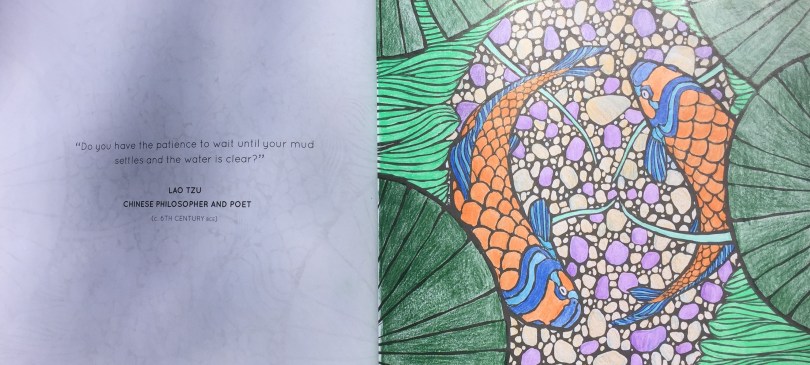
coloring-page-of-koi-fish-with-lao-tzu-quote-about-mindfulness

4 More Poems From a Mental Hospital

I. Partway Up

The rising sun

seems stuck in its journey,

halted,

partway up


while I wake

and sleep,

wake,

and sleep.


Disoriented,

the only way to track the time

is by the shuffling

of nurses’ footsteps.


Tomorrow, I will rise

and, like the sun,

get stuck-

partway up.


II. Looking Out

Cafeteria skylights-

wide squares of sun

move slowly over patients

moving slowly.


I crane my head back

and watch a cloud

far, far above this place

dance from one window to the other


cotton candy arms spread wide

in a perfect arabesque

that soon diffuses-

and is gone.


III. What’s in a Mile?

It’s 24 steps

from the desk

to the door-

to the other is 31 more.


The door’s always locked,

but still,

I walk,

If I can keep going, I will.


Again and again,

lap after lap,

linoleum lines

as my only map.


I lost count

for a while,

but I know

that 21 laps is a mile


and it’s 24 steps

from the desk

to the door,

to the other is 31 more.


How long will it take

if I pick up my pace

for me and my mind

to embrace?


IV. Comparison

My first roommate

left her toothbrush

and some clothes

when she gained her freedom.


They put the clothes in a bag,

and then it was just the toothbrush,

small, etched heart on the back

staring up at me.


My second roommate

doesn’t notice

the evidence

of the first.


She cries in bed,

blanket pulled up over her eyes

while I tiptoe

around her.


When she packs up her things,

I wait for the third

hoping this time-

I’ll be the one to leave first.

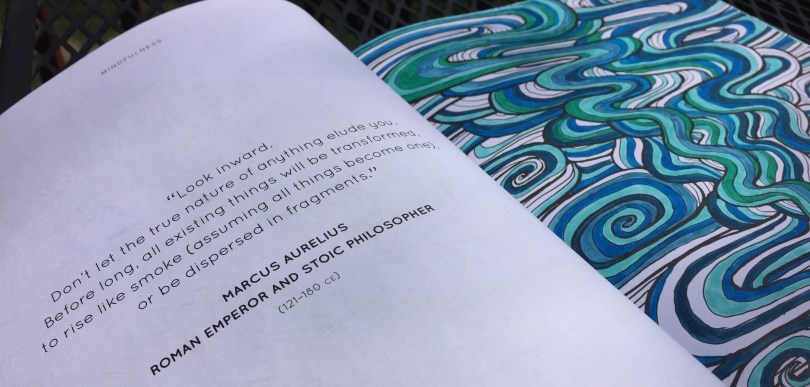
coloring-page-with-marcus-aurelius-quote-about-looking-inward

4 Poems From a Mental Hospital

I. Constants

In the courtyard

turning inward-

each one of us

small spheres of loneliness.


We’re locked

-in our minds

-in our pain

-in our patient IDs


What do you do

when the treatment

feels worse

than the illness?


Stripped of everything

familiar,

except that constant-

depression.


II. Foggy

Should I ask for the nail clippers?

Small signs of time passing-

longer nails, body hair,

and that monthly reminder of womanhood.


Everything else blurs together-

groups, meals, and the patients

who come and go

before I can come back to myself.


Twice a day, the question

“are you thinking about wanting to be dead?”

Each time I reply,

I’m less sure of my answer.


III. Scrutinized

The nurses walk by every 15 minutes

and flip through their clipboards,

monitoring their charges

with small, inked notes.


Some of us deal with it

alone,

cocooning ourselves

inside our skulls.


Others direct it outward,

venting to anyone who will listen

in an attempt

to regain control.


Ever present: the choice to perform-

or be authentic.

Which will get me out

and which will get me better?


IV. Treatment

They say it’s not a punishment, being here-

and it’s not-

but my sputtering brain,

fighting to maintain pathology,


begs

to differ.


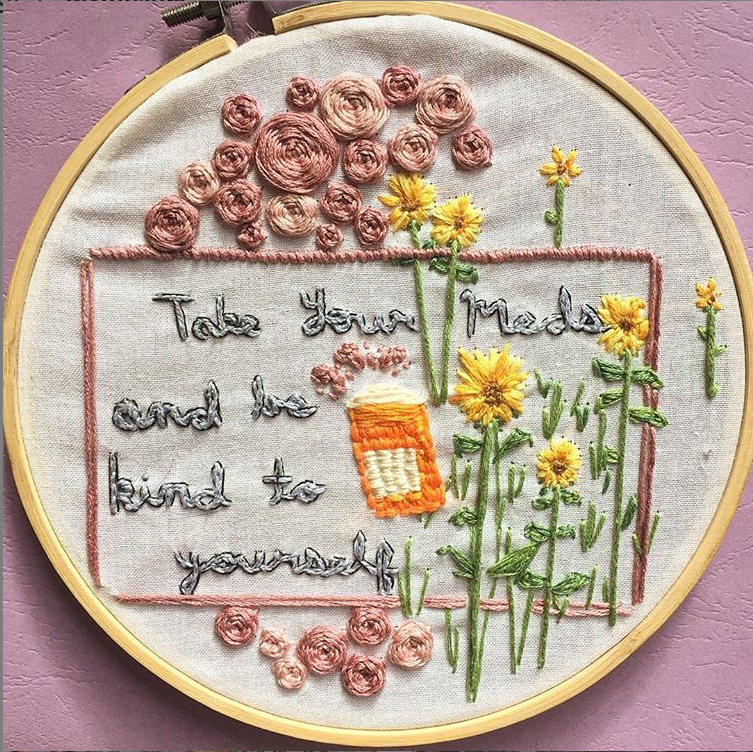
embroidery-hoop-with-words-take-your-meds-and-be-kind-to-yourself-with-flowers-and-pill-bottle

11 Days Hospitalized for Depression

I spent a week and a half hospitalized for depression as an inpatient at a behavioral health hospital, and all I got was a lot of decaf, terrible antiperspirant, and ungroomed eyebrows (dangerously close to being “eyebrow”). Oh, and a will to live.

When I ran out of methylfolate, my mutant brain began to rebel. All of the work I had done to pull myself out of the dark pit of depression flew out the window as my symptoms came roaring back. I was tired of living with the darkness, the fatigue, the brain fog, and the sadness of depression. And, because it seemed that there was no other way to live, I was tired of living. I fell into the old habits of isolating, harming myself, and outwardly presenting as if everything were fine.

When you stuff everything down, at some point you run out of space. My tipping point came during my weekly therapy session. After describing the hopelessness and elaborating on the details of my thoughts about suicide, my therapist convinced me to go to the hospital. Once I had been assessed, I was given the choice (that wasn’t really a choice) to either sign myself in voluntarily or be put on a 72-hour hold. I signed myself in.

The unit I was on is designed to be a crisis stabilization unit. There’s no one-on-one therapy, visiting hours are actually a singular visiting hour each day, and the items you’re allowed to have are extremely limited. Patients are expected to be in group therapy, meeting with a doctor or social worker, or working on an alternate activity like journaling. You are locked out of your bedroom for most of the day, so your options for privacy are slim to none. You and your roommate must sleep with the door open, as nurses walk around all night long doing “checks,” where they mark down your whereabouts and what you’re doing on their clipboard paperwork. Not to mention your bed is hard and noisy, and your pillow feels like a sack of uncooked rice. It was a difficult environment to be in for 11 days, to say the least.

Being hospitalized for depression is not easy, but the good news is, it works. I switched medications, and while it’s too soon to say whether it’s a good fit for me, being kept in a safe place surrounded by people who understood what I was going through went a long way towards getting me back on my feet. The groups tended to cover topics that were familiar to me, so not much of the information was new. That being said, hearing other patients’ perspectives and experiences was what made my stay helpful.

I stayed for several days longer than the average at that hospital. The staff wanted to see more improvement than I was making, and I wanted to avoid triggering a 72-hour hold by declaring that I was checking out against medical advice. This resulted in my estimated discharge date being pushed out a day or two at a time while my frustration levels grew. Eventually, I agreed to do a partial hospitalization program at a different facility near where I live. This was enough to convince the staff that I was safe to go home. Today, I start the process of doing a PHP. I feel much better than I did when I was admitted to the hospital. I know that shifting back into my normal routines will be a tricky transition and that a week and a half in a hospital doesn’t fix everything. But, it’s a start.

And now, the real work begins.

A Lumpdate

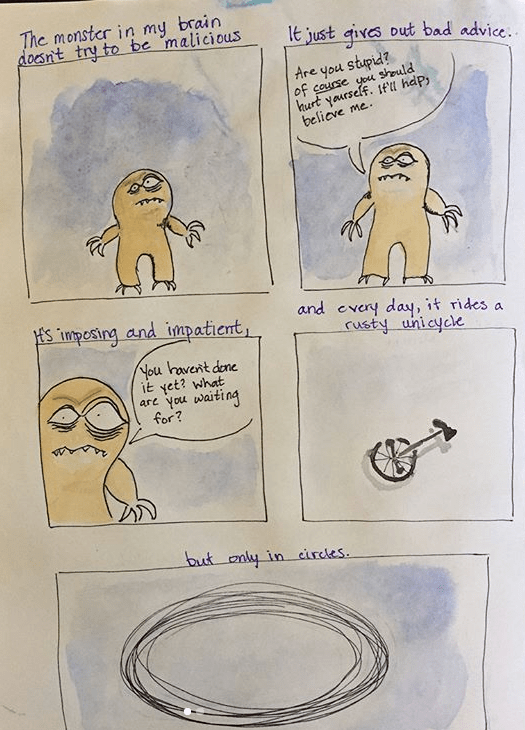
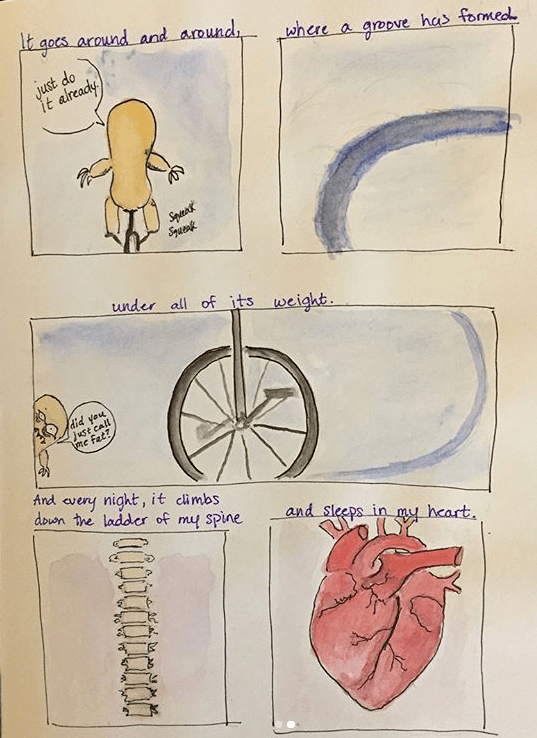
What is a lumpdate? I’m glad you asked. “The Lump” is the name I use to refer to the imaginary goblin in my brain that rides a tiny, rusty unicycle in circles, day and night.

watercolor artwork of a cartoon goblin giving bad advice about mental health

The Lump was quiet for a while, but it’s back again, so this is a lumpdate- an update about the Lump. It won’t be a long lumpdate; the Lump is rather unoriginal and doesn’t have many new points to make. Really, they’re all repeats of the same damaging doubts from before.

In sum, the Lump is back, setting up shop in my mind.

A cartoon goblin riding a unicycle and damaging mental health by refusing to leave

I’m trying to evict it.

Love,

Your brain

Relapse: A Poem about Self-Harm

black and white painting of woman with furrowed bow and eyes closedThe remnants

were there all along-

wrapped inside my skull,

twined around every neuron.


In spring,

it awoke from its dormancy,

stretched its vines

to suffocate me further.


I’ll prune it back

and pull

what roots I can.

Maybe this time


I’ll get them before

late summer,

when the poison berries

are full,


bursting with

rotten propagation.

Waiting to sow the blight-

again.


Next year,

I’ll be clean


Love,

Your brain