I’d like to introduce you to my irrational brain, partly to illustrate how distorted depression can make your thoughts, and partly to convince myself that this will pass. I take methylfolate because I’m a mutant and it helps my antidepressants work better. I ran out a couple of weeks ago and was slow to get it refilled. There aren’t any withdrawal symptoms of going cold-turkey because it’s really more of a supplement than anything else. (I’m much more careful about my other medications; you should never stop taking antidepressants suddenly without the supervision of your doctor.)
In any case, I didn’t call right away to get my methylfolate refilled. Initially, I thought that it would surely stay in my system for a few days and that it wouldn’t be a big deal to go without it briefly. In hindsight, that was a mistake. It was ok for a few days, but once I started to feel my depression worsen, I started to think some really unhelpful thoughts.
I messed up by not being on top of my responsibilities health-wise. This is my fault. I deserve to feel this. Therefore, I should not refill this medication, so as to prolong my suffering and punish myself.
Uh, no. Just… no. This is rational brain speaking. The statements above are utter nonsense and are not helpful in the slightest.
While I know that the most logical explanation for this decline in my mood is the lack of that medication, irrational brain whispers that maybe it’s just me. And that just in case it’s not me, and the arrival of that medication marks an end to this little blip, now’s my chance to self-destruct.
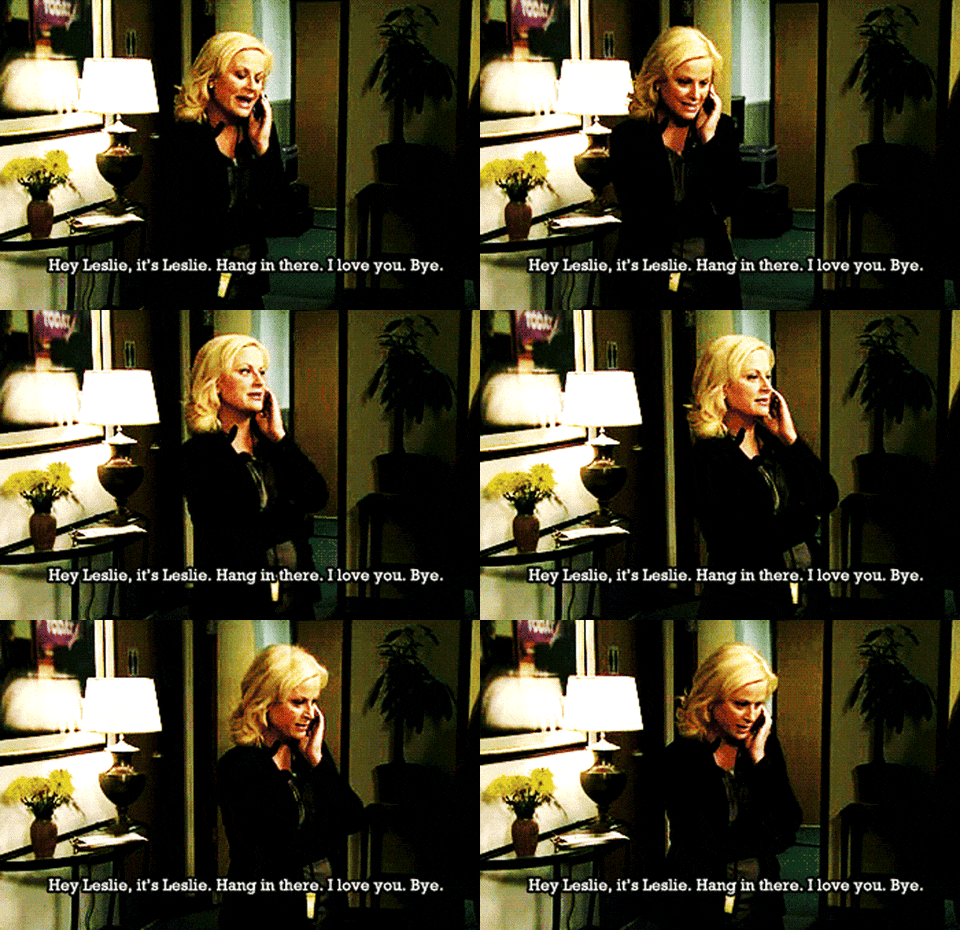
Seriously. Where do these thoughts come from?! Here’s another example: I was sitting outside with my dog and realized I hadn’t had any water in a while. Out of nowhere, my irrational, depressed brain said I deserve to be thirsty.
Apparently, I should just completely deprive myself of all comfort and nourishment, because according to my automatic thoughts, I’m a terrible person.
My meds have arrived, so the thing to do now is to try not to listen to myself until they kick in. Much easier said than done. In the meantime, I’m doing my best. That’s all we can ever do.
I’m hoping to make this the first post in a series called “Science Saturdays” (now taking suggestions for a more creative name) where I dive into the research at the intersection of mental health and (fill in the blank). I dipped my toes into these waters with previous posts like “Pets and Mental Health“, “Can You ‘Grow Out Of’ Childhood OCD?“, and “What’s the Deal with MTHFR and Psychiatric Conditions?” My intention is to take an objective look at recent research, let it percolate through my noggin while I sift through the dozens of tabs I’ve amassed in Google Scholar, then report back with what I think are some important takeaways.
Here in the northern hemisphere, we’re perched on the cusp of spring, and boy, am I ready to get outside. I live in Colorado, and hiking is one of, if not the most, enjoyable ways I spend my time in the warmer months. I’ve been gazing longingly at the mountains, perusing dog backpacks (that’s backpacks for dogs to wear) on Amazon, and figuratively dusting off my trail map app in anticipation. It could just be that I’m particularly drawn to being outside because of my personality and upbringing, but I’ve recently come across some buzz surrounding the positive effects that nature has on our emotional and physical health. So, I figured, what better way to become even more entrenched in spring fever than to spend a few hours reading about the outdoors?
Nature and Physical Health Studies
Nearly every article I’ve read so far has referenced a study published in 1984 by RS Ulrich. The study looked at a group of 46 hospital patients, all of whom had their gallbladders removed and were monitored postoperatively. 23 patients stayed in rooms with views of trees, while the other 23 had views of a brick wall. The now classic study found that the patients who had views of trees recovered faster and required less pain medication than the other group of patients.
Increasingly, researchers are investigating the relationship between biodiversity in green spaces and psychological benefits. Several nature and mental health studies have found significant associations between higher plant and bird diversity and positive mental effects. A 2007 study by Fuller et al. found a positive correlation between plant species richness and participants’ sense of identity and ability to reflect. The 312 participants were fairly accurate at assessing plant species richness, which muddies causality. The question then becomes: are the benefits derived from species richness or perceived species richness?
Here’s another study to elaborate on that distinction. Researchers here found that psychological benefits of nature exposure were correlated not with biodiversity, but with participants’ perception of biodiversity only. In this study, participants were apparently not at all good at estimating species richness, and it affected their experience of being outside, regardless of how many species were actually present.
Frequency and Duration of Nature Exposure
So it seems that the more varied and species-rich the environment, the better. But is glancing out a window now and then the same as going for a walk outside, psychologically? I’d say no, but that doesn’t mean that short exposures to nature don’t benefit us. After all, just a 40-second break to look at a green, plant-filled roof has been shown to improve attention and performance on cognitive tasks, as compared to a break of the same length with views of concrete roofs.
In a sample of over 1500 Australian respondents, longer duration of nature excursions is associated with decreased prevalence of depression and high blood pressure. More frequent visits to public green spaces are associated with a greater sense of social cohesion, which I imagine contributes positively to mental health in general.
Criticisms of Nature and Mental Health Research
Few studies on the topic of nature and mental health take an epidemiological approach, leading some to point out that we have very little data on long-term, population-level health effects of nature exposure. Criticisms of some studies also include sample size, lack of adequate controls, and statistical rigor. However, the number of studies that demonstrate a correlation between nature and mental health benefit vastly outweigh the number of studies that show no relationship. While this does not negate the weaknesses mentioned previously, it does seem to suggest that there is validity to the idea that nature is emotionally beneficial.
The Daffodils are Blooming
All the signs that winter is ending are here; the daffodils are blooming, more birds are singing, the neighbors are cleaning out their garage, and before spring really gets underway, Colorado is scheduled to get one or two more last-minute dumps of snow.
Speaking of, now that I’ve gotten myself extra excited to get outside and let my brain soak in the wonderful sights, sounds, and smells of spring, it’s time to prepare myself for tonight’s snowstorm.
Staring at me with six amber eyes from the fork in the ash tree. Their shapes like pressed flowers in the soft light of dawn, when one is not sure if the slant of sun means a new day, or is remembered from some earlier rising- the aftertaste of memory, beckoning.
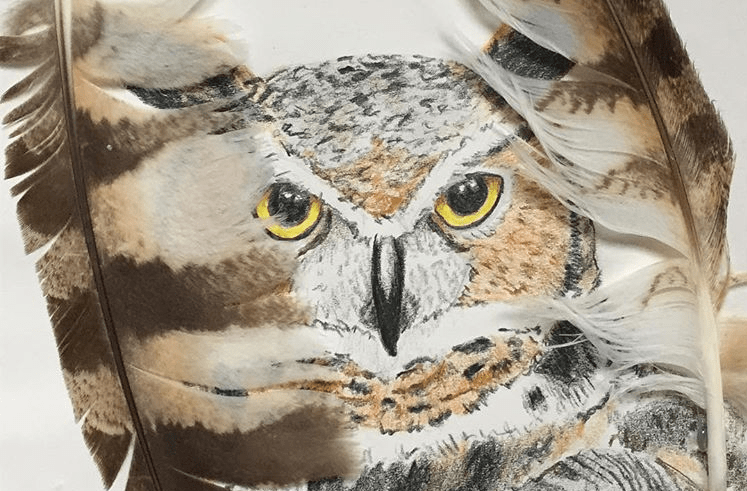
At first, there were two; we’d see them glide past our house and disappear into the top of a cottonwood tree down the block. They’d be out at dusk, rousing themselves after a hot day perched up high. Great horned owls are fascinating to watch. For an animal that’s so still most of the time, it’s amazing that I never get bored of observing them. One summer, the two regulars were suddenly four. Two fluffy, baby owls joined the mated pair on their nighttime excursions, hopping and screeching when mom and dad left them for too long. I could sit and watch them for hours, and all told, I’m sure I did.
They haven’t been around recently, and I miss seeing their stately forms keeping watch over the neighborhood. I’m not sure why I love owls so much. What I do know, however, is that those four owls were a source of happiness for me when things were hard. I’d sit on my bed and watch them sleep in the tree outside my window. I was going to sit on my bed and do nothing anyway, so I may as well spend that time watching the owls. Maybe there was a subtle sense of solidarity; the owls in their daily state of rest and me in my extended, bleary hibernation.
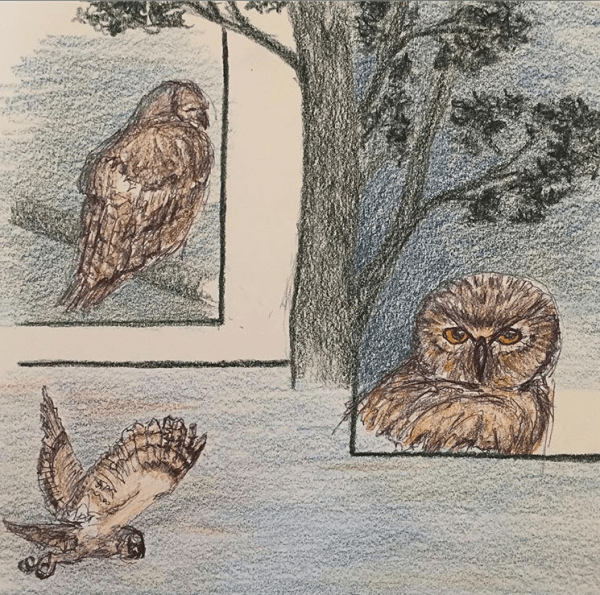
Of course, their tendency to sit very still also makes them excellent subjects for drawing.
Nature has always been a source of healing for me, so when being outside was too much to ask of myself, watching it through the window was the next best thing. Then, I’d put down what I saw on paper so that even in their absence, the owls were still here.
I used to look at the time when I heard a train go by at night, the heavy silence of 2 AM broken by the siren call of escape. I used to notice unlocked windows on the fourth floor of West Hall as I went up and down the stairs, each trip to and from class becoming harder. I used to see ways to die everywhere; in the passing bus, in the cold, dark current of the Huron River, in the pastel-blue sewing scissors tucked under my pillow. I used to wonder how long it would take for these morbid opportunities to escape my notice. How long before I can go a full day without putting some new, self-destructive idea on a mental shelf? How long before any phrase including the word “cut” doesn’t make me yearn to be alone so that I can do just that? I used to wonder about these things until I realized,
I’m prone to an almost crippling inability to verbalize my feelings. Some of that is because of Sensory Processing Disorder, and some is probably due to depression and other factors, like my need to feel capable and independent, which results in me pretending I have no feelings whatsoever and consequently getting no practice in identifying them, but the point is: metaphors. I love ’em.
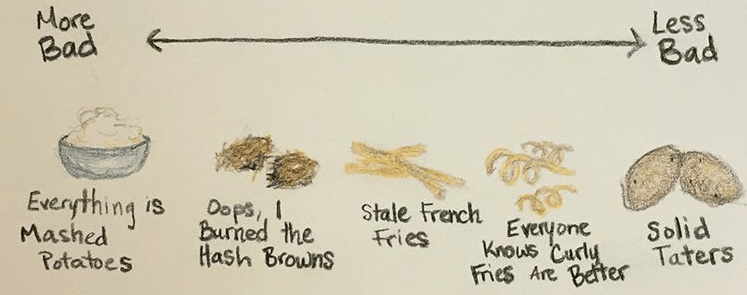
For inexplicable reasons, I find it so much easier to say “everything is mashed potatoes” than to say “I’m lost in a miserable fog of depression.” (Actually, come to think of it, that second one is also a metaphor, but you get the idea.) Hence: The Potato Scale of Depression.
It’s Not a Good Scale (but it kind of is)
Roughly ten months ago, I really did tell my friends “everything is mashed potatoes,” and thus, The Scale was born. Unlike other scales, there are no numbers, no frowny faces, and no defined increments between items. In other words, it’s a terrible scale. There’s no way to objectively determine how someone is feeling based on the potato scale of depression, but it worked for me during a time when talking about my feelings was both very difficult and very important. It became a kind of inside joke, and my friends would ask me “how are the taters?” and I’d respond with some arbitrary, starchy answer:
“Tots,” or “potato pancakes,” or “undercooked hash browns,” or “just the eyes.”
They’re all utterly meaningless answers, but they started a conversation. We’d debate the relative positive and negative qualities of each dish, and it served (pun intended) to connect us when all I wanted to do was withdraw.
Laughter = The Okayest Medicine
Eventually, I became more comfortable with talking about my emotions. A silly scale opened the door (metaphors are everywhere) to talking about how I reallyfeel. Sometimes using humor to defuse stressful situations and topics gets a bad rap, but it’s incredibly common. Plus, research shows that the right kind of humor can have a protective effect against recurring depression. The adaptive forms of humor (self-enhancing and affiliative) are associated with emotion regulation and positive mental health. The maladaptive forms of humor are the aggressive and self-defeating types. I could probably dedicate an entire post to why I think suicide jokes aren’t funny or healthy, but this is a post about a nonsensical tuber scale. So- perhaps another time. Back to the adaptive humor:
In consequence, an individual can successfully distance himself/herself from a negative situation and appraise its meaning from a less distressing point of view.
When you mentally distance yourself from a negative situation, you’re creating what researchers call “metacognitive awareness,” where thoughts and behaviors are interpreted as “mental events, rather than as the self.” Mental illnesses can often be associated with feelings of guilt and inadequacy, which is why it’s important to take a step back and remember that your symptoms are not character flaws. This has become a regular mantra for me, and anytime I start thinking badly of myself for my symptoms, I turn it around with I’m not lazy, I’m just soggy hashbrowns right now. Y’know, the kind that maybe didn’t get cooked enough, so now they’re getting cold and seeping oil onto your toast. Depending on your humor preferences, this might border on maladaptive, but it reminds me to not get bogged down in a temporary feeling or judgment. And really, what potato dish isn’t still delicious, no matter how poorly cooked?
Depression Scales: PHQ9, Who?
The Potato Scale of Depression is obviously not a tool that will ever be used in any kind of professional setting, but that doesn’t mean that it can’t be beneficial. Maybe potatoes aren’t your thing, and some other metaphor would be more helpful. Whatever it is, I know that for me, finding a less clinical way to communicate how I feel has made it way easier to do so.
May you all have curly fries and solid taters for the foreseeable future.
2021 Update: My therapist and I now have a wide repertoire of replacement metaphors, including “clams” in place of “goals” and “feathers” in place of “small barriers between inaction and action.” The Potato Scale of Depression has fallen to the wayside, likely because I have gotten better at saying words about how I feel. Therapy works!
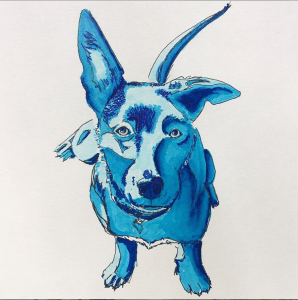
When I brought Stella home from the shelter, she was skittish and timid. It must have been such an abrupt transition for her; she has an address and a phone number hanging from her collar, and just like that, she has a home. I hope that she grows even more confident in her new life here, but it strikes me that what I’m asking of her is difficult for me to do as well. Every day, I try to teach her and guide her. I set boundaries and offer affection. I want her to feel secure as a part of my pack, and I want her to trust me.
And yet, sometimes when I look at her, I feel as though I’ve made a terrible mistake. At first, it was hard to pinpoint why, but I think it’s because she makes the door that is suicide close a little more. I’m feeling a lot better these days, but it’s reassuring to have my plan as an option. I simply don’t trust that this improvement in my depression will last. That’s not to say that the other sources and objects of love in my life aren’t enough to keep me here. They are why I’m alive right now, after all. But welcoming another creature into my heart only ties me more securely to life. She deserves happiness and security as much as I do. How can I ask her to trust that I’ll be there for her when I don’t even trust that I’ll be here for her whole life? I like to keep my options open, and it’s terrifying to willingly let one go. So I try to focus on the wonderful parts of having a new friend.
Her personality comes out more and more each day, and each night, she sleeps a little closer to me. She loves belly rubs more than anything else, and will fall asleep on her back, legs askew. She’s afraid of lots of things, but she’ll walk toward them if you go with her. She wags her tail in a wide arc that’s more than 180 degrees, and the sound of her paws on the floor makes me smile every time. Sometimes at night, her round, puppy tummy goes up and down in time with the crickets, and I wonder if she likes the rhythm or if she and the crickets share a wild, natural pacemaker. And then her breathing breaks, and she sighs deeply, content to lie next to her human.
I think we both need time to build trust in order to get to where we want to be. I’m willing to wait.

 The remnants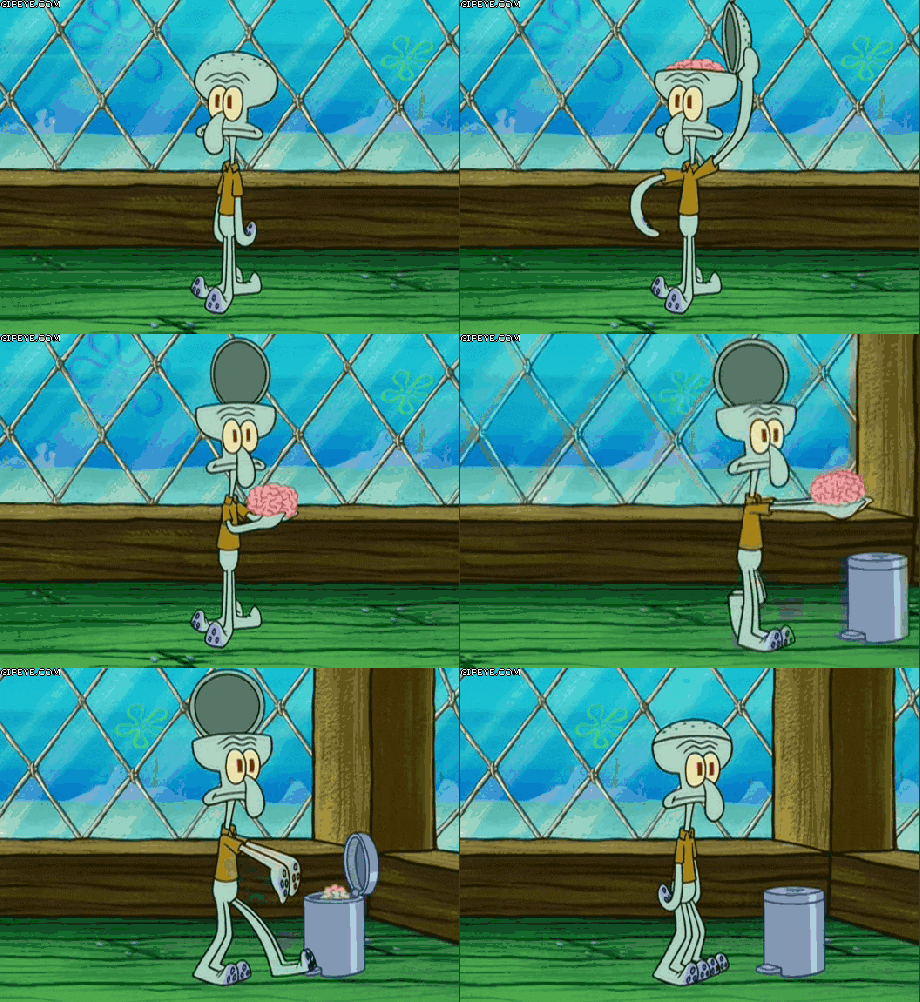

 Did I dream there were three?
 Love, Your Brain