My Secret Fear about Depression

I have a secret fear that maybe this is what life is like for everyone. Maybe I’m expecting too much. Maybe other people can cope with life’s stressors better than I can. Maybe I should try harder. Maybe my depression is fake.

Spoiler alert: it’s not.

Part of what makes depression so terrible is that, by its very nature, it keeps you from getting help. It tells you you’re worthless, it makes you ashamed, and it robs you of motivation and energy. My depression tells me that I’m ungrateful and burdensome and that I should keep quiet about the things I’m struggling with. Well, y’know what? I’m sick of taking orders from The Lump.

I’m going to PHP group therapy, individual therapy, and I’m talking to my family and friends about my illness. I’ve even told a few acquaintances about my hospitalization. And, guess what? Everyone has responded with compassion and support. Not one person has said “You’re faking it. Just stop being sad.” The only time I ever hear that phrase is when it’s inside my own mind.

It’s time I show myself a little of the understanding and reassurance I receive from others. After all, I have a biochemical imbalance in my brain. It’s not my fault.

Mindfulness and Emotions

If you’ve been keeping up with my posts lately, you know that I’ve been having a rough time of things. I’m waiting for my new medication to kick in and doing my best to implement skills I’m learning in partial hospitalization. Whether it’s the meds, the skills, or just the ebb and flow of emotion, I’m finding myself…feeling….feelings. Wild, right?! The numbness is retreating and being replaced with actual emotions. Which, is good. I think. I’m no longer feeling crushing sadness through a thick haze of nothingness; I’m feeling crushing sadness in a pure, unadulterated manner. But, that’s okay- because it passes. I’m trying to work on my mindfulness skills. The sadness checks in, I sit with it and do my best not to catastrophize that it will stay forever, then my dog does something funny and amusement bumps the sadness out of the way.

Later, I’m outside, enjoying the sunshine when sadness saunters up again and says “Hey. Really sucks that you missed out on all of this pleasantness when you were in bed for days on end, doesn’t it?” Yeah. Yeah, it does. Thanks for that reminder, brain. So then I’m sad about being sad. I’m meta sad. Immediately, worry and despair pop in to let me know that a moment of enjoyment doesn’t fix everything and that I still have a long way to go. Oops, now I’m crying, and maybe I’ve ruined the moment entirely. Quick, focus on the sunshine! Focus. On the. Dandelions! 

Forcing yourself to be mindful is kind of the opposite of mindfulness. Clearly, I have some work to do, which is why this weekend I’m trying to embrace the “non-judgmental” part of mindfulness. Emotions are healthy, and although I’m still feeling more negative ones than I’d like to, it’s ok that they’re there. When I start to feel sad about the past or anxious about the future, the best way to not get trapped in it is to just notice it and then redirect my thoughts. The weather is beautiful, I’m fortunate in more ways than I can count, and it’s ok to take time to heal.

On Being Vulnerable

They thanked me for my vulnerability, but it spilled out by accident, like beads of condensed sadness crammed into a too-small vessel. A wave comes, and while I sit among this circle of strangers, I cry. Nine sad faces avert their eyes. Is this circle a liferaft or a sinkhole?

In the distance, we see life as it should be- a mental ecosystem in balance. For six hours each day, we hover on the edges of the ring, tossing insecurities, worries, and vulnerabilities into the middle. We wait to see if they sink, but often, they float back to us. At three P.M., we depart; a snippet of normal routine, just long enough for our symptoms to impair us under the cover of darkness, then it’s back to the circle again. Soon, each of us will leave and swim to shore, but for now, we are lost at sea. All we can do is embrace our vulnerability and let it carry us towards one another.


Last week, I was discharged from an 11 day stay in a psychiatric hospital. This week, I spent six hours every day in a partial hospitalization program. Since being admitted almost three weeks ago, I’ve received more messages of concern and support than I know how to process, and that’s a little bit scary.

A part of me is resistant to receiving so much love because it means that all of these people know about a part of my life that contains a good deal of shame. My instinct is to politely accept the well-wishes and then quietly close the door and never discuss it again. Unfortunately, being independent to a fault can get you in trouble. It can make you more likely to wait too long to ask for help, at which point, the situation has snowballed out of control and it’s a crisis. So, reach out to your loved ones. Ask for help and offer help. Being vulnerable is how we connect.

I Forgot to Refill My Medication, ft. GIFs

I’d like to introduce you to my irrational brain, partly to illustrate how distorted depression can make your thoughts, and partly to convince myself that this will pass. I take methylfolate because I’m a mutant and it helps my antidepressants work better. I ran out a couple of weeks ago and was slow to get it refilled. There aren’t any withdrawal symptoms of going cold-turkey because it’s really more of a supplement than anything else. (I’m much more careful about my other medications; you should never stop taking antidepressants suddenly without the supervision of your doctor.)
In any case, I didn’t call right away to get my methylfolate refilled. Initially, I thought that it would surely stay in my system for a few days and that it wouldn’t be a big deal to go without it briefly. In hindsight, that was a mistake. It was ok for a few days, but once I started to feel my depression worsen, I started to think some really unhelpful thoughts.

I messed up by not being on top of my responsibilities health-wise. This is my fault. I deserve to feel this. Therefore, I should not refill this medication, so as to prolong my suffering and punish myself.


Uh, no. Just… no. This is rational brain speaking. The statements above are utter nonsense and are not helpful in the slightest.
While I know that the most logical explanation for this decline in my mood is the lack of that medication, irrational brain whispers that maybe it’s just me. And that just in case it’s not me, and the arrival of that medication marks an end to this little blip, now’s my chance to self-destruct.

Seriously. Where do these thoughts come from?! Here’s another example: I was sitting outside with my dog and realized I hadn’t had any water in a while. Out of nowhere, my irrational, depressed brain said I deserve to be thirsty. 

Apparently, I should just completely deprive myself of all comfort and nourishment, because according to my automatic thoughts, I’m a terrible person.

My meds have arrived, so the thing to do now is to try not to listen to myself until they kick in. Much easier said than done. In the meantime, I’m doing my best. That’s all we can ever do.

Note to self: be like Leslie
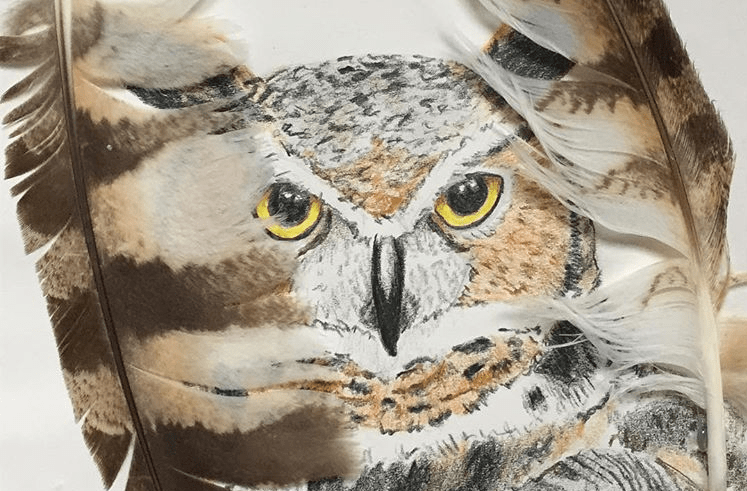
colored-pencil-drawing-of-great-horned-owl-with-feathers-framing-sides-of-paper

The Owls and Me: A Poem on the Nature of Depression

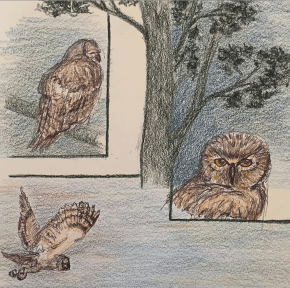
colored-pencil-drawing-of-three-great-horned-owlsDid I dream there were three?

Staring at me with six amber eyes
from the fork in the ash tree.
Their shapes like pressed flowers
in the soft light of dawn,
when one is not sure if the slant of sun
means a new day,
or is remembered from some earlier rising-
the aftertaste of memory,
beckoning.


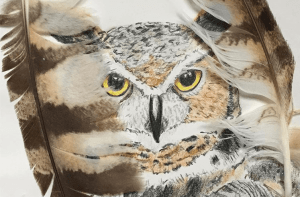
At first, there were two; we’d see them glide past our house and disappear into the top of a cottonwood tree down the block. They’d be out at dusk, rousing themselves after a hot day perched up high. Great horned owls are fascinating to watch. For an animal that’s so still most of the time, it’s amazing that I never get bored of observing them. One summer, the two regulars were suddenly four. Two fluffy, baby owls joined the mated pair on their nighttime excursions, hopping and screeching when mom and dad left them for too long. I could sit and watch them for hours, and all told, I’m sure I did.

They haven’t been around recently, and I miss seeing their stately forms keeping watch over the neighborhood. I’m not sure why I love owls so much. What I do know, however, is that those four owls were a source of happiness for me when things were hard. I’d sit on my bed and watch them sleep in the tree outside my window. I was going to sit on my bed and do nothing anyway, so I may as well spend that time watching the owls. Maybe there was a subtle sense of solidarity; the owls in their daily state of rest and me in my extended, bleary hibernation.

colored-pencil-drawing-of-great-horned-owl-with-feathers-framing-sides-of-paper

Of course, their tendency to sit very still also makes them excellent subjects for drawing.

Nature has always been a source of healing for me, so when being outside was too much to ask of myself, watching it through the window was the next best thing. Then, I’d put down what I saw on paper so that even in their absence, the owls were still here. 


Recovery From Depression

TW: suicide & self-harm

I Used To

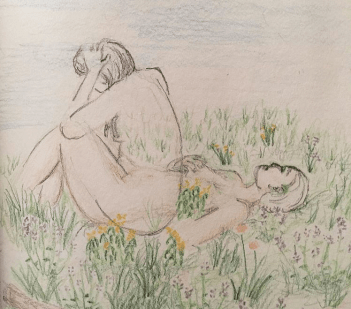
I used to look at the time when I heard a train go by at night, the heavy silence of 2 AM broken by the siren call of escape. I used to notice unlocked windows on the fourth floor of West Hall as I went up and down the stairs, each trip to and from class becoming harder. I used to see ways to die everywhere; in the passing bus, in the cold, dark current of the Huron River, in the pastel-blue sewing scissors tucked under my pillow. I used to wonder how long it would take for these morbid opportunities to escape my notice. How long before I can go a full day without putting some new, self-destructive idea on a mental shelf? How long before any phrase including the word “cut” doesn’t make me yearn to be alone so that I can do just that? I used to wonder about these things until I realized,

drawing-of-woman-lying-in-field-of-wildflowers


I used to.

Love,

Your brain

scale-from-more-bad-to-less-bad-ranking-depression-as-potatoes

The Potato Scale of Depression

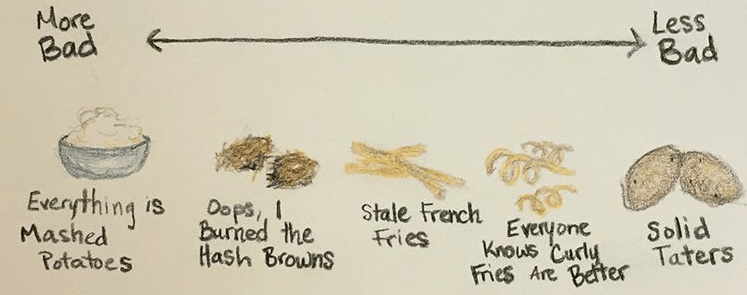
I’m prone to an almost crippling inability to verbalize my feelings. Some of that is because of Sensory Processing Disorder, and some is probably due to depression and other factors, like my need to feel capable and independent, which results in me pretending I have no feelings whatsoever and consequently getting no practice in identifying them, but the point is: metaphors. I love ’em.

For inexplicable reasons, I find it so much easier to say “everything is mashed potatoes” than to say “I’m lost in a miserable fog of  depression.” (Actually, come to think of it, that second one is also a metaphor, but you get the idea.) Hence: The Potato Scale of Depression.

It’s Not a Good Scale (but it kind of is)

Roughly ten months ago, I really did tell my friends “everything is mashed potatoes,” and thus, The Scale was born. Unlike other scales, there are no numbers, no frowny faces, and no defined increments between items. In other words, it’s a terrible scale. There’s no way to objectively determine how someone is feeling based on the potato scale of depression, but it worked for me during a time when talking about my feelings was both very difficult and very important. It became a kind of inside joke, and my friends would ask me “how are the taters?” and I’d respond with some arbitrary, starchy answer:

“Tots,” or “potato pancakes,” or “undercooked hash browns,” or “just the eyes.”

They’re all utterly meaningless answers, but they started a conversation. We’d debate the relative positive and negative qualities of each dish, and it served (pun intended) to connect us when all I wanted to do was withdraw.

Laughter = The Okayest Medicine

Eventually, I became more comfortable with talking about my emotions. A silly scale opened the door (metaphors are everywhere) to talking about how I really feel. Sometimes using humor to defuse stressful situations and topics gets a bad rap, but it’s incredibly common. Plus, research shows that the right kind of humor can have a protective effect against recurring depression. The adaptive forms of humor (self-enhancing and affiliative) are associated with emotion regulation and positive mental health. The maladaptive forms of humor are the aggressive and self-defeating types. I could probably dedicate an entire post to why I think suicide jokes aren’t funny or healthy, but this is a post about a nonsensical tuber scale. So- perhaps another time. Back to the adaptive humor:

In consequence, an individual can successfully distance himself/herself from a negative situation and appraise its meaning from a less distressing point of view.

When you mentally distance yourself from a negative situation, you’re creating what researchers call “metacognitive awareness,” where thoughts and behaviors are interpreted as “mental events, rather than as the self.” Mental illnesses can often be associated with feelings of guilt and inadequacy, which is why it’s important to take a step back and remember that your symptoms are not character flaws. This has become a regular mantra for me, and anytime I start thinking badly of myself for my symptoms, I turn it around with I’m not lazy, I’m just soggy hashbrowns right now. Y’know, the kind that maybe didn’t get cooked enough, so now they’re getting cold and seeping oil onto your toast. Depending on your humor preferences, this might border on maladaptive, but it reminds me to not get bogged down in a temporary feeling or judgment. And really, what potato dish isn’t still delicious, no matter how poorly cooked?

Depression Scales: PHQ9, Who?

The Potato Scale of Depression is obviously not a tool that will ever be used in any kind of professional setting, but that doesn’t mean that it can’t be beneficial. Maybe potatoes aren’t your thing, and some other metaphor would be more helpful. Whatever it is, I know that for me, finding a less clinical way to communicate how I feel has made it way easier to do so.

May you all have curly fries and solid taters for the foreseeable future.

2021 Update: My therapist and I now have a wide repertoire of replacement metaphors, including “clams” in place of “goals” and “feathers” in place of “small barriers between inaction and action.” The Potato Scale of Depression has fallen to the wayside, likely because I have gotten better at saying words about how I feel. Therapy works!