A black letterboard with white capital letters spelling "your life matters" with each word on a separate line

Ketamine Treatment for Depression: The Ketamine Chronicles (Part 1)

This is the beginning of a series of posts chronicling my experience with IV ketamine for depression. Starting something new, something very different from the numerous antidepressants I’ve gone through in the last few years is overwhelming. I’d like to document my experience as a way for me to process it through writing, as well as to provide a first-person account of what this might look like for others who are considering ketamine for depression. The use of ketamine to combat treatment-resistant depression is effective for many, many people. So, whether it works for me or not, I’ll try to use The Ketamine Chronicles to be as honest as possible.

Why Use IV Ketamine for Depression?

Several months ago, my psychiatric nurse practitioner suggested that I look into IV ketamine infusions as a potential new avenue in the search for something that will work against my treatment-resistant depression. Every antidepressant I’ve thrown at it has had little to no impact, and I’ve effectively become chronically suicidal. I said “ok, sure,” and then pretended that conversation had never happened. Weeks passed, then months passed, and as I got closer to the present and could no longer ignore my reality, ketamine seemed more and more like the next logical step. Nothing I’ve tried has given me much relief, and my depression has steadily worsened.

The silhouette of a person standing in a field in a thick fog.
Photo by Dimitar Donovsky on Unsplash

Luckily for me, my lovely mother is an avid Googler. By the time I was ready to go down the ketamine treatment path, she had bookmarked and downloaded every resource and testimonial in a three-page radius of a “depression ketamine” Google search. When I came home from a difficult appointment and told her that I’d decided to schedule a consultation at a clinic, she said, “Great. I’ll send you the website of the one near us that I think is best. You can start filling out their forms.”

As an aside, let me point out that my mom is so wonderful. She did hours of research and planning but respected my right to choose my treatments enough to wait for me to make the decision before piling it on. Thanks, Mom

How Does Ketamine Treat Depression?

OK, so what is ketamine for treatment-resistant depression? In brief, ketamine is an anesthetic that, when used in very low doses in a clinical setting, has been shown to dramatically improve symptoms in participants with treatment-resistant depression. Chronic depression that doesn’t respond to traditional antidepressants is associated with significant alterations in brain structure and function, as well as deficits in BDNF, a marker of neuroplasticity. Evidence suggests that ketamine facilitates the repair of those damaged areas by increasing the levels of BDNF.

Wrestling with Depression Treatment Decisions

At this point, my depression is severe, and it has been for a long time. I probably met the criteria for what would make me a candidate for IV ketamine treatments a long time ago. So, why did I wait so long to do this? For one thing, a ketamine infusion is a procedure, a word packed with health-anxiety overtones. For another, moving from antidepressant pills to a treatment administered by an anesthesiologist feels like a big deal. It forces me to confront the fact that my depression is really serious; if I don’t up my game from antidepressants, I could die. That’s scary. What’s even more scary is that for a long time, that’s exactly what I’ve wanted. I’ve had thoughts of suicide in varying degrees for years now, and at this point, the thought of dying doesn’t shock me at all.

Right now, despite having an appointment already booked for tomorrow, I’m on the fence. I know that it sounds absolutely bonkers that I would still be considering suicide, even when faced with a very promising treatment that I have access to. But, that’s depression. It’s an illness that you can’t reason your way out of because the illness itself affects the way that you think.

large-translucent-orbs-of-blue-and-purple-tones-on-dark-blurry-background
Photo by: Tomas Williams, @tomaswilliamsa on Unsplash

Finding Hope for Better Days

I have never known what it’s like to be a young adult without depression symptoms. When I think about the possibilities that life holds, my mind can only conjure up images tinted by depression. I can imagine having a job that I like, but my mental image of it includes the constant fatigue and loss of focus that my depression brings. “Feeling Better” no longer holds much meaning for me because I no longer remember what it feels like to Feel Better. So, when I think about how other treatments have affected me (minimally), it makes trying another one seem… not worth it. I can’t fathom what life would be like without depression, but then again, depression makes my imagination dull and limited.

In one more day, I’ll have had my first IV ketamine infusion for depression. I’m trying to keep an open mind, to admit that maybe life with fewer symptoms is better than I can imagine, and to allow myself to have a little bit of hope. Although I don’t have much faith, I’ll have to take a leap.

photo of desert ground with interlocking cracks and dry plants

I’m a (Self)-Control Freak

I’ve trained myself to be restrained whenever possible. I hold myself back when I don’t like something, and even my enthusiasm is tempered. People find me hard to read, and I don’t open up immediately, a little later, or even a bit after that. It takes a while.

Some of this is surely a product of my Sensory Processing Disorder. The world is abrasive to my nervous system; it’s loud, fast, bright, and unpredictable. So, to avoid standing out, I bury my reactions. I’ve developed excellent self-control. Of course, this has repercussions for me when I go home in a haze and need to do a lot of nothing for a while. Hiding how I feel about outside stimuli often protects me from two of the things I dislike the most: interrupting people and being the center of attention. Sometimes, enduring the feeling of people crowding around me is more bearable than attracting attention by elbowing my way to the door on legs that don’t feel like mine.

I have a fear of not being in control of myself. I find nearly every environment to be full of stimuli that are “too much” for me. Even my internal body sensations are problematic. My brain doesn’t always know exactly where in space my body is located or how things are moving around me. All of this feels very much out of my control, so I cling to my self-control for safety. However, I think my self-control has expanded past its allotted jurisdiction, and it’s time to address it.

My need to be in control of my reactions has seeped into my sense of what is my responsibility and what is not. It’s easy for us to think we’re responsible for others; we come to think that their feelings, their setbacks, and their decisions are on our shoulders. What any good friend would tell is you that you aren’t. You’re not responsible for how other people move through the world. We make our own choices, manage our own feelings, and deal with change on our own terms.

small black sign with white letters reading make today tolerable with succulent in wooden container next to sign

My particular misplaced sense of responsibility lies in how I think about my depression. I have always had a nagging (or roaring) sense that my depression is my fault. If I could just do more, or try harder, maybe I could fix myself. I’ve recently been faced with a treatment option that forces me to confront the fact that I have treatment-resistant depression, and that it’s not my fault. Seeing my severe depression as an illness that is out of my direct control is terrifying. It’s simply more comfortable for me to think that I’m just not doing a very good job at solving a problem that can be solved with enough effort.

And that’s how I realized that I’m a (self)-control freak.

actually would rather believe that I’m a failure than that I drew the short mental health straw. At the same time, it’s freeing to view my depression as something that has happened to me rather than something I caused. It takes some of the burden off of me, but it also takes some of the control away from me. Brains are weird, and sometimes they have a mind (har har) of their own. Sudden relapses, triggers, and even seemingly spontaneous ends to episodes are not entirely understood. It’s scary to think that after all of this- the numerous medications, the hospitalization, the group therapy, the individual therapy, the occupational therapy– my brain has stubbornly remained depressed.

If I’m going to get better, I need to stop blaming myself. I need to accept that some things are out of my control and that I don’t need to hold myself entirely accountable for my symptoms. I’ve learned a lot about healthy coping mechanisms in my years of therapy, and although right now I feel too debilitated to put them into useful practice, I hope that a new approach might relieve my symptoms enough to let me begin to heal on my own, the way I like to do it: with hard work.


The term “control freak” has plenty of negative connotations, and it can be hurtful to people who struggle to trust others or to let go of perceptions about the “right” way to do something. This post is in no way a jab at others, only at myself. The title is meant to be humorous, to poke fun at a coping mechanism that holds me back. I’m a self-described self-control freak, and as the term does not bother me, I hope that it doesn’t come across as insensitive.

Several Bad Weeks

You’d think that bad weeks would push me to write- to channel my too-full brain into words on a page. But no, bad weeks leave me unable to open my laptop and string words into sentences that express how I feel. Describing my symptoms feels repetitive, like I have nothing new to say. And maybe after four years of severe depression, I don’t. This is a symptom; I don’t want to write, and I don’t want to think.

Lately, I’ve been feeling suicidal, almost like how I felt before my hospitalization. After weeks of bad days, I finally had a good day. I got things done, I said “yes” to invitations out, and I had a microscopic feeling of hope. Then, like I knew it would, it ended. I woke up with the same depression I had two days before.

It’s taken me two weeks to write this much. It’s only 300 words, but I have to come back again and again to chip away at it. I feel disorganized in my thoughts, and if I had the spark to edit this, I would. I haven’t posted in a while because I feel the need to end each post on as hopeful a note as possible, and I don’t think I can muster that right now. Is it better to say nothing in order to preserve a positive message, or abandon optimism to illustrate real life with depression? I’ll strike it somewhere in the middle.

Sometimes you have bad weeks, and sometimes there are many, one after another. I’ve been told, and have experienced in the past, that if you keep going, good days will fall into place. At first, they’re few and far between, but then they start multiplying. I’m not there yet. I don’t see many good days, and I feel far from optimism. But it’s possible that I’ll get there.

Update: It took me so long to finish this post that I’m now feeling better enough to continue blogging. However, I thought it important to post this anyway.

woman wearing floral dress blocking sun with hand while walking on sand dune in desert

Mental Health and Resilience

Is it ever ok to give up? Cultures around the world are inundated with myths, lore, and tales of a protagonist overcoming seemingly insurmountable obstacles and emerging triumphant. They’re admirable, they’re heroic, and we strive to be like them. How do they do it? It’s not that they’re unaffected by tragedy and hardship. Their secret is resilience.

The concept of resilience can be difficult to pinpoint, but I think this quote by Janna Cachola encapsulates what I think of as the essence of resilience.

“Resilience is not about being able to bounce back like nothing has happened. Resilience is your consistent resistance to give up.”

Resilience does not mean that you’re the same after your ordeal as you were before; we’re constantly changing. It means that even in the darkest of times, we either wait for it to pass, or we work to change our reality. These are both demonstrations of resilience- sometimes you just have to hunker down and hold on. But no matter what, we refuse to give up.

TW: This section discusses suicide

September 10th is International Suicide Awareness Day. In the last few days, I’ve been reflecting on what it means to be resilient in the context of mental health.  Cultivating resilience is one way to help us resist hopelessness and feelings of helplessness. It puts the power back in our hands. It says “I can get through this, no matter what.” This line of thinking is in no way a judgment on those who have died by suicide. It’s simply an attempt to continue a conversation started by researchers, therapists, and people fighting mental illnesses every day.

I’m no stranger to the importance of resilience in mental health. I’ve thought about suicide in such detail and for so long, sometimes it seems like an acceptable option. At the same time, the part of me that values hard work and persistence is appalled that I would consider giving up. It’s a dangerous balance that I need to monitor carefully in order to remain safe. Resilience doesn’t mean that you have to do it on your own. Rely on the people who care about you and all of your other resources. Ask for help, and accept it when it’s offered. As the saying goes, you’ve survived every single bad day so far- that’s a damn good track record.

– Love, your brain


“i was not born with roses
in my chest
to be afraid of thorns.i was born to
bloom
in spite of them.”
― Vinati Bhola, Udaari

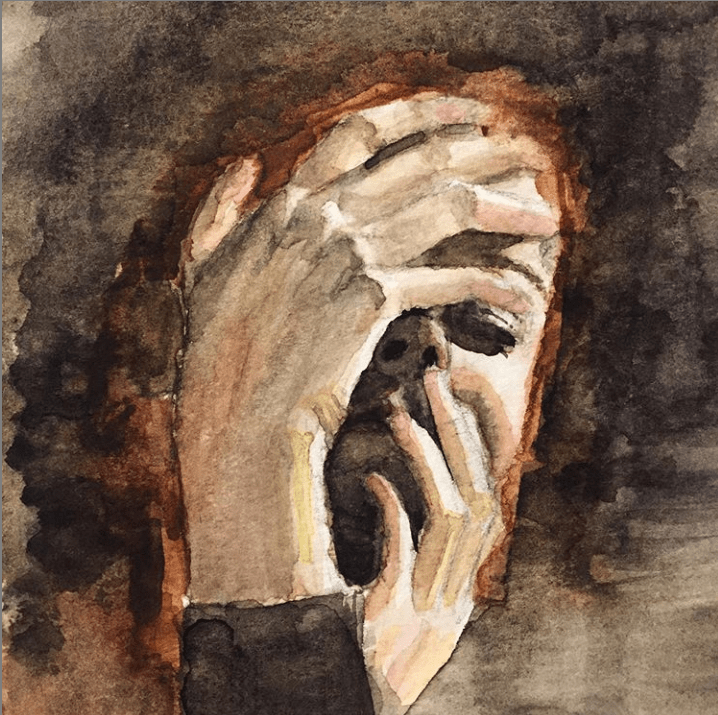
watercolor painting of woman's putting hands on face with eyes closed and dark background

The Lithium Slumber

There is no sleep like the sleep of parched eyelids and lithium limbs. Even before you swallow your nightly dose, your breathing deepens, your spine curves forward. Your thoughts retreat to a distant rumble, as if your brain is hosting a party to which you weren’t invited. Perhaps you’re already asleep. Maybe. Did you ever wake up? Maybe not.

In the morning, you place more pills on your tongue and let them be carried down with the water your kidneys are begging for. Today, you tell yourself, no more sleepI have things to do. But then it’s only been three hours since you rose this morning, and you find yourself sitting heavy on your bed, quickly slipping into the horizontal. No! No more sleep. You drag yourself from your cozy nest and plod to a less comfortable seat.

Yesterday, you slept for four and a half hours in the afternoon, and at that point, is it even called a nap? That’s just second bedtime in your book. And so today, like all the other days, you vow no more sleep. But your bed has its own gravity just for you, and before long, you’re crawling in; a perfect cove, with blanket waves and a pillow beach. Through the open window, you can almost taste the breeze, laden with lithium salt.

Love,

Your brain


I should be clear. I’ve been plagued by suicidal thoughts for three years, sometimes worse than others. Taking a high dose of lithium has given me, by far, the most dramatic positive result of any medication I’ve taken in my adult life.

I don’t want this post to be just another internet story about how terrible a particular psychiatric medicine was for someone. Those reviews are usually written by the people who had the worst side effects and the least benefit; after all, they’re the most motivated to write a review. Every medication has benefits and drawbacks. Scrolling through pages and pages of negative experiences paints a picture that doesn’t capture the thousands of people whose lives are vastly improved by that medicine.

It’s not perfect, and I still have bad days. It’s also a possibility that these sleep marathons are partly a symptom of my depression or the combination of meds I take that can make you drowsy. While I hope that lithium is not a medication I have to take long-term, I would be remiss if I didn’t acknowledge that taking it has probably saved my life.

Be well,

lumpdates

How to Persist Through Apathy

In the depths of depression and throughout the hills and dips of recovery, apathy is a frequent visitor. It steals motivation and leaves nothing behind. When this happens, it’s tempting to let it overtake you. I’ve found that continuing with a task despite apathy can help end a spell of it. Here are some of the ways I use to get me through a period of apathy.

Rewards

Whatever gets you even a little bit motivated can be useful when battling apathy. Granted, if you’re feeling apathetic, even the usual rewards might not have much of an effect. For me, I sit in the shade with a book and my dog. Maybe for you, it’s watching your favorite show or treating yourself to a delicious snack. Whatever it is, reward yourself for your hard work; apathy isn’t easy to overcome.

A Conversation With Future You

You might not care right now, but you might care a lot in the future. We like to think that we can predict the future, but the truth is that none of us really know what’s going to happen in a week or a month or a year. So, while this one requires a little hope for the future, sometimes all it takes is to allow for the possibility that things might get better; to admit that you’re not a fortune-teller. In fact, I’m working on this one right now.

Cultivate Satisfaction

I know what you’re thinking–well, I don’t know. (That’s another distortion.) But you might be thinking “obviously, if I’m feeling apathetic, I don’t want to do anything because I don’t get satisfaction from completing a task. Why would I do something that gives me no intrinsic reward?”

Well, that’s a good point. I’ll counter with this: an oyster creates a pearl when a grain of sand becomes lodged in its tissues. Layer by layer, the mollusk coats the grain of sand with calcium carbonate to protect itself from the irritating particle. What began as a negative from the oyster’s perspective is turned into something valuable.

Motivation often comes from the desire to solve a problem. Whether it’s a seemingly small problem like noticing that your hair needs to be washed, or a larger-scale problem like slipping grades that could affect your graduation, everything we do, we do to solve a problem. Every time you do something that moves you towards a goal, you’re building a metaphorical layer around the underlying issue. Every time you go to class even though you don’t want to, you’re building up to something great. Every time you go for a run even though you’d rather sleep, you add another layer of persistence to your pearl.

Often, it’s only after many layers, many instances of forcing myself through apathy, that I begin to get a glimmer of satisfaction. Sometimes, the only way to reach the other side of apathy is to just begin. Momentum only comes when you start to move.


sketch-of-hand-holding-razor-blade-with-text-not-today-brain

Self-Harm: Is It Eating At You?

Lately, I’ve been noticing the return of one of my most distressing depression symptoms: thoughts about self-harm. When I first started harming myself, I was so ashamed that I couldn’t talk about it at all. When asked, I’d shut down and say nothing for fear of crying uncontrollably. I have the same struggle when it comes to suicidal ideation; I feel such overwhelming shame that just saying the words out loud has been a gradual process. I was recently talking to my (very patient) nurse practitioner, who reminded me that the first time we talked about my suicidal thoughts it took me about ten minutes to get the words out, and I was shaking like a leaf the whole time.

It’s only recently that I’ve really been working on seeing these things – self-harm and suicidal thoughts – for what they are: symptoms of a larger issue. They’re indicators that my depression has worsened. There should be no judgments about willpower or self-control. They’re symptoms that should be taken seriously, but they’re nothing more or less – just symptoms.

While I know this intellectually, when those old thoughts come rushing back, so do the remnants of guilt and shame that I’ve worked to eliminate. It eats at me – the thoughts themselves and the judgments I hold against them. That’s how it always is; whether it’s a trickle or a flood, the thoughts eventually erode my determination not to give in to self-harm. It’s a battle to hold out until the thoughts pass, and sometimes I make it, but sometimes I don’t. The good news is, it does get easier with time and practice. If you relapse it can feel like you’re back at square one, but you’re not. If you need a little encouragement today, keep going. Keep working to treat yourself with kindness. You’ve got this.