I was sitting in my therapist’s office yesterday, quiet and subdued, while we discussed the challenge of recovering from repeated episodes of depression. I had explained that sometimes I take solace in the knowledge that the episodes eventually end, but other times, I despair that depression will inevitably return. In trying to ask me where I sat on the continuum that day, my therapist posed an interesting rhetorical question.
How do you measure hope?
Neither of us answered it, but I found myself pondering it as I left. We measure things because it helps us put them into the context of the world around us. But how do you measure a subjective thing like hope? Can you weigh it? Stand it up against your kitchen doorframe and mark its growth as the years go by? Or maybe you measure it by volume- how much space it takes up in your life; in your goals; in your routines. If you could measure hope in decibels, would yours be louder than your doubt?
For now, I choose to measure hope in binary terms. Hope is hope, no matter how small or dim. If your hope is small, feed it with the belief that the better times are worth it.
There’s nothing better than a cozy evening spent snuggled up with your dog or cat, right? Pets come with lots of responsibilities, but also with plenty of benefits for our health. I know how it weighs out for me- strongly positive. My dog has been an enormous help in my recovery from depression, and she also helps me regulate my nervous system when Sensory Processing Disorder gets in the way. But what does science say about pets and mental health?
Animal Assisted Therapy
I’m particularly interested in how pet ownership affects mental health and wellbeing, but perhaps it’s best to start with the research on therapeutic interventions. I’m guessing that it’s much easier to study the effects of human-animal interactions in the context of short visits than in the context of pet ownership for a few reasons.
It’s more difficult to determine causality in cases of pet ownership. Are people with pets healthier, or are healthier people more likely to have pets?
Many pet ownership studies rely on participants’ ability to report results over a long period of time, as opposed to short AAT sessions.
AAT is implemented and monitored by professionals who keep detailed records.
Before I even read any articles, I was expecting to find that AAT is backed by a sizeable amount of evidence supporting the link between pets and mental health. After all, I’d seen those news stories about unconventional Emotional Support Animals, and those aren’t necessarily trained to perform a therapeutic role.
A 2017 review compiled data from 18 studies of AAT. In 15 of those studies, at least one positive effect was found, although the authors point out that most of the studies found no significant effect on treatment outcome. Overall, the review suggests that AAT, particularly dog assisted therapy, provides mild to moderate effects. Not bad, given how many variables are unavoidable when it comes to animal interactions.
So, if AAT is mildly or moderately effective in short “doses”, how does near-constant interaction with animals affect us? I’m wary of extrapolating too far because pet ownership is certainly not just a scaling-up of petting a therapy dog at your university’s library during finals. There’s a lot more to it; perhaps the responsibility, stress and frustration when a pet misbehaves, and of course, the emotional pain of losing a beloved companion outweigh the benefits of interacting with animals.
My Roommate is a Quadruped
Did y’all see that Reddit thread about how weird it would sound if we called our pets “roommates”?
My roommate ate every Lactaid pill out of my mother’s purse and left all the wrappers on the floor. The other day, I walked into the kitchen to find my roommate standing on the table, eating jam right out of the jar. I know someone whose roommate ate crayons and then pooped rainbows for a week.
Pet owners share their lives with their pets; not just their time and energy, but their homes, too. Many people consider their pet as part of their family, and I can see why (and not just because I’m one of those people). Anecdotally, I can understand why pets and mental health benefits are often linked in our minds.
Social Support
A qualitative study of people with mental health conditions, conducted in 2016, had participants map out their social support networks in three concentric circles, the innermost circle being the most important. 25 of the 54 participants were pet owners, and the majority of them placed their pets in the innermost circle. The researchers identified several common ways in which participants reported benefits from owning pets.
Establishing routines
Distraction from symptoms (e.g. hallucinations, suicidal ideation)
Sense of certainty that pets would reliably provide support
Caring for pets gave participants a sense of meaning
Reducing the stigma of mental illness through pets’ unconditional acceptance of owners
This meme will one day be horribly outdated, but that day is not today.
Another study with a similar design had me grinning from ear to ear- some of the transcripts of participants talking about their pets are delightful. Although this study focused more on chronic physical illnesses, I noticed some relevant parallels. The authors describe the apparent infantilization of pets and hypothesize that it provides a sense of reciprocity that chronic illness sufferers may not have in their human relationships. Those with chronic illness- physical or mental- often report feeling like a burden on others. Doting on a pet, it seems, alleviates some of those feelings and makes the pet owner feel needed.
For people with Sensory Processing Disorder, pets can provide a myriad of soothing sensory benefits. They offer tactile feedback in the form of fur, feathers, wool, etc., and the extra snuggly ones can provide deep pressure (depending on how heavy they are). Indirectly, pets provide proprioceptive and vestibular input simply by requiring interaction- walking, feeding, bathing, and training them. Pets tend to have less complex, more predictable social cues, which may make them less stressful to interact with than humans, especially for people who are easily overwhelmed.
Some of the Drawbacks
On the other hand, pets are their own entities with their own agendas. They don’t always do what we want them to. For instance, my dog barking at me while I try to drink my coffee in the morning is definitely NOT soothing. There are distinct disadvantages to owning a pet when you’re affected by SPD and/or mental illness. They can be messy and loud (unless you like those things- then add that to the advantages list), and sometimes they get in your personal space when you don’t want to be touched.
The Intersection of Pets and Mental Health for Me
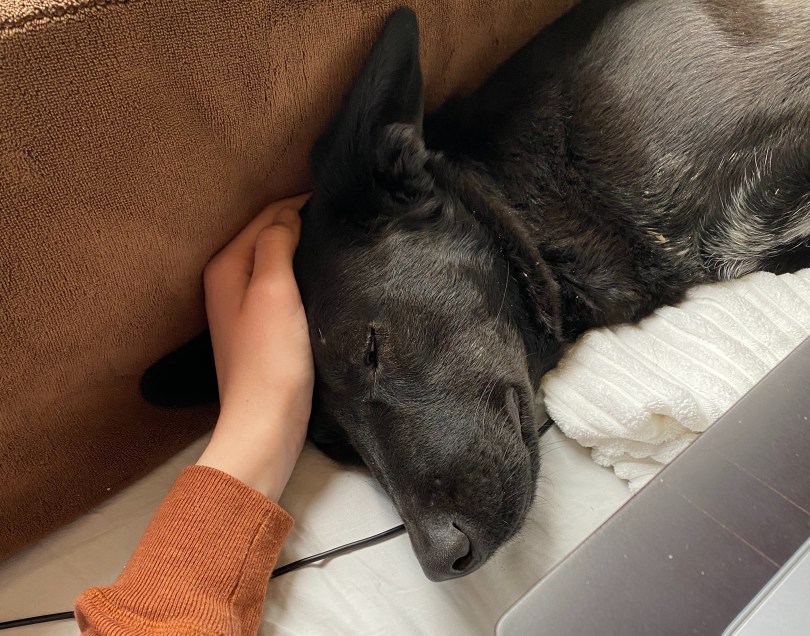
Despite the frustrations and occasional discomfort, I’ve found pet ownership to be immensely helpful and rewarding. My dog reminds me to get outside and walk, to look up from my computer every once in a while (she’s being quiet…too quiet), and to enjoy all the little pleasures- long naps, eating with gusto, and rolling in smelly things.
The sun has left us for a few rotations, only peeking out from behind the clouds in short intervals. It smiles down on us weakly, filtered through miles of gauzy cotton. How did I manage a more northern latitude? Just a day or two of relative darkness is enough to upset my balance.
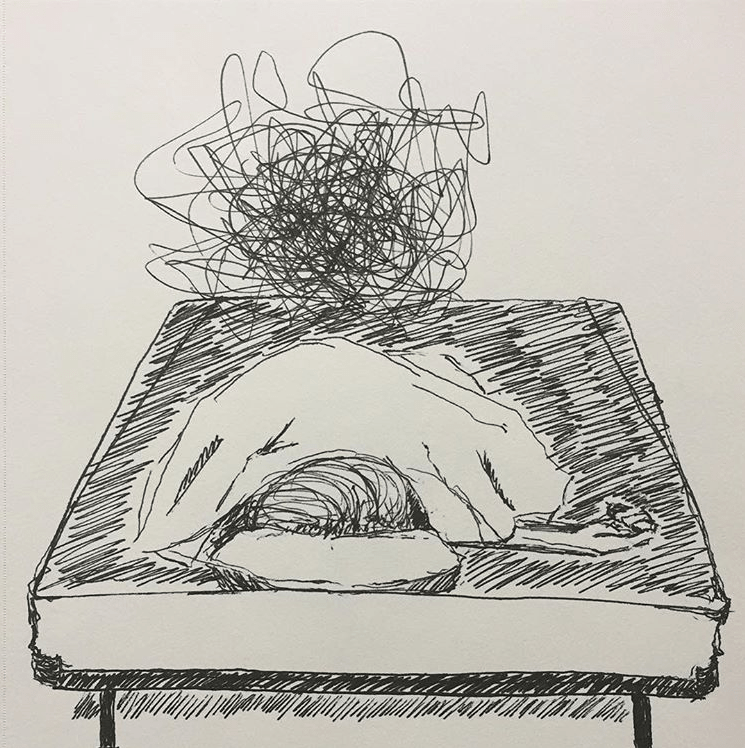
Maybe I’m searching for explanations that don’t exist. To excuse my mood as simply a mirror for what’s outside. It seems impossible that such a minute change could affect me so drastically, and yet when I embark on my morning walk, the slow, chemical drip of melatonin invariably calls me back to bed. So, I hunker down, and I wait for February’s grip to loosen. Love, Your Brain
Sometimes I run because it’s when I feel strongest. I run because I love the feeling of my muscles working beneath my skin, my breath matched to my stride. Breathe in for three steps, breathe out for three steps. I love the sense of accomplishment, knowing that my body can carry me further than I think it can. Sometimes I run because it gives me joy. The simple pleasure of the wind in my hair and the sun on my face, moving with a body I’m thankful for. My body is a canvas for my mental state; when I’m well, I run for the joy of it. When I’m unwell, I run because it’s just another way to hurt myself. I run because at mile three I’m still thinking about cutting, but by mile five my brain is numb. Breathe in for three steps. Breathe out for three steps. I run because maybe if I can push my body to obey me, my brain might follow suit. I run because to be exhausted is to be empty, and where could my depression have gone except to have been left behind on the path? Expelled by my lungs, my racing heart, my wrung-out muscles. I run because it makes me feel good, and because sometimes, it makes me feel nothing at all.
Several years ago, I awoke with a slight but sharp pain in my chest. I went about my day, doing my best to ignore it. I thought it was one of those random, passing pains that bodies get sometimes. But the next day, it was much worse. Every time I inhaled, stabbing pain shot through my chest. I also was developing severe pain down my left shoulder blade and around my ribs. I debated going to the doctor for three days; meanwhile, I couldn’t sleep unless I was sitting up, and moving at a pace slightly faster than your local library’s Wi-Fi left me in breathless tears. It turned out that I had pneumonia, which was strange because I hadn’t been sick beforehand, nor was I obviously sick in any way other than having debilitating chest pain.
When I reflect on that experience, my first thought is “why did I not go to the doctor right away?” I’m certainly not a fan of going to the doctor, and I don’t like to draw attention to myself, even from concerned family and friends. But neither of those reasons fully explain why I waited.
I didn’t go right away because I didn’t know if the pain I was experiencing warranted a trip to the doctor. I distinctly remember thinking “am I imagining this?” Let’s let that sink in. I couldn’t get out of bed without first psyching myself up for several failed attempts and some tears, and I wasn’t sure if I was just~~imagining~~it.
My brain is always a little confused about the information it’s receiving because I have trouble with sensory discrimination. When someone asks me “how do you feel”, nine times out of ten I’ll go “I dunno”–because I really don’t. Especially when it’s something new, I don’t know what the heck I’m feeling from outside or inside my body. So, when I mysteriously developed pneumonia, my thought process went a little like this:
Hmm. This hurts. I think my chest definitely hurts. Should I go to the doctor? They’re gonna ask me what it feels like. Is it burning, or stabbing? What’s the difference? Maybe it’s not that bad. How bad is bad? Wait, which came first- the chest pain or the shoulder pain? Are they even the same kind of pain? Maybe I’m imagining it- if I ignore it, it might go away. Good gravy, putting on socks is really hard. I’m probably fine, though.
Because I know that sensory processing disorder (SPD) makes me sensitive to a lot of stimuli, this often leads me to understate how I feel, be it good or bad. I aim to be neutral in all aspects- I’m feeling sensations more intensely or in a mixed-up way, so it must be wrong, right? When you spend many years confused about how you feel, you get pretty good at hiding it. So, on the outside, I can appear relaxed and calm, but on the inside, I feel like that screaming bird meme. You know the one.
My nervous system 85% of the time
Anyway, do as I say, not as I do (did). The problem with approaching sensory discrimination this way is not just that you might neglect yourself when you have pneumonia, although that’s certainly not optimal. On an everyday level, taking this approach perpetuates the confusion and only makes things worse. It takes practice to start listening to your body, and it might take some serious courage to start advocating for yourself. I try to remember that the way I perceive things might be different from what other people feel, but that doesn’t mean it’s wrong.
When I was 10, I felt compelled to tell my parents “I love you” every time they left the house. Going to the grocery store? I love you. Going to work? I love you. Going to the mailbox? I love you. The fear that something catastrophic will happen to family members is a common manifestation of childhood and adolescent OCD. I thought that if I failed to carry out this ritual, my parents wouldn’t know that I loved them if or when something terrible occurred.
I was also preoccupied with germs; my hands were cracked and bleeding from excessive washing, and I worried constantly about contamination. I always walked a specific pattern on the rug in the hallway, and I carefully watched the family dog to be sure I’d notice when he winked at me–so that I could wink back. I couldn’t tell you why I had to wink at the dog, I just had to.
I knew that these behaviors were irrational, and yet the anxiety it caused me to resist the compulsions seemed unbearable. I was afraid to go to sleep because I worried I might sleepwalk and harm my family in the middle of the night. Nearly every evening, I would tearfully confess my intrusive thoughts to my mother, convinced that she would be afraid of me for thinking such awful things. OCD commanded almost every aspect of my life.
Did I Grow Out Of It?
My parents tried to get me into therapy, but I was shy and ashamed, and simply refused to participate. So, I started taking an SSRI, slowly titrating up to the maximum dose. And incredibly, it worked. Suddenly, I was free from the torturous anxiety and embarrassing compulsions. I could be a kid again. Two years on, I slowly came off my medication. We waited, on edge, for symptoms to return, but they never did. I’ve often wondered why I never relapsed. It seemed impossible that something that had plagued me for so long had just vanished.
Thanks, PubMed
I wanted to know if other people had experiences similar to mine, so I headed over to trusty ol’ PubMed. I found several articles that explore the topic of OCD remission. Some have woefully small sample sizes and others are barely longitudinal, but there does seem to be a higher rate of OCD remission in the pediatric population than the adult population. The factors that influence this aren’t very well understood; some studies show that an earlier onset of symptoms predicts better outcomes, while others associate earlier onset with chronic, adult OCD. Don’t you just love conflicting results? I do, however, think these results can be reconciled.
Maybe It’s About Treatment, Not Age
A study published in 2014 followed up with children and adults with OCD over a three-year period. Children achieved remission more quickly than adults who had juvenile-onset of symptoms, but the age of onset did not affect the likelihood of remission. Instead, the authors show that the less time passes between the onset of symptoms and receiving treatment, the better the outcome.
This fits with the statistics on OCD treatment. In a different study by the same authors, children went an average of 1.5 years before receiving treatment, whereas adults reported a wide range of latency periods. On average, they went 14.5 years before receiving treatment, although the standard deviation was close to 12 years. Clearly, some adults suffer in silence for decades before getting treatment.
It’s plausible, then, that children who receive treatment soon after developing symptoms see remission more often, but children who endure a longer period of uninterrupted symptoms are more likely to have chronic OCD into adulthood.
The Takeaway
Multiple studies emphasized the importance of early recognition and treatment of childhood-onset OCD. Overall, I was encouraged by what I found during my deep dive into the literature. The sources I found all seemed to agree; long-term persistence of childhood-onset OCD is less common than it is for adult-onset OCD.
After all this, I’m still not sure whether I grew out of OCD. It’s difficult to determine whether anybody grows out of it without treatment because study samples come largely from inpatient and outpatient treatment centers. I will say that I occasionally get a sticky thought that reeks of OCD, but I set it aside fairly easily.
In a completely anecdotal way, this seems to me like the pathways that I was stuck in as a child had a chance to be rewired while I was on medication. Now, my brain can cope with intrusive thoughts pretty much like anybody else’s. If I had known that the chances were pretty good that I wouldn’t suffer from OCD forever, it might have been a little easier to cope as a child.
Treatment with ERP and medication offers adults and children relief from their OCD symptoms. So, if you have a kid with OCD, know that remission is possible. And for all the adults with OCD, know that there is hope, and you are not alone. Adults absolutely achieve remission as well. A 40-year follow-up study found that of 251 participants, improvement was observed in 83%. Those are pretty good odds!
Sometimes I wish someone would just roll me into the literal body shop and get me a self-care tune-up. Alas, it doesn’t work that way.
I’ve stopped using the term “self-care” to describe a lot of the things I do for myself. Hear me out, though. It’s not because there’s anything wrong with calling it self-care; it’s just that a lot of self-care tasks are not as flowery and gentle as the term implies. Sometimes you have to buckle up and make that phone call you’ve been avoiding so that your dentist doesn’t think you dropped off the face of the planet. (And so that you can get your teeth cleaned, I guess.)
I’ve found that reframing some self-care tasks as “corporeal maintenance” helps me tackle them with less procrastination. Something about approaching these tasks as simply maintenance and upkeep feels less daunting.
Here are some examples:
“Oh, my ‘check hydration tank’ light is on. Better go drink some water.”
Or “Didn’t I just go grocery shopping, like…oh, yeah, I guess it’s been a while. I should probably get some fuel for this week.”
If I call it “self-care,” I’m likely to not do it – either because I don’t care, or because I don’t feel worthy of being cared for. But, if you want to keep driving to the things you do care about, you have to get the oil changed every once in a while.
There’s a lot of talk about self-care these days; some criticize it and some embrace it whole-heartedly. There tends to be an atmosphere of self-indulgence when we discuss it; as if every act of caring for ourselves is rooted in all-encompassing positivity. And yes, self-care can be self-indulgent and rooted in self-love. Those things are necessary. But self-care is also doing the things that aren’t very fun but are kind of non-negotiable when it comes to being healthy.
It may very well be the case that you do complete these tasks out of self-love, and I think that’s great. In fact, that seems like a wonderful goal to work towards. But if you’re not there yet, and calling those unpleasant/boring tasks “self-care” feels insincere, go ahead and call them something else. Whatever floats your goat.






 Love, Your Brain