Sensory Ramblings About Building a Fire

One day it’s 70 degrees, and the next there’s freezing rain and heavy snow. February in Colorado is a strange creature. After a day of low light and cold fingers, I clomped down the stairs to the back door, Stella in tow. She stood on the stairs to the deck and watched me as I chose logs from the woodpile underneath her. That’s by far my least favorite part of building a fire; I always inspect each piece carefully for spiders before I put it in the crook of my elbow. It’s probably too cold for them to be at the top of the pile, but as seeing black widow spiders was not unheard of in the house where I grew up, it’s my preference to be a choosy wood-carrier.

Building a fire is a skill that I learned as a child. We heated our house with a wood stove, and my formative winters were spent helping my parents keep the fire burning and the cold at bay. Now, when the snow is falling and I have nowhere to be, my first inclination is to get a fire going and then park myself in front of it with a book and a blanket. On this day, I brought two armfuls of wood upstairs and then searched the recycling for some newspaper or junk mail to burn. Then I grabbed some matches and plopped down in front of the fireplace.

From an occupational standpoint, building a fire is a fairly complex task, and it offers a lot of sensory input. You have to be able to tell which logs are dry, which ones have dangerous spiders on them, and then carry them safely to the fireplace without tripping over the dog. I know what kinds of materials are good for getting the blaze going, and which kinds are good for maintaining it. Arranging all of those materials in a way that lets enough oxygen in is a skill that takes practice, and you need to be able to look at your materials and imagine the best arrangement. This is a praxis-heavy task. Fortunately for my coziness goals, I’ve had plenty of practice. Building a fire is also a task that requires a lot of sensory discrimination; you have to use your eyes and ears to determine when and where it’s safe to put your hands near the flames. Even lighting a match is tricky if you can’t tell how much pressure to use. I remember being horrified as a kid, watching my dad place new logs in the fireplace, convinced he would catch on fire as he stuck his hand over the flames. Now, I know that he simply had a good sense of the heat and sparks.

I love sitting in front of a fire in winter. It feels cozy and warm, and it gives me the sense that there’s nowhere else I need to be. There’s the sound, the flickering light, the heat, and all the other parts of being inside by the fire, like hot chocolate and pajamas. Sitting in front of a fire evokes a feeling of security in me, even if I’m already safely indoors. Many people believe that the discovery of fire and how to control it marked an acceleration in human evolution because it offered a new abundance of calories and nutrients from more easily digestible, cooked foods. It may also have served to bring communities together, strengthening bonds and changing the dynamics of an already social genus. Perhaps my brain recognizes this ancient connection and knows that family is nearby and predators will stay away. At the very least, there’s gentle crackling and a nice, orange glow that puts me at ease. Plus, my domesticated canine, who also evolved around fires, likes to rip up the paper and small kindling while I’m getting it started, and that’s always fun to watch. She’s such a good helper.

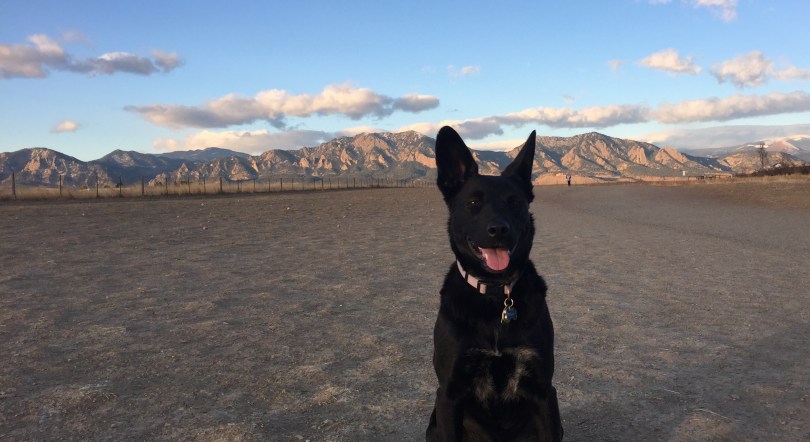
Stella fire

black-dog-with-pointy-ears-sitting-near-mountains

How Running Helps My Mental Health

I really wish that my dog, Stella, was a good running buddy, but she’s just not. First of all, she refuses to do the entire 3.5-mile loop that I run. She’ll reach a point where she turns around and sits on the path, facing back the way we came. I’m jogging in place, pulling on the leash and cajoling her into moving, to no avail. If I start to really put my weight into her harness, she’ll lie down so that her center of gravity is low and I can’t tip her towards me. She then begins her slow army crawl towards home, belly in the dirt. She looks so pitiful that I often give in.

Keep in mind that Stella is a healthy, almost 2-year old cattle dog mix who sprints in giant circles in the dog park and wrestles for an hour every day. She’s not out of shape. She’s not opposed to running in the park. She’s just not interested in running with me. Not to mention that she’s compelled to investigate every smell we run by, so I’m constantly tugging her along or getting my shoulder yanked so that she can traipse into the grass. It’s ok– if I were a dog, I’d rather explore with my nose, too. Jogging is boring compared to 300 million olfactory receptors.

Suffice it to say, Stella is not a good running buddy. Maybe when she’s a little more grown-up she’ll like it more, but I’m not holding my breath. It would be nice to have the motivation of having a dog to run with, but I’m actually pretty well into a running habit these days. On days when I’m not feeling it, I do the regular loop. Frequently, I add more distance with the other paths on the mesa, and sometimes I even do the loop twice!

Every time I take an extended break from running and then start it up again, I find that it’s easier to regain my endurance. I’m always worried that I won’t be able to get back to the part where it’s enjoyable, but I’ve found that part at the beginning where you’re lifting cement shoes off the trail and breathing through a straw to be much shorter than I remember. Once my body readjusts to the requirements of running, I’m always happy that I did it. I notice that running helps my mental health in more ways than just the release of those precious endorphins. It also gives me a routine to plan my day around and something to look forward to. When I get home from a run, I often feel grounded and capable, and noticing my tired muscles is an exercise in mindfulness. Plus, there’s the simple fact that I’m not looking at a screen while I’m outside, running.

I really enjoy the sense of accomplishment that it brings me, although I have to be careful not to connect this too tightly to distance. Otherwise, I find myself disappointed if I don’t run as far or farther than my current limit. (Curse you, perfectionism!) It’s much better to feel accomplished for the act of running itself; I got out of the house, breathed some fresh air, and got my heart rate up. That’s all that matters.

Tracking My Anxiety

The anxiety began when I was eating lunch and scrolling through youtube, trying to find something interesting to watch. I scrolled faster, considering each thumbnail more and more briefly as the tightness in my chest increased. “Hold up,” I thought. “I’m supposed to be tracking my anxiety for my appointment next week. Let me write this down.”

Here’s how to overthink your anxiety record: First, I spent several minutes considering the medium I should use to document my anxiety; paper and pen seemed reasonable, but what kind of format? List? Table? Stream of consciousness essay? I also considered the kind of paper I’d use, be it sticky notes, that half-used legal pad in my bookcase, small notebook–ugh. Too many choices. Let’s go digital. Thank goodness the Notes app is pretty minimal, or I’d still be waffling on what kind of font to use. (Speaking of “stream of consciousness”, I just realized that I could totally make a PowerPoint presentation, complete with awesome clip art and slide transitions. That would really prove my therapist right when she said I’d probably find a way to make it complicated because I’m an overachiever. Challenge accepted.)

So far, I have written down everyday things like realizing I wasn’t sure if someone introduced themselves as Janice or Janet and imagining the obviously catastrophic embarrassment when I inevitably pick the wrong one. I also have bigger things like my unknown life plans, noticing that Stella had put her sneaky paws on the counter and eaten chunks of chocolate cookies out of the pan (she’s fine), and also seemingly random anxiety with no discernable cause. Some of the “random” anxiety is probably due to sensory processing disorder and my tendency to steamroll over discomfort rather than make adjustments for my nervous system. It’s a work in progress.

I think I’ve spent a long time telling myself that anxiety isn’t an issue for me, which makes it a challenge to be mindful of it. After the OCD mostly disappeared, I guess I went “Well, that’s done. I don’t have anxiety anymore.” If only it worked like that. I keep having to reassess my understanding of what’s a normal amount of anxiety and in what contexts it’s normal. Seriously, I have no idea at this point. Do other people feel anxious when they have to walk by the check-out lanes on their way to somewhere else in the grocery store because they can feel people looking at them? No? What kind of lie have I been living?! I guess I knew that some of my anxiety was unreasonable, but convinced myself that it was minor enough that it didn’t need to be addressed. Now I’m just not sure what should be on my list of concerns. Time to go put “worrying about the amount I worry” on my list.

In case my therapist reads this: don’t worry, I will not be showing up with a PowerPoint detailing my anxiety, although that would be hilarious and probably a new one for you.


A hand with red nail polish holding a live shrimp in the air by the ocean

A Tower of Shrimp and Absurdity in IV Ketamine Therapy: The Ketamine Chronicles (Part 13)

Having IV ketamine therapy for treatment-resistant depression is always a fascinating experience. This edition of The Ketamine Chronicles features a crime scene, a tower of shrimp, and a painting of a carnivorous giraffe. Folks, I couldn’t make this stuff up if I tried.

I remember feeling the ketamine almost immediately, and I closed my eyes as I lost track of my limbs. The music I was listening to was a lively classical piece, and my mind created intersecting lines to the notes that formed long evolutionary trees. There were noises around me that distracted me at first; something that sounded like hammering from the floor above us, then quiet conversation in the room, and a door opening and closing. Soon, though, the ketamine pulled me away, and I wasn’t concerned with anything outside my mind.

Absurdity in Ketamine Therapy Imagery

Silhouettes of a human face and a bull in profile, carefully stretched-out tape measures arranged in rows, and thousands of old family photos being sent on a conveyor belt to be turned into decorative pebbles were just some of the odd things I saw this time.

The Crime Scene

The crime scene was set in an arid landscape. There were shrubby bushes and reddish-brown caked dirt as far as the eye could see. Two or three people stood around a small body of water – what seemed like the only one for miles and miles. I got the sense that they were pondering something, as a detective would do when a puzzling scene presents itself. As I tried to read more of the scenario, my perspective began to shift. I zoomed out smoothly but quickly, like I had scrolled down on Google Maps with intention. Perhaps I’ve been watching too many police procedurals and true crime shows lately.

A desert landscape with red rock outcroppings and shrubs.
Photo by Agnieszka Mordaunt on Unsplash

A Tower of Shrimp

The shrimp tower stretched higher and higher, eventually reaching the edge of the atmosphere. The singular shrimp at the very top swayed back and forth, pondering the shrimps holding it aloft and balancing in the wind. Each shrimp interlocked with the shrimp around it, like that barrel of monkeys in Toy Story. I don’t know if you know this, but the sensation of perching on top of a stack of shrimps that stretches all the way to the edge of the atmosphere produces some stomach-dropping vertigo. If you’ve ever read the Dr. Seuss Book, Yertle the Turtle, the shrimp tower may remind you of that. Instead of an incredibly arrogant shrimp forcing the others to form the tower so that it could sit at the top, this was the reverse. The top shrimp wasn’t entirely sure how it got there and was not very comfortable with it.

Mixing of Identity and Observation During Ketamine Therapy for Depression

There are some interesting parts of my IV ketamine treatments that seem to blend my identity with strange scenarios and characters. For instance, how did I know that the shrimp at the top of the tower didn’t know how it got there? Was I the shrimp? Similarly, the funeral scene in the seventh part of The Ketamine Chronicles also evoked a sudden understanding. I was watching the scene, but when the coffin was set down, I felt like I was being pressed into the ground. Was I watching, or was I in the coffin?

Carnivorous Giraffe

The day before this IV ketamine infusion, my aunt and I did one of those paint-n-sip classes. The painting to emulate was a cute, cartoonish giraffe with multi-colored spots. We noticed that there were two kids in the back who had really taken their paintings to the next level. Their giraffes had blood-red eyes, thick, metal earrings, and gaping smiles filled with pointed teeth. One also had thick blue stripes rather than spots, but that’s neither here nor there. We got a big kick out of these kids’ creativity and confidence to go off-book.

Now, imagine that painting in the style of a ten-year-old’s artistic skills, and then imagine how taken aback I was when a dark silhouette in my ketamine dream revealed itself to have that giraffe’s face. It was both unsettling and hilarious at the same time.

A Mildly Creepy Scene

After the carnivorous giraffe, my brain may have opened the door to where the creepy images are held. I remember seeing dark forms standing over me, laughing. Thankfully, something in the room beeped, and I reoriented myself to my surroundings. That was probably the most disturbing thing I’ve experienced during IV ketamine therapy so far, and even that was not bad. I knew that it was creepy but didn’t feel especially scared.

Most of the time while I get ketamine infusions for my depression, I just see bizarre scenes like the tower of shrimp, marvel at how much my teeth feel like stale marshmallows, and wonder if I’m slowly tilting in one direction or another.

If you’d like to read more about my experience with ketamine for depression, start from the beginning of The Ketamine Chronicles or visit the archives. Click here for mobile-optimized archives of The Ketamine Chronicles.

Anxiety and Doing New Things

In an attempt to fill my time with things that will keep me from slipping back into severe depression, I’ve started doing New Things. One is volunteering and the other is taking a neighbor/friend up on her offer to teach me how to ride horses.

I really want to quit and crawl back into my hermit cave. I am way outside of my comfort zone, which, for me, always leads to near-constant worrying and ruminating. I can’t help but laugh because when my new therapist asked if anxiety was also a problem for me in addition to depression, I said “hmm, no, not really.” She later disagreed, and the more I think about it, the more I realize that yes, yes it definitely is. Now that my depression is easing, I think that anxiety is coming to the surface. (Additionally, when I tell people about this anxiety realization, they look at me like “you…didn’t know that?” So, that’s cool. Everyone knows about this but me.)

When I’m really depressed, I’m so numb and slowed down that I don’t even worry about saying “yes” to new things; the answer is automatically “no”. But when the depression lifts, my natural tendency to overthink everything and fall face-first into crippling indecision has room to become obvious. Because I feel capable of doing more than I did while depressed, I feel like I should say “yes” to new opportunities, even if I’m on the fence.

Rather than deciding to just get out there and demolish the boundaries of my comfort zone, I get…stuck. Really stuck. I want to do new things in general, but when an opportunity comes along, my worry and fear keep me from making a confident decision. It’s tough for me to decipher whether I don’t want to do something because I’m feeling overwhelming New Thing-anxiety or because I won’t like it. And, since I know that this is a problem for me, if I think there’s a chance I might like it eventually, I tend to make myself push through and do it no matter what. Of course, I do that while also continuing to worry about whether or not that’s the right thing to do.

An additional layer of this terrible cake is that I do not like quitting, even if I really want to bail. And even if this hypothetical New Thing has very natural exits where I can decide it’s not for me and stop, it still feeeeels like quitting. This makes me even more indecisive because not only do I need to know if my anxiety is coming from a dislike of the Thing or not, but I also need to know if I can be committed to the entire Thing. No quitting. Approaching opportunities like this is not fun, and I do not recommend it. 0/10.

I imagine the goal is to take each new opportunity and be able to decide, quickly and simply, whether I want to do it or not. I just don’t know how to do that without taking all of the stuff above into account and getting hopelessly tangled up. I guess step one is to remind myself that I can say “no”, changing my mind is ok, and that in many cases, it’s not that big of a deal.

Much easier said than done.


I Woke Up Cold: Thoughts From My Morning Coffee

I put on a scarf at 5:30 in the morning because I woke up cold. It seems that I’m always cold these days. Months remain before the crocuses poke through the soil and the robins start to chirp. Months of ice and salt, of bitter wind and cracked skin. Of waking up cold. I step lightly on the wood floor in the dark and flick on the kitchen lights. It’s time for coffee, so I follow the familiar steps: a new filter, two and a half scoops, and enough water for a full pot. I don’t mind waking up so early; it gives me time to start the day slowly. If I try, I can get another half hour before I’m rudely awakened by a paw to the face– Stella has limited patience. So in the end, 5:30 is peaceful and silent, and I can sit alone at the table with my coffee while Stella smells the early morning air through the crack between the sliding door and the frame.

This morning is grey; the trees are grey, the sky is grey, the grass looks nearly grey. I can already tell that today will be a sluggish one. There will probably be a long nap, and I will likely struggle through work, only to wander aimlessly from one uninteresting hobby to another. I wonder if the ketamine is wearing off, but it’s only been two weeks since my last infusion. I want to will myself into a longer interval between infusions because two weeks seems rather short. I argue with myself when it comes time to rate my mood for the day on a scale of one to ten. (I get an automated reminder text on my phone and send the number as a reply. The results create a graph that my doctor can see.) I have this urge to fib- to make it seem like I feel better than I do. It takes some effort to not lie, and I always get a small twist of disappointment and shame when I send anything below a five.

What will today be? A four? Maybe if I get moving, I can make it a five or even a six. But frankly, today is grey and cold, and I don’t feel like doing anything. My depression is not seasonal; it stays all year. I’ve noticed, however, that the quiet arrival of spring sometimes tows along my missing optimism. The return of new growth and green things makes me feel a little more ready to come out of my shell. Anticipation tinged with anxiety will begin to stir in me as winter comes to an end. Anxiety because there will be more to do, and I worry that I won’t be able to drag myself out of bed to do it. Anticipation because I desperately want to.

For now, I am lost in January. Sometimes, the best I can do is curl up in the cashmere blanket my mother made for me, still wearing my scarf, and sleep. And hope that I won’t wake up cold.

What to Consider When Switching Therapists

There are lots of reasons you might go from one therapist to another. You might be moving, looking for another perspective, or simply feel ready for a change. Or, it could be that your therapist is leaving; career change, maternity leave, any number of scenarios in which you must decide what to do with your treatment. And, pretty much no matter what, switching therapists is hard.

I’m in this boat right now, and I’m finding it more tricky than I expected. For one thing, I’ve had the same therapist for almost two years. We’ve gotten to know each other (in a heavily one-sided way), and when I’m not completely shut down with depression, I really enjoy her company. It takes me a minute to be comfortable with someone, so the thought of switching therapists and beginning that process again is daunting.

Online Research

When I began my search for a new therapist, I started with Psychology Today’s therapist directory. You can filter it by issue, insurance, gender, and other factors that might help you narrow it down. I also tried googling a combination of “therapist” with “depression” and my area.

Contact Method

Some therapists provide an email address with their contact information. Text, be it emails or SMS, is BY FAR my favorite way to communicate. Making phone calls is an arduous process, what with the scripting and practicing and heavy sweating. But, leaving a message on an answering machine is, in my experience, more likely to get you a speedy reply. [Pro tip: if you approach phone calls the same way I do, keep a list of potential therapists and the status of your contact. I can just imagine leaving the exact same scripted message for the same person twice and being mortified enough to cut contact entirely.]

Make Appointments with Multiple Therapists

I highly, highly, highly recommend that you make appointments or consultations with multiple people. It’s way more time-consuming, and I’m finding it difficult to tell my story again at each new appointment, but it’s the best way to find a therapist that you like. Your current therapist might give you a list of people to call, you can search the web, and if you meet with someone and it doesn’t work out, ask them if they have any colleagues they can recommend.

Therapists Understand that Switching Therapists is Hard

Switching therapists is an interesting process to go through after being in therapy for a while and having done the search a few times before because I feel much more sure of myself. I know what kinds of approaches I’m looking for and I know roughly what to expect at an initial appointment. But, I also have more of a history within the mental health treatment sphere to explain in a coherent manner. The sequence of events is too long to describe in detail at a first meeting, so I have to decide how to summarize in a way that gets everything across. I don’t always succeed, and then we’re left filling in important gaps that I forgot about. Fortunately, therapists understand that the transition can be a difficult process.

It can be hard to leave a therapist who has helped you through really tough times. They’ve supported you and listened to you, and it’s natural to be sad that your time with them is over. But, it’s not meant to be a relationship that lasts forever. I’m going to miss my current therapist, but I’m also looking forward to getting a new perspective. It might be just what I need to put all the pieces of my recovery together.