photo of desert ground with interlocking cracks and dry plants

I’m a (Self)-Control Freak

I’ve trained myself to be restrained whenever possible. I hold myself back when I don’t like something, and even my enthusiasm is tempered. People find me hard to read, and I don’t open up immediately, a little later, or even a bit after that. It takes a while.

Some of this is surely a product of my Sensory Processing Disorder. The world is abrasive to my nervous system; it’s loud, fast, bright, and unpredictable. So, to avoid standing out, I bury my reactions. I’ve developed excellent self-control. Of course, this has repercussions for me when I go home in a haze and need to do a lot of nothing for a while. Hiding how I feel about outside stimuli often protects me from two of the things I dislike the most: interrupting people and being the center of attention. Sometimes, enduring the feeling of people crowding around me is more bearable than attracting attention by elbowing my way to the door on legs that don’t feel like mine.

I have a fear of not being in control of myself. I find nearly every environment to be full of stimuli that are “too much” for me. Even my internal body sensations are problematic. My brain doesn’t always know exactly where in space my body is located or how things are moving around me. All of this feels very much out of my control, so I cling to my self-control for safety. However, I think my self-control has expanded past its allotted jurisdiction, and it’s time to address it.

My need to be in control of my reactions has seeped into my sense of what is my responsibility and what is not. It’s easy for us to think we’re responsible for others; we come to think that their feelings, their setbacks, and their decisions are on our shoulders. What any good friend would tell is you that you aren’t. You’re not responsible for how other people move through the world. We make our own choices, manage our own feelings, and deal with change on our own terms.
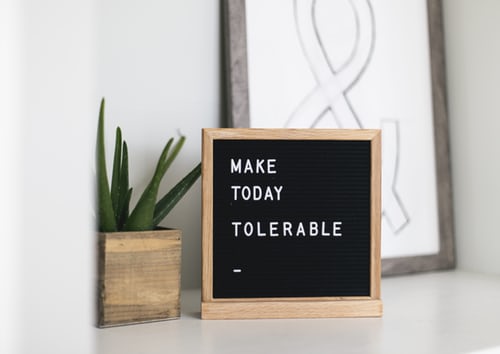
small black sign with white letters reading make today tolerable with succulent in wooden container next to sign

My particular misplaced sense of responsibility lies in how I think about my depression. I have always had a nagging (or roaring) sense that my depression is my fault. If I could just do more, or try harder, maybe I could fix myself. I’ve recently been faced with a treatment option that forces me to confront the fact that I have treatment-resistant depression, and that it’s not my fault. Seeing my severe depression as an illness that is out of my direct control is terrifying. It’s simply more comfortable for me to think that I’m just not doing a very good job at solving a problem that can be solved with enough effort.

And that’s how I realized that I’m a (self)-control freak.

actually would rather believe that I’m a failure than that I drew the short mental health straw. At the same time, it’s freeing to view my depression as something that has happened to me rather than something I caused. It takes some of the burden off of me, but it also takes some of the control away from me. Brains are weird, and sometimes they have a mind (har har) of their own. Sudden relapses, triggers, and even seemingly spontaneous ends to episodes are not entirely understood. It’s scary to think that after all of this- the numerous medications, the hospitalization, the group therapy, the individual therapy, the occupational therapy– my brain has stubbornly remained depressed.

If I’m going to get better, I need to stop blaming myself. I need to accept that some things are out of my control and that I don’t need to hold myself entirely accountable for my symptoms. I’ve learned a lot about healthy coping mechanisms in my years of therapy, and although right now I feel too debilitated to put them into useful practice, I hope that a new approach might relieve my symptoms enough to let me begin to heal on my own, the way I like to do it: with hard work.


The term “control freak” has plenty of negative connotations, and it can be hurtful to people who struggle to trust others or to let go of perceptions about the “right” way to do something. This post is in no way a jab at others, only at myself. The title is meant to be humorous, to poke fun at a coping mechanism that holds me back. I’m a self-described self-control freak, and as the term does not bother me, I hope that it doesn’t come across as insensitive.


portrait view of black dog with pointy ears sleeping on bed with pillows

3 Things My Dog Teaches Me About Listening to My Body

Ever since I welcomed my puppy, Stella, into my life, I’ve noticed some things about how she treats her body. Unlike Stella, I have trouble recognizing what my body needs; Sensory Processing Disorder can make it hard to discriminate one feeling from another, and to identify what actions would fix an uncomfortable sensation. My dog, however, is especially in tune with her body. Sometimes I marvel at how good she is at giving herself what she needs. In honor of that, here are three things I’ve learned from Stella about listening to my body.

Test Your Surroundings

Stella has no qualms about finding a new place to hang out, no worries about offending others by moving. She goes from place to place as she wants. If the bed becomes too hot or too soft, she switches to the floor. If she feels too exposed around loud noises, she finds somewhere sheltered to lay.

The number of times I’ve kept myself from moving or adjusting my surroundings because I might stand out is too many to count. The little things can make a big difference in how you see your environment and how you feel in your body. Small adjustments help us regulate our nervous systems– a cold drink can wake you up while a warm one can calm you. Do you like your feet to feel secure, or do you prefer the freedom of open-toed shoes? Break up the monotony of your schedule by riding your bike to school or work every once in a while. I work on the computer a lot, and when my slouch has reached extreme levels, I know it’s time to get up and stretch. Take a page from Stella’s book, and feel free to get comfortable in your environment.

Express Your Emotions

Dogs don’t lie about how they feel; if you know how to read their body language, it’s easy to tell when they’re feeling happy, anxious, confident, or any other reaction to outside stimuli. There’s a certain amount of uncomfortable stimuli that we all must face every day. Maybe you hate the feeling of brushing your teeth, yet you do it because it’s important for your health. Maybe you’re sensitive to temperatures and dislike walking to work in the heat, but have limited transportation options. There are times that we have to prepare ourselves for and recover from unpleasant feelings that are unavoidable. There are also times when we suppress our instincts because we think we “should” be able to handle something. If there’s a way that you or someone else can adjust your surroundings to make you more comfortable, speak up!

Look for Joy

Stella loves a lot of things; she loves barking at rabbits, playing in sprinklers, and rolling in the grass. The things that she enjoys the most are the ones that require spontaneity. She approaches every dog she meets with a play bow; there’s no time like the present to make a new friend. She lives entirely in the moment, and whatever feels right to her is what she does– (sometimes to my immense frustration).

Look for joy in the little things. Find ways to have fun with boring activities. When no input is exciting or fun, we become understimulated and listless. So, jump in those puddles, paint with your fingers, and put your waste paper basket far away so you have to toss things from your desk. I don’t know, whatever brings you joy.

black-and-white-photo-of-people-sitting-and-standing-at-airport-gate-B30

Traveling with Sensory Processing Disorder

I’ve been traveling a lot lately, and I’m worn out. While waiting to board my latest flight home, I pretty much sat at the gate in a sensory stupor while the gate agents droned on the speaker about checking your carry-on bag. Because I have Sensory Processing Disorder, I needed an afternoon (or more) to reset my nervous system and return to the real world as a functioning human being. Unfortunately, airports have very few places in which to hide from the noise, movement, and general chaos of airport activity. (But for help finding those rare spots, check out sleepinginairports.net)

Dyspraxia, SPD, and Airports

And, it’s not just the crowds of people that are overstimulating- it’s also the tasks you have to do in order to get onto your flight. These tasks fall under the concept of praxis. In the context of Sensory Processing Disorder, dyspraxia refers to difficulty with planning complex movements and tasks. It falls under the Sensory-Based Motor Disorder subtype of Sensory Processing Disorder.

Tackling Motor Planning Challenges

I have symptoms of dyspraxia, so encountering uncertain situations can be stressful and draining for me. Standing in lines is okay for me; it’s ordered, it’s neat, and the most difficult part for me is identifying which kiosk just opened up (might take me a little longer, but I’ll get it eventually). Security is a mess. People crossing from the main line to a security line across the room, the choices involved in preparing your things to go through the imaging machine (should I take off my shoes first? What about my belt?), and then all of a sudden the line has moved ahead and I’m the dam holding back a flood of grumpy people trying to catch their flights. At least, that’s what I always worry will happen. In reality, it usually goes more smoothly than I expect, and I imagine we look more like ants, focused on our own tasks with occasional hiccups but somehow hurrying around one another to reach our destinations without incident.

Airports Have All the Sensory Stimuli

Airports are visually busy, and with loudspeaker announcements, children crying, businessmen talking shop on their cell phones; it’s a barrage of auditory assaults for people with sensitive nervous systems. Not to mention the vestibular hurdles- the moving walkways clogged with people, the escalator that somehow jostles you up and down while also transporting you diagonally to the next floor. Too much of this, and I begin to get vertigo, letting me know that I’m nearing my limit.

Tips for Traveling with Sensory Processing Disorder

Airports are challenging places to navigate for people with Sensory Processing Disorder. Luckily, there are strategies you can use to make your airport experience less stressful.

  • Get organized the night before to set yourself up for success.
    • Print your ticket.
    • Organize your belongings so that essential items are easy to grab.
    • Double check your arrangements for transportation. Have parking, shuttle busses, or your ride from a friend figured out in advance.
    • Consider writing down important information in one easily accessible place. Having your terminal, gate, airline, flight times and numbers, and your itinerary at the ready can help you feel prepared.
    • Wear clothing that makes getting through security simple.
  • Bring things that ground you.
    • Mints, hard candy, gum.
    • Strong smells such as in diffuser jewelry or a travel deodorant.
    • Weighted lap pad, compression socks, hats, and other clothing that calms you.
    • Headphones and a supply of music or your favorite content.
  • Give yourself time to recover after your flight.
  • Be patient with yourself and others.
  • Take care of the needs you can control.
    • Food and water.
    • Wear layers.
    • Bring travel toiletries.
    • Try to be rested before your adventure!

Traveling with Sensory Processing Disorder may take a little more planning and some extra self-care, but with any luck, you’ll get to your destination as cool and self-regulated as possible.

prickly-pears-in-rocky-mountains

Why I Love Hiking: a Sensory Photo Narrative

Mud squelches underneath my boots, and I reach out with my fingers to balance myself against a tree. I can feel the pack on my shoulders, hear birds chirping, and smell the sharp scent of pine needles.

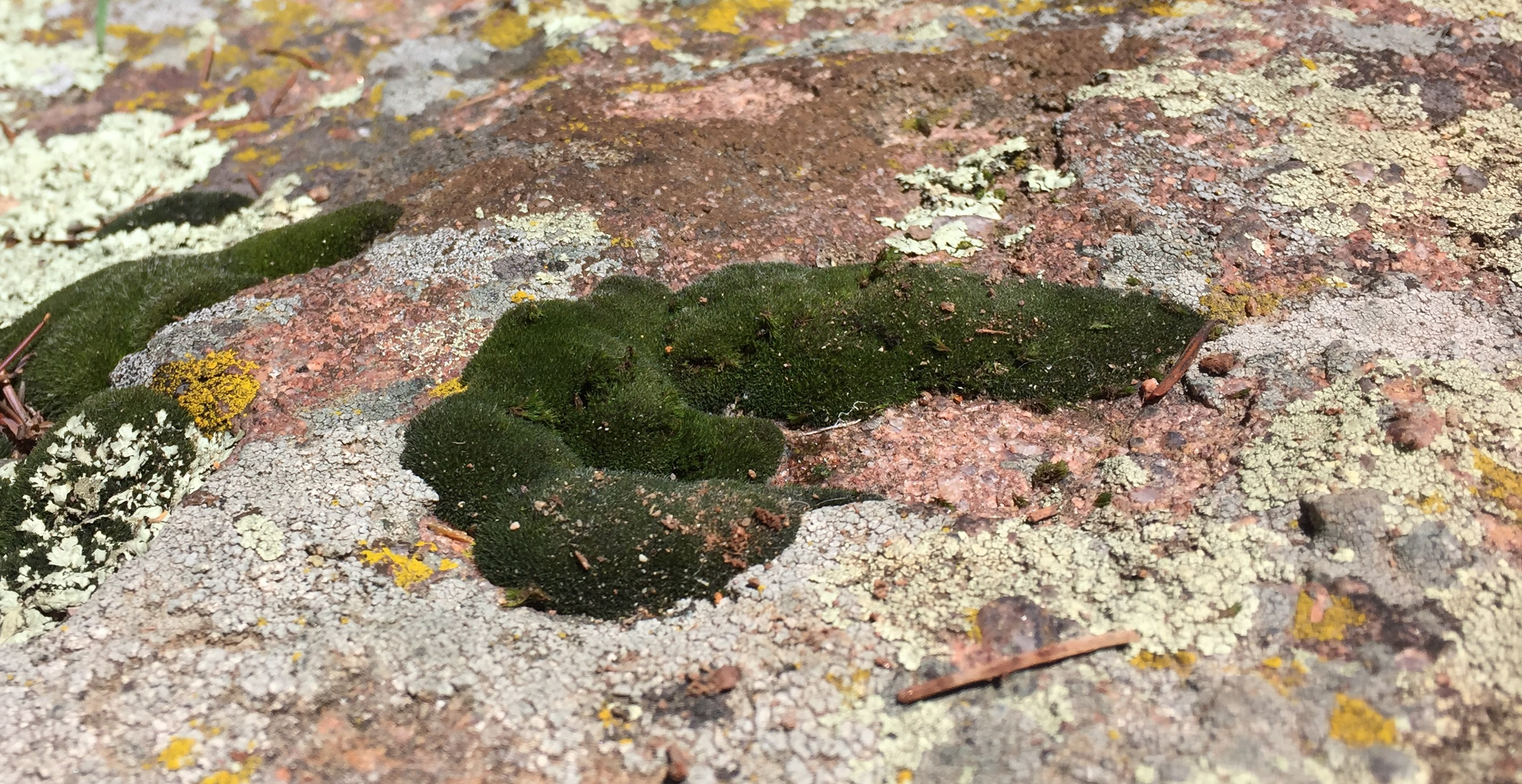
I love hiking both because I love nature and because it fulfills nearly all of my sensory requirements. I can go at my own pace and under the power of my own body; only the weather and the wildlife are out of my control. When the world around you is overwhelming and hard to understand, it’s nice to put on a backpack with everything you’ll need for the day and let your legs carry you just as far as you want to go. Along the way, every element of a hike serves as a sensory “snack”. The vestibular input of balancing on rocks as I cross a stream. The feeling of my arms swinging at my sides as I get into a rhythm. The soft, spongy moss that I pause to touch with my fingertips.

close-up-of-green-moss-on-multi-colored-rock

piece-of-quartz-on-rock-with-dried-moss


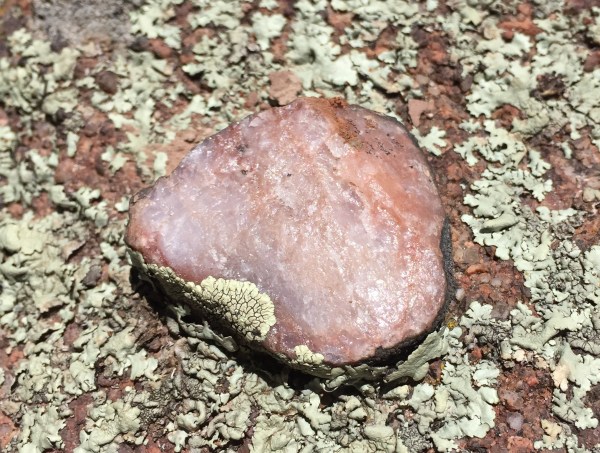
I don’t like the dried moss surrounding it, but I notice a smooth piece of quartz that draws my eye.


muddy-hiking-boots-on-feet-of-hiker-sitting-on-large-rock


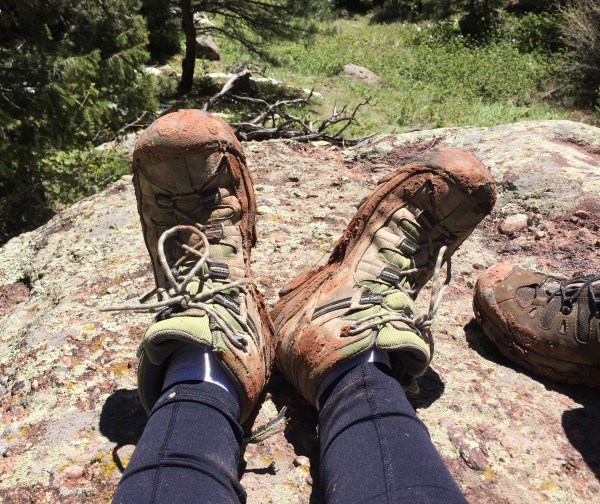
Later, we stop for lunch and I study the rust-colored mud on my boots.


two-hiking-backpacks-on-a-rock-in-the-rocky-mountains-on-a-sunny-day


My pack feels secure; it’s a comforting weight. We get up to investigate the surrounding plants, and I look back at our lunch spot. It’s breathtaking in the sunlight.


black-dog-in-profile-sitting-with-hiking-day-dog-pack-on-back


I hear my dog lapping up some water from her bowl, and I take a moment to appreciate her presence.


We find some prickly pears and admire their toughness. Centers chewed through, their spiny armor breached, they continue to survive. We don’t touch them; we just look at the color and shape of them.

prickly-pears-in-rocky-mountains

Across the path, a Ponderosa pine stands tall and broad. This one isn’t in the sun, but I gently scratch the bark and lean in to smell it. Warm Ponderosa pine bark smells like vanilla, and it’s one of my favorite parts of hiking. This one offers a very faint fragrance. It smells like vanilla and fresh cookies and hiking and happiness.

ponderosa-pine-bark

After lunch, we decide that it’s time to head back. Back through the forest, back through the mud, back through the tall grass at the base of the mountain. When we get home, I settle on the lawn with my dog, our muscles tired but happy, and our senses satisfied. Time for a well-deserved nap.

black-dog-sleeping-on-side-in-grassy-lawn

There is Always a Choice

TW: self-harm and suicide

I wrote this in my hospital journal towards the end of my stay. A few days ago, I published a post about self-compassion. The two seem to go together, in my mind.

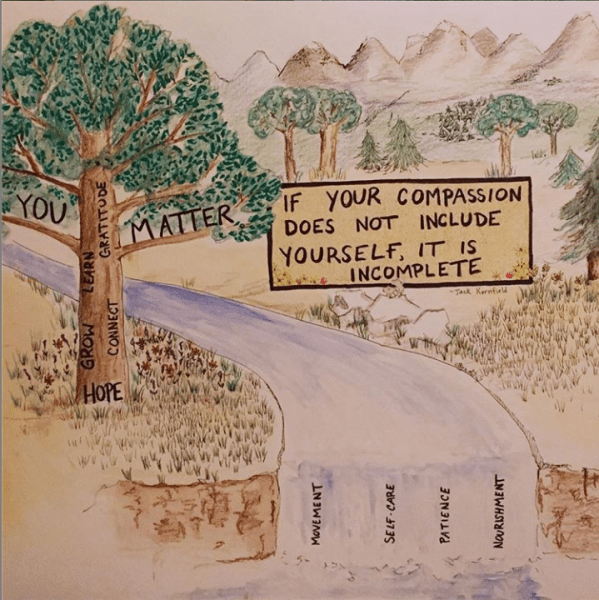
drawing of landscape with tree and river and words about self-compassionThere is always a choice. Two therapists have told me this independently. It took a little while for the meaning to sink in after the first therapist said it. I had gone a few weeks without self-harm at that point, and I still felt utterly controlled by it. The question of whether to do it or not didn’t seem like a choice; it seemed like an inevitability. Over time, the less trapped by it I felt, and the more sense that statement made. Although the choice of whether to self-harm might have been stacked in favor of doing it, the choice to take steps to change that was still mine.


I relapsed and eventually ended up here, in the hospital. On the surface, I’m likely to view all of that as a failure. However, I didn’t make the wrong choice. I experienced the symptoms of wanting to self-harm and having suicidal thoughts. I made the choice to be honest and to go to the hospital. I’m making choices every day to participate in groups and to work towards stability.

Was cutting a choice? Yes, but it’s about more than that. It’s about larger choices. When my disorder makes resisting those urges and thoughts too difficult, agency over my life as a whole is still mine. I can decide to work towards taking back control in all areas, however slowly I have to do that. It’s about the choices I make to be honest with my loved ones, to go to therapy, and to take my medication, that will affect my recovery from an illness that makes me want to hurt myself, that makes me want to disappear, that tells me that I don’t matter.

I do matter. I choose to work towards self-love.

There is always a choice.

Love,

Your brain

College and SPD: Dealing with Overwhelm

In my last “College and SPD” post, I talked about what I wish I had known about living with Sensory Processing Disorder while in college. This time, I’m going to share what I learned about self-regulation throughout my four years at a large university.

First, a Story

Let me set the scene: I was a sophomore, sitting in the largest lecture hall in the Chemistry Building at my university. The class was Organic Chemistry, and the year was 2015. It was the height of popularity for Bruno Mars’s song, “Uptown Funk”, and nobody was safe from its groovy, brass beat. My 200-some classmates and I were sitting there, trying to draw the chair conformation of alpha glucose with the same finesse as Professor N., when from the back of the hall came the sharp staccato of percussion instruments. If I could describe the look of pure bewilderment on Prof. N.’s face as a group known for interrupting lectures launched into a truly impressive rendition of “Uptown Funk”, I would. But it escapes description. As for the song: it was loud, it was exhilarating, and it left the class reeling for the remaining 30 minutes. Prof. N. was commendably patient and picked up her lecture where she left off, but my peers were distracted and buzzing with excitement.

The spike of adrenaline that I get from the sound of a dropped saucepan or a vacuum being turned on is just like the feeling of having your train of thought derailed by six thespians with trumpets, a bass, and some killer vocal cords. That day in Organic Chemistry was one of the few times I haven’t felt alone in my sensitivity. It was so jarring that you couldn’t help but react, and I wasn’t the only one!

There’s Always Something

Musical interruptions are not commonplace, at least not at my alma mater. There are, however, plenty of stimuli to put you on edge.

home_flexi1
Why do you have to scream? Also, how is this legal?

From the hordes of students clogging the walkways to the documentary clips played at full volume during your history class, to the inebriated bachelorette party on that weird bicycle/drinking bus that passes under your window at midnight.

I quickly found that I needed more time to recharge than I did before college. I also found that it was more difficult to find time to do so. I was swamped with assignments, study groups, and exam prep, and feeling the pressure of those expectations that I should live it up.

I Did Not “Live it Up”

My sophomore-year roommate and I went to one (1) party and spent the entire time shouting over the music to help a drunk student whose friends had lost track of her. For a while, I thought there must be something that I was missing out on. Why would so many people enthusiastically subject themselves to that? The answer is that my threshold for intense stimuli is probably much, much lower than that of someone who loves to party. Parties are loud, crowded, and messy; all things that raise my nervous system’s arousal past where it’s comfortable. While a little bit is enough to overwhelm me, it’s perfect for someone who craves that kind of input. Eventually, I accepted that the party scene just isn’t my thing, and I was much happier for it.

Find What’s Soothing

While you can simply choose not to go to parties, there are some aspects of college life that are unavoidably draining. For the general stress of being a college student, I found that establishing a routine was immensely helpful. Breakfast is my favorite meal and probably my favorite time of the day. I’d wake up at the same time, head down to the dining hall with my own mug, get some coffee and food, and start my day off right (read: predictably).

Having my own space set up the way I liked it was also helpful. Many people don’t have the option of living alone in college, but even when I had roommates, I tried to make my desk and bed into little sanctuaries where I could shelter and recharge. My weighted blanket is wonderful, and I learned to never underestimate the power of changing into pajamas.

When my insomnia was at its worst, it took me two hours to fall asleep at night. I just couldn’t settle down; I’d consciously relax my body, and then ten minutes later, realize it was tense again. All the while, my mind was running through deadlines and anxieties. Taking some time in between schoolwork and bed to do something soothing helped my insomnia. I brought my favorite poetry and fiction books from home so that I could read something enjoyable but not too exciting. I also did mental word games to keep my mind occupied until I could fall asleep.

I would have done some things differently if I’d known more about SPD, but I still found ways to cope. Looking back, I suppose that means that I shouldn’t discount my intuition. Listening to it and not judging it is the hard part.

worm's-eye-view-of-one-bare-cherry-blossom-tree-and-one-with-blossoms-against-blue-sky

Explaining SPD to Health Professionals

It’s become clear that I have a hard time explaining how Sensory Processing Disorder (SPD) affects me, particularly when I’m speaking to health professionals.

When I was recently hospitalized, I spoke to a ton of mental health professionals, all of whom asked me about my diagnoses. I had no trouble letting them know about my diagnosis of Major Depressive Disorder, nor did I struggle to tell them about my childhood history of OCD. Disclosing that I have Sensory Processing Disorder was something that I was oddly unprepared for. I either would minimize it by mentioning it as an afterthought, neglect to mention it at all, or not do an adequate job of explaining it if I was asked follow-up questions.

Sensory Processing Disorder is not in the DSM, and I’m never sure whether the person I’m speaking to believes in its validity. I’ve never run into anyone who gives me reason to believe they don’t, but the disorder’s lack of diagnostic acceptance puts me on edge. SPD is a neurological condition that results in differences in how the brain processes information. Does this make it a physical health condition or a mental health condition? SPD has multiple sub-disorders; is it enough to simply say “I have SPD”? How should I go about explaining my disorder without minimizing it or coming across as defensive?

Usually, when someone asks me how SPD affects me, I end up saying something like “I’m over-responsive to a lot of stimuli, so things like loud noises, bright lights, and certain textures really bother me.” While accurate, this doesn’t capture the extent to which SPD affects me. Saying loud noises bother me doesn’t illustrate that I have to spend 2-3 full minutes psyching myself up with my finger on the button before I turn on the blender. When I say that changes to my routine drain me, what I really mean is that I once had a full-blown panic attack while driving on the highway because I had to leave earlier than usual and it was drizzling.

Sensory Processing Disorder is real. It’s also hard to explain. I’ve started using a mixture of SPD terminology and real-life examples to illustrate my symptoms, and while it’s difficult, I combat my tendency to understate everything by tossing in some descriptive adjectives like “overwhelming,” “draining,” and “dysregulated”. The vast majority of health professionals just want to help, so describing your challenges as accurately as possible is really the best approach. Plus, advocating for yourself is important, something that I recently learned firsthand. But, that’s a story for another time.

How do you explain SPD to health professionals? Share your tips in the comments!