A Lumpdate

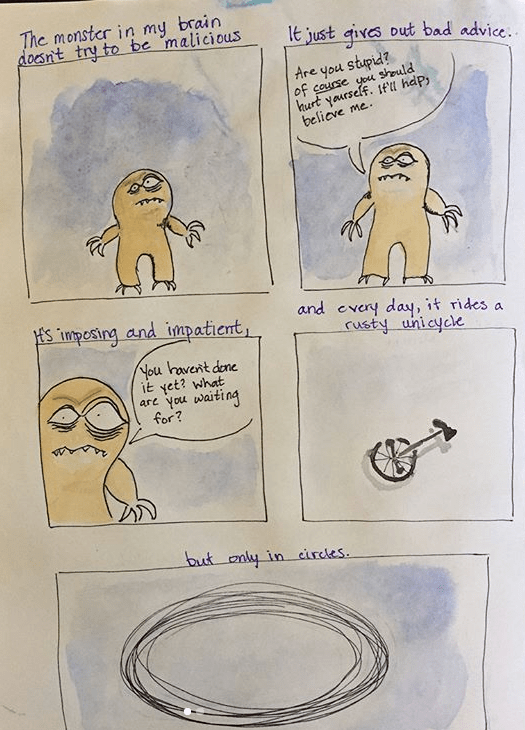
What is a lumpdate? I’m glad you asked. “The Lump” is the name I use to refer to the imaginary goblin in my brain that rides a tiny, rusty unicycle in circles, day and night.

watercolor artwork of a cartoon goblin giving bad advice about mental health

The Lump was quiet for a while, but it’s back again, so this is a lumpdate- an update about the Lump. It won’t be a long lumpdate; the Lump is rather unoriginal and doesn’t have many new points to make. Really, they’re all repeats of the same damaging doubts from before.

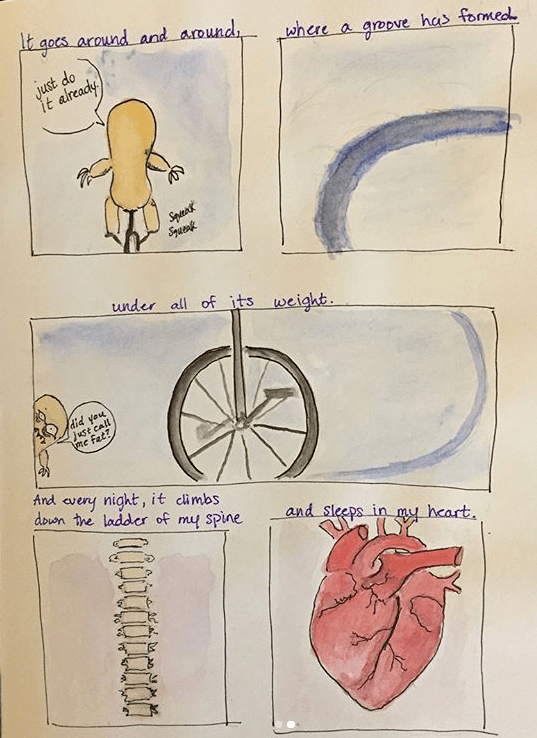
In sum, the Lump is back, setting up shop in my mind.

A cartoon goblin riding a unicycle and damaging mental health by refusing to leave

I’m trying to evict it.

Love,

Your brain

Relapse: A Poem about Self-Harm

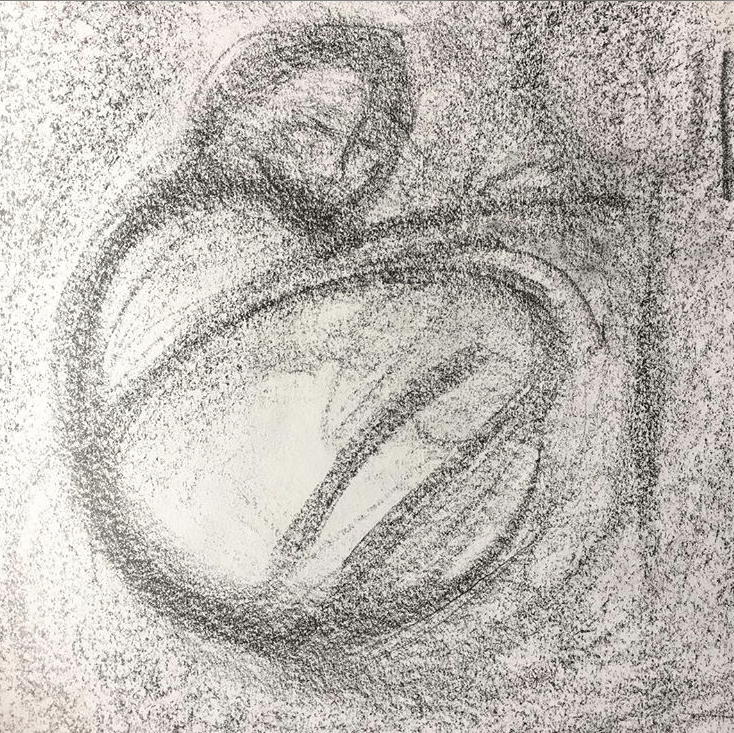
black and white painting of woman with furrowed bow and eyes closedThe remnants

were there all along-

wrapped inside my skull,

twined around every neuron.


In spring,

it awoke from its dormancy,

stretched its vines

to suffocate me further.


I’ll prune it back

and pull

what roots I can.

Maybe this time


I’ll get them before

late summer,

when the poison berries

are full,


bursting with

rotten propagation.

Waiting to sow the blight-

again.


Next year,

I’ll be clean


Love,

Your brain


Recovery From Depression

TW: suicide & self-harm

I Used To

I used to look at the time when I heard a train go by at night, the heavy silence of 2 AM broken by the siren call of escape. I used to notice unlocked windows on the fourth floor of West Hall as I went up and down the stairs, each trip to and from class becoming harder. I used to see ways to die everywhere; in the passing bus, in the cold, dark current of the Huron River, in the pastel-blue sewing scissors tucked under my pillow. I used to wonder how long it would take for these morbid opportunities to escape my notice. How long before I can go a full day without putting some new, self-destructive idea on a mental shelf? How long before any phrase including the word “cut” doesn’t make me yearn to be alone so that I can do just that? I used to wonder about these things until I realized,

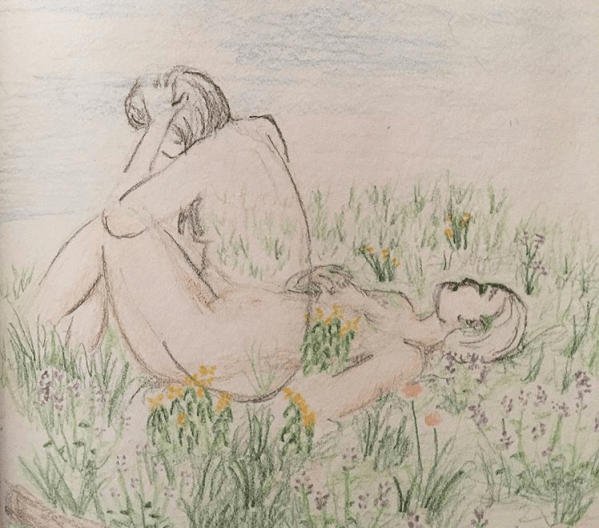
drawing-of-woman-lying-in-field-of-wildflowers


I used to.

Love,

Your brain

How Do You Measure Hope?

I was sitting in my therapist’s office yesterday, quiet and subdued, while we discussed the challenge of recovering from repeated episodes of depression. I had explained that sometimes I take solace in the knowledge that the episodes eventually end, but other times, I despair that depression will inevitably return. In trying to ask me where I sat on the continuum that day, my therapist posed an interesting rhetorical question.

How do you measure hope?

Neither of us answered it, but I found myself pondering it as I left. We measure things because it helps us put them into the context of the world around us. But how do you measure a subjective thing like hope? Can you weigh it? Stand it up against your kitchen doorframe and mark its growth as the years go by? Or maybe you measure it by volume- how much space it takes up in your life; in your goals; in your routines. If you could measure hope in decibels, would yours be louder than your doubt?

For now, I choose to measure hope in binary terms. Hope is hope, no matter how small or dim. If your hope is small, feed it with the belief that the better times are worth it.

Love, 

Your brain

February’s Grip

The sun has left us for a few rotations, only peeking out from behind the clouds in short intervals. It smiles down on us weakly, filtered through miles of gauzy cotton. How did I manage a more northern latitude? Just a day or two of relative darkness is enough to upset my balance.
Maybe I’m searching for explanations that don’t exist. To excuse my mood as simply a mirror for what’s outside. It seems impossible that such a minute change could affect me so drastically, and yet when I embark on my morning walk, the slow, chemical drip of melatonin invariably calls me back to bed. So, I hunker down, and I wait for February’s grip to loosen.
Love,
Your Brain

Some Thoughts on Running

CW: mentions of self-harm

Sometimes I run because it’s when I feel strongest. I run because I love the feeling of my muscles working beneath my skin, my breath matched to my stride. Breathe in for three steps, breathe out for three steps. I love the sense of accomplishment, knowing that my body can carry me further than I think it can. Sometimes I run because it gives me joy. The simple pleasure of the wind in my hair and the sun on my face, moving with a body I’m thankful for. My body is a canvas for my mental state; when I’m well, I run for the joy of it. When I’m unwell, I run because it’s just another way to hurt myself. I run because at mile three I’m still thinking about cutting, but by mile five my brain is numb. Breathe in for three steps. Breathe out for three steps. I run because maybe if I can push my body to obey me, my brain might follow suit. I run because to be exhausted is to be empty, and where could my depression have gone except to have been left behind on the path? Expelled by my lungs, my racing heart, my wrung-out muscles. I run because it makes me feel good, and because sometimes, it makes me feel nothing at all.

Love, 

Your Brain

Why I Sometimes Call Self-Care “Corporeal Maintenance”

Sometimes I wish someone would just roll me into the literal body shop and get me a self-care tune-up. Alas, it doesn’t work that way.

I’ve stopped using the term “self-care” to describe a lot of the things I do for myself. Hear me out, though. It’s not because there’s anything wrong with calling it self-care; it’s just that a lot of self-care tasks are not as flowery and gentle as the term implies. Sometimes you have to buckle up and make that phone call you’ve been avoiding so that your dentist doesn’t think you dropped off the face of the planet. (And so that you can get your teeth cleaned, I guess.)

I’ve found that reframing some self-care tasks as “corporeal maintenance” helps me tackle them with less procrastination. Something about approaching these tasks as simply maintenance and upkeep feels less daunting.
Here are some examples:

“Oh, my ‘check hydration tank’ light is on. Better go drink some water.”
Or
“Didn’t I just go grocery shopping, like…oh, yeah, I guess it’s been a while. I should probably get some fuel for this week.”

If I call it “self-care,” I’m likely to not do it – either because I don’t care, or because I don’t feel worthy of being cared for. But, if you want to keep driving to the things you do care about, you have to get the oil changed every once in a while.

There’s a lot of talk about self-care these days; some criticize it and some embrace it whole-heartedly. There tends to be an atmosphere of self-indulgence when we discuss it; as if every act of caring for ourselves is rooted in all-encompassing positivity. And yes, self-care can be self-indulgent and rooted in self-love. Those things are necessary. But self-care is also doing the things that aren’t very fun but are kind of non-negotiable when it comes to being healthy.

It may very well be the case that you do complete these tasks out of self-love, and I think that’s great. In fact, that seems like a wonderful goal to work towards. But if you’re not there yet, and calling those unpleasant/boring tasks “self-care” feels insincere, go ahead and call them something else. Whatever floats your goat.

Love, 

Your Brain