

I just watched a video that Kyle Kittleson of the MedCircle YouTube channel posted about IV ketamine. It’s called, “What It’s Like to Do Ketamine Treatment for Depression.” The video itself was great; I love that Kyle and his producer, Brigid, were so open about sharing their first ketamine treatment experiences with over 950,000 subscribers. I think their courage will have a big impact on the public’s understanding of why and how professionals administer ketamine for depression.
Online Discussions about Ketamine for Depression
Building awareness about ketamine in mental health treatment is good because we have a LONG way to go. Scrolling through the comments on Kyle’s ketamine infusion video was a rollercoaster of feelings. I have a ketamine infusion about every 4 weeks. I write about ketamine on my blog, and if someone were to ask me about it in public, I would happily talk about it. But I don’t tell just anyone that I use this treatment. I thought that I was being overly cautious, but frankly, after reading the comments I’m about to present to you, I’m not so sure. The judgment, condescension, flippant jokes, and dangerous misinformation were hard for me to read. I could imagine people reading those comments and losing hope in a potentially lifesaving treatment.

Ketamine has many uses as an anesthetic in human and veterinary medicine, and yes, as a recreational drug. It works as a powerful treatment for suicidal thoughts, depression, PTSD, and more. When I get a ketamine infusion, I’m using a legal treatment that helps my brain repair itself. Then, I go home and resume the rest of my regular mental health practices – therapy, medication, being outside, confronting painful issues – the whole nine yards.
I was so excited to see that many comments on the MedCircle video were positive, ranging from support to curiosity to stories of success with ketamine treatments for depression.
Other comments featured honest questions about addiction, cost, what it feels like, and how to get a referral.
And then there were THOSE comments. The ones that spread misinformation, jumped to conclusions, and judged others for their choices. The ones that doubted Kyle’s depression, saying, “He looks fine to me.” And the ones that declared ketamine a dangerous street drug and the people who use it for depression irresponsible high-chasers who can’t face their problems.
Let’s visit some of these comments. I’ve covered the names, but these are real comments from the comments section of Kyle’s ketamine infusion video I linked above. My intent is not to harass anyone with this post. I only want to point out misinformation and address some damaging attitudes about ketamine infusions.
The “this is just a high” comments:

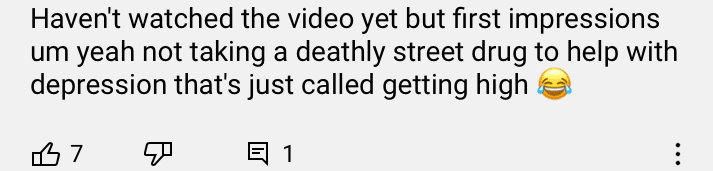
I haven’t found a source for the 99% statistic, but there are many studies demonstrating the rapid improvement of suicidal thoughts in a majority of patients following a single ketamine infusion. Assuming you share the moral conviction that people deserve to live, that is a wonderful thing. So to respond with a flippant question is insensitive, and that particular question is such an oversimplification that it misses the point entirely.
To be clear: the way in which ketamine leads to improvements in mood is not simply through the perceptual experience of being high, although it’s possible that contributes to the benefits. The biochemical effects of ketamine in the brain, which happen as a consequence of the part where you’re high, can improve depression for weeks or months at a time.
The “not even once” comments:
Here, we get into just a few of the many, many comments about Kyle’s interest in experiencing a ketamine infusion again. In the brief interview immediately following his treatment, he emphatically expressed a sense of amazement and wonder. He said that he wanted to go back to “where [he] got it.” He wanted to be back “in that space.” Lots of comments labeled Kyle’s enthusiasm a “red flag” for addiction.





I have to wonder if those commenters are reading into Kyle’s words a little too much. I don’t know Kyle, so I can’t say whether he really is in danger of abusing ketamine, but he and Brigid were screened and each consulted their psychiatrists. It’s not something that anyone can go into lightly. I didn’t become a candidate for ketamine infusions until I had spoken to my psychiatric nurse practitioner, my therapist, and the doctor at my ketamine clinic. I explained my lengthy history with antidepressants, consistent psychotherapy, and my hospitalization for suicidal ideation. The doctor then spoke to my psych NP, I filled out a whole lot of forms and then had an initial appointment, in which I asked questions and he explained the process, its risks, and what to expect. I take a pregnancy test before every infusion, I’m still in therapy once a week, and I still take my oral medications. I couldn’t have just rocked up to the ketamine clinic and demanded they accept me as a patient. If I had indicated that I’d had a history of addiction, I’m sure the screening process would have been altered to address that.
Starting treatment with ketamine for depression was a fascinating experience for me, and it still is. I think it’s reasonable to expect a bit of wonder and excitement about the experience. Without knowing Kyle Kittleson personally, I don’t think anyone can determine whether those feelings indicate anything more than innocent fascination for him.
Exploring the way my mind works on ketamine is sometimes bizarre, sometimes soothing, and sometimes it gives me new ways to think about my depression. And yes, when I’m severely depressed, it’s nice to escape for 45 minutes in a dim room with a blanket and people I trust. That doesn’t mean I’m going to “chase down” ketamine and become addicted. I have absolutely no desire to seek out illegal sources of ketamine, nor would I know how.
While I’m glad that last commenter is content to live their life sober, I’m also glad that I have access to medically supervised ketamine infusions. I didn’t start ketamine infusions so that every day can be “sunshine and lollipops, cherries and all that stuff.” I did it so I could stay alive. So that I wouldn’t spend every waking moment in crushing depression anymore. Let’s not minimize the suffering that people with treatment-resistant depression endure.
A Drug By Any Other Name…Would Act the Same
There is a subset of comments that argue that using ketamine for depression is dangerous. Many of those comments revolve around the fact that it has other uses. The comments were full of references to each of ketamine’s names as a party drug. Those who disagree with ketamine treatments for depression seemed split between people who worry that patients will become addicted and people who look down on its history as a recreational drug.

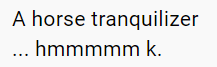
Ketamine was developed in the 1970s and was quickly adopted as a battlefield anesthetic. It now has uses in elective and emergency surgery and chronic care settings. And yet, the applications for ketamine that everyone seems to focus on as reason not to use it are its uses in veterinary medicine:



SSRIs are commonly prescribed for depression, and they work great for some people. This person’s claim that THE chemical cause for depression is about serotonin is not accurate. Many other neurotransmitters are involved in depression – possibly even more than we know about yet. Not to mention, the antidepressant effect of ketamine involves, among other neurotransmitters, serotonin.
Chemicals are everywhere. They are everything. The combinations and amounts of them are what make them behave differently in different environments. Ketamine is used to anesthetize animals, whether they have four legs or two. Things that can be deadly in large amounts can also be safe and therapeutic in small amounts.
The “say it with conviction and people will believe you” comments:
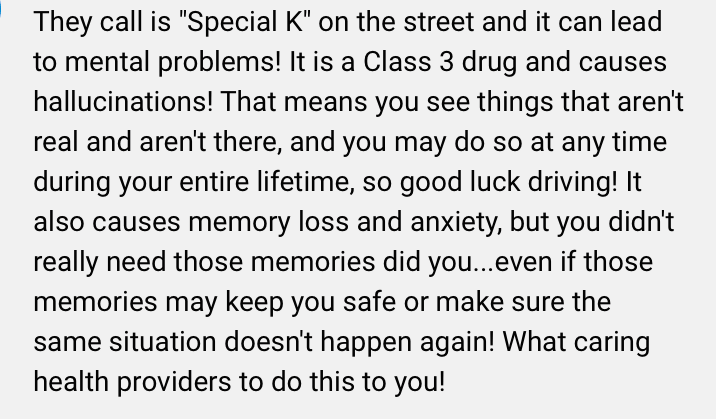

Good God, my teeth will fall out?! How horrifying and comically inaccurate. Barring accidental facial trauma due to intoxication, the only way you’ll lose teeth on ketamine is if a dentist is removing them while you’re anesthetized. Memory loss and anxiety can be associated with a ketamine high, but the half-life of ketamine is short and, as these researchers found, “ketamine-induced long-term cognitive deficits were confined almost exclusively to frequent users.” There is a big difference between using ketamine for legitimate medical purposes and abusing it.

I noticed that many of the comments expressing shock, derision, or confident predictions about Kyle’s ketamine infusion came from people who identified themselves as having experience with addiction in one way or another. I can see how learning that people are using ketamine to treat depression could be initially disturbing, especially if you have a background with addiction. What I don’t understand is that people left comments like this when the video very clearly states that there is research to back it up, people are carefully screened beforehand, and it’s administered by a licensed anesthesiologist. This isn’t the guy down the street telling vulnerable people he can cure their depression with some special k. This is science.

Understanding the Risks of Ketamine for Depression
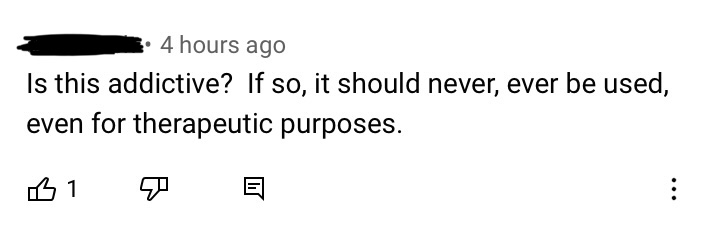
The bottom line with many of these comments is that they argue against the use of ketamine treatment for depression because it has risks. Everything has risks. NOT using ketamine to treat depression has risks. When the alternative is death and you’ve tried the other options already, it’s ok to take a calculated risk. Ketamine may not be safe for people who are prone to addiction – it’s a very individualized decision that should be made with communication between every mental health professional who treats you.
Although a StatPearls overview of ketamine toxicity argues that, “…patients…should [be] risk-stratified similar to those under consideration for chronic opioid therapy,” we see a significant difference of opinion from practitioners and strong evidence that ketamine can be used to treat addictions of many kinds, including alcohol, cocaine, and opioid use disorders.
What About Overdose?
It’s difficult to find statistics on ketamine-related deaths, possibly because there are so few that major trend-monitoring bodies don’t seem to report them in their own category. Instead, I can only guess that, if there are any deaths at all, they might be included under broad diagnosis codes that encompass several other substances. When researchers use death certificate data, they sometimes attribute the deaths to ketamine use when, confusingly, multiple drugs were involved or physical accidents were the direct cause of death. This strikes me as extremely misleading; actual ketamine overdoses are rare.
One review, stated to be the most comprehensive review of ketamine-related deaths published to date, found that there were 283 ketamine-related deaths in England and Wales between 1997 and 2020. The majority of these deaths involved the use of other drugs. Only 32 involved just ketamine, and only 23 were attributed strictly to the drug as opposed to accidents resulting from its use.
Mysteriously, the authors go on to say, “[This review] should dispel the myth that ketamine-related deaths are rare events.” On the contrary: while tragic, 23 deaths over the course of 23 years indicates that ketamine-only-related deaths are quite rare, as are ketamine-related deaths in general.
As for the StatPearls quote about risk stratification, there were 2,263 opiate-related deaths in England and Wales in 2020 alone. In 2019, there were 49,862 fatal opiate overdoses in the US. I can’t find a single mention of ketamine-related deaths in 2019 from US statistics providers, either because the few cases are hidden among various ICD codes or because there are zero. (I have also heard the latter from experienced professionals who may have access to data that I don’t.) Regardless, the fact is that ketamine is implicated in far, far fewer deaths than opiates are. Its use in surgery can reduce postoperative opioid consumption and, as previously mentioned, it can be a valuable tool for treating addiction.
Ketamine in medical contexts is highly controlled, constantly monitored, and the patient should always be active in therapy while undergoing ketamine treatments for depression. No, this isn’t foolproof, and not every clinic provides adequate support for their patients. On the whole, though, ketamine is very safe. I hope that as ketamine becomes more widely accepted for this use, our understanding of the entire picture will improve. Discouraging all people from getting a lifesaving treatment because “drugs are bad” and, as some of these commenters want you to think, risks inevitably become reality, is a dangerous attitude to take when it comes to treating mental illness.
The “stop avoiding your problems by getting high” comments

This comment is like saying, “They have the ability to help people without TMS. It’s just zapping magnets on your head.” It dismisses a complex treatment without considering the actual mechanism by which it works.


I’ll speak for myself when I say that all of these commenters seem to think that by being in therapy once a week for several years straight, revealing extremely painful, personal details about myself, digging into my thought patterns and history and beliefs, spending time in a psychiatric hospital, patiently titrating up and down on numerous medications, and working every day to improve my treatment-resistant depression through behavioral change, I’m simply avoiding my problems now by getting high on ketamine.
It’s also important to note that some of these types of comments are problematic in more than one way. People getting ketamine treatment for depression shouldn’t be shamed, and neither should people suffering from addiction. The stigma of having ketamine treatments relies in part on the stigma of drug abuse and addiction, and ultimately, I think it creates more division and fewer solutions.
A reputable clinic will not allow you to start ketamine infusions for depression unless you’ve demonstrated a clear need for it. It’s a tool like any other. It does help people “get to the root of it” and ketamine patients often use their experience to change their mindsets and heal from trauma.
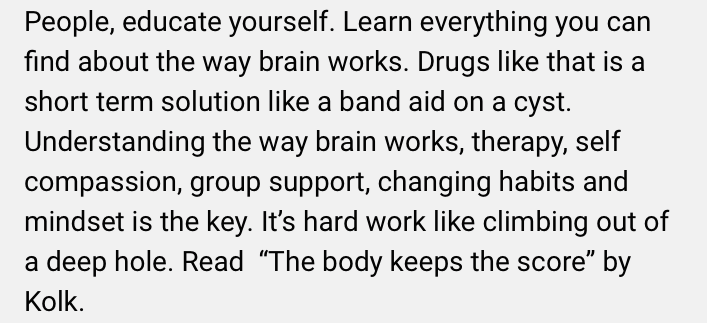
I agree with the overarching message of this comment. It is hard work to treat depression, and it does take more than one strategy. However, I dislike the implication that people who turn to ketamine for depression are trying to avoid doing that work. Ketamine infusions should not be used in isolation. In my experience, it’s less like a band aid on a cyst and more like a life raft on the ocean. I still have to deal with the waves, but at least I’m floating.
(Band-Aid on a Cyst is going to be my new punk rock band name. I called it first.)
Ketamine for Depression Saves Lives
Ultimately, I’m disappointed but not surprised that so many people left ignorance, insensitivity, and moral judgments in the comments of the MedCircle ketamine video. Kyle took a chance and shared something he likely knew would be controversial. I don’t want to gloss over the fact that there were lots of comments supporting him and Brigid, as well as ones expressing excitement and interest in this emerging treatment. I loved seeing other people refuting misinformation and sharing their own stories of healing with ketamine for depression. There was a significant portion of the comments section that was bursting with positivity.





And those were just a few. ❤
More Research is Always Needed
It’s absolutely true that more research is needed on the long-term effects of ketamine treatments for depression, chronic pain, and PTSD. Ketamine has been in use for over 50 years, but we still need to understand more about its effects in order to more accurately predict its efficacy in each patient and its risk of addiction when used for depression in this way. I just wish that we could all respect each others’ mental healthcare decisions and keep an open mind about a promising treatment.
Shaming People Who are Desperate for Help is Counterproductive
The comments I’ve highlighted here may come from people who have experience with addiction and a strong bias against the use of ketamine. They have a right to their opinions, and I hear their concern. Ketamine is a schedule-III drug that should continue to be handled carefully in medical settings. When people come to a judgment about something without being informed and then leave comments intended to divide through fearmongering, insulting assumptions, and straight-up incorrect information, it moves all of us back in the fight against mental illness stigma.

I struggled immensely with the idea of treating my depression with ketamine. The unknowns of what it would feel like scared the pants off me and I was completely intimidated by the social implications of using a mind-altering substance for any reason. If I had read these comments when I was in the process of deciding to try ketamine infusions, I might have been ashamed enough to reconsider. That might have been catastrophic for me. I was recently past my hospitalization and subsequent partial hospitalization and I had been thinking about suicide every single day for years. Ketamine became my life raft, and I’m so thankful that I have the privilege to access it.
If you’d like to read more about my experience with ketamine for depression, start from the beginning of The Ketamine Chronicles or visit the archives. Click here for mobile-optimized archives of The Ketamine Chronicles.









 Love, Your Brain