
What to Consider When Switching Therapists

There are lots of reasons you might go from one therapist to another. You might be moving, looking for another perspective, or simply feel ready for a change. Or, it could be that your therapist is leaving; career change, maternity leave, any number of scenarios in which you must decide what to do with your treatment. And, pretty much no matter what, switching therapists is hard.

I’m in this boat right now, and I’m finding it more tricky than I expected. For one thing, I’ve had the same therapist for almost two years. We’ve gotten to know each other (in a heavily one-sided way), and when I’m not completely shut down with depression, I really enjoy her company. It takes me a minute to be comfortable with someone, so the thought of switching therapists and beginning that process again is daunting.

Online Research

When I began my search for a new therapist, I started with Psychology Today’s therapist directory. You can filter it by issue, insurance, gender, and other factors that might help you narrow it down. I also tried googling a combination of “therapist” with “depression” and my area.

Contact Method

Some therapists provide an email address with their contact information. Text, be it emails or SMS, is BY FAR my favorite way to communicate. Making phone calls is an arduous process, what with the scripting and practicing and heavy sweating. But, leaving a message on an answering machine is, in my experience, more likely to get you a speedy reply. [Pro tip: if you approach phone calls the same way I do, keep a list of potential therapists and the status of your contact. I can just imagine leaving the exact same scripted message for the same person twice and being mortified enough to cut contact entirely.]

Make Appointments with Multiple Therapists

I highly, highly, highly recommend that you make appointments or consultations with multiple people. It’s way more time-consuming, and I’m finding it difficult to tell my story again at each new appointment, but it’s the best way to find a therapist that you like. Your current therapist might give you a list of people to call, you can search the web, and if you meet with someone and it doesn’t work out, ask them if they have any colleagues they can recommend.

Therapists Understand that Switching Therapists is Hard

Switching therapists is an interesting process to go through after being in therapy for a while and having done the search a few times before because I feel much more sure of myself. I know what kinds of approaches I’m looking for and I know roughly what to expect at an initial appointment. But, I also have more of a history within the mental health treatment sphere to explain in a coherent manner. The sequence of events is too long to describe in detail at a first meeting, so I have to decide how to summarize in a way that gets everything across. I don’t always succeed, and then we’re left filling in important gaps that I forgot about. Fortunately, therapists understand that the transition can be a difficult process.

It can be hard to leave a therapist who has helped you through really tough times. They’ve supported you and listened to you, and it’s natural to be sad that your time with them is over. But, it’s not meant to be a relationship that lasts forever. I’m going to miss my current therapist, but I’m also looking forward to getting a new perspective. It might be just what I need to put all the pieces of my recovery together.

green-mug-with-steam-rising-sitting-on-side-table-with-rumpled-sheets-on-bed-in-background

Taking Stock of My Life with Depression

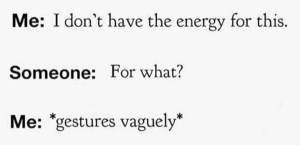
text about not having energy for anything
Not my meme. Not sure whose.

In my experience, severe depression creates a kind of tunnel vision whereby the non-essential tasks of life get shuffled to the edges and only the act of surviving can be focused on. It’s not that you don’t know what’s on the edges, you just don’t have the energy to expand your field of view and look directly at them. I’m in an increasingly healthy place right now, and I’m taking stock of the state of my life with depression. I always knew that I was “falling behind” in my self-imposed timeline. In fact, I’m acutely aware of how much time has passed without me accomplishing the milestones and achievements someone my age is expected to be doing. My life looks very little like what I hoped it would by this point, a fact that is heavy with self-judgment and regret.

I still struggle to believe that depression happened to me. That it wasn’t poor planning, laziness, or a lack of ambition that kept me from moving forward, but an illness. I think that there are two helpful ways of looking at this. In one, the state of my life is a result of severe depression, a disorder that has kept me from functioning at the level I used to. This view helps stop me from blaming myself for every perceived inadequacy and from expecting too much from myself too soon; I do, after all, still have a serious mental illness that requires daily management.

On the other hand, I try to consider the state of my life to be in spite of severe depression. I didn’t do nothing while horribly depressed, I fought for my life. I studied and graduated, I worked part-time, and I adopted a dog. I went to therapy and tried medications and pushed myself to do things when I just wanted to sleep. Most importantly, my life – even as a life with depression – has continued. The things that I consider important for young adults to do or have mean nothing if there is no life to be led.

If you’re struggling right now, give yourself some credit for the courage and persistence it takes for you to show up for yourself every day. There is no timeline.

envelope labeled 2020 with golden streamers and small potted plant

My Mental Health Resolutions

In December, I gave myself four goals to test before the new year rolled around. I wanted to give myself a chance to work on some (mainly) mental health resolutions without the pressure of an entire year ahead. It wasn’t wildly successful, but it wasn’t a flop, either.

These were my goals:

  1. Keep running, be able to go five miles somewhat comfortably: Done!
  2. Reestablish skincare routine: Sort of done! Currently on track, but it wasn’t a straight line.
  3. Start volunteering: Sort of done! I’m signed up to start in January.
  4. Begin relearning German: Not at all done! Yeah, nope. Didn’t even start.

Even though I didn’t check all the boxes, it felt pretty good to have a list of actionable goals. My overarching goal with all of them (except maybe relearning German) was to improve or support my mental health. In that, I think I succeeded! It was motivating to remember that I only had one month to make progress on my goals, which helped me not get complacent and stuck in bed with depression. As with any vague intention like “improve my mental health,” setting out some well-defined steps is vital. I needed to know where to start and how to do it.

2019 was really, really hard. I plummeted even further into the pit of depression than ever before and ended up hospitalized. I continued on my quest to find medications that work for me, and most of the time, I felt entirely discouraged and worthless. But, I kept going. I kept myself alive, and that was a huge accomplishment. Now, with the assistance of moderately helpful medications and much more helpful IV ketamine infusions, I feel like I’m inching my way out of my blanket burrito of sadness. To continue that progress, I’m aiming to carry on my mental health resolutions from December into the new year.

Wishing everyone a Happy New Year’s Eve and a wonderful year ahead.

Anonymity and Mental Health Stigma

IMG_2405

When I started this blog, it was deliberately anonymous in an effort to avoid any mental health stigma from reaching my real life. I didn’t have my name anywhere on it and I made a conscious effort not to mention anything about my life outside the sphere of mental health. I don’t think I even told my immediate family about it until a few months in.

I liked the freedom of writing anything I wanted without overthinking it. Those fears of what will people think? were almost nonexistent because nobody knew who I was. Over time, I began sharing it with people I knew. My immediate family and friends, then my extended family, my therapist, and others involved in my treatment.

I know that putting my name on my blog doesn’t change much for you, the reader. It does, however, signify a big change for me in the context of internalized mental health stigma. I’m finally coming to terms with my diagnoses and feeling more comfortable talking and writing about them as myself, with my real name attached.

Everyone has their own reasons for keeping their online presence anonymous. My reason was rooted in shame. I was afraid that if people knew I was writing about topics like depression, self-harm, and suicidality, they would never again see me for the things that make me, me. The reality is that people I know tend to notice the things that shine through the overarching topics. They comment on my love of writing and my sense of humor before they mention the content of my posts. And when they do broach the subject of my blog, they express their happiness that I’m still working towards stability. It helps, of course, that my family and the people surrounding me are very understanding. Not everyone has that, and I’m so thankful that I do.

Anyway, there you have it. My name is Genevieve (Gen), I’m 23 years old, and I live in Colorado. I got my bachelor’s degree from the University of Michigan, where I studied Ecology and Evolutionary Biology as well as Evolutionary Anthropology. I work from home as an editor and freelance writer (not at all related to my degree, but whatever). On my blog, I write about my diagnoses of sensory processing disorder and major depressive disorder. I like reading, making art, and being in nature. This is starting to sound like a cross between a cover letter and a dating profile, so I’m going to wrap it up.

Lumpdates is still lumpdates, but I’m pretty dang proud of myself for standing up to mental health stigma by typing the nine letters of my name into my username settings.

Wishing you curly fries,

Genevieve

Oh No. More Depression Naps

The irony of my recent post about unnecessary sleeping in the form of depression naps is glaringly obvious. Yesterday, I got up at 6, took care of Stella’s morning routine, then took a four-hour nap. Then, I fell asleep at 7pm, woke up at 2am still wearing my clothes, took my meds and brushed my teeth, then went back to sleep until 6. Big oops.

At this point, I don’t think I can still use the “I’m tired from traveling” excuse, much as I would like to. Sleeping too much is, for me, a big indicator of depression. I’m really hoping this is a fluke and not the ketamine wearing off. If it’s the latter, that would make my time between maintenance infusions about three weeks, which is a little short for my liking.

I had errands to do today, which I managed to do after an entirely too-long nap. I’m putting my foot down. Time to drag myself outside and go for a run, because you can’t sleep if you’re moving. Curse you, depression symptoms!

Update: My run was lovely, despite stepping in an icy puddle and getting my socks wet. Also nearly ate it on some ice deceptively camouflaged with snow. It definitely woke me up. I saw some cute dogs, though, and the mountains were pretty. All in all: would recommend, minus the puddle and the ice.

woman in orange jacket holding flowers in front of face

5 Tips for Therapy Clients Who Don’t Like Talking About Themselves

If you ever feel like a deer in headlights when asked to talk about yourself, I empathize. Whether it’s one of those dreaded get-to-know-you icebreakers or your therapist asking you a question, having to talk about yourself is uncomfortable for many people. By now, I’ve been in mental health treatment for several years, and I have a few tips for therapy I’d like to offer.

When I first sought therapy for myself, I found it extremely difficult to engage with it fully. If you don’t like being the center of attention, beginning therapy can be overwhelming. After all, the entire point of it is to focus on you. Early on, talking about myself in therapy felt, at times, nearly unbearable. Too many questions too fast made me shut down, and too loose of a structure lead to lots of awkward silences, both of us waiting for the other to say something. Over time, however, I’ve gotten much better at it. Here are some of the ways I’ve found to help me feel more comfortable about talking about myself in therapy.

The essentials

Any list of tips for therapy wouldn’t be complete without a soapbox moment about the therapeutic relationship. It doesn’t matter if you’re just starting therapy or you’ve been in it for a while; it’s vital that you like your therapist. The struggle of talking about yourself will be even worse if you don’t feel understood or accepted in therapy. In fact, research shows that therapy is much more effective when you and your therapist click. Don’t feel bad about shopping around or about switching therapists if it’s just not working out.

Secondly, remember that therapy sessions are for you. Push yourself out of your comfort zone, but go at your own pace. Therapy is your time to do with it what you will.

Communicate what you want to get from sessions

This is a tough one. There’s a lot that falls under this umbrella, but mostly what I mean by it is: tell your therapist if you would like to direct the topic of each session or be given more structure. Maybe it’s hard to talk about yourself because answering questions feels too probative, and you’d rather start off with a narrative. I prefer to have more structured questions because if I’m given free rein, I go blank and have absolutely nothing to say. Regardless of which end of the spectrum you’re on, your therapist is always there to help direct you and keep you on track.

Practice saying how you feel

I struggle hardcore with identifying how I feel. Maybe it’s sensory processing disorder, maybe it’s Maybelline. Sensory discrimination issues have extended into the emotional realm and mean that I often don’t know how I feel about something. If you have a hard time verbalizing how you feel, my advice is to practice. It sounds silly, but just as if you were a little kid, practice saying “I feel ____” and then fill in the blank with something more specific than “okay” or “fine.” Even on your own, check in with yourself; am I feeling excited? Lethargic? Irritated? It really does start to feel more natural over time.

I also find that using metaphors breaks the tension and allows me to communicate more comfortably. For example, my therapist and I talk about “clams” instead of “goals” because the very mention of goals used to make me a sweaty, anxious tear factory. The Potato Scale of Depression is another way that I like to remove a little of the scrutiny from myself and package it up in a statement about mashed potatos or soggy gnocci. There are many ways to get used to talking about your feelings!

Make the Space Comfortable

Of course, it’s not your office. You can’t go swapping out furniture and changing the overhead lights. But you can do some things to make the space more comfortable for you. A therapist I saw in college noticed that I have a very wide bubble of personal space and offered to move her chair a little further away from me. You can ask to close the blinds if it’s too bright for you, bring a small blanket to help you feel cozy, and be sure to wear comfortable clothing.

Stay (Mildly) Busy

Something that I learned in occupational therapy but haven’t put into practice (maybe I should!) is that talking about difficult things is often easier when your hands are busy. Bring a coloring book, a fidget toy, or a craft- if you’re a knitter, crocheter, or have some other portable project. Of course, this is one of my tips for therapy clients that is only good advice as long as your therapist doesn’t need you to be completely present during your work together. It doesn’t hurt to ask.

For us reticent folks, therapy can be scary even just to think about. But, like so many things in life, working on what’s difficult often leads to the best outcomes. With time and practice, talking about yourself in therapy gets easier, especially if you find what will support you and then advocate for yourself.

grey cat in sunlight yawning

My Depression Naps are Unnecessary (Shocker)

Over the last week, I have taken a grand total of one nap. ONE. This is grossly reduced from my usual minimum of six depression naps per week, each spanning roughly three hours. I cut back on naps this week because I was spending time with my family, instead. Between running errands, cooking, cleaning up, and catching up, there wasn’t much time to sleep during the day, and if there was, I prioritized family time.

The week is over, and I’m learning that I’m capable of being more active than I feel I am. My depression and the medication I take to treat it make me tired, and I might need a whole ‘nother week to recoup from this napless week, but I can function without naps. I think I should take this to mean that doing more is more sustainable than I thought.

I’ve been nervous that adding activities outside the house would be a disaster, because how could I go out and do stuff when I sleep for three hours every afternoon? This is probably a cart and horse problem; I’m worried that I won’t be able to fulfill my commitments if I still feel the need for excessive sleep. But perhaps adding more commitments to my schedule will make me less depressed, and therefore, I would sleep less. There’s bound to be an unhappy medium in the middle, but it would probably settle out eventually. In (wildly simplified) essence, be tired and have nothing to do, do more and briefly be more tired, then be a normal amount of tired and have fun doing whatever you want. This is something that everyone in my life has been saying forever, but sometimes it takes a while for you to come to the same conclusion, right?

A large part of my robust depression nap schedule is due to the lithium I take in the morning. However, I’m sure that another part of it is, at this point, a habit. My brain has learned that every day at the same time, we go to sleep for a few hours. It’s come to expect it. Breaking out of that habit is tough, but if I eliminate that and reduce my depression as much as possible, I’ll be left with just the lithium tiredness. That’s manageable, and as I’ve learned this week, very possible to function with.

Before I was even taking any medication, I slept as an escape. I went to bed before dinner because I didn’t want to be awake anymore, and I took long naps because I couldn’t stand the feeling of experiencing an entire day. Maybe this was what I needed, for a time. It helped me face my existence in more manageable chunks, but then it spiraled into something more damaging. I’m not going to stop taking naps entirely. I feel best when I give in and curl up on my bed for a few hours, sleep it off, and wake up partially refreshed. But I’m also going to remember that I don’t have to do that.