Mindfulness and Emotions

If you’ve been keeping up with my posts lately, you know that I’ve been having a rough time of things. I’m waiting for my new medication to kick in and doing my best to implement skills I’m learning in partial hospitalization. Whether it’s the meds, the skills, or just the ebb and flow of emotion, I’m finding myself…feeling….feelings. Wild, right?! The numbness is retreating and being replaced with actual emotions. Which, is good. I think. I’m no longer feeling crushing sadness through a thick haze of nothingness; I’m feeling crushing sadness in a pure, unadulterated manner. But, that’s okay- because it passes. I’m trying to work on my mindfulness skills. The sadness checks in, I sit with it and do my best not to catastrophize that it will stay forever, then my dog does something funny and amusement bumps the sadness out of the way.

Later, I’m outside, enjoying the sunshine when sadness saunters up again and says “Hey. Really sucks that you missed out on all of this pleasantness when you were in bed for days on end, doesn’t it?” Yeah. Yeah, it does. Thanks for that reminder, brain. So then I’m sad about being sad. I’m meta sad. Immediately, worry and despair pop in to let me know that a moment of enjoyment doesn’t fix everything and that I still have a long way to go. Oops, now I’m crying, and maybe I’ve ruined the moment entirely. Quick, focus on the sunshine! Focus. On the. Dandelions! 

Forcing yourself to be mindful is kind of the opposite of mindfulness. Clearly, I have some work to do, which is why this weekend I’m trying to embrace the “non-judgmental” part of mindfulness. Emotions are healthy, and although I’m still feeling more negative ones than I’d like to, it’s ok that they’re there. When I start to feel sad about the past or anxious about the future, the best way to not get trapped in it is to just notice it and then redirect my thoughts. The weather is beautiful, I’m fortunate in more ways than I can count, and it’s ok to take time to heal.

worm's-eye-view-of-one-bare-cherry-blossom-tree-and-one-with-blossoms-against-blue-sky

Explaining SPD to Health Professionals

It’s become clear that I have a hard time explaining how Sensory Processing Disorder (SPD) affects me, particularly when I’m speaking to health professionals.

When I was recently hospitalized, I spoke to a ton of mental health professionals, all of whom asked me about my diagnoses. I had no trouble letting them know about my diagnosis of Major Depressive Disorder, nor did I struggle to tell them about my childhood history of OCD. Disclosing that I have Sensory Processing Disorder was something that I was oddly unprepared for. I either would minimize it by mentioning it as an afterthought, neglect to mention it at all, or not do an adequate job of explaining it if I was asked follow-up questions.

Sensory Processing Disorder is not in the DSM, and I’m never sure whether the person I’m speaking to believes in its validity. I’ve never run into anyone who gives me reason to believe they don’t, but the disorder’s lack of diagnostic acceptance puts me on edge. SPD is a neurological condition that results in differences in how the brain processes information. Does this make it a physical health condition or a mental health condition? SPD has multiple sub-disorders; is it enough to simply say “I have SPD”? How should I go about explaining my disorder without minimizing it or coming across as defensive?

Usually, when someone asks me how SPD affects me, I end up saying something like “I’m over-responsive to a lot of stimuli, so things like loud noises, bright lights, and certain textures really bother me.” While accurate, this doesn’t capture the extent to which SPD affects me. Saying loud noises bother me doesn’t illustrate that I have to spend 2-3 full minutes psyching myself up with my finger on the button before I turn on the blender. When I say that changes to my routine drain me, what I really mean is that I once had a full-blown panic attack while driving on the highway because I had to leave earlier than usual and it was drizzling.

Sensory Processing Disorder is real. It’s also hard to explain. I’ve started using a mixture of SPD terminology and real-life examples to illustrate my symptoms, and while it’s difficult, I combat my tendency to understate everything by tossing in some descriptive adjectives like “overwhelming,” “draining,” and “dysregulated”. The vast majority of health professionals just want to help, so describing your challenges as accurately as possible is really the best approach. Plus, advocating for yourself is important, something that I recently learned firsthand. But, that’s a story for another time.

How do you explain SPD to health professionals? Share your tips in the comments!

On Being Vulnerable

They thanked me for my vulnerability, but it spilled out by accident, like beads of condensed sadness crammed into a too-small vessel. A wave comes, and while I sit among this circle of strangers, I cry. Nine sad faces avert their eyes. Is this circle a liferaft or a sinkhole?

In the distance, we see life as it should be- a mental ecosystem in balance. For six hours each day, we hover on the edges of the ring, tossing insecurities, worries, and vulnerabilities into the middle. We wait to see if they sink, but often, they float back to us. At three P.M., we depart; a snippet of normal routine, just long enough for our symptoms to impair us under the cover of darkness, then it’s back to the circle again. Soon, each of us will leave and swim to shore, but for now, we are lost at sea. All we can do is embrace our vulnerability and let it carry us towards one another.


Last week, I was discharged from an 11 day stay in a psychiatric hospital. This week, I spent six hours every day in a partial hospitalization program. Since being admitted almost three weeks ago, I’ve received more messages of concern and support than I know how to process, and that’s a little bit scary.

A part of me is resistant to receiving so much love because it means that all of these people know about a part of my life that contains a good deal of shame. My instinct is to politely accept the well-wishes and then quietly close the door and never discuss it again. Unfortunately, being independent to a fault can get you in trouble. It can make you more likely to wait too long to ask for help, at which point, the situation has snowballed out of control and it’s a crisis. So, reach out to your loved ones. Ask for help and offer help. Being vulnerable is how we connect.

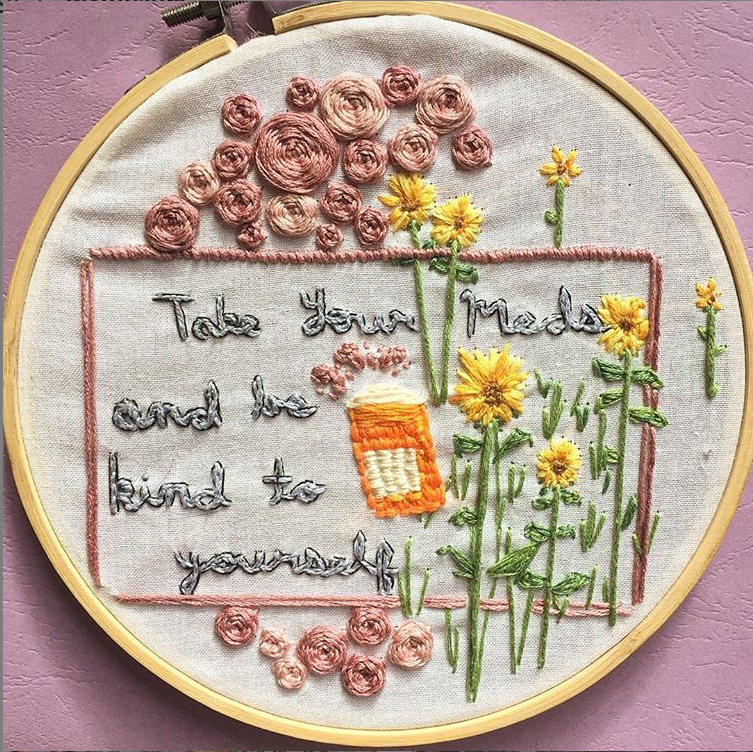
embroidery-hoop-with-words-take-your-meds-and-be-kind-to-yourself-with-flowers-and-pill-bottle

11 Days Hospitalized for Depression

I spent a week and a half hospitalized for depression as an inpatient at a behavioral health hospital, and all I got was a lot of decaf, terrible antiperspirant, and ungroomed eyebrows (dangerously close to being “eyebrow”). Oh, and a will to live.

When I ran out of methylfolate, my mutant brain began to rebel. All of the work I had done to pull myself out of the dark pit of depression flew out the window as my symptoms came roaring back. I was tired of living with the darkness, the fatigue, the brain fog, and the sadness of depression. And, because it seemed that there was no other way to live, I was tired of living. I fell into the old habits of isolating, harming myself, and outwardly presenting as if everything were fine.

When you stuff everything down, at some point you run out of space. My tipping point came during my weekly therapy session. After describing the hopelessness and elaborating on the details of my thoughts about suicide, my therapist convinced me to go to the hospital. Once I had been assessed, I was given the choice (that wasn’t really a choice) to either sign myself in voluntarily or be put on a 72-hour hold. I signed myself in.

The unit I was on is designed to be a crisis stabilization unit. There’s no one-on-one therapy, visiting hours are actually a singular visiting hour each day, and the items you’re allowed to have are extremely limited. Patients are expected to be in group therapy, meeting with a doctor or social worker, or working on an alternate activity like journaling. You are locked out of your bedroom for most of the day, so your options for privacy are slim to none. You and your roommate must sleep with the door open, as nurses walk around all night long doing “checks,” where they mark down your whereabouts and what you’re doing on their clipboard paperwork. Not to mention your bed is hard and noisy, and your pillow feels like a sack of uncooked rice. It was a difficult environment to be in for 11 days, to say the least.

Being hospitalized for depression is not easy, but the good news is, it works. I switched medications, and while it’s too soon to say whether it’s a good fit for me, being kept in a safe place surrounded by people who understood what I was going through went a long way towards getting me back on my feet. The groups tended to cover topics that were familiar to me, so not much of the information was new. That being said, hearing other patients’ perspectives and experiences was what made my stay helpful.

I stayed for several days longer than the average at that hospital. The staff wanted to see more improvement than I was making, and I wanted to avoid triggering a 72-hour hold by declaring that I was checking out against medical advice. This resulted in my estimated discharge date being pushed out a day or two at a time while my frustration levels grew. Eventually, I agreed to do a partial hospitalization program at a different facility near where I live. This was enough to convince the staff that I was safe to go home. Today, I start the process of doing a PHP. I feel much better than I did when I was admitted to the hospital. I know that shifting back into my normal routines will be a tricky transition and that a week and a half in a hospital doesn’t fix everything. But, it’s a start.

And now, the real work begins.

Recovery From Depression

TW: suicide & self-harm

I Used To

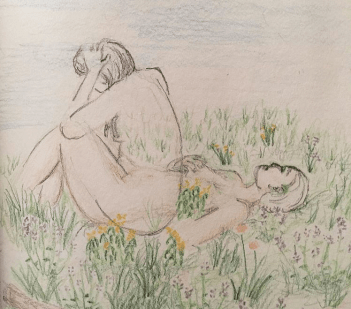
I used to look at the time when I heard a train go by at night, the heavy silence of 2 AM broken by the siren call of escape. I used to notice unlocked windows on the fourth floor of West Hall as I went up and down the stairs, each trip to and from class becoming harder. I used to see ways to die everywhere; in the passing bus, in the cold, dark current of the Huron River, in the pastel-blue sewing scissors tucked under my pillow. I used to wonder how long it would take for these morbid opportunities to escape my notice. How long before I can go a full day without putting some new, self-destructive idea on a mental shelf? How long before any phrase including the word “cut” doesn’t make me yearn to be alone so that I can do just that? I used to wonder about these things until I realized,

drawing-of-woman-lying-in-field-of-wildflowers


I used to.

Love,

Your brain

How Do You Measure Hope?

I was sitting in my therapist’s office yesterday, quiet and subdued, while we discussed the challenge of recovering from repeated episodes of depression. I had explained that sometimes I take solace in the knowledge that the episodes eventually end, but other times, I despair that depression will inevitably return. In trying to ask me where I sat on the continuum that day, my therapist posed an interesting rhetorical question.

How do you measure hope?

Neither of us answered it, but I found myself pondering it as I left. We measure things because it helps us put them into the context of the world around us. But how do you measure a subjective thing like hope? Can you weigh it? Stand it up against your kitchen doorframe and mark its growth as the years go by? Or maybe you measure it by volume- how much space it takes up in your life; in your goals; in your routines. If you could measure hope in decibels, would yours be louder than your doubt?

For now, I choose to measure hope in binary terms. Hope is hope, no matter how small or dim. If your hope is small, feed it with the belief that the better times are worth it.

Love, 

Your brain