woman in orange jacket holding flowers in front of face

5 Tips for Therapy Clients Who Don’t Like Talking About Themselves

If you ever feel like a deer in headlights when asked to talk about yourself, I empathize. Whether it’s one of those dreaded get-to-know-you icebreakers or your therapist asking you a question, having to talk about yourself is uncomfortable for many people. By now, I’ve been in mental health treatment for several years, and I have a few tips for therapy I’d like to offer.

When I first sought therapy for myself, I found it extremely difficult to engage with it fully. If you don’t like being the center of attention, beginning therapy can be overwhelming. After all, the entire point of it is to focus on you. Early on, talking about myself in therapy felt, at times, nearly unbearable. Too many questions too fast made me shut down, and too loose of a structure lead to lots of awkward silences, both of us waiting for the other to say something. Over time, however, I’ve gotten much better at it. Here are some of the ways I’ve found to help me feel more comfortable about talking about myself in therapy.

The essentials

Any list of tips for therapy wouldn’t be complete without a soapbox moment about the therapeutic relationship. It doesn’t matter if you’re just starting therapy or you’ve been in it for a while; it’s vital that you like your therapist. The struggle of talking about yourself will be even worse if you don’t feel understood or accepted in therapy. In fact, research shows that therapy is much more effective when you and your therapist click. Don’t feel bad about shopping around or about switching therapists if it’s just not working out.

Secondly, remember that therapy sessions are for you. Push yourself out of your comfort zone, but go at your own pace. Therapy is your time to do with it what you will.

Communicate what you want to get from sessions

This is a tough one. There’s a lot that falls under this umbrella, but mostly what I mean by it is: tell your therapist if you would like to direct the topic of each session or be given more structure. Maybe it’s hard to talk about yourself because answering questions feels too probative, and you’d rather start off with a narrative. I prefer to have more structured questions because if I’m given free rein, I go blank and have absolutely nothing to say. Regardless of which end of the spectrum you’re on, your therapist is always there to help direct you and keep you on track.

Practice saying how you feel

I struggle hardcore with identifying how I feel. Maybe it’s sensory processing disorder, maybe it’s Maybelline. Sensory discrimination issues have extended into the emotional realm and mean that I often don’t know how I feel about something. If you have a hard time verbalizing how you feel, my advice is to practice. It sounds silly, but just as if you were a little kid, practice saying “I feel ____” and then fill in the blank with something more specific than “okay” or “fine.” Even on your own, check in with yourself; am I feeling excited? Lethargic? Irritated? It really does start to feel more natural over time.

I also find that using metaphors breaks the tension and allows me to communicate more comfortably. For example, my therapist and I talk about “clams” instead of “goals” because the very mention of goals used to make me a sweaty, anxious tear factory. The Potato Scale of Depression is another way that I like to remove a little of the scrutiny from myself and package it up in a statement about mashed potatos or soggy gnocci. There are many ways to get used to talking about your feelings!

Make the Space Comfortable

Of course, it’s not your office. You can’t go swapping out furniture and changing the overhead lights. But you can do some things to make the space more comfortable for you. A therapist I saw in college noticed that I have a very wide bubble of personal space and offered to move her chair a little further away from me. You can ask to close the blinds if it’s too bright for you, bring a small blanket to help you feel cozy, and be sure to wear comfortable clothing.

Stay (Mildly) Busy

Something that I learned in occupational therapy but haven’t put into practice (maybe I should!) is that talking about difficult things is often easier when your hands are busy. Bring a coloring book, a fidget toy, or a craft- if you’re a knitter, crocheter, or have some other portable project. Of course, this is one of my tips for therapy clients that is only good advice as long as your therapist doesn’t need you to be completely present during your work together. It doesn’t hurt to ask.

For us reticent folks, therapy can be scary even just to think about. But, like so many things in life, working on what’s difficult often leads to the best outcomes. With time and practice, talking about yourself in therapy gets easier, especially if you find what will support you and then advocate for yourself.


white sign with black capital letters reading "you are worthy of love" near telephone pole, green bush, and asphalt walkway

Considering Worth and Achievement

I’m going to therapy tomorrow morning. Last week, there was a moment when we were talking about my goals and I became very quiet. Something in my thoughts had made me feel emotional, but as I was enjoying having a normal conversation with my therapist, I pretended nothing happened. (Haha, nice try. I think she knew.) Now that I’ve had a week to think about it, I’m planning on bringing it up when I go to my appointment tomorrow.

Here’s the issue: there were parts of me that I had thought were stemming directly from my depression. Feeling worthless, after all, is a symptom of depression. But now that I’m feeling better, I find that I’m still thinking of myself as less valuable than other humans. Whether that’s a product of having been depressed for a while, or it was there all along, I’m not sure how to change it. Talking about my goals led me to this realization because I started thinking about the value of my accomplishments and the cost of my depression. Treatment for my depression has become expensive, and when I pondered that in therapy last week, I suddenly concluded internally: “I’m not worth that much.” Reaching my goals and accomplishing what I want to is, in my mind, the way for me to become “worth” the expense.

I don’t want to get too philosophical- that’s not my area- but I’m comfortable declaring all human life inherently valuable. Let’s exclude those variables like violent crime and abuse, and consider everyone without any actions in their past. John Locke considered the mind at birth a blank slate, which experience acts upon to form our beliefs and knowledge. This leaves us with two possible conclusions, I think. Either the “blank slate” of human life is worthless until some positive attributes or achievements earn that person value, or all people have innate value by virtue of simply existing with potential.

It’s clear to me, and to most people, I think, that human life is innately valuable. So, why am I so stumped when it comes to believing in my own value?

Sometimes, I try to trick myself by arguing that because I think I am fairly average, there is no reason that I would be special enough to be an exception to such a universal rule like “all people have value.” Then I reach some kind of does not compute error in my brain and start the whole thing over again.

Aaand this is probably the point where my therapist would tell me that I’m very cerebral and maybe should return to feeling feelings. Yeah. I get stuck in existential loops a lot.

Acceptance, Self-Compassion, and Growth

The other day, my therapist gave me a handout on self-compassion. My “assignment” is to read through it and make some notes on what stands out to me. Since she reads my blog, (Hi, J!) why not expand my notes into an entire post?

A Definition of Self-Compassion

Self-compassion has to do with accepting that we are not infallible and treating ourselves gently when we’re suffering. Just like you’d extend understanding and compassionate support to someone else, we can strive to do the same for ourselves. As humans, we’re going to make mistakes; our imperfections are not only part of what make us unique, but their existence is also a common element shared among all humans. The handout encourages readers to stop fighting against the reality that we are imperfect beings.

Here’s my initial reaction to that bit of advice: but if I stop fighting it, I’ll stop improving. 

Growth

drawing of woman surrounded by plant growth

I worry that if I stop fighting the reality that I’m going to make mistakes, I’ll end up stagnating. If you also hold this belief, I wonder if we can change it by convincing ourselves that the components of success don’t necessarily include criticism and harsh judgment. You can like yourself and still be motivated to grow and improve. (This is what the Dialectics in DBT is all about; two seemingly opposed things can be valid at the same time. It’s about finding the middle ground.) Not to mention, you don’t need to beat yourself up for your mistakes in order to learn from them.

Acceptance vs. Resignation

At the heart of it lies another DBT concept, the difference between acceptance and resignation. Acceptance is the ability to recognize and come to terms with the reality of a situation. It leaves room for you to change it. Resignation doesn’t. When you’re resigned to something, it’s like putting blinders on. You see the reality of what’s in front of you, but not the opportunities to your left and right. With acceptance, you can understand that something is the way it is and still take steps to change it.

Depression’s Symptoms

Here’s where I run into trouble. Depression comes with behavioral symptoms that can get in the way of my productivity. When I sleep too much, for example, it somehow feels easier to be hard on myself than to accept that my illness causes these symptoms. Why? Probably because it gives me a sense of control. If I take responsibility for things that are out of my control, I don’t have to face that they are, in fact, out of my control. It scares me to feel like a victim of my illness. I’d rather be hard on myself for something that’s not my fault than relinquish my (false) sense of control over my actions. I think the key issue is that I’m not distinguishing between acceptance and resignation. I can accept that depression causes me to experience symptoms. If I accept that (not resign myself to it), then there are actions I can take to combat those symptoms, and practicing self-compassion will be easier.

Keep in mind I said “easier“. I’ll be honest, self-compassion is something I’m really struggling with. How can I hold myself accountable for working to get better without being judgmental when it’s not going to plan? It seems like a delicate balance, but my current strategy is not serving me in the way that I’d like. I guess it’s time to invest in a tightrope.

Are there times when you struggle with self-compassion? How do you remedy it? Share your tips in the comments!

Art as an Expression of Mental Health

I’ve loved making art for as long as I can remember. I used to draw the same picture of a dog on different pieces of paper and leave them scattered around the house as a not-so-subtle hint to my parents that their 5-year-old really wanted a puppy. I like to draw images that I want to remember; memories of pleasant things and places. But I also use art as an expression of mental health.

self portrait

Feelings are hard to articulate, but colors, shapes, and textures can carry meaning without the structural constraints of sentences. Creating an image can be a cathartic way to express feelings that also lets other people in on the experience. When I don’t know exactly what to make but I have an urge to make something, I start with choosing materials and just let my hand move freely. Something usually takes shape, but even if it doesn’t, I can always just scrap it and start over.

Part of what I love about art as a way to express mental health is that everyone can interpret it in their own way. As the artist, there’s something that it means to you, but you don’t even have to share that meaning with the people who see your art. And even if you do share it, people will still have an immediate reaction based on their own life circumstances and interpretation style.

The therapist I saw in college believed that there were no accidents in art, and would analyze my sketchbook while sitting next to me. While I’m sure there are some elements of my art that come from my subconscious, I don’t usually see the “accidental” parts of my art as meaningful.

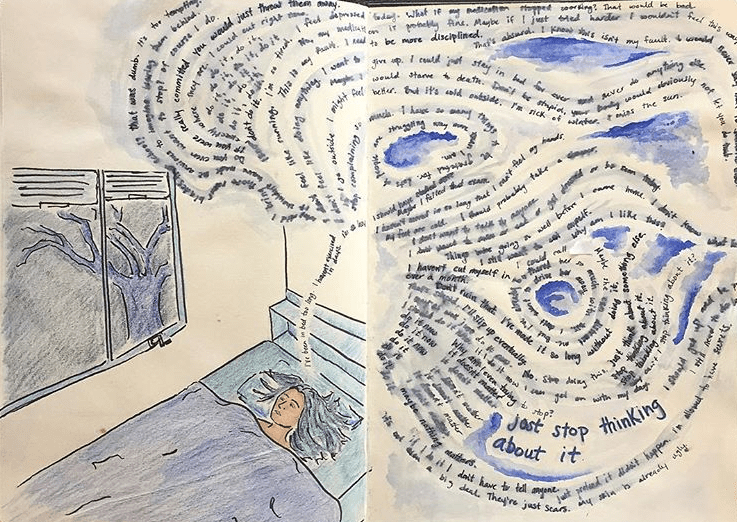
That said, there were always parts of my art that my therapist pointed out as meaningful that I hadn’t noticed before. I could always come away with a better understanding of myself, or at least something new to think about. For example, the window mechanism in this piece is very detailed.

Thoughts

She suggested that detail might be an indicator that there was some hope of freedom or escape from the thoughts in the drawing. Whether that’s something that ended up in the drawing because some part of me believed there was hope, I’m not sure. But I can certainly take that sense of hope away from it, into my normal life. 

Art about mental health is not just an excellent way to express feelings, but it also starts a conversation. It can make people feel less alone in their experience, and it can help your loved ones understand your symptoms and how you feel. Sometimes, it even helps me understand where I’m at in regards to my own outlook. Sometimes a piece of art will take me by surprise at its dark overtones when I thought I was feeling ok. Other times, I’m pleasantly surprised to find that drawing a whimsical picture is exactly what I want to do.

whimsical-drawing-of-yellow-blue-and-pink-shapes

If you’re interested, you can follow my art Instagram @lumpdates

peter-cohen-quote-wellness-and-self-care

Levels of Mental Health Care

In light of my recent posts, I thought it might be useful to elaborate on the levels of mental health care you can find in a hospital setting (at least in the US). What are the differences between them, and what can you expect from each?

Inpatient Treatment

Entering a hospital as an inpatient for mental health care can be incredibly nerve-wracking. If you don’t know what to expect, the experience is overwhelming. The important thing to remember is that the system is designed to keep you and the other patients safe.

In an inpatient setting, you sleep at the hospital and spend your days on the unit. You might have a roommate; they’re probably just as overwhelmed as you are. The staff will likely elaborate on the expectations for patients, but you may be expected to spend the majority of your time in a common area, interacting with other patients and staff. Your nurses and doctors will want to see that you’re participating in group therapy, willingly spending time outside of your room, and eating meals with the unit. You’ll meet with your doctor and a social worker, and have a chance to discuss your treatment goals and any concerns you have. Different hospitals have different timeframes for this; you could meet with your doctor as often as every day, although it may happen less frequently.

Before you’re discharged, the staff will probably want to be sure that you have a support system, safety plan, and aftercare set up. Continuing mental health care might look like a partial hospitalization program, intensive outpatient program, or outpatient therapy with your own mental health counselor.

Partial Hospitalization Program (PHP)

The next level down from inpatient care is a partial hospitalization program. In a PHP, patients typically attend therapy for most of the day, sleep at home, then return for the next day of programming. For example, the PHP I did was from 9 am to 3 pm, Monday through Friday for ten days.

Programming usually focuses on teaching skills and information you can use to manage your illness. The PHP I was in took content mainly from DBT, although we also touched on ACT and CBT. You’ll meet with a psychiatrist and your case manager, who is usually one of the therapists who leads group discussions and teaches content. Your case manager will probably set up a treatment plan with you, and meet with you periodically to check in on your progress.

Many people come to a PHP through inpatient hospitalization. After spending time isolated from your normal, day-to-day life, it can be overwhelming to be tossed back into it. A PHP can serve as a helpful step-down to ease you back into your routine. Other people come straight from their outpatient treatment. They may not need the level of mental health care you get with inpatient treatment, but the support of a PHP can give them the structure they need to stay safe.

Intensive Outpatient Program (IOP)

In the same way that a PHP offers a transition from inpatient back into your normal life, an IOP does the same. It’s the next level down from a PHP, but is still, well, intensive. An IOP is similar to a PHP in the content that’s taught, but you meet less frequently and for a shorter amount of time each session, but for a longer overall duration. Many IOPs meet three times per week for three hours. The program might run for as many as eight weeks. The IOP at the hospital where I did my partial hospitalization had a more independent treatment; you didn’t get to meet with a psychiatrist or a case manager. That meant you would need to have outside medication management set up for your time in the IOP.

Many people go straight from inpatient treatment to an IOP, although others may need the structure of a PHP. Some people continue on from partial hospitalization to intensive outpatient, but sometimes that’s not feasible with work or family obligations. I decided not to do an IOP, but rather to return to my regular schedule and leave IOP as an option should I need more intensive mental health care down the road. It’s all very individual, and which program you choose depends on your specific needs and constraints.

prairie-with-blue-sky-and-clouds

What I Gained in Partial Hospitalization

Two or three days into my partial hospitalization program, it became clear to me that my peers were seeing positive results. At check-in, those closest to leaving would report feeling “good”, or “light”- two sensations that are unfamiliar to my depressed brain. I was glad that they were feeling better, and initially, it gave me a glimmer of hope for myself.

As the days passed, that hope dimmed; I wasn’t feeling much better at all. In fact, as my last day approached, I started feeling lower and lower. My thoughts about self-harm came back in full force, and when I tried to use the skills we’d been taught to combat them, I was unsuccessful. Morning check-in was even more excruciating than usual because I had to admit that I wasn’t doing well. The people who had come before me had felt better, so what was I doing wrong?

For one thing, I wasn’t doing anything “wrong”. The psychiatrist and both therapists for the program all agreed that the root cause of my depression is chemical. This doesn’t mean that coping skills are useless. They can help keep me safe and offer healthier alternatives to my go-to, maladaptive coping mechanisms. Over time, I can retrain my brain to help me get out of negative thought patterns or habits. However, coping skills are unlikely to do much to address the causative problem.

Secondly, there is no right pace for recovery. Comparing myself to others was only making me feel worse. That said, it’s only natural that we look to others to find out what to expect when we’re in an unfamiliar situation. I wish I had been able to temper my expectations when comparing myself to others in partial hospitalization.

Just because I didn’t leave partial walking on air doesn’t mean I “failed”. I still got a lot out of the experience.


Connection

Similar to my experience of being an inpatient at a mental hospital, one of the most valuable takeaways for me was the sense of connection I had with other patients. Hearing about other people’s perspectives on a shared experience helped me gain insight into my own thoughts and behaviors. Plus, it feels good to talk to people who understand your suffering and can empathize. I definitely came away from the ten-day program feeling less alone.

A sense of my own value

The first few days of my participation in the PHP, I was there for my family. I was there because other people wanted me to be, and I was willing to commit my time to a program like that in order to ease my family’s fears. A few days ago, though, I realized that I felt more like I was there for myself. It was a subtle shift, but it feels like a big step.

Acceptance

Throughout my inpatient hospitalization and partial hospitalization, I had several moments that stopped me in my tracks. The fact that I was at that level of care for my mental illness seemed surreal, and I couldn’t wrap my mind around the situation. I think that I have a better grasp on my symptoms and what I need to do to keep them under control. I also have a sense of acceptance that once I feel better, I’ll still need to manage my illness; I won’t be able to push returning symptoms under the rug. That’s how I ended up in the hospital.

Greater understanding of my patterns and behaviors

While the skills I learned may not address the root of my depression, they certainly help me shift my behavior towards healthy responses and actions. Perhaps the biggest behavioral takeaway for me is greater awareness of how I withdraw, isolate, and avoid addressing the issue of my depression with my loved ones.

Patience

No, I didn’t leave partial hospitalization feeling like my peers who had left before me. Everyone goes at their own pace, and everyone has unique circumstances and factors involved in their symptoms. All we can do is go day by day.

My Secret Fear about Depression

I have a secret fear that maybe this is what life is like for everyone. Maybe I’m expecting too much. Maybe other people can cope with life’s stressors better than I can. Maybe I should try harder. Maybe my depression is fake.

Spoiler alert: it’s not.

Part of what makes depression so terrible is that, by its very nature, it keeps you from getting help. It tells you you’re worthless, it makes you ashamed, and it robs you of motivation and energy. My depression tells me that I’m ungrateful and burdensome and that I should keep quiet about the things I’m struggling with. Well, y’know what? I’m sick of taking orders from The Lump.

I’m going to PHP group therapy, individual therapy, and I’m talking to my family and friends about my illness. I’ve even told a few acquaintances about my hospitalization. And, guess what? Everyone has responded with compassion and support. Not one person has said “You’re faking it. Just stop being sad.” The only time I ever hear that phrase is when it’s inside my own mind.

It’s time I show myself a little of the understanding and reassurance I receive from others. After all, I have a biochemical imbalance in my brain. It’s not my fault.