Using Weighted Blankets for Sensory Processing Disorder: Sleep and Anxiety

For people with sensory processing disorder, weighted blankets can be valuable tools. I use mine for more than just sleeping; it helps me ground myself when my senses are overwhelmed, it helps me focus, and it helps me calm my anxiety. Many people report feelings of safety and relaxation when they use their weighted blankets for sensory processing disorder. In this post, I discuss the science of weighted blankets when it comes to sleep and relaxation, as well as my own experience using a weighted blanket for SPD.

Weighted Blankets and Sleep in SPD

Tools like weighted blankets and vests use deep pressure, which is thought to reduce the body’s level of arousal, leading to relaxation. They’re highly popular among kids and adults alike, and some people swear by them for alleviating insomnia. But when it comes to whether weighted blankets help you fall asleep, stay asleep, and enjoy better-quality sleep, the evidence is mixed.

Image by Victoria_rt from Pixabay

What Scientific Research Says

I found studies that offer evidence for and against the idea that weighted blankets can improve sleep in people with sensory processing difficulties, often defined by falling asleep faster, waking up less during the night, improved mood in the morning, and other measurements like sleep efficiency.

Surveys

Some research shows that weighted blankets are effective at improving sleep quality and sense of restfulness as well as shortening the time to fall asleep. Weighted blankets were shown to improve morning mood in this study, but the overall results were inconclusive. Most of the studies I looked at that concluded that weighted blankets can improve sleep used surveys to collect their data, which have their limitations.

Observational and Experimental Studies

While surveys offer valuable insights into subjective experiences, experiments can provide a more objective look at a question. In a study that used actigraphy (small accelerometers that measure movement), weighted blankets had no effect on the number of times participants moved in their sleep. In a different study on people without SPD, weighted blankets were associated with a significant 32% increase in salivary melatonin, but they didn’t affect cortisol, oxytocin, subjective sleepiness scores, or the duration of sleep.

On the other hand, another study that used a sleep sensor and surveys (funded by Gravity Blanket) found a significant 7% improvement in a measure called Wake After Sleep Onset and improvements of 2% or less in other sleep measures.

To me, the most interesting part of that last study is that participants’ subjective reports seemed to overshoot the measurements – by a lot. They thought they were sleeping 36% better without waking up in the night. Compare this to the 7% improvement in Wake After Sleep Onset, and this seems to match what we see from other surveys; people feel like they sleep better when they use a weighted blanket, even if the objective measurements don’t match.

More research is needed to understand the effects of weighted blankets on sleep in people with sensory processing disorder, but if you feel that they help you, why not use one?

Are Weighted Blankets Safe?

As far as I can tell, yes. The American Academy of Neuroscience says, “No serious adverse events with [weighted] blanket use” were found in its review of the literature on the topic. The main considerations involved in this weighted blanket competency training program are:

  • Do you have medical conditions that would be a concern?
  • Do you have claustrophobia?
  • Don’t walk around with it over your head.
  • Carry it in an ergonomic manner.
  • Do not use it as a restraint.

As far as weight recommendations, I had trouble finding an authority on the matter. A 30-lb weighted blanket was shown to be safe as measured by heart rate, blood pressure, and blood oxygenation. Manufacturers typically say their weighted blankets are safe only for adults, adolescents, and older children due to the risk of suffocation in young children. But overall, we can be confident that weighted blankets are safe when used appropriately.

Should You Sleep with a Weighted Blanket for Sensory Processing Disorder?

If using a weighted blanket to fall asleep feels good to you, I say go for it.

I get a little too hot when I sleep with a weighted blanket during the summer, so I tend to only use mine for that in the colder months. Part of why I find those studies so interesting is that they surprised me. Based on my own experience, I expected to find a consensus on their efficacy.

Turns out, I do the same thing those study participants did; I think of my sleep as being vastly improved by my weighted blanket. I even identify waking up fewer times a night as one of the most dramatic differences I notice!

Photo by Daniela Constantini on Pexels

Sleeping with a weighted blanket is a cozy, relaxing experience for many people. There’s something kind of special about using a weighted blanket. It’s like it elevates my sleeping experience from regular relaxing to extravagant relaxing.

Throughout the day, our senses are bombarded by stimuli. In my experience of sensory processing disorder, being tired makes my nervous system feel spring-loaded. My ability to handle sounds, lights, and movement declines as the day progresses. Making decisions gets harder, driving gets harder, and by the time I get to bedtime, it can be hard to decompress and fall asleep. Compounded by some of the medications I take and my tendency to think too much, my insomnia sometimes features a lot of restless tossing and turning. Fortunately, my weighted blanket is there to help me. Using a weighted blanket for sensory processing disorder can look like a lot of things, though — not just sleep.

Calming Overstimulation and Anxiety with Weighted Blankets

Where the literature is iffy on weighted blankets for sleep, it solidly supports the claim that weighted blankets are effective at reducing anxiety. Occupational therapists have used weighted blankets for sensory processing disorder and associated anxiety for decades, and there’s a good reason for that.

Photo by Nathan DeFiesta on Unsplash

Deep Pressure for SPD

In 1992, Temple Grandin published a study on the effects of her groundbreaking “hug machine.” The machine is designed to deliver deep-pressure stimulation using a set of pads that squeeze the user’s body. Dr. Grandin’s hug machine was found to have a calming effect on people with ASD, college students, and animals. Deep pressure stimulation has been further explored as a therapy for those with sensory processing disorder, even leading to the development of inflatable smart vests, pneumatic compression garments, and shape memory alloy spring garments.

Weighted blankets provide the same kind of deep pressure touch that a compression vest, Dr. Grandin’s hug machine, or a real hug from someone you trust does. It’s this consistent, firm pressure that can settle your senses and put you back in the moment.

Sensory Over-Responsivity, Sensory Defensiveness, and Anxiety

If you have sensory over-responsivity (SOR) as part of your sensory processing disorder, you know how quickly you can go from cool to completely overwhelmed. When your nervous system is highly activated, you might have trouble functioning in the way you usually do, whether it’s focusing, planning actions, or keeping your emotions regulated. SOR is also associated with sensory defensiveness, which means that you have strong negative reactions to stimuli that aren’t dangerous.

It’s incredibly draining to live with sensory defensiveness. I’m fortunate to have gotten treatment when I was young, which improved my symptoms in that arena. I remember being so terrified of getting water in my eyes as a kid that I screamed and sobbed if one tiny droplet rolled down my forehead during a bath. These days, my sensory defensiveness is much better, especially when I’m well rested.

There’s a complicated interplay between SOR and anxiety. When you have bad experiences with stimuli that are too much for you, it’s easy to get anxious about encountering them unexpectedly. Being prone to anxiety can mean your guard is always up, which sensitizes you to your environment. SOR and anxiety can feed into one another, and teasing apart the causative mechanisms is an individual process.

In general, we know that sensory over-responsivity (SOR) and anxiety often co-occur, and deep-pressure interventions are commonly used by occupational therapists to reduce discomfort and sensitivity. One such intervention is a weighted blanket.

How to Use a Weighted Blanket for Sensory Processing Disorder

(According to me, your well-read layperson.)

Firstly, if you don’t yet have one, it’s important to get one that you like. The main function is, of course, the weight, but as this article is about sensory processing disorder, I imagine you have concerns about a blanket’s other sensory features as well. When sifting through the options online, think about:

  • Weight (Super heavy? Just a tad weighty?)
  • Material (Softness, durability, how to wash, etc.)
  • Dimensions (I love my bed-size blanket, but I used to have a lap pad that was great.)
  • What’s inside the blanket? (Consider the tactile and auditory aspects of beads vs. sand, for example.)

One way I like to use my weighted blanket is to get into a seated position and wrap the blanket around me like a cape so that it drapes over my shoulders. Then, I take a moment to arrange the extra material on top of my legs, grab the edges of the blanket in each hand, and pull it closed in front of me so that I basically just look like a floating head. A really relaxed floating head.

I don’t think there’s a wrong way to use a weighted blanket, as long as you’re being safe. Sleep with it, sit with it, put it on your lap — whichever way you choose to use it is right.


A person sitting with their knees bent and their arms around their legs with pillows in the background

Examples of Sensory Processing Disorder Symptoms From an Adult with SPD

There are many resources online with examples of Sensory Processing Disorder, but what does it really feel like? As an adult who was diagnosed with SPD as a child, I finally have the language and perspective to be able to describe what Sensory Processing Disorder feels like to me. This article provides examples of Sensory Processing Disorder symptoms with accompanying descriptions of how I perceive things.

I am overresponsive to many stimuli, so this article doesn’t encompass every symptom or experience of SPD. A symptom checklist can be found at the end of this post.

What is Sensory Processing Disorder?

Sensory Processing Disorder (or Sensory Integration Dysfunction) can be thought of as a “neurological traffic jam” that prevents information from the senses from being organized for use in an appropriate way. There are several subtypes and various forms the disorder can take, but the underlying issue lies in the nervous system’s ability to take in and deal with sensory stimuli.

Examples of Sensory Processing Disorder Symptoms

Visual Overstimulation

Red, blue, and yellow shapes overlapping with light shining through
Photo by Chris F on Pexels

I can’t seem to filter visual “noise” in the same way that other people do. It feels like an onslaught of lights and images that I have no natural defense against. I reach my limit quickly.

Examples

  • 30 minutes of fluorescent lights make me feel like I’ve been out on a bright, snowy slope for a day without sunglasses.
  • Chaotic movement, like that in busy stores and restaurants is hard for me to follow. It just becomes a sharp scene of color and light that disorients me.
  • Flashing lights are highly distracting. My brain can’t tune them out, so they constantly vie for my attention.
  • I prefer an uncluttered living space because it requires less visual work to navigate. Clutter feels suffocating, and the constant stimulation of so many items around me feels draining.
  • I don’t always wear my glasses because the blurry distance is calming. It removes some of the sharpness of my visual field and lets me lower my defenses a little.
  • Digital screens can cause nausea for me, especially if I have to do a lot of scrolling up and down.

Sound Sensitivity and Sensory Gating

For some people with SPD, repeated stimuli don’t get filtered out like they do in people without sensory symptoms. This function is called “sensory gating.” The electrical response your brain has to an initial stimulus typically becomes smaller with subsequent stimuli as your brain adjusts to it and decides it doesn’t need your full attention. With SPD, however, this process is not as efficient.

A 3D render of a gray/blue material spraying outward against a black background
Photo by Petar Petkovski on Unsplash

Say you encounter a barking dog. Everyone is startled by the first bark. We get a boost of adrenaline, our hearts start beating faster, and we start imperceptibly (or perceptibly) sweating. Some people can quickly return to normal even as the dog continues to bark, but for people with SPD, every bark can feel just as jarring as the first one.

Sensory gating is not limited to auditory stimuli, but here are some examples of how sensitivity to sounds and sensory gating deficits affect me.

Examples

  • Stiff plastic wrappers hurt my ears and make my eyes water. Opening a granola bar feels like someone is aggressively crumpling 3 wrappers directly next to each of my ears. I don’t understand the acoustics of this phenomenon, but it is mighty unpleasant.
  • Loud toilets are a sudden thunderous roar to me. I used to refuse to go to the bathroom if I knew the toilet was one of those automatic, rapid flush ones. The noise would throw me into a panic and I’d burst out of the stall with my heart pounding. Thankfully, I have since mastered toilets.
  • I like wearing headphones even without anything playing because they soften the sounds around me.
  • Much like the barking dog example, some noises don’t get adjusted in my brain and therefore sound deafening the entire time they’re happening. I have to psych myself up to trigger or use loud household items, like:
    • blender
    • garbage disposal – my family knows to warn me before turning it on.
    • closing the microwave
    • electric toothbrush – I switch off between electric and regular when I feel I can’t handle the noise and vibration of the electric one.
    • garage door
    • coffee grinder
    • vacuum
    • lawn mower – if I don’t take enough breaks, I end up leaving the mower in the middle of the yard and then crying and hyperventilating on the floor. It feels like running the lawn mower while in a metal box, sound flying all around me at intolerable volume.

I have a technique for pouring dry dog food into a stainless steel bowl with minimal noise, I like to close doors quietly, and I prefer not to wear shoes indoors because my own footsteps are too loud.

Tactile Over-Responsivity and Sensory Defensiveness

A right hand touching a pine tree
Photo by Petr Macháček on Unsplash

Sensory defensiveness means that a person has an aversive, out-of-proportion reaction to a stimulus that is not considered dangerous or harmful by others. It doesn’t have to be tactile, but as I’ve always been sensitive to touch (tactile over-responsivity), these are some of the most challenging examples of Sensory Processing Disorder in this regard for me.

Examples

  • Unexpected hugs (especially from behind). Touch sometimes startles me even when I know it’s coming, so being suddenly grabbed is scary. Agreed-upon hugs are usually good in my book, though.
  • The feeling of tearing paper towels without the perforation is one of the most viscerally horrible sensations I’ve ever felt, and I can’t even explain why. It makes me want to throw up and then crumple into a little ball on the floor.
  • Lotion. I have a love/hate relationship with it due to its revolting sliminess and soothing itch relief.
  • Splashing in pools is a surefire way to make sure I get out. This is partly visual, as I’m sensitive to movement near my face, and partly that I seem to feel every individual drop. I interpret it as danger and react in the way someone would if a spray of pebbles were kicked up near their face.
  • Clothes Shopping with Sensory Processing Disorder is difficult in part because I eliminate at least half of the available choices without even trying them. Lace, elastic, velvet, corduroy, wool, sequins, stiff fabric, and prominent seams are all out automatically. Certain textures and designs create constant aversive sensory input, like if your clothing were made of sandpaper.
  • Bunched-up and constrictive clothing. Everything has to be arranged perfectly, especially my shirt sleeves inside my coat sleeves. If not, it creates uneven contact with my skin and I am hopelessly distracted.

I’ve found that my experience of unpleasant tactile stimuli is terrible not only because the feeling itself is bad, but because it lingers.

The paper towels, for instance, leave something like an echo of the sensation. I keep feeling it as if it were still happening, with decreasing intensity over time. I tend to deal with this by frantically looking for something hard and smooth to touch to replace the tactile horrors of improperly torn paper towels.

Body Awareness with Sensory Processing Disorder

A moving, illuminated ferris wheel at night
Photo by Shahzin Shajid on Unsplash

Sensory Processing Disorder can make it difficult to discern where your body is in space, a sense called “proprioception.” Together with the vestibular sense, these systems help us balance, understand where our limbs are, and generally keep track of which way is up.

Examples

  • Vertigo and dizziness when I don’t sleep enough and when I’ve been in a car for a long time.
  • Rollercoasters? I’ve been on one. Absolutely never again.
  • Using touch controls on wireless earbuds. A challenge for me because I can’t touch the earbud without looking in a mirror. I don’t always know where my arms are in relation to my ears.
  • I’m highly prone to motion sickness.
  • Dental exam chairs. I feel genuinely confused about the angle at which I’m reclined. For years, I really thought that they were putting me slightly more than 90 degrees back and that I was actually tilted upsidedown. Knowing the earthshattering truth doesn’t change how it feels, but at least I know now that my body is lying to me.
  • Slightly fast elevators are exhilarating.
  • Motion sickness. Did I say that already? So much motion sickness.

Dyspraxia in Sensory Processing Disorder

A wooden chess board with assorted wooden chess pieces mid-game
Photo by Jani Kaasinen on Unsplash

Praxis is the process of planning and carrying out sequences of movements. This can be as simple as the automatic steps you take to get dressed, or it can be as complex as planning long-term goals. Impaired praxis is referred to as “dyspraxia.” Dyspraxia falls under the sensory-based motor disorder subtype of Sensory Processing Disorder.

Not everyone with Sensory Processing Disorder also has dyspraxia. I have symptoms of it that only tend to become a problem when I’m tired or overstimulated. It’s like something short-circuits in my brain and I suddenly can no longer comprehend how to do things.

Examples

  • “Simple” household tasks. I recently had two forks and two knives jumbled in one hand while setting the table, and all I had to do was divide them among two plates. For a solid 5 seconds, I could not figure out what I was supposed to do first. I had to walk myself through it step by step. I’m a little embarrassed to admit that, but it illustrates how dyspraxia can affect functioning at every level.
  • Making decisions. When I’m tired or overstimulated, my decision-making abilities tank. Just choosing what to eat at a loud restaurant can be difficult. When my brain is trying to cope with the sensory information that’s flooding in, there’s not much bandwidth left to handle decisions. It feels like I’m trying to juggle several raw eggs while comparing the 25+ menu items.
  • Copying movements. I learn concepts best through visual means, but translating actions I see someone doing, like in an exercise video, into coherent directions for my own body doesn’t come naturally to me.
  • Driving. I’ve improved immensely, but it took me a long time to get comfortable with it.
  • Getting on escalators. Planning the movement and timing it correctly is not an automatic task for me.

Allowing Myself Patience with SPD

A blue sign with yellow block letters reading "Be kind. Unwind."
Photo by Tim Mossholder on Unsplash

Over the years (and for multiple reasons), I’ve become an expert at hiding my emotions and powering through. I don’t want to inconvenience anyone and I don’t want to stand out. I can do anything that someone without SPD can do. But it takes a toll, and sometimes, it’s not worth it. Learning to listen to myself is still a work in progress, but it’s a valuable goal.

On the plus side, I don’t need to pay for horror movie tickets or haunted houses. I get my thrills by flushing toilets and riding elevators.

I hope that these examples of Sensory Processing Disorder are helpful. They are only my own experience, and they don’t encompass every SPD symptom. For more information specifically about Sensory Processing Disorder in adults, I suggest checking out the resources below.


Sensory Processing Disorder Symptoms Checklist (scroll down for the adult checklist)

Find SPD Treatment (be sure to check “works with adults” on the specialty menu)

Sensory Blogs I Follow:

http://comingtosenses.blogspot.com/

https://eatingoffplastic.com/

https://sensorycoach.org/blog/

An open laptop with the screen angled down and a bright swirl of colors being displayed against a dark background

How Sensory Processing Disorder Can Make Screens Unbearable

Twice this week, I surpassed my daily limit of 5 consecutive hours of high-focus screen time. This limit is one imposed by Sensory Processing Disorder, and if I carry on without adjusting my environment and practices, there are unpleasant consequences. These include nausea, vertigo, and intense anxiety bordering on sudden panic.

Visual Stimuli and Sensory Processing Disorder

My job as an editor is done entirely on the computer, and it’s very detail-oriented work. I have to focus intently on the screen in order to catch typos and fix grammar and punctuation mistakes. I also have to do a lot of tab switching and scrolling up and down as I add words and change headers. Some sensory stimuli, like bright lights and visual movement, bother me more than they might bother someone who doesn’t have Sensory Processing Disorder. Taking breaks helps stave off the effects of digital screens, but when I spend too much uninterrupted or eventually, cumulative time looking at my laptop or phone without taking steps to reduce my level of stimulation, something gets mixed up in my brain. As a non-expert, I don’t know the precise details of what happens, but I do know that it feels TERRIBLE.

Nausea

When I’m tired and not paying attention to my sensory state, I start feeling some vague nausea around hour 4 of mostly continuous work. It spikes when I switch tabs or close windows- the little “whoosh” of a window disappearing into one corner is not something I notice at other times, but when I’m getting overstimulated, it makes my stomach turn. The light of my screen is physically painful to look at, so I turn it progressively lower as I go on.

Panic

Scrolling is the worst; short vs. long makes a big difference, but they’re both bad. A long scroll makes the nausea much more severe and gives me an indescribably strange pulling sensation in my sternum. It’s something like how I imagine having a long, wet string pulled slowly up and out of your chest would feel. It creates an intense feeling of horror and high anxiety distilled down into the 1.5 seconds it takes to scroll from the top of a page to the bottom. Short-term panic. Something about the movement on my screen is powerfully repelling. The longer I push on past my limit, the more the panic sensation bleeds into the time around the scrolling.

Sensory Strategies for Managing Overstimulation

For a little while, turning the brightness down low and wearing sunglasses helps, but eventually, even that doesn’t work. I take short breaks to press my feet into the floor and look at something stationary in the middle distance. I often close my eyes while scrolling, but this just prolongs the experience because I never scroll to exactly the right spot. If I’m typing anything, I look away from the screen. As the anxiety gets worse, I take deep breaths and pause to look elsewhere. My 5 to 10-minute breaks become time for me to lie on my back on the floor and squeeze my knees to my chest – trying to ground my frazzled nervous system.

A glowing blue laptop screen over a backlit black keyboard
Photo by Markus Petritz, @petritz on Unsplash

It became the worst it’s ever been this week when I carried on to about 7 hours of editing. The two hours leading up to the end were miserable. I was doing everything I could to make it through my remaining work, to the complete detriment of my body. I found myself involuntarily rocking back and forth after particularly awful scrolls, just trying to keep it together while my nervous system went haywire. I should have stopped, but I’m perfectionistic and had decided that it was my un-shirkable responsibility to finish all of it myself. When I did finally finish it, I barely held down vomit after booking it to the bathroom.

Problem-Solving Sensory Processing Disorder Triggers

I wonder if it has to do with the blue light (I plan on trying some blue-light-blocking glasses) or the frame rate of my screen. I haven’t been sleeping well lately, and I suspect that my sensitivity is heightened when I’m not well rested. Sensory Processing Disorder does weird things to my ability to handle multiple types of stimuli at once, and being tired just exacerbates it. In the same way that an escalator on its own is fine but an escalator after a busy day in an airport filled with noise and movement gives me vertigo, being tired makes handling the imperceptibly flickering light and movement of a laptop screen way harder.

There’s something different about this exact setup and workflow that makes things worse. I haven’t pinpointed what that is, but I suspect it has to do with the amount of scrolling. The platform on which I edit requires me to span entire pages numerous times within a very short timeframe.

In contrast, I often work on my blog for hours at a time, just as I worked on my computer for long periods of time on schoolwork or on other jobs I’ve held. Those activities have never had the kind of effect I’ve been experiencing recently, despite being quite similar.

Acceptance of SPD Symptoms

I spent many years not paying attention at all to the way my Sensory Processing Disorder impacts me. I knew I had it, but I told myself that I should be able to do all of the things that other people can do. So I minimized it in my mind. Despite having learned more about Sensory Processing Disorder and having gotten some treatment in the form of occupational therapy in the recent past, acceptance is something I still need to work on.

When simply looking at my laptop screen for too long has such debilitating results, SPD is something I should be considering more carefully. Pushing myself to the point of throwing up was extremely unwise and points to a general disregard for my own wellbeing. I didn’t want to inconvenience other people by being late with my work or shuffling it off onto someone else. And ultimately, I just did not want to admit defeat when it came to something as innocuous as looking at a screen.

I think I’ll try to reframe “admitting defeat” as “taking a really big hint from my body.” If it means living in a way that doesn’t leave me green with nausea and crying, that seems more like winning to me.

light-and-dark-blue-in-close-up-of-glacial-ice

The Subtleties of Water: The Ketamine Chronicles (Part 27)

I’m always looking up at the sky when the water closes over me. This time, it was cold, and an eggshell-thin layer of ice formed above me while I watched. Gentle waves followed one another, freezing over the previous layer and leaving a frosty texture on the surface. Darkness spread from the periphery of my vision until I strained to see through the last window of light, the only notable image being the shadow of a person standing above me on the ice.

I didn’t put a lot of effort into remembering this IV ketamine infusion. I know there were graceful, disembodied hands dancing amid blue and red lines, swirls, and dots. There was more water – ripples and waves, mostly. There was a pyramid with a circle above it, which turned into a blinding white light. I’m certain that there was a lot more, but it’s faded away from me by now.

Treatment-Resistant Depression

My mental health is declining. I’m not sure why. IV ketamine treatment doesn’t seem to be working as well for me, now. Every day, I have to rate my mood on a ten-point scale. It’s hard to capture how I feel in numbers. Potatoes are easier, but still not quite enough. Honestly, sometimes words themselves seem too limited. How can I describe how I feel?

This morning, I woke up at 4. I got dressed in the cold – same clothes as yesterday – and went to the kitchen for some food. I walked the dog when the sun came up, but we came home quickly because of the sharp, cold air. My eyes feel heavy. Not the lids – the actual eyeballs; they sit heavy in their sockets, like wet marbles or enormous caviar. I wonder, if I tip my head forward, will they fall out? When my depression is worsening, I often notice this feeling in my face. Everything is heavy and hard to move, and I’m sure my expression is grim. I think the clinical term is RDF – resting depression face. At least my pandemic mask covers most of it.

Maybe the person above me on the ice in my ketamine dream is me. I’m on thin ice. Skating across a just-frozen lake in my wool socks at 4am. Someone else is waiting beneath the surface, straining to see through the darkness. Is she also me?

__________

Why Do I See Water in My Ketamine Treatments?

My recent IV ketamine infusions have all featured water, and I’m often drowning in it. It’s not scary – it’s peaceful. It’s soothing. I’ve never stayed up by the surface before; always finding myself sinking into the dark, quiet depths. But this time, I was floating – pressed against the underside of the ice, trying to see through it to the person on the other side. I was curious about this person, but the darkness closed in before I could begin to unravel what was happening, and then I found myself in a different scene, which I do not remember.

I’m fascinated by this recurring theme of water, especially because in my regular life, I’m not a big fan of it.

An Early Trauma

I have sensory processing disorder, and as a young child, I flat-out refused to swim. I was overwhelmed to the point of tears by the splashing, the echoes in the pool, the temperature change from air to water, and most of all, the fear of people touching me. I eventually came around to the idea, but never enough to take lessons. So, having never properly learned how to swim, I nearly drowned at a friend’s birthday party when I was 8.

I remember being uncomfortable going into the deep end, but my friend was insistent. I lost my grip on the side of the pool and began to sink. When people say that drowning is not a dramatic event – there’s no splashing or screaming – they’re right. My head tilted back instinctively as I went under, and I could see my hand, extended above me, slip under as well while the rest of my limbs flailed uselessly underwater. A panicked hopelessness overtook me as I choked on chlorinated pool water. Then, my friend’s hand broke the surface, reached down, and grabbed my wrist.

I have never felt relaxed on or in water, and it’s not just the near-drowning that explains it. The same sensitivities that kept me from participating in swimming lessons have persisted into my adulthood. I dislike the unsteadiness of water, the unpredictability of how it will splash, the feeling of water on my face.

And yet, when I’m reclined in my doctor’s office, ketamine moving into my bloodstream, visions of water are soothing. I can feel the cool, constant pressure of being underwater without the anxiety or the sensory overload. I can feel myself standing on the deck of a boat, watching the foamy water beneath me leap forward and recede, and I feel peaceful. I’ve seen whirlpools, rivers, melting glaciers, and the unbelievable enormity of oceans. It’s a strange experience to suddenly realize what water might be like for other people, as those feelings are foreign to me in my waking life.

Open ocean near the surface with light filtering down from above.
Photo by Cristian Palmer on Unsplash

I feel as though, unhampered by the symptoms of my sensory processing disorder, I can connect to a larger, evolutionary interest in water that I am unable to find under normal circumstances. Humans have been fascinated with water for millennia. In fact, some evolutionary anthropologists believe that nearness to water supported the development of large brains – that we are, in part, the heritage of small, coastal communities of early humans whose lives revolved around the movement of water and the food within it. To this day, many island and coastal cultures retain great reverence for the ocean. When we gaze out upon a watery horizon, it is difficult to not be awed by the vastness before us. In my eye, to find our place in relation to bodies of water is akin to our struggle to find our place in the vastness of space. Questions of identity and survival are found in the depths, and I believe we carry the answers within ourselves.

Lessons from IV Ketamine Treatment for Depression

My depression is a constant in my life. It is all-encompassing, lonely, and feels like drowning. I’m not one to find meaning in every dream, but the images of water that I experience during IV ketamine treatments have begun to feel profound. What does it mean? Certainly not that I should give in, wave a white flag and let the water crush me. Nor should I wait breathlessly under the ice, squinting as if to look through a frosted pane of glass, uncertain if I’m even above or below. Rather, I believe my visions of water are windows into the nature of the human experience. Perhaps they’re snapshots of how I feel – how depression feels to me. My mind is an ocean, and at times, it’s oppressive. I sink within myself, finding it easier to let the water cradle me as I descend than to keep swimming. At other times, I find comfort in accepting the changing nature of my illness. Like a river flowing downhill, impermanence is unstoppable, and the emotions of being a human move inexorably back and forth. When we crest the top of a wave and begin to fall down the other side, we wait for the next one, just as we take each arriving day. And when you are drowning, reach up. A helping hand may be just about to break the surface.

If you’d like to read more about my experience with ketamine for depression, start from the beginning of The Ketamine Chronicles or visit the archives. Click here for mobile-optimized archives of The Ketamine Chronicles.

The Sensory Meditation of Flow

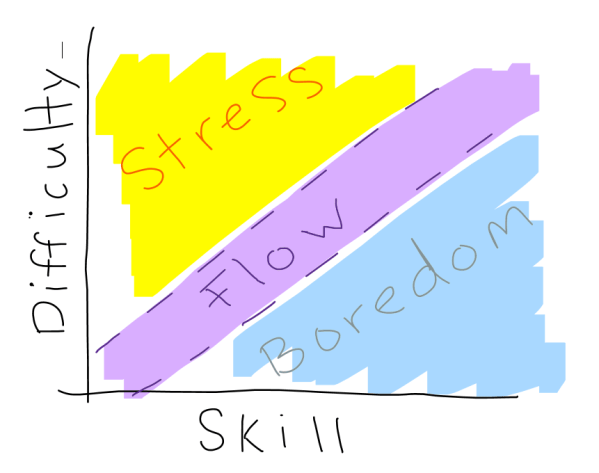
When you’re reading a good book, playing a familiar song on your instrument, doing a word search or a jigsaw puzzle, or any number of absorbing activities, you might be experiencing flow.

A while back, my occupational therapist explained the concept like this:Flow

If the difficulty of whatever you’re doing is too high and you haven’t spent very long doing it (aka: have a low level of skill), you’re likely to be above the “flow” line and feeling stressed.

If the difficulty is low and you just started, you’re probably pretty close to flow from the start. The longer you do it, though, the more skilled you get and the more bored you become.

This is probably pretty intuitive to most people. To stay close to flow, you need to adjust the difficulty level to match your skill. Otherwise, you get either overwhelmed or bored. Everyone has unique sensory needs, so your nervous system might react differently to inputs that create a perfect state of flow for another person. For instance, my ability to follow a cardio dance video is atrocious, but someone with awesome praxis skills might think it’s exactly right for them.

Currently, my favorite leisure activity is embroidery.

embroidery-of-wooden-fence-and-red-poppies

I started out with those pre-packaged kits that have the image inked onto the fabric, like a paint-by-numbers but for stitches. That was great because I didn’t know what I was doing, but as I learned and got more comfortable with it, those kits became a little boring. Now, I make it up as I go, so it takes some focus and creativity but it’s also repetitive and relaxing.

If, like me, you have trouble with sensory discrimination and often don’t know what you’re feeling or what qualities of something you do or don’t like, finding an activity at the right difficulty to produce flow might be tricky. Trial and error is always a good way to approach this. Give the “trial” enough time that you’re able to decide whether you like it or not, and why. When you do find something that gets you to a state of flow, don’t forget to up the difficulty on occasion. The challenge is what makes it interesting!

woman in orange jacket holding flowers in front of face

5 Tips for Therapy Clients Who Don’t Like Talking About Themselves

If you ever feel like a deer in headlights when asked to talk about yourself, I empathize. Whether it’s one of those dreaded get-to-know-you icebreakers or your therapist asking you a question, having to talk about yourself is uncomfortable for many people. By now, I’ve been in mental health treatment for several years, and I have a few tips for therapy I’d like to offer.

When I first sought therapy for myself, I found it extremely difficult to engage with it fully. If you don’t like being the center of attention, beginning therapy can be overwhelming. After all, the entire point of it is to focus on you. Early on, talking about myself in therapy felt, at times, nearly unbearable. Too many questions too fast made me shut down, and too loose of a structure lead to lots of awkward silences, both of us waiting for the other to say something. Over time, however, I’ve gotten much better at it. Here are some of the ways I’ve found to help me feel more comfortable about talking about myself in therapy.

The essentials

Any list of tips for therapy wouldn’t be complete without a soapbox moment about the therapeutic relationship. It doesn’t matter if you’re just starting therapy or you’ve been in it for a while; it’s vital that you like your therapist. The struggle of talking about yourself will be even worse if you don’t feel understood or accepted in therapy. In fact, research shows that therapy is much more effective when you and your therapist click. Don’t feel bad about shopping around or about switching therapists if it’s just not working out.

Secondly, remember that therapy sessions are for you. Push yourself out of your comfort zone, but go at your own pace. Therapy is your time to do with it what you will.

Communicate what you want to get from sessions

This is a tough one. There’s a lot that falls under this umbrella, but mostly what I mean by it is: tell your therapist if you would like to direct the topic of each session or be given more structure. Maybe it’s hard to talk about yourself because answering questions feels too probative, and you’d rather start off with a narrative. I prefer to have more structured questions because if I’m given free rein, I go blank and have absolutely nothing to say. Regardless of which end of the spectrum you’re on, your therapist is always there to help direct you and keep you on track.

Practice saying how you feel

I struggle hardcore with identifying how I feel. Maybe it’s sensory processing disorder, maybe it’s Maybelline. Sensory discrimination issues have extended into the emotional realm and mean that I often don’t know how I feel about something. If you have a hard time verbalizing how you feel, my advice is to practice. It sounds silly, but just as if you were a little kid, practice saying “I feel ____” and then fill in the blank with something more specific than “okay” or “fine.” Even on your own, check in with yourself; am I feeling excited? Lethargic? Irritated? It really does start to feel more natural over time.

I also find that using metaphors breaks the tension and allows me to communicate more comfortably. For example, my therapist and I talk about “clams” instead of “goals” because the very mention of goals used to make me a sweaty, anxious tear factory. The Potato Scale of Depression is another way that I like to remove a little of the scrutiny from myself and package it up in a statement about mashed potatos or soggy gnocci. There are many ways to get used to talking about your feelings!

Make the Space Comfortable

Of course, it’s not your office. You can’t go swapping out furniture and changing the overhead lights. But you can do some things to make the space more comfortable for you. A therapist I saw in college noticed that I have a very wide bubble of personal space and offered to move her chair a little further away from me. You can ask to close the blinds if it’s too bright for you, bring a small blanket to help you feel cozy, and be sure to wear comfortable clothing.

Stay (Mildly) Busy

Something that I learned in occupational therapy but haven’t put into practice (maybe I should!) is that talking about difficult things is often easier when your hands are busy. Bring a coloring book, a fidget toy, or a craft- if you’re a knitter, crocheter, or have some other portable project. Of course, this is one of my tips for therapy clients that is only good advice as long as your therapist doesn’t need you to be completely present during your work together. It doesn’t hurt to ask.

For us reticent folks, therapy can be scary even just to think about. But, like so many things in life, working on what’s difficult often leads to the best outcomes. With time and practice, talking about yourself in therapy gets easier, especially if you find what will support you and then advocate for yourself.

yearly calendar on table with cup of coffee and dish of paper clips

December Resolutions

The yearly frustration that most of us can likely relate to is that our New Year’s resolutions only last a few weeks, or at best, a few months, and yet we continue to make them. It’s relatable because change is hard, and the excitement of turning over a new leaf soon gives way to the stresses of normal life and the reality of breaking old habits. But there’s something so attractive about starting fresh; new calendar, new me.

Clearly, I like the idea of making a deliberate change on a specific date. Something about marking your resolution with an external, cyclical change makes it feel more decisive. Unfortunately, I am so put off by the pressure of an entire year ahead of my resolutions that I simply don’t make any. I’ve made New Year’s resolutions in the past but petered out before they really formed habits. Then, the internal shame of having failed a New Year’s resolution discourages me from trying again mid-year. Because really, why can’t I just resolve to change whenever I want? Because human brains like to impose order on things like arbitrary laps around the sun.

Instead of griping about the pitfalls of New Year’s resolutions and why I can never seem to make it work for me, I’m going to try something different.

~*~*~*~December Resolutions~*~*~*~

This sounds incredibly silly and I think that it’s a little bit sad that it’s come to this, but I think I need to trick myself into meeting my goals. Instead of making a list of resolutions and waiting until the new year to begin, I’m going to have a trial month for my new habits. December will be my 31-day behavior test, and if I hate the goals/habits I come up with, no big deal. I won’t feel bad about quitting because it’s only my December resolutions, not the monumentally more important New Year’s resolutions.

(Yeah. It’s exactly the same thing, but shhh, don’t tell my brain.)

Bonus, if I do like my resolutions and am happy to keep going with them, I won’t have to face the overwhelm of a brand new year stretching ahead of me. I’ll already have a whole month under my belt.

I really think this is going to work for me, at least better than the usual resolution schedule does. Here’s my list of December resolutions, but remember, it’s low-stress, low-commitment, so these can change without me feeling like a failure. At least, that’s the theory.

  1. ACTUALLY start volunteering. Somewhere. Anywhere. Don’t just think about it.
  2. Keep running regularly (yay, I’ve already started!) See if I can reach a comfortable 5 miles by January. I’m more than halfway there, so this seems very doable.
  3. Reestablish a skincare routine, aka get my psoriasis under👏 control👏.
  4. Welcome the hostile Duolingo owl back into my life and start re-learning German.

These seem reasonable to accomplish within a month. The one that I’m definitely most apprehensive about is volunteering. At this point, I’ve thought about it for so long and looked at opportunities in such detail that I really have to just go and do it, and try not to worry about all of the unknowns (thanks, SPD).

Ok, internet, hold me accountable.