white bell-shaped flowers pointed down during dusk light

Setbacks in Depression Recovery

Lately, I’ve been excited to begin going in the other direction with medications as part of my depression recovery- reducing rather than adding. Through years of treatment, it seemed like I was always either increasing a medication or trying a new one. I never got much relief from antidepressants (except the one it turns out I’m allergic to), and lithium, the mood stabilizer that has probably saved my life, comes with the risk of kidney damage if the levels of it in your blood creep too high. I still take an antidepressant, two mood stabilizers, and Deplin (because I’m a mutant). These drugs help me function, and although they don’t kick my depression completely out the door, they are important.

I have a love/hate relationship with lithium. It dramatically reduces my suicidal thoughts, and that’s amazing. If I were to describe how it felt when I was at my highest dose of lithium: it’s like you’ve been gritting your teeth for years, and then all of a sudden you realize you’ve stopped. All of that pressure, the wear on your teeth every single day as you work your jaw muscles without cease, suddenly vanished. Like the peace you feel when static background noise shuts off, and you’re left in silence. When I got to a high dose of lithium, I was floored when I realized that I hadn’t thought about suicide all day. In fact, lithium makes it a little bit difficult for me to think about suicide in the same way I do without it. Focusing my thoughts on the idea feels a bit like trying to push the same poles of two magnets together. But when I had to reduce my dose because of the risk of lithium toxicity, the suicidal thoughts started to come back. Not to the degree that they once were, but it was clear that the change in my lithium dose was to blame. Still, I’ve enjoyed a lesser degree of suicidality than I experienced without lithium.

Lithium restrains my thoughts from straying into suicidal ideation, but it comes with some unpleasant costs. Because it’s processed through your kidneys, it has a tendency to make people thirsty. If I go too long without water, I feel like I’m shriveling up like a dry sponge. It also makes me feel absolutely exhausted, napping excessively (even more than I normally do when I’m depressed). So although it does some wonderful things for me, I’ve always hoped that I wouldn’t need it forever.

Overall, I’ve been enjoying a recent improvement in my mental health. This is because of IV ketamine infusions, which treat, among other conditions, treatment-resistant depression. When I started to feel better and my depression recovery seemed to be on track, the spark of hope that I might someday be able to come off some of my medications began to grow. I was excited- why stay on meds that are only half-working if you have something better?

I talked to my psychiatric nurse practitioner about reducing my lithium dose by about a third. Within a week, the consequences of reducing my dose were becoming clear. I started to feel less interested in things again, tearful, and guilty about my depression. The slip was minor; I wasn’t feeling much worse, but it was compounded by my thoughts about the situation. I was looking forward to reducing my medications so much that when it went badly, I let disappointment carry me into catastrophizing. I thought that I’d never be able to leave lithium behind me, and would always rely on it to keep me safe from myself.

I quickly went back to my previous dose and waited for my symptoms to subside. Honestly, if it turns out that I do need it forever, that would be okay. There’s nothing wrong with needing medication. For now, though, I’ll tell myself that I was just too hasty, and try again someday soon.

It’s tempting to beat myself up for “losing progress,” but that’s all just part of life. When I feel trampled by my mental illness, I try to reframe the “progress” I think about as being more about the time you spend living and the things you learn along the way than about the state of your mood. Progress is existing each day and surrounding yourself with ideas and actions that keep you going. You’re living along the course of your own life- whatever that might be- and that’s progress.


Several Bad Weeks

You’d think that bad weeks would push me to write- to channel my too-full brain into words on a page. But no, bad weeks leave me unable to open my laptop and string words into sentences that express how I feel. Describing my symptoms feels repetitive, like I have nothing new to say. And maybe after four years of severe depression, I don’t. This is a symptom; I don’t want to write, and I don’t want to think.

Lately, I’ve been feeling suicidal, almost like how I felt before my hospitalization. After weeks of bad days, I finally had a good day. I got things done, I said “yes” to invitations out, and I had a microscopic feeling of hope. Then, like I knew it would, it ended. I woke up with the same depression I had two days before.

It’s taken me two weeks to write this much. It’s only 300 words, but I have to come back again and again to chip away at it. I feel disorganized in my thoughts, and if I had the spark to edit this, I would. I haven’t posted in a while because I feel the need to end each post on as hopeful a note as possible, and I don’t think I can muster that right now. Is it better to say nothing in order to preserve a positive message, or abandon optimism to illustrate real life with depression? I’ll strike it somewhere in the middle.

Sometimes you have bad weeks, and sometimes there are many, one after another. I’ve been told, and have experienced in the past, that if you keep going, good days will fall into place. At first, they’re few and far between, but then they start multiplying. I’m not there yet. I don’t see many good days, and I feel far from optimism. But it’s possible that I’ll get there.

Update: It took me so long to finish this post that I’m now feeling better enough to continue blogging. However, I thought it important to post this anyway.

sketch-of-hand-holding-razor-blade-with-text-not-today-brain

Self-Harm: Is It Eating At You?

Lately, I’ve been noticing the return of one of my most distressing depression symptoms: thoughts about self-harm. When I first started harming myself, I was so ashamed that I couldn’t talk about it at all. When asked, I’d shut down and say nothing for fear of crying uncontrollably. I have the same struggle when it comes to suicidal ideation; I feel such overwhelming shame that just saying the words out loud has been a gradual process. I was recently talking to my (very patient) nurse practitioner, who reminded me that the first time we talked about my suicidal thoughts it took me about ten minutes to get the words out, and I was shaking like a leaf the whole time.

It’s only recently that I’ve really been working on seeing these things – self-harm and suicidal thoughts – for what they are: symptoms of a larger issue. They’re indicators that my depression has worsened. There should be no judgments about willpower or self-control. They’re symptoms that should be taken seriously, but they’re nothing more or less – just symptoms.

While I know this intellectually, when those old thoughts come rushing back, so do the remnants of guilt and shame that I’ve worked to eliminate. It eats at me – the thoughts themselves and the judgments I hold against them. That’s how it always is; whether it’s a trickle or a flood, the thoughts eventually erode my determination not to give in to self-harm. It’s a battle to hold out until the thoughts pass, and sometimes I make it, but sometimes I don’t. The good news is, it does get easier with time and practice. If you relapse it can feel like you’re back at square one, but you’re not. If you need a little encouragement today, keep going. Keep working to treat yourself with kindness. You’ve got this.

Two Black Dogs

A short drive up a dirt road after a long drive up a canyon, there is a cabin in the woods. Inside, there is a sleeping dog–wearing her coat of all-black fur, resting on her side, one upright ear has flopped over. She has sniffed every inch of this cabin since we arrived yesterday afternoon. Her job complete for now, she allows herself a brief intermission to do what puppies do– nap soundly and sweetly.

I am sitting in an armchair near the sleeping dog. I came to the cabin for a short reprieve, to escape the relentless tide of life’s obligations. Most of them, I left behind. But one, I can’t seem to shake. A black dog followed me up here, and not the one at my feet. It goes where I go, does what I do. It can be menacing and imposing, or familiar and safe. This black dog is of my brain’s own creation, made from worry and sadness and guilt. It was set in motion before I knew of its existence. It came from faulty neurotransmitters, genetic predispositions, and the fickle imaginings of chance.

The black dog at my feet jolts awake — a noise on the stairs. It is only the cabin creaking, so she returns to her slumber. We both settle into the peaceful sounds of the woods. A duck laughs on the pond. Swallows swoop and chirp over the water, plucking mosquitos from the sky. A gurgling brook feeds the pond, and its sound is a balm to a worn-out mind. But a balm cannot evict the black dog of depression. It howls its objection, then herds me back to bed, nipping my heels with fatigue and foggy thoughts. As I sink into sleep, I know that soon, my other black dog will come to wake me. She will breathe on my face and wag her tail. She will tell me that it’s time to get up, time to go out, time to take in the sounds and smells of this short reprieve in the woods.

Depression Limbo

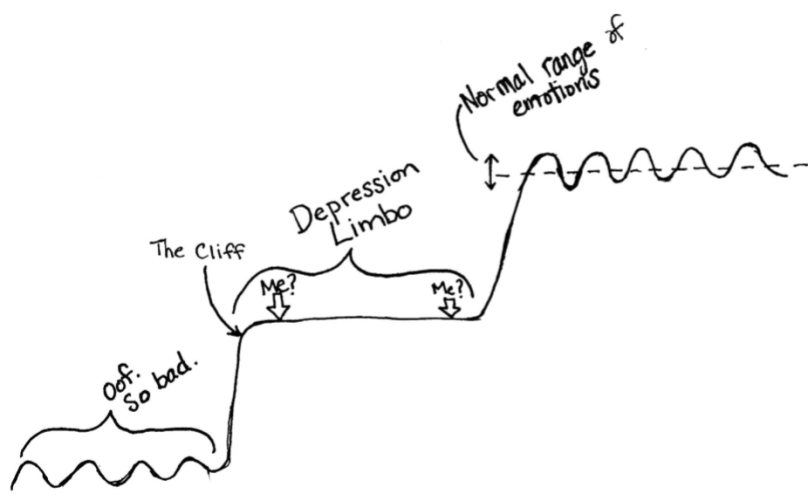
There’s a plateau that I always seem to hit in my recovery from a bout of depression. Since the first time I became depressed, I don’t think I’ve ever gotten past the plateau. I call it “Depression Limbo”. Here’s what I mean:

graph-of-depression-limbo-concept

Depression Limbo is an in-between place where things aren’t terrible, but they’re not great, either. Because you’re not in the pit of darkness, it’s easy to think you’re doing alright; and you are- comparatively. Things aren’t great, but they are ok. This makes it hard to find the motivation to pull yourself out of Depression Limbo. You think “this isn’t so bad. I can settle for this.” And that’s where it gets dangerous. Depression Limbo is flat, so you have no idea how close you are to the cliff and, therefore, to crisis. You could be anywhere along the plateau, but it all looks the same.

I’m in Depression Limbo. It’s a familiar place; I’ve been here several times before. I can laugh again. I’m enjoying my hobbies. I’m exercising again. I’m tempted to say it’s good enough, but I know that that’s risky. I’m tired all the time, I don’t really want to eat, and I tend to be trapped in my routine. This time, I won’t be settling for “good enough”. I’m going all the way to the top.

There is Always a Choice

TW: self-harm and suicide

I wrote this in my hospital journal towards the end of my stay. A few days ago, I published a post about self-compassion. The two seem to go together, in my mind.

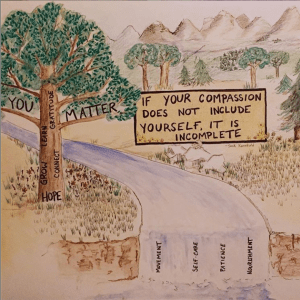
drawing of landscape with tree and river and words about self-compassionThere is always a choice. Two therapists have told me this independently. It took a little while for the meaning to sink in after the first therapist said it. I had gone a few weeks without self-harm at that point, and I still felt utterly controlled by it. The question of whether to do it or not didn’t seem like a choice; it seemed like an inevitability. Over time, the less trapped by it I felt, and the more sense that statement made. Although the choice of whether to self-harm might have been stacked in favor of doing it, the choice to take steps to change that was still mine.
I relapsed and eventually ended up here, in the hospital. On the surface, I’m likely to view all of that as a failure. However, I didn’t make the wrong choice. I experienced the symptoms of wanting to self-harm and having suicidal thoughts. I made the choice to be honest and to go to the hospital. I’m making choices every day to participate in groups and to work towards stability.

Was cutting a choice? Yes, but it’s about more than that. It’s about larger choices. When my disorder makes resisting those urges and thoughts too difficult, agency over my life as a whole is still mine. I can decide to work towards taking back control in all areas, however slowly I have to do that. It’s about the choices I make to be honest with my loved ones, to go to therapy, and to take my medication, that will affect my recovery from an illness that makes me want to hurt myself, that makes me want to disappear, that tells me that I don’t matter.

I do matter. I choose to work towards self-love.

There is always a choice.

Love,

Your brain

Acceptance, Self-Compassion, and Growth

The other day, my therapist gave me a handout on self-compassion. My “assignment” is to read through it and make some notes on what stands out to me. Since she reads my blog, (Hi, J!) why not expand my notes into an entire post?

A Definition of Self-Compassion

Self-compassion has to do with accepting that we are not infallible and treating ourselves gently when we’re suffering. Just like you’d extend understanding and compassionate support to someone else, we can strive to do the same for ourselves. As humans, we’re going to make mistakes; our imperfections are not only part of what make us unique, but their existence is also a common element shared among all humans. The handout encourages readers to stop fighting against the reality that we are imperfect beings.

Here’s my initial reaction to that bit of advice: but if I stop fighting it, I’ll stop improving. 

Growth

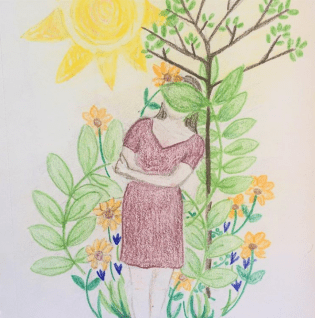
drawing of woman surrounded by plant growth

I worry that if I stop fighting the reality that I’m going to make mistakes, I’ll end up stagnating. If you also hold this belief, I wonder if we can change it by convincing ourselves that the components of success don’t necessarily include criticism and harsh judgment. You can like yourself and still be motivated to grow and improve. (This is what the Dialectics in DBT is all about; two seemingly opposed things can be valid at the same time. It’s about finding the middle ground.) Not to mention, you don’t need to beat yourself up for your mistakes in order to learn from them.

Acceptance vs. Resignation

At the heart of it lies another DBT concept, the difference between acceptance and resignation. Acceptance is the ability to recognize and come to terms with the reality of a situation. It leaves room for you to change it. Resignation doesn’t. When you’re resigned to something, it’s like putting blinders on. You see the reality of what’s in front of you, but not the opportunities to your left and right. With acceptance, you can understand that something is the way it is and still take steps to change it.

Depression’s Symptoms

Here’s where I run into trouble. Depression comes with behavioral symptoms that can get in the way of my productivity. When I sleep too much, for example, it somehow feels easier to be hard on myself than to accept that my illness causes these symptoms. Why? Probably because it gives me a sense of control. If I take responsibility for things that are out of my control, I don’t have to face that they are, in fact, out of my control. It scares me to feel like a victim of my illness. I’d rather be hard on myself for something that’s not my fault than relinquish my (false) sense of control over my actions. I think the key issue is that I’m not distinguishing between acceptance and resignation. I can accept that depression causes me to experience symptoms. If I accept that (not resign myself to it), then there are actions I can take to combat those symptoms, and practicing self-compassion will be easier.

Keep in mind I said “easier“. I’ll be honest, self-compassion is something I’m really struggling with. How can I hold myself accountable for working to get better without being judgmental when it’s not going to plan? It seems like a delicate balance, but my current strategy is not serving me in the way that I’d like. I guess it’s time to invest in a tightrope.

Are there times when you struggle with self-compassion? How do you remedy it? Share your tips in the comments!