Counterintuitively, stubborn determination is a trait that really holds me back from personal growth. It creates a cycle of unnecessary stress, anxiety, and avoidance that leads me to say “no” more often than I’d like.
The Cycle
When I start something, I automatically lock myself into seeing it out, even if I don’t like it, am bad at it, or if any number of valid reasons for stepping away from something crop up. So, the thought of doing something new comes with a flood of anxiety about entering into something I would never allow myself to quit. I worry about doing a bad job, letting people down, disappointing myself, ruining something, etc., and ultimately, being trapped in a role that doesn’t fit. So, I’m tempted to never start at all. It’s rather paralyzing.
But doing something new is not necessarily forever. You can quit things, and it’s ok. In fact, movement and personal growth can come from quitting, as taking new opportunities frequently requires that you let go of something else. It inherently results in change, and although change is uncomfortable, it’s how we grow. And so, I want to be a quitter, and despite the negative connotation of the word, I want it to be like one of those positive affirmations that I never say to myself in the mirror.
“I’m a QUITTER!” I’d say, and then I’d do some fist pumps and charge out of the house, ready to quit some things so that I can start anew, flush with the knowledge that if those new things go awry, I can quit those, too. I don’t want to quit everything, of course – I just want it to be easier for me to accept risk and not hold myself to impossible, permanent standards.
An Quick Anecdote About Quitting
I quit a job with no warning, once. In fact, I quit on the first day. It was such a terrible fit for me that the discomfort of quitting something was nothing compared to the prospect of working there every day. I called after going home and explained that, having experienced the job for a day, I definitely would not be able to do the job in a safe, satisfactory way. And it was fine! In fact, they thanked me for being frank with them. I felt awful for wasting their time, but in hindsight, it was 100% the right thing to do. Quitting was good.
Finding Personal Growth in Stressful Situations
For some reason, that experience has not completely impressed upon me the non-world-ending nature of most quitting scenarios. Just the possibility of encountering something I end up wanting to quit still causes me a lot of anxiety. But logically, I know that for the kinds of choices I make in my daily life, nothing catastrophic would happen if I chose to change things. Even in the worst-case scenario, my life would be likely be altered, but certainly not threatened. People are resilient. I could make it through the bumps of quitting, just fine, and I would probably find some ongoing personal growth along the way.
If only I could just quit my dedication to not quitting things.
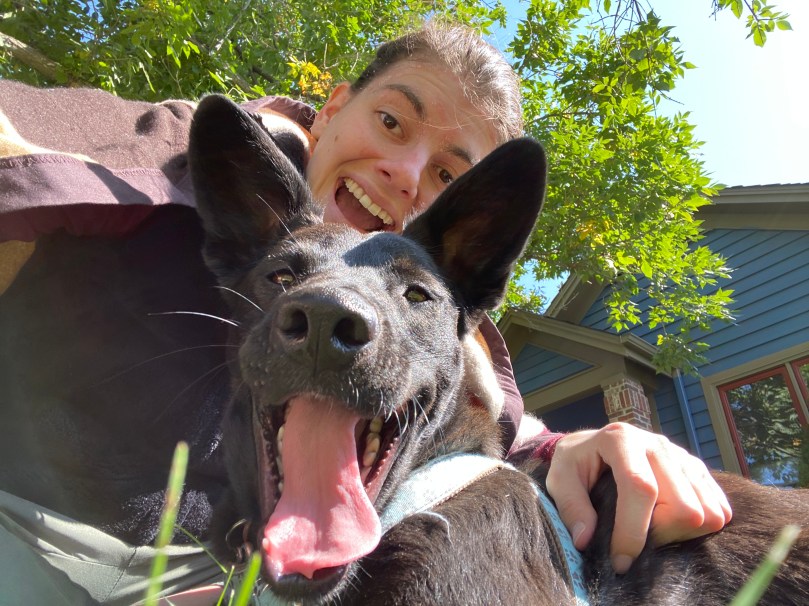
I’ve started bringing my dog to therapy. Does she sit with me and look patiently into my eyes while I cry? No, definitely not. She spends 10 minutes wandering around, smelling the smells of the week with great vigor. She pokes the diffuser with her nose, sticks her whole head in the trash can, and squeeeezes behind my therapist’s chair to not-so-sneakily smell her belongings. Then, she goes back and forth between the window and relaxing on the rug, ears perked up, listening for outside sounds. She comes over to me for pets and cookies every once in a while, but mostly, she’s just nice to have around as my unofficial therapy dog. She’s completely oblivious to my human problems. Looking at her blissful ignorance during therapy is like a brain palate cleanser.
You can’t help but wonder what she thinks of this development. Here we are, in this room we come to sometimes for no discernible reason. Pretty comfy. New smells since last week. 8/10. Would be better if I got second dinner. All that matters to her is that I feed her, walk her, and let her sleep at the foot of my bed. She’s a simple creature – intensely curious and frustratingly smart – but simple in that she really doesn’t need a lot to be happy.
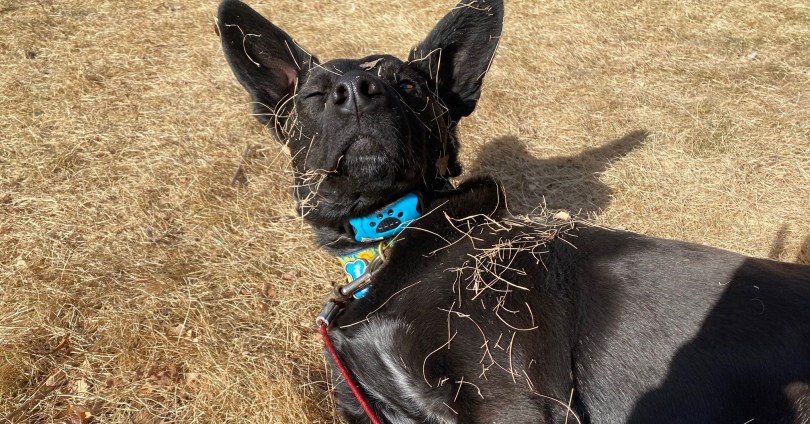
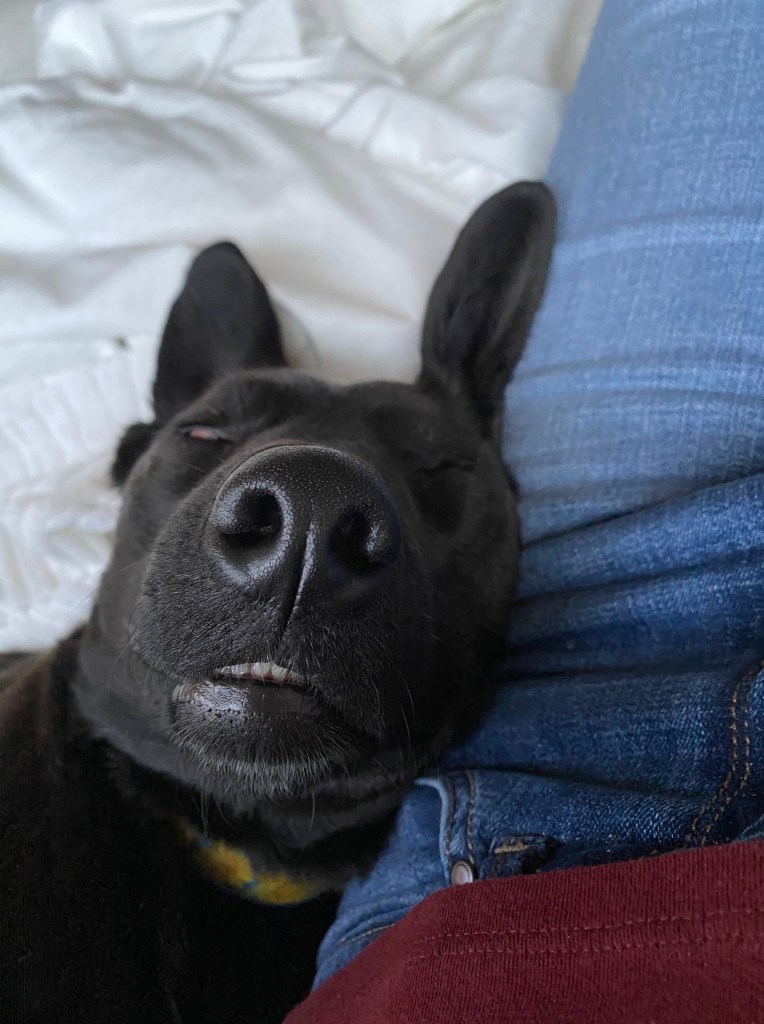
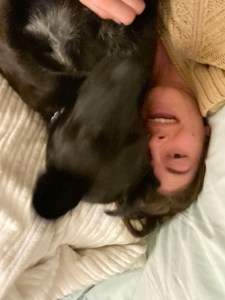
She shares some of that innocent joy with me. She makes me smile every single day. It doesn’t matter how depressed I am – she does something goofy or sweet and has no clue that I find her antics ridiculous. Like how she leads with her face when encountering snowdrifts, or her exasperation at me taking constant photos of her, or the many, many hilarious faces of Sleeping Stella.
Sometimes, when I try to change something in my treatment(s), my depression says, “No, thank you.” Changing my medications has not gone well for me in the past, but I continue to clutch my personal dream of reducing the number of things I pick up from the pharmacy. I recently added a drug which required me to get off of something else, which overall, does not seem to have gone well. The options now are complicated and I don’t particularly like any of them, but I still have Stella! The routine, obligatory outdoor time, and turbo-boosted zoomies have done me immeasurable good. She demands my attention and action, and there’s really no telling her to just go entertain herself. Our walks are sacrosanct to her. No replacements. And no skimping on length, either!
This was part of my goal in adopting her, and it worked in more ways than just the responsibility of it. I thought that it would be healthy for me to be forced to get out of bed and do things, but that the emotional reward of that would come during my good times. I wasn’t expecting my unofficial therapy dog to be able to careen through the fog of my depression and make me smile every single day. A smile or laugh every day certainly doesn’t fix everything, but it’s something to be thankful for.
My experience of receiving IV ketamine for depression this time around is now almost completely lost in the recesses of my brain. I do remember having an odd, somewhat uncomfortable feeling early on that I recognized from one of my recent ketamine infusions. My best description of this feeling is that my thoughts were physically too large for my head and too fast to really grasp. But what was most interesting about this infusion was what happened afterward.
First of all, I was so incredibly disoriented that when I thought that my mom was driving in the wrong direction, I asked, “Wait. Where are we going?”
“…Home…?” She replied. It then dawned on me that we were leaving my appointment rather than being on our way there. I was so impaired that I didn’t even remember going to the appointment at all.
The second very strange thing that happened post-infusion was that I began having brief, uncontrollable muscle spasms combined with sudden knee buckling that affected my entire body. I was wobbling along, trying not to fall in the parking garage, when it hit me. My arm shot out in front of me, flinging the apple juice I was holding onto the floor, and the rest of me doubled over for a second. It felt sort of like when you fall asleep sitting up and then violently jerk awake. Except, I was walking. For the rest of the afternoon/evening, this happened in varying degrees at least once per hour. At least, that’s my estimate. Then again, maybe we shouldn’t trust the person who couldn’t even remember going to a ketamine infusion.
The muscle spasms are mysterious but may have been due to the magnesium we’ve been adding, which helps some people see better results from ketamine. We plan to skip it next time, as it hasn’t made a dramatic difference for me, mood-wise. While magnesium may not be important for my depression, something was very different about this experience. The infusion itself seemed the same, but the bizarre visual, proprioceptive, and even auditory components extended far past the time when they usually disappear for me. I can only attribute this to the other measures we take in the effort to slow down my metabolism of ketamine, plus the somewhat recent increase in dose, but to be honest, I don’t know why this one was different.
Generally, by the time I’m capable of putting my shoes on to leave the clinic, things look pretty much normal. This time – not so much. Once home, I noticed that a piece of crumpled paper appeared to have cobwebs on it with tiny insects crawling around inside it. At first, I was completely fooled. Fascinated, unsettled, and fooled. I peered at it from a close-but-safe distance, trying to get my eyes to focus on its movement. I tried alternately holding my breath and blowing on it to see if the gentle movement was actually caused by my own proximity; I tried holding my hand above it to feel for a draft, and I tried touching it with another piece of paper. But, no matter what I did, the cobwebs continued to wave slowly back and forth at their own pace, and the small bugs never explored past the cobwebs. My little tests helped me realize that it wasn’t real, but I was so interested in it that I continued to stare.
Eventually, I dragged my eyes away from the paper to look behind me, and when I turned back, the bugs and cobwebs were gone. After the rather large amount of time I spent engrossed in a crumpled piece of brown paper, I suddenly understood via first-person experience why ketamine’s effects make for a useful clinical model of psychosis. The entire event was bizarre and deeply unsettling in a way I can’t quite describe.
My eyesight was frustratingly blurry, to the point that things actually looked clearer without my glasses. I’m not sure exactly how the physics of that works, but wearing my glasses seemed to make it much more difficult to focus my eyes than it was without them. Attempting to lock my gaze on something flat and relatively close to me, like texts on my phone, made the object recede and push forward into subtle 3-dimensionality on repeat.
Perhaps the most persistent phenomenon of this post-ketamine experience was the sound of voices next to me. I’ve been re-watching a show I like lately, and at some point in the afternoon, I realized that I had been “listening in” on the dialogue of several fictional characters off to my right for at least an hour — not sure about that timeline, though. Their voices sounded exactly like the actors’ voices; so much so that I felt I could identify the person speaking at any given time. There seemed to be a choppy plot- not one familiar to me from the actual show. My brain must have created a whole new plot, but I couldn’t tell you what it was. I again reminded myself that I was just not quite past the effects of ketamine, and that it would pass. It wasn’t that I ever thought those fictional people were actually next to me; the voices just wouldn’t stop. It was like listening to a podcast that I couldn’t turn off. I kept trying to distract myself with something else, but I would eventually drift away from it, back to the voices. Then, after what felt like a few minutes, I’d remember that it’s generally not good to be hearing voices and would try to distract myself again. I was moderately creeped out, but mostly exasperated by the fact that I couldn’t reliably corral my thoughts back to reality.
All of this – the experience of seeing and hearing things so long after an infusion is distinctly new to me. There have been times when I thought I heard things post-infusion, but I’m never quite positive that those sounds weren’t real, and they always happened much closer to the infusion. It seems possible that I might have just been thinking about that show and gotten pulled into an imaginary scene, which doesn’t necessarily count as hearing things. But the cobwebs – which I also saw once during an infusion when I left my eyes open for too long – definitely appeared to be taking up space in the real world, and long after I’m usually good to go.
Today, I feel much more like myself, although I’m strangely exhausted despite doing basically nothing all day yesterday. My vision is still a tad blurry, which I think might have been the scopolamine patch I was wearing, which can dilate your pupils. I’m going to make a checklist before the next time of things that I need to do when I come home from a ketamine infusion. It’s difficult to keep things straight when you can’t remember whether you even made it to the infusion in the first place! I’m going to take this weird continuation of my ketamine infusion experience to mean that it might be more effective against my depression this time. Or, maybe it’s a really bad sign and nobody else ever experiences this. When I find out, I’ll let you know.
The warm, vaguely citrusy feeling of ketamine spilled down my back while I tried to get my earbuds in and my music started. I fumbled around for a moment, not sure which earbud was which, but finally settled with the knowledge that I had a 50/50 chance of getting it right. I jammed those puppies in there while the world outside my eyeballs spun around. After some time, I realized that I had left my index finger suspended in the air with the pulse oximeter on it. One of those deep-seated memories, the ones that you wish you could get rid of because they always seem to displace more critical information, rose to the surface. Yes. I remembered that SpongeBob episode in which Patrick teaches SpongeBob that holding your pinky up is fancy, so, “the higher you hold it, the fancier you are.” I kind of wanted to laugh, but was afraid that if I started, I wouldn’t able to stop and I’d just spend the whole infusion cackling over fancy pinkies.
I’ve learned that if I don’t put my head back and try to relax my neck before the ketamine gets started, it takes a herculean effort to do so later on. I find this strange. Like I did when I left my finger pointed up, I can go long stretches of time without even noticing that I’m doing it. One would think that sitting in a reclined position with their neck bent to keep their head aloft would be really uncomfortable. But somehow, it’s just easier to forget about it than to try to move. It reminds me of that locking mechanism that birds do with their feet so that they don’t fall off of telephone wires while they sleep. I just get stuck in whatever position I’m in when the ketamine hits me.
I don’t remember much from this ketamine infusion, although I know that it was one of the most choppy, disconnected visual experiences I’ve had during a ketamine infusion. There was a man dressed in 19th century clothing – ruffled white collar peeking out from a buttoned up, navy tailcoat jacket, with a gold monocle arranged over his left eye. He was leaning over me, large grey beard waggling while he spoke, telling me something about achievement and perfection and getting started before it’s too late.
I don’t think that I’ve ever heard my ketamine dreams make any noise at all, except for one time when I heard some garbled gibberish in the center of my head after an infusion, when I was on my way home. Who knows what that was, though – the radio, people on a crosswalk, etc. But in any case, it was startling to realize that someone imaginary was speaking to me during an active ketamine infusion. I don’t remember exactly what he said, but the advice the man was giving me wasn’t encouraging. It was more like a stern lecture, siphoned from my own inner dialogue about failure, perfectionism, and growth. Quite strange.
Side note: I started writing this when I got home from my infusion. This morning, I opened up my laptop to see that I had written “before it’s two late.” I must have been more impaired than I thought. It’s not as bad as, say, waking up to find that I’d spent all my money on vintage beanie babies or clown figurines, but whoo, boy. What an egregious mistake for an editor to make.
The image of monocle man is what I remember with the most clarity, but I also remember a taxidermized rat with an oblong hole in its neck. A live white rat emerged from the hole, pulling itself free like some kind of disturbing mammalian version of a snake shedding its skin. Seriously creepy. Other than a lot of colorful TV static and a white sand beach, that’s all I remember.
I wish I had a better way to end this post, but that’s all I’ve got. Go look at something heartwarming to get that rat image out of your brain. Bye, for now!
My mental health has once again taken a turn in a not-fun direction, which I attribute to some recent medication changes. So, instead of sitting here thinking, I should write something. I can’t think of anything to write, and then putting down anything I do write as being the worst drivel ever to appear on my screen, I’m going to take you on a little diversion.
Did you know that an elephant’s sense of smell is twice as strong as that of a bloodhound’s? (C, that documentary led me astray. Google says twice, not four times.) This is what I said to my therapist the other day in one of my many futile attempts to distract from the topic at hand. We’ve also discussed, among other things, a documentary I watched called “Octopus Volcano,” how scallops have eyes, and what “horse” is in ASL. Usually, when I share a fun fact like this, there’s a brief exchange, and then she goes, “Well, that used up about a minute and a half.” And then we’re back where we started, just a little more entertained. This time, I think we probably used up, like, at least three minutes with the elephant fact. It may have been the most productive time-wasting fact I’ve ever pulled out of my sleeve. We got going on a train of thought that I think has some incredible real-world promise.
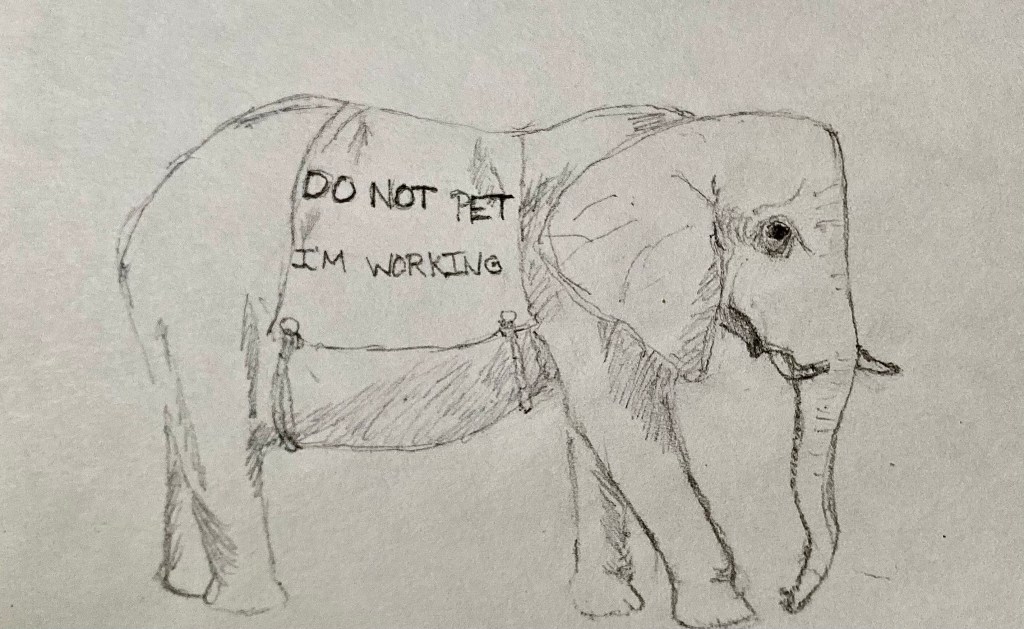
Just imagine: search and rescue ELEPHANTS. The police force brings out the specially trained sniffer elephants in super-wide trailers. They step down, decked out in vests that say “DO NOT PET. I’M WORKING,” but the vests are really just tarps secured around their bellies with bungee cords because the elephant service vest market just isn’t there yet. Soon, they’re working in airports, sniffing for bombs and drugs. All floors have widened stairs and elephant-safe ramps, and next to the dog relief areas are rooms with piles of dirt for the pachyderms to toss over their backs. Retired sniffer elephants spend their golden years relaxing with their family herd with frequent visits from their old handlers, revered as heroes for their invaluable contributions. I think we’re on to something, here.
“Sir? Sir! This is a service animal. Please don’t feed her the limp lettuce off your hamburger.”
Is this a breakthrough? Did I have a breakthrough in therapy?! Yeah, yeah, it’s not about me, but a striking realization is a striking realization. Elephants are the next sniffer dogs. Maybe they’re not as motivated to please humans, and they do need to eat a tremendous amount of foliage as they travel great distances throughout the day, but I think those problems could be overcome with some creativity. There really is no limit to what you can take away from therapy.
Non-sequitur segue! Other problems that can probably be overcome include my current difficulties with changing my clothes and eating and getting work done and my general depression problems. Titrating down on an antidepressant can be tricky. I’m trying to figure out whether this dip in my mood is because this antidepressant was helping me more than I thought it was, regular old withdrawal, ketamine wearing off, or any number of other variables. I suppose time will tell. Let’s persist in our efforts to overcome wacky, theoretical elephant scenarios and the challenges of living life.
P.S. Good luck to the Google algorithm in trying to figure out what the heck this post is about. 🙂
And I love it. Well, “love” is too strong, but I have distinctly positive feelings about this change in my depression. From the outside, it may sound amazing to take a four-hour nap every day. Living it is a different matter. When you’re absolutely exhausted all the time and you crawl into bed simply because you don’t want to exist as a conscious person anymore, it’s not rejuvenating. When you go to sleep because you just want the day to be over and at least that way, you won’t perceive the passage of time, it’s not indulgent self-care. Instead, it’s just a black hole siphoning days, weeks, months of your life away from you. So, when you suddenly have every precious second of the day to be awake, it’s wonderful – and a little bit uncomfortable.
Wellbutrin is what’s still making me anxious – a side effect that Google says goes away within a week or two. Not so, for me, although hopefully, for a more complex reason. When I started taking propranolol, a beta blocker, to counteract the anxiety and jitters, I hoped that I could start to really enjoy my improved motivation. I’ve been mostly feeling like it arose solely as a product of anxiety that propels me from distraction to distraction. Instead, I encountered a strange result. Two propranolol per day had minimal effect, but three made me so shaky that I struggled to type or to use a spoon. This is weird, and not at all what’s supposed to happen. Perhaps I had a paradoxical reaction to it, but it’s hard to say. As for the anxiety, my psychiatric nurse practitioner theorized that the addition of Wellbutrin made for three medications in my list that deal with norepinephrine. I was making too much of it, essentially leaving me constantly primed for fight or flight. I’m now tapering down on one of those meds in preparation to increase the Wellbutrin.
Although the anxiety is improving, it still keeps me from napping most days. It’s that odd combination of being tired and full of energy at the same time. I want to close my eyes and rest, but it kind of feels like my trachea is the size of a large straw, and I can feel my heartbeat in my ears. It’s a tug-of-war between depression, which still votes in favor of sleep, and anxiety, which votes for frantic activity. Consequently, many of my days feel much longer than they used to because I’m unable to sleep. I’m still not as interested in my, well, interests as I used to be, so although I have this itch to be active, nothing seems quite right. The anxiety is also not nice, but it is a novel experience to be conscious for an entire day. There are so many hours to pass!
In an example day, I’ve:
fixed my clogged bathroom sink
drawn some potted plants
accomplished my part-time work in one sitting
refilled the bird feeder
took the dog to the vet
*perused the web for “doggles”
went for a walk
There have been some recent days that included naps, but on the whole, I’m pleased with my daily awakeness. Now to try not to go too far in this direction and become more anxious that I’m only doing very minimal activity and it somehow feels like a lot to me. Don’t. Over. Think. It.
*Doggles, or dog goggles, are on my shopping list because my dog, Stella, habitually develops eye infections, likely in the course of her high-speed, full-contact dog park outings. The doggles are for her to wear while we play fetch, silly as that is. But hey – ten bucks for doggles, or $180 for each vet trip? They also look awesome.
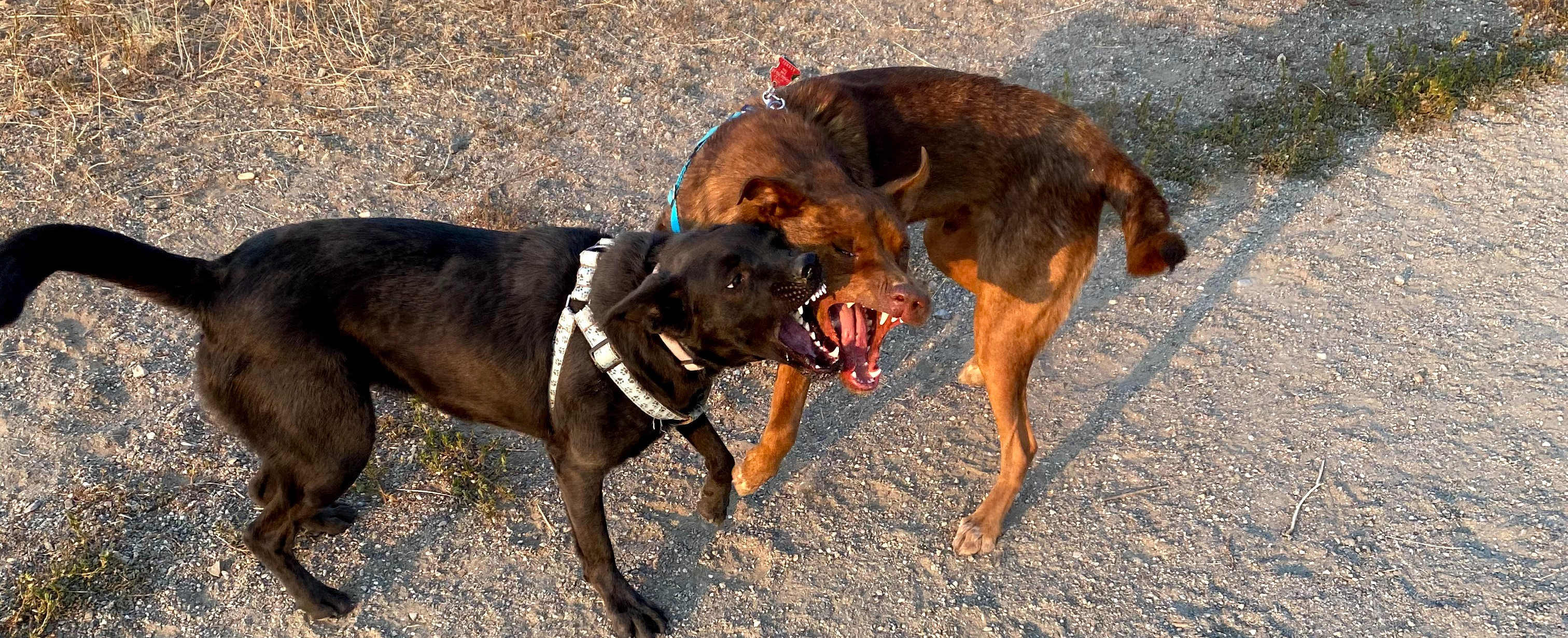
It’s hard to get photos of dogs playing that don’t look terrifying, but I swear, this is Stella and Tugs having a great time. Imagine how cool they would look with doggles.
It’s part 30 of the Ketamine Chronicles! Time flies, doesn’t it? My previous ketamine infusion (which I use as part of my treatment-resistant depression treatment), was surprisingly more effective than it has been in the last couple of months. I’ve been enjoying the general lightness and ease with which I can get out of bed. Last Thursday seemed to take a downturn, although it’s always hard to tell which factors explain which results. In any case, my regularly scheduled ketamine appointment was yesterday, so it was good timing, if so.
Whereas the last infusion was extremely trippy, this one seemed more mundane. That might only be because I don’t have much memory of what I experienced, though. At the start of my infusion, my ears began feeling incredibly hot, as if I’d just said something horrifyingly embarrassing. Once I closed my eyes, I remember feeling a tad uncomfortable, like my thoughts were becoming too big for the confines of my head. It seemed like I was seeing darkness for longer than usual, and I think that the lack of engaging visual noise is what made my thinking feel too big. Of course, I don’t remember what I was pondering, just that it was happening.
Photo by: Leni und Tom on Pixabay
Once again, I fell asleep when I got home and then had several disorienting instances upon waking up and not knowing what day or time it was. It felt like I had been sleeping for many hours when my mom poked her head into my room. All that had registered in my brain a moment before was that my phone said 6:30. So, when my mom informed me of the shrimp and rice on the table, I momentarily thought, “why would she make shrimp and rice for breakfast?” It quickly dawned on me that it was, in fact, the same day. I woke up a few more times during the night, still briefly believing that it was the next morning. The pitch black scene outside my window hinted that no, it was not 11:30 AM. It took me a few seconds to reassess.
Start from the beginning of the Ketamine Chronicles! Or, visit the archives for a list of month-by-month posts.Other posts have far more absurdity and detail in my descriptions of what it feels like during an infusion.
Ketamine FAQs
Since this entry in the Ketamine Chronicles is pretty short, I thought I’d share the questions that I asked when I started ketamine therapy. I’m not sure that these are actually frequently asked, but it made the heading nice and concise, and I do love some organization. The answers to these questions are a blending of what my doctor told me, plus what I’ve learned through personal experience. Everyone is different, so the answers may not apply to everyone.
I love strange stock images. Photo by: Tumisu on Pixabay
1. How do you know when you should get a maintenance infusion? Is it a sudden change, or more gradual?
For me, it’s usually a gradual change that I notice somewhere between two and three weeks after an infusion over the course of three or four days. I know that it’s time to get another infusion when I find myself doing a lot of nothing and feeling apathetic. My motivation disappears and I usually start thinking that acting to counter my symptoms is pointless.
However, it can be more of a sudden change for some people. They may wake up one morning knowing that, because their symptoms have returned quickly, the ketamine has worn off.
2. Do some people eventually manage their depression with just therapy, etc.? Or is the damage that depression causes a continuous process that you have to constantly work against?
Unfortunately, it’s the latter. After your initial series of infusions, you’ll need to periodically get maintenance, or “booster”, infusions. The effects of ketamine wear off at different rates for different people.
I suppose it’s possible that someone could really piggyback on the results of ketamine therapy and launch themselves into better long-term mental health, but as far as I know, the vast majority of people need booster infusions.
Exercise, therapy, social interaction, and other activities that support your mental health can help the effects of ketamine last longer. It’s possible for some people to extend the interval between their infusions. #goals
3. How do people decide whether or not to keep taking their medicine?
This is a uniquely personal decision that you make with your psychiatrist or other prescriber. I was hopeful that the benefits of ketamine would allow me to at least reduce some of my more side-effect prone medicines, but so far, trying it hasn’t worked out for me.
4. Is it possible that for some people, ketamine makes their meds work better because of the brain repair it facilitates?
Yes! As I discovered first-hand, going off some of my medications had pretty abysmal results. It’s clear that for me, the combination of my usual medications and periodic ketamine infusions is what works best. You can even try medications that you’ve taken and discontinued before, as sometimes they work better with ketamine.
5. Is my reaction to the first infusion a good indicator of whether or not it will work?
No. While ketamine works for some people nearly immediately, it takes longer for others to see any benefit. I didn’t feel better until roughly my fifth infusion.
Additionally, the way you do your first infusion is not set in stone. Sometimes, you need to change the dose or add other medications. It’s not a one-size-fits-all treatment.
6. Does ketamine ever “kinda work,” or is it all or nothing?
I apparently didn’t write down my doctor’s answer to this, so this is entirely my own experience.
I find that it can “kinda work” for me, depending on circumstances that I haven’t pinned down yet. Still, even when it’s not amazingly helpful, it’s still worth it for that small benefit. I tend to vacillate between “meh,” and “wow, I feel so much better.” So, much like question #3, it’s probably worth tweaking things if it’s less beneficial than you hoped.
However, for some people, it seems not to work at all. On the other hand, there are people for whom ketamine makes a dramatic difference almost immediately. It seems to be a continuum.
7. Will I do anything embarrassing during a ketamine infusion?
I don’t think I asked my doctor about this, but it was definitely part of my apprehension. I tend to be quiet during my infusions, in part because it feels nearly impossible to carry on a conversation. When asked if I’m doing ok, I usually just sort of nod my bobblehead a little.
I do know that other people are far more chatty than I am and can just talk the whole time. I doubt they divulge any deep, dark secrets without meaning to, though. Even though I can’t muster up the energy to speak, I have contemplated whether or not I should say something. Some of the things I see behind my eyelids are so absurd that I want other people to know about them. But even with that desire to share something funny, I’m still capable of deciding whether or not to say it. I probably would talk more if it weren’t so hard to work around my bubble gum tongue.
Feel free to leave questions in the comments. If I have an answer, I’d be happy to share it with you.








 Love, Your Brain