photo-of-open-day-planner-with-pencil-on-top-and-cup-of-coffee-nearby

The Weekly Plan: Structure and Expectations

I recently wrote a post about SPD and dyspraxia, in which I mentioned using a weekly plan to help me deal with uncertainty and change. In all honesty, I haven’t used my weekly plan in a while, so I’m hoping that reflecting on what worked for me and what didn’t might encourage me to get back into it.

How to Make a Weekly Plan

There really isn’t one right way to make a weekly plan. I like to create mine with an hourly-organized template so that I can schedule each part of my day. It helps me stay on track and prevent procrastination. Sometimes I take more of a loose, overarching goal approach where I identify a couple of tasks per day or week that I want to accomplish, and then fit those in around my normal routine.

I’ve tried a paper planner and a digital notes app, and I’d say I prefer the digital method; I can refer to it anytime because, like a typical millennial, I’m never far from my phone. It’s also easy to alter by replacing items or copy and pasting them to another day/list. The digital method also appeals to me because replacing tasks leaves no evidence of the previous one, as with paper and pen, which brings me to another point:

Pitfalls

I had to dedicate several weeks to trial and error when starting my weekly plans as part of my occupational therapy. I tend to avoid making choices as much as is humanly possible (thanks, sensory discrimination challenges), so when I’m faced with a decision like “digital or paper?” I won’t know which one I prefer until I try both and compare them.

Rigidity

Here, we come back to the “digital changes leave no trace”. This is a relic of my own high expectations for myself and my reluctance to change plans. I found that erasing (or worse- crossing out) tasks in my weekly plan when I couldn’t complete them brought on a sense of guilt and failure. Nevermind that imposed the plan in the first place and may have bitten off more than I could chew. Once it’s in the plan, I have to do it, right? Nope- moving things around and postponing some tasks is often necessary. Something takes longer than you anticipated, an unexpected problem arises, or you’re really just not up for tackling a particular task that day. I think eventually, I’ll get better at finding the balance of flexibility and rigidity, but until then, a digital format works best for me. That way, I don’t have to see the faint outlines of my overly ambitious, past plans.

Too Much Detail

Honestly, this is still something I struggle with. It’s tricky to know how much is reasonable to plan into one day, especially because, as with the previous section, sometimes things come up and you’ve got to shift gears. When I started figuring out my weekly plans, I started seeing improvements in my productivity, and consequently, my mood. Riding the wave of that success, I was perhaps a bit overzealous in my weekly planning and crammed as much detail as possible into each day. Every hour was occupied by some task, either work-related or relaxation-related. (You can imagine that that approach wasn’t very conducive to relaxation.) Ultimately, too much detail would lead me to fall “behind” on my plan, start to feel discouraged, and sometimes just give up on the day altogether. Now, I like to leave a buffer zone around work tasks and intentionally leave at least a couple of hours empty to take care of little chores or just sit around and do nothing.

My Ideal Plan with Sensory Processing Disorder

I think that anyone can benefit from a weekly plan; even if you try it and decide it’s not for you, you’ll likely learn something about yourself in the process.

I’m over-responsive to a lot of stimuli, and I have some issues with discriminating sensory information, so I do best with predictability. Routine is how I function best, and spur-of-the-moment action makes me anxious. For me, my ideal weekly plan is one that looks pretty similar to the previous week’s. Whether I write it out or keep it in my head, my day-to-day routine is remarkably consistent; and that’s how I like it. For someone who seeks more stimulation, this might be incredibly dull, so it’s certainly not for everyone. I keep most of what I do every day the same, and then sprinkle in equal amounts of fun and dreaded tasks. Going to the dentist on Tuesday? Make Wednesday a library day. Need to go grocery shopping? Pick up a treat as a reward. When things start to get a little too consistent, I go back to the drawing board and make an effort to incorporate new activities.

Extra Tips

  1. Keep a running to-do list for when you’re at a loss for what to do.
  2. Pick a day of the week to sit down and plan the next one.
  3. Break large tasks down into smaller chunks to be accomplished over time.
  4. Don’t take it too seriously- it’s a tool, not a rule.

College and SPD: 3 Things I Wish I Knew

I’ve known that I’m sensitive my entire life. I don’t like crowds, loud noises, getting splashed in the pool, or rollercoasters, and although I technically knew that I had Sensory Processing Disorder, that fact clung to the periphery of my awareness until I was nearing my college graduation. For the majority of my time at university, I questioned my worth, my intelligence, and my capabilities. Had I gone into college prepared with knowledge about my disorder and the intention to remember my sensory differences, I think my experience would have been much more positive.

But, here we are, and shoulda, coulda, wouldas won’t change the past. But they might change your future, so I thought I’d expand upon what I wish I knew about college and SPD.

1. I Got In For a Reason

I can’t tell you how much time I wasted worrying about my perceived inadequacy and comparing myself to my peers. So. Much. Time. And where did it get me? Countless sleepless nights and a heck of a lot of cortisol. When the other freshmen complained about the workload and said that they “breezed through high school”, what I thought was geez, I had to work really hard in high school. That must mean I’m not smart enough to be here. What I should have thought was: I worked really hard in high school and developed valuable time-management skills and study techniques. 

In hindsight, I probably felt I needed to put a lot of effort into my high school classes because planning and abstract thought are not my strong suits (read: math is hard for me). I often felt behind my peers because I learn best when I have quiet time to digest new information on my own; doing homework was usually when concepts started to make sense, but I was often utterly lost in class.

So, the bottom line is: I wish I knew that my learning style has more to do with sensory processing and less to do with my intelligence.

2. Everyone’s College Experience is Different

I’m an early-to-bed, early-to-rise type. This doesn’t tend to mesh well with the party lifestyle many people associate with college. I also really like oatmeal raisin cookies and think they’re vastly underappreciated. (Read: I’m actually an old person in a young person’s body.) My point is, I spent a lot of time feeling like I was missing out on all the things I knew I wouldn’t like, just because it seemed like I should.

A sub-category of this section is that finding a space that fits your needs in terms of community, interests, and activities is definitely possible and makes a huge difference in creating a sense of belonging. I went to an enormous university, and I was worried that it would be hard to make friends. So, I lived in a small, all-female dorm for three of my four years there. That turned out to be the best part of my college experience. I made life-long friendships and I immediately felt welcomed and accepted.

3. Focus on Yourself

In some ways, I did do this; I went to office hours, I prioritized classwork, I took the maximum number of credits a few times in order to fit in two majors. In other words, I focused on my academic goals, pretty much to the exclusion of all else. I didn’t start seeing a therapist until my senior year, and I failed to advocate for myself when it came to things like roommate disagreements and class accommodations.

When you’re in college, it’s important to remember that it’s your education. It’s a privilege many people don’t have, so get the most out of it while you can. That being said, your education won’t be much good to you or anyone else if you’re unable to use it after graduating. Taking care of yourself should be your first priority.

deer
Gotta love Nichol’s Arboretum and its weirdly habituated deer.

There are some aspects of college life that are unavoidable. For example- I don’t like crowds, and going to a big school meant that I was bound to encounter crowded walkways several times a day. When I had roommates, I realized that there weren’t many places on campus where I could be truly alone. Being surrounded by people at all times was exhausting, so I went on long walks to the arboretum near campus. I even started timing it so that I wouldn’t be leaving or returning when classes let out and the sidewalks were jammed with students.


There are a ton of other things related to Sensory Processing Disorder that I wish I knew or that I discovered a little late in my college career. Before I’m out of college for too long and forget them, I figured I’d share a few of them here. If coursework and time management, navigating campus, creating your ideal dorm room, or anything else SPD and college life-related is something you’d like to read more about, let me know.


colored-pencil-drawing-of-great-horned-owl-with-feathers-framing-sides-of-paper

The Owls and Me: A Poem on the Nature of Depression

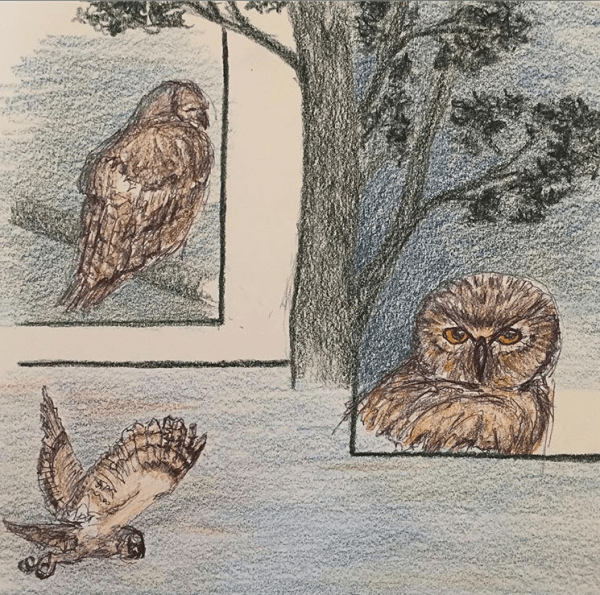
colored-pencil-drawing-of-three-great-horned-owlsDid I dream there were three?

Staring at me with six amber eyes
from the fork in the ash tree.
Their shapes like pressed flowers
in the soft light of dawn,
when one is not sure if the slant of sun
means a new day,
or is remembered from some earlier rising-
the aftertaste of memory,
beckoning.


At first, there were two; we’d see them glide past our house and disappear into the top of a cottonwood tree down the block. They’d be out at dusk, rousing themselves after a hot day perched up high. Great horned owls are fascinating to watch. For an animal that’s so still most of the time, it’s amazing that I never get bored of observing them. One summer, the two regulars were suddenly four. Two fluffy, baby owls joined the mated pair on their nighttime excursions, hopping and screeching when mom and dad left them for too long. I could sit and watch them for hours, and all told, I’m sure I did.

They haven’t been around recently, and I miss seeing their stately forms keeping watch over the neighborhood. I’m not sure why I love owls so much. What I do know, however, is that those four owls were a source of happiness for me when things were hard. I’d sit on my bed and watch them sleep in the tree outside my window. I was going to sit on my bed and do nothing anyway, so I may as well spend that time watching the owls. Maybe there was a subtle sense of solidarity; the owls in their daily state of rest and me in my extended, bleary hibernation.

colored-pencil-drawing-of-great-horned-owl-with-feathers-framing-sides-of-paper

Of course, their tendency to sit very still also makes them excellent subjects for drawing.

Nature has always been a source of healing for me, so when being outside was too much to ask of myself, watching it through the window was the next best thing. Then, I’d put down what I saw on paper so that even in their absence, the owls were still here. 


Recovery From Depression

TW: suicide & self-harm

I Used To

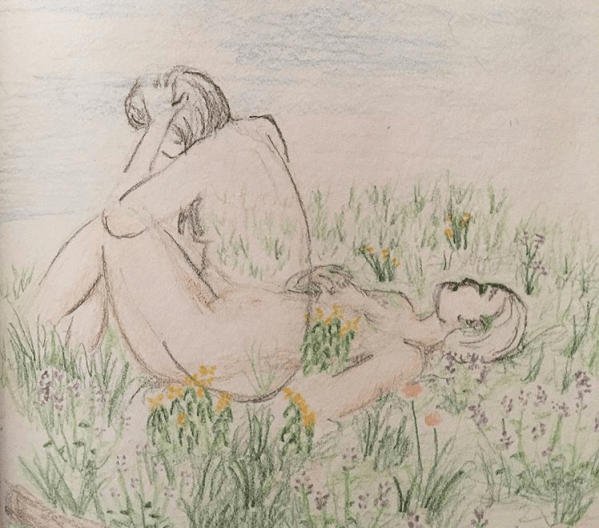
I used to look at the time when I heard a train go by at night, the heavy silence of 2 AM broken by the siren call of escape. I used to notice unlocked windows on the fourth floor of West Hall as I went up and down the stairs, each trip to and from class becoming harder. I used to see ways to die everywhere; in the passing bus, in the cold, dark current of the Huron River, in the pastel-blue sewing scissors tucked under my pillow. I used to wonder how long it would take for these morbid opportunities to escape my notice. How long before I can go a full day without putting some new, self-destructive idea on a mental shelf? How long before any phrase including the word “cut” doesn’t make me yearn to be alone so that I can do just that? I used to wonder about these things until I realized,

drawing-of-woman-lying-in-field-of-wildflowers


I used to.

Love,

Your brain

scale-from-more-bad-to-less-bad-ranking-depression-as-potatoes

The Potato Scale of Depression

I’m prone to an almost crippling inability to verbalize my feelings. Some of that is because of Sensory Processing Disorder, and some is probably due to depression and other factors, like my need to feel capable and independent, which results in me pretending I have no feelings whatsoever and consequently getting no practice in identifying them, but the point is: metaphors. I love ’em.

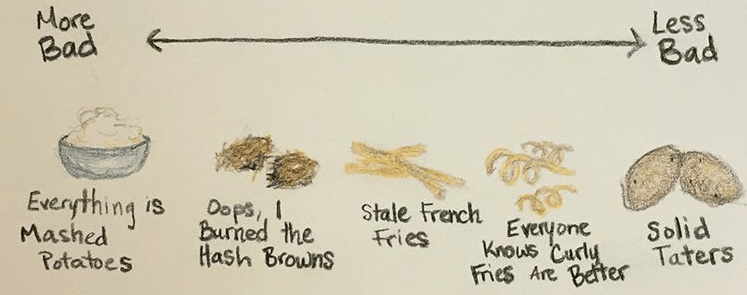
For inexplicable reasons, I find it so much easier to say “everything is mashed potatoes” than to say “I’m lost in a miserable fog of  depression.” (Actually, come to think of it, that second one is also a metaphor, but you get the idea.) Hence: The Potato Scale of Depression.

It’s Not a Good Scale (but it kind of is)

Roughly ten months ago, I really did tell my friends “everything is mashed potatoes,” and thus, The Scale was born. Unlike other scales, there are no numbers, no frowny faces, and no defined increments between items. In other words, it’s a terrible scale. There’s no way to objectively determine how someone is feeling based on the potato scale of depression, but it worked for me during a time when talking about my feelings was both very difficult and very important. It became a kind of inside joke, and my friends would ask me “how are the taters?” and I’d respond with some arbitrary, starchy answer:

“Tots,” or “potato pancakes,” or “undercooked hash browns,” or “just the eyes.”

They’re all utterly meaningless answers, but they started a conversation. We’d debate the relative positive and negative qualities of each dish, and it served (pun intended) to connect us when all I wanted to do was withdraw.

Laughter = The Okayest Medicine

Eventually, I became more comfortable with talking about my emotions. A silly scale opened the door (metaphors are everywhere) to talking about how I really feel. Sometimes using humor to defuse stressful situations and topics gets a bad rap, but it’s incredibly common. Plus, research shows that the right kind of humor can have a protective effect against recurring depression. The adaptive forms of humor (self-enhancing and affiliative) are associated with emotion regulation and positive mental health. The maladaptive forms of humor are the aggressive and self-defeating types. I could probably dedicate an entire post to why I think suicide jokes aren’t funny or healthy, but this is a post about a nonsensical tuber scale. So- perhaps another time. Back to the adaptive humor:

In consequence, an individual can successfully distance himself/herself from a negative situation and appraise its meaning from a less distressing point of view.

When you mentally distance yourself from a negative situation, you’re creating what researchers call “metacognitive awareness,” where thoughts and behaviors are interpreted as “mental events, rather than as the self.” Mental illnesses can often be associated with feelings of guilt and inadequacy, which is why it’s important to take a step back and remember that your symptoms are not character flaws. This has become a regular mantra for me, and anytime I start thinking badly of myself for my symptoms, I turn it around with I’m not lazy, I’m just soggy hashbrowns right now. Y’know, the kind that maybe didn’t get cooked enough, so now they’re getting cold and seeping oil onto your toast. Depending on your humor preferences, this might border on maladaptive, but it reminds me to not get bogged down in a temporary feeling or judgment. And really, what potato dish isn’t still delicious, no matter how poorly cooked?

Depression Scales: PHQ9, Who?

The Potato Scale of Depression is obviously not a tool that will ever be used in any kind of professional setting, but that doesn’t mean that it can’t be beneficial. Maybe potatoes aren’t your thing, and some other metaphor would be more helpful. Whatever it is, I know that for me, finding a less clinical way to communicate how I feel has made it way easier to do so.

May you all have curly fries and solid taters for the foreseeable future.

2021 Update: My therapist and I now have a wide repertoire of replacement metaphors, including “clams” in place of “goals” and “feathers” in place of “small barriers between inaction and action.” The Potato Scale of Depression has fallen to the wayside, likely because I have gotten better at saying words about how I feel. Therapy works!

close-up-of-denim-pants-with-button

SPD Confession: Sometimes I’m Not Sure If I’m Wearing Pants

In casual conversation, I once said to my mother, “You know how sometimes you just have to look down and make sure you’re fully clothed before you leave the house?” She responded with a blank expression, and that’s when I realized that most people can tell without looking whether or not they’re wearing pants. Yet another way in which Sensory Processing Disorder (SPD) affects strange parts of my life.

Several Small Mysteries, Solved

There are SO MANY things that make sense in the context of Sensory Processing Disorder that I had never considered before my recent re-education on SPD. Like how I cease to function when someone asks me more than one question at a time, or how I actually find elevators a little bit exhilarating. Once, a friend scared me when I had the hiccups, and I was totally overloaded and burst into tears. (I then promptly hiccuped again, so it was all for naught.) When yoga instructors suggest the class close their eyes in a pose, I scoff internally because I know that if I did that, I’d end up falling spectacularly and taking half the class down with me. I’m seriously incapacitated in the dark.

Not to mention the wide variety of school-related struggles that I had never connected to SPD before. It doesn’t help me in any practical way now to know that Socratic seminars were so torturous because I’m not great at praxis, but it does reassure me that the anxiety I felt had a definable cause. Give me a few hours to think and I’ll give you a detailed response, but put me a circle with my peers and expect me to formulate an opinion on something and share it immediately, otherwise, I lose points?! C’mon. That’s a recipe for a non-answer.

You’re an Adult: Now What?

I had the benefit of being diagnosed at a young age, so I had some inkling of the broad aspects of SPD. It is, however, very different to manage your disorder as an adult; you have a more complete understanding of societal expectations and your growing independence means that you must deal with a lot more on your own. I can imagine that for people receiving a diagnosis for the first time as an adult, it would be even more overwhelming to put all of their behaviors, quirks, and challenges into context. You can suddenly tie seemingly unrelated things together into a single explanation, and that can be extremely validating. But, it can also be a little bit intimidating. Armed with all this knowledge, you now have the power to make life 1,000 times easier for yourself, but that often requires an element of assertiveness. If you’ve been pushing yourself to endure things that drive you bananas and drain you of all life force because “everyone else can do it,” it’s really hard to change that habit. (And no, not everyone else can comfortably do it. Just for the record.)

Change can be tricky for everyone, but particularly if, like for me, dyspraxia makes dealing with uncertainty extra hard for you, it’s ok to take it slowly. It may be somewhat counterintuitive that advocating for yourself would be harder than continuing to do things that don’t work for your nervous system. Even though those things are uncomfortable or distressing, they’re likely also familiar. If you don’t know exactly what will happen if you change your routine or how other people will react, it might seem safer to just stick with what you do know.

If you’re in that boat, try to be patient with yourself. Ever so slowly, I’m getting better at saying “no” to things (and not feeling guilty about it). I’ve also learned that it’s totally worth it to speak up on car trips and explain that everyone will be much happier if I sit in the front seat so that I don’t get carsick and hyperventilate/blow chunks in the backseat. I rely a lot on what I see to help me discriminate sensory information, so yeah, sometimes I double-check that I’m wearing pants before I step outside. And that’s ok. With practice, it gets easier to advocate for yourself, and I think you’ll find that it’s worth it.

How Do You Measure Hope?

I was sitting in my therapist’s office yesterday, quiet and subdued, while we discussed the challenge of recovering from repeated episodes of depression. I had explained that sometimes I take solace in the knowledge that the episodes eventually end, but other times, I despair that depression will inevitably return. In trying to ask me where I sat on the continuum that day, my therapist posed an interesting rhetorical question.

How do you measure hope?

Neither of us answered it, but I found myself pondering it as I left. We measure things because it helps us put them into the context of the world around us. But how do you measure a subjective thing like hope? Can you weigh it? Stand it up against your kitchen doorframe and mark its growth as the years go by? Or maybe you measure it by volume- how much space it takes up in your life; in your goals; in your routines. If you could measure hope in decibels, would yours be louder than your doubt?

For now, I choose to measure hope in binary terms. Hope is hope, no matter how small or dim. If your hope is small, feed it with the belief that the better times are worth it.

Love, 

Your brain