Two Poems, One Year Apart

I. 2018

How long can I hold my breath

in this murky, underwater state?


Life moves in slow motion.

Here, strange fish glide past-

feathers mark them as birds

in a different world.

There, tall grass sways

in the current.


My lungs are screaming-

-breathe in

-breathe in

it’s only air.


II. 2019

Finally-

my head above water,

I begin to swim

towards shore.


I get fatigued-

my body’s heavy,

still waterlogged,

and yet-


Clear air

and sunshine-

kiss my face

each day.


mountains

I was recently flipping through a journal and came across the first poem. I remember writing it. I was sitting on a bench outside, feeling utterly defeated by depression. I had gone for a walk on a trail I’d paced a hundred times, but felt foreign on the path and in my own body. Everything heavy, I sat on a bench and looked numbly at the world around me. All the parts of being outside that I love the most- the sun, the animals, the plants- seemed wrong. The sunlight was flat, the grasses moved unnaturally, and the birds seemed oblivious to my presence- as if I had already faded away.

These days, I still walk the same trail. Sometimes it feels like a chore, and sometimes it feels just right. I listen to the meadowlarks sing and the prairie dogs yip, and moving forward is easy. One foot in front of the other, I let the motion of my legs carry me without a thought. Other days, the weight of depression demands my attention. When that happens, and I’m overwhelmed by the sense that I shouldn’t be here- I shouldn’t be anywhere- all I can do is breathe, and wait for another good day.

Love,

Your brain

Time-lapse photography in black and white of stars appearing to rotate in the sky over silhouetted trees

Overcoming Depression’s Inertia

It seems that every stage of depression recovery comes with its own tortuous fear.

I’m depressed, and I’m afraid I’ll feel like this forever.

I’m depressed and can see recovery in the distance, but I’m afraid I won’t be able to handle it. What if I don’t even know who I am anymore?

I’m less depressed, and I’m afraid that if I give myself a break, everything will fall apart again. 

I feel good, but I’m afraid that my depression will come back at any time.

I’m less depressed, and I’m getting out of the house and going for runs and doing yoga and going for hikes and doing the shopping and talking to neighbors and making appointments and I’m terrified. I’m terrified that if I stop even for a second, everything will fall apart. I’ll be right back where I started, in the deep nothingness of depression.

I wish it were easy to maintain balance; add a sprinkle of joy on this side, toss in a handful of rationality over here. But entropy won’t allow it, and neither will the laws of inertia. If an object at rest stays at rest, I must keep moving.

Except- there are outside forces acting on this object. I cannot keep moving indefinitely. Eventually, I must rest. Then, when I’ve replenished my energy, I’ll move again, each time becoming more and more balanced.

Love,

Your brain

Depression Limbo

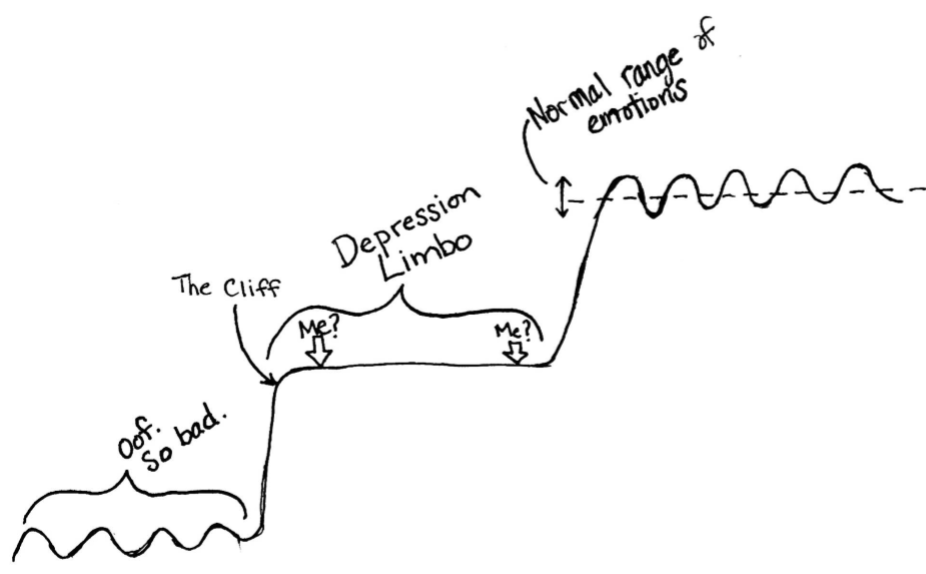
There’s a plateau that I always seem to hit in my recovery from a bout of depression. Since the first time I became depressed, I don’t think I’ve ever gotten past the plateau. I call it “Depression Limbo”. Here’s what I mean:

graph-of-depression-limbo-concept

Depression Limbo is an in-between place where things aren’t terrible, but they’re not great, either. Because you’re not in the pit of darkness, it’s easy to think you’re doing alright; and you are- comparatively. Things aren’t great, but they are ok. This makes it hard to find the motivation to pull yourself out of Depression Limbo. You think “this isn’t so bad. I can settle for this.” And that’s where it gets dangerous. Depression Limbo is flat, so you have no idea how close you are to the cliff and, therefore, to crisis. You could be anywhere along the plateau, but it all looks the same.

I’m in Depression Limbo. It’s a familiar place; I’ve been here several times before. I can laugh again. I’m enjoying my hobbies. I’m exercising again. I’m tempted to say it’s good enough, but I know that that’s risky. I’m tired all the time, I don’t really want to eat, and I tend to be trapped in my routine. This time, I won’t be settling for “good enough”. I’m going all the way to the top.

There is Always a Choice

TW: self-harm and suicide

I wrote this in my hospital journal towards the end of my stay. A few days ago, I published a post about self-compassion. The two seem to go together, in my mind.

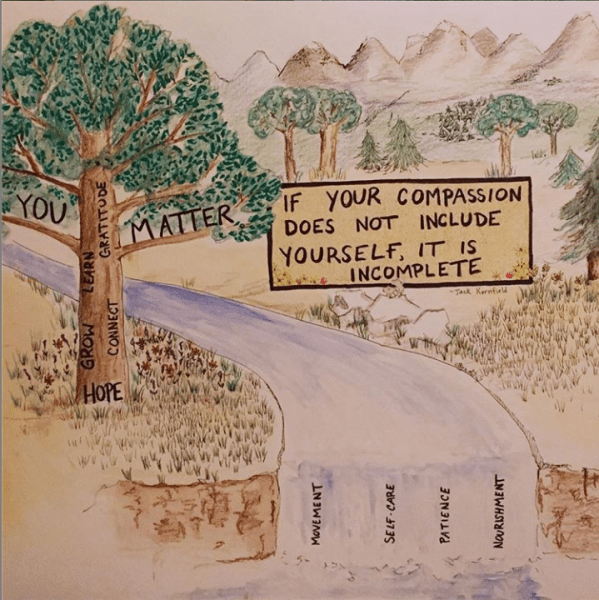
drawing of landscape with tree and river and words about self-compassionThere is always a choice. Two therapists have told me this independently. It took a little while for the meaning to sink in after the first therapist said it. I had gone a few weeks without self-harm at that point, and I still felt utterly controlled by it. The question of whether to do it or not didn’t seem like a choice; it seemed like an inevitability. Over time, the less trapped by it I felt, and the more sense that statement made. Although the choice of whether to self-harm might have been stacked in favor of doing it, the choice to take steps to change that was still mine.

I relapsed and eventually ended up here, in the hospital. On the surface, I’m likely to view all of that as a failure. However, I didn’t make the wrong choice. I experienced the symptoms of wanting to self-harm and having suicidal thoughts. I made the choice to be honest and to go to the hospital. I’m making choices every day to participate in groups and to work towards stability.

Was cutting a choice? Yes, but it’s about more than that. It’s about larger choices. When my disorder makes resisting those urges and thoughts too difficult, agency over my life as a whole is still mine. I can decide to work towards taking back control in all areas, however slowly I have to do that. It’s about the choices I make to be honest with my loved ones, to go to therapy, and to take my medication, that will affect my recovery from an illness that makes me want to hurt myself, that makes me want to disappear, that tells me that I don’t matter.

I do matter. I choose to work towards self-love.

There is always a choice.

Love,

Your brain

College and SPD: Dealing with Overwhelm

In my last “College and SPD” post, I talked about what I wish I had known about living with Sensory Processing Disorder while in college. This time, I’m going to share what I learned about self-regulation throughout my four years at a large university.

First, a Story

Let me set the scene: I was a sophomore, sitting in the largest lecture hall in the Chemistry Building at my university. The class was Organic Chemistry, and the year was 2015. It was the height of popularity for Bruno Mars’s song, “Uptown Funk”, and nobody was safe from its groovy, brass beat. My 200-some classmates and I were sitting there, trying to draw the chair conformation of alpha glucose with the same finesse as Professor N., when from the back of the hall came the sharp staccato of percussion instruments. If I could describe the look of pure bewilderment on Prof. N.’s face as a group known for interrupting lectures launched into a truly impressive rendition of “Uptown Funk”, I would. But it escapes description. As for the song: it was loud, it was exhilarating, and it left the class reeling for the remaining 30 minutes. Prof. N. was commendably patient and picked up her lecture where she left off, but my peers were distracted and buzzing with excitement.

The spike of adrenaline that I get from the sound of a dropped saucepan or a vacuum being turned on is just like the feeling of having your train of thought derailed by six thespians with trumpets, a bass, and some killer vocal cords. That day in Organic Chemistry was one of the few times I haven’t felt alone in my sensitivity. It was so jarring that you couldn’t help but react, and I wasn’t the only one!

There’s Always Something

Musical interruptions are not commonplace, at least not at my alma mater. There are, however, plenty of stimuli to put you on edge.

home_flexi1
Why do you have to scream? Also, how is this legal?

From the hordes of students clogging the walkways to the documentary clips played at full volume during your history class, to the inebriated bachelorette party on that weird bicycle/drinking bus that passes under your window at midnight.

I quickly found that I needed more time to recharge than I did before college. I also found that it was more difficult to find time to do so. I was swamped with assignments, study groups, and exam prep, and feeling the pressure of those expectations that I should live it up.

I Did Not “Live it Up”

My sophomore-year roommate and I went to one (1) party and spent the entire time shouting over the music to help a drunk student whose friends had lost track of her. For a while, I thought there must be something that I was missing out on. Why would so many people enthusiastically subject themselves to that? The answer is that my threshold for intense stimuli is probably much, much lower than that of someone who loves to party. Parties are loud, crowded, and messy; all things that raise my nervous system’s arousal past where it’s comfortable. While a little bit is enough to overwhelm me, it’s perfect for someone who craves that kind of input. Eventually, I accepted that the party scene just isn’t my thing, and I was much happier for it.

Find What’s Soothing

While you can simply choose not to go to parties, there are some aspects of college life that are unavoidably draining. For the general stress of being a college student, I found that establishing a routine was immensely helpful. Breakfast is my favorite meal and probably my favorite time of the day. I’d wake up at the same time, head down to the dining hall with my own mug, get some coffee and food, and start my day off right (read: predictably).

Having my own space set up the way I liked it was also helpful. Many people don’t have the option of living alone in college, but even when I had roommates, I tried to make my desk and bed into little sanctuaries where I could shelter and recharge. My weighted blanket is wonderful, and I learned to never underestimate the power of changing into pajamas.

When my insomnia was at its worst, it took me two hours to fall asleep at night. I just couldn’t settle down; I’d consciously relax my body, and then ten minutes later, realize it was tense again. All the while, my mind was running through deadlines and anxieties. Taking some time in between schoolwork and bed to do something soothing helped my insomnia. I brought my favorite poetry and fiction books from home so that I could read something enjoyable but not too exciting. I also did mental word games to keep my mind occupied until I could fall asleep.

I would have done some things differently if I’d known more about SPD, but I still found ways to cope. Looking back, I suppose that means that I shouldn’t discount my intuition. Listening to it and not judging it is the hard part.

Art as an Expression of Mental Health

I’ve loved making art for as long as I can remember. I used to draw the same picture of a dog on different pieces of paper and leave them scattered around the house as a not-so-subtle hint to my parents that their 5-year-old really wanted a puppy. I like to draw images that I want to remember; memories of pleasant things and places. But I also use art as an expression of mental health.

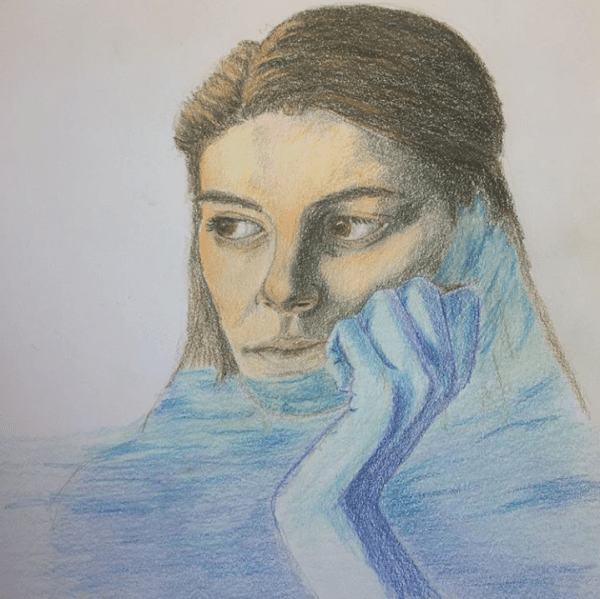
self portrait

Feelings are hard to articulate, but colors, shapes, and textures can carry meaning without the structural constraints of sentences. Creating an image can be a cathartic way to express feelings that also lets other people in on the experience. When I don’t know exactly what to make but I have an urge to make something, I start with choosing materials and just let my hand move freely. Something usually takes shape, but even if it doesn’t, I can always just scrap it and start over.

Part of what I love about art as a way to express mental health is that everyone can interpret it in their own way. As the artist, there’s something that it means to you, but you don’t even have to share that meaning with the people who see your art. And even if you do share it, people will still have an immediate reaction based on their own life circumstances and interpretation style.

The therapist I saw in college believed that there were no accidents in art, and would analyze my sketchbook while sitting next to me. While I’m sure there are some elements of my art that come from my subconscious, I don’t usually see the “accidental” parts of my art as meaningful.

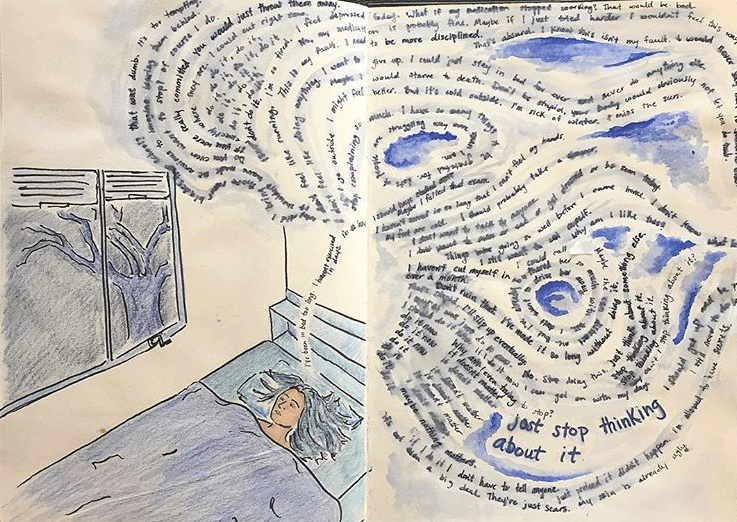
That said, there were always parts of my art that my therapist pointed out as meaningful that I hadn’t noticed before. I could always come away with a better understanding of myself, or at least something new to think about. For example, the window mechanism in this piece is very detailed.

Thoughts

She suggested that detail might be an indicator that there was some hope of freedom or escape from the thoughts in the drawing. Whether that’s something that ended up in the drawing because some part of me believed there was hope, I’m not sure. But I can certainly take that sense of hope away from it, into my normal life. 

Art about mental health is not just an excellent way to express feelings, but it also starts a conversation. It can make people feel less alone in their experience, and it can help your loved ones understand your symptoms and how you feel. Sometimes, it even helps me understand where I’m at in regards to my own outlook. Sometimes a piece of art will take me by surprise at its dark overtones when I thought I was feeling ok. Other times, I’m pleasantly surprised to find that drawing a whimsical picture is exactly what I want to do.

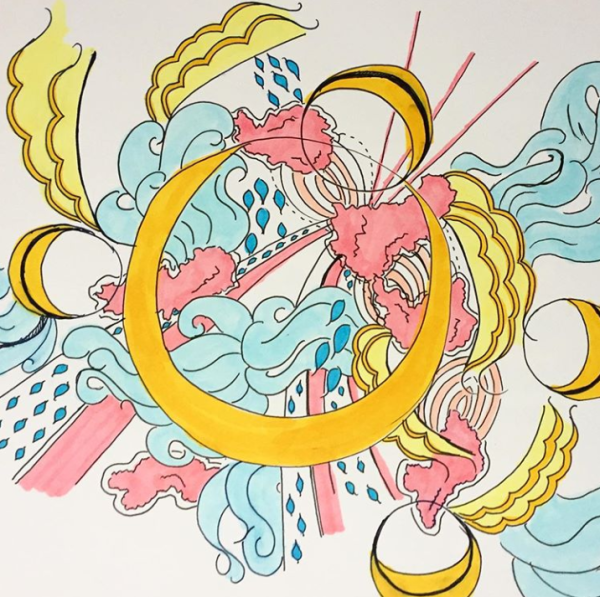
whimsical-drawing-of-yellow-blue-and-pink-shapes

If you’re interested, you can follow my art Instagram @lumpdates

Medicine

medicineIt’s nothing to be ashamed of I tell myself twice daily. What day is it? They all blend together. I open the third compartment, pour the pills into my palm, wait for a moment. Maybe this day will be the day. Maybe if I give the medicine a moment of silence; infuse it with my desperation before I let it fall down the dark well of my esophagus.

How many have I tried? Not enough that all hope is lost. How many have I tried? Enough that they call it “treatment resistant” depression. I call it drowning by degrees. Later, I open the third compartment, pour the pills into my palm, and wait a moment.

It’s nothing to be ashamed of.

Love,

Your brain