An Honest Snapshot

Much has happened since I was last a regular writer. The details are too numerous to recount, but suffice to say, I had a period of contentedness that convinced me depression was conquerable. I started a relationship, I moved, I made friends. Life was incredible and full and sparkling. But the contentedness didn’t last, and my memory of the feeling is becoming hard to grasp.

As always, depression is a heavy fog. The longer it lasts, the thicker and wider it becomes. It’s hard to imagine that there’s anything beyond it. It started as summer came to a close last year. I had a strong sense that winter would be difficult, and I was right. I got back on Lamictal and tried to remember to use my SAD lamp. The months slogged by, but having supportive relationships helped. I hoped that when the weather warmed in the spring, my mood would lift. Unfortunately, that hasn’t happened. I’m not the most depressed I’ve ever been, but when my therapist asked me if it would be okay if I felt the way I feel for the next five years, the answer was a clear “no.”

The most noticeable problem at the moment is the hibernation that I’m doing. I have a distinct daily pattern: I feel relatively good in the morning and then absolutely abysmal in the afternoon. The pull of my bed is terribly strong. Sleeping feels right in the moment, but I know it’s a bad idea. There’s a void in my day, and clawing my way out of it after several hours leaves me feeling much worse than when I fell into it. I know that I need to fill that time with something healthier, but leaving the house in the afternoon is difficult.

Writing has fallen to the very distant wayside for far too long. Running this blog was a source of satisfaction for a long time, and it always helped me work through my thoughts in ways a journal just couldn’t. A journal is usually private, but a blog has an audience, and the act of explaining can illuminate what we do not know and solidify what we do. Feelings are elusive and subjective, so the process of pinning them down in words others can understand often helped me work through them. But I’m out of practice, and I’m low on motivation. I’ve heard that when you lack motivation, you just have to do the thing until a habit forms. So let this be the first step in rediscovering my old habit. I’m going to trek out to the very distant wayside and poke around until I find it.

This post is in memory of Ashley Peterson, a fellow blogger I exchanged comments with before her passing in 2022. Her support of my blog helped me immeasurably during a difficult time, and I wish I had known her more. Ashley’s blog remains a valuable resource for those seeking information about mental health.

Noticing Signs of Depression

Over the last couple of months, I’ve noticed a decline in my mood. I’m not sure why this is happening. Maybe it was stopping the ketamine, or maybe it’s the seasons changing. Or maybe it’s just the cycle my depression has taken. It was so subtle at first that I questioned whether I was imagining it. Fortunately/unfortunately, my extensive experience with being depressed has taught me to look out for several signs that my mood is trending in a concerning direction.

First, I start dreading and putting off my daily walks with Stella. When I do walk her, I get frustrated and impatient, often cutting the walk short so that I can get back inside. This sign is so consistently an indicator that my mood is slipping that I’ve learned to pay attention to it even before I notice any other symptoms of depression.

I also start crying more, which is extremely uncomfortable for me. Displays of emotion make me feel entirely too self-conscious, and crying in front of people is about seven steps too far. I dislike the feeling of losing control of myself. When I start crying at mildly poignant YouTube ads and any time I try to verbally express a slightly negative feeling, I know something’s up.

When I’m depressed, my PMS symptoms are monumentally more disruptive. The aforementioned tearfulness is elevated, my desire to do anything social disappears, and I often start to have urges to harm myself. It’s not a fun time.

Having trouble keeping up with self-care is a classic depression sign, and it’s definitely one I experience. When I start sleeping in my clothes because I just can’t be bothered to change into pajamas — even if it’s just one night — I try to pay attention. It’s easy to put off self-care tasks without realizing that I’m depressed, so sometimes I miss the significance of it. Certainly when it becomes a pattern, though, I know I’m in trouble.

Routine in general is very supportive for me. When I feel good, I adhere to my routine easily, and I feel that it helps me maintain my good mental health. But when I’m depressed, I forget to water my plants, I fall behind on laundry, and I don’t get dressed until the afternoon (when the dreaded walk with Stella becomes unavoidable).

Knowing my signs of depression is vital for combatting the slide into poor mental health, but it’s only part of the process. By the time I notice and accept that I’m becoming depressed, it’s already difficult to pull myself out of it. I’m considering reintroducing Lamictal to my list of medications, but I’m struggling with the concept of it. Being reluctant to take my medication is another unfortunate sign that my depression is worsening. I’m working on just being consistent with the ones I already take.

Seeing as tomorrow is Thanksgiving here in the U.S., I’ll end this post with some positive thoughts. I have a new job, which I really enjoy so far. I’m fortunate to be in a relationship with a wonderfully empathetic, intelligent person, and I’m looking forward to spending time with my family and friends tomorrow. My mental health may not be exactly where I want it to be, but my outlook is still largely positive, and my life is objectively amazing. Wishing you all comfort and happiness on whichever day of the year you read this.

My Mental Health Has Been Good

Life has been good lately. I’ve been taking Mirapex for a few months, and it’s turned out to be very helpful for me. My depression has improved dramatically. I’m more social, more interested in doing things, and more positive in my everyday life. I’m still taking lithium, Seroquel, and Deplin, which I’ve found through trial and very painful error to be completely necessary. All in all, I’m fairly content to continue my current medication regimen — with some minor adjustments.

Balancing Side Effects and Improvement

While Mirapex has proven to be effective at improving my mood, it has also had an effect on my appetite. I struggle with low appetite as a result of my depression anyway, so being even less inclined to eat has become a problem. I’m significantly underweight and struggling to gain. I tried reducing my Mirapex dose in the hopes that it would help my appetite and decrease my anxiety, but it wasn’t a very impactful change in those departments. I also started to notice some worsening depression symptoms, so I returned to the slightly higher dose.

Recognizing Depression Symptoms

I’m glad that at this point, I can put my extensive experience being depressed to good use in recognizing when symptoms are returning. I’m always very aware of how much I’m sleeping during the day. Napping tends to be a reliable indicator that my mood is declining. It’s both a result of the fatigue depression brings as well as a good old-fashioned escape mechanism. When I lose interest in doing anything, sleep seems like a great way to pass the time I don’t want to be conscious for anyway.

I also get this aimless, melancholy feeling that accompanies the anhedonia. I feel like I should be doing something, but I don’t know what, so I move from activity to activity, room to room, feeling lost. When I finally just sit down and embrace the lack of productivity, I feel a sinking, hopeless feeling in my chest.

Dealing with Anxiety

Seesawing between depression and anxiety is an unfortunate pattern for me. Mirapex helps lift my depression, which naturally ushers in the anxiety. The anxiety is augmented by the Mirapex, which tends to make me feel more awake and energized. I feel generally more tightly wound lately. Driving seems to set the anxiety off — to the point of crying, shaking, hyperventilating panic attacks on a few occasions. Even when nothing anxiety-inducing is happening, I find myself feeling restless and tense.

I struggled with debilitating OCD and generalized anxiety as a child and teenager, and I fear going back to that. When I start to get anxious now, as an adult, it feels horribly familiar. So, I try my hardest to combat it. If it’s an intrusive thought that feels like OCD, I do whatever the anxiety tells me not to do. In some ways, the idea of giving in and avoiding the thing makes me more anxious than doing it because I have such a fear of slipping back into old patterns.

Even though I’m fairly good at doing exposures and keeping the OCD in check, being anxious about being anxious is tough to get out of.

Adding Another Medication

In an effort to try to reduce the anxiety, I’m starting to take pregabalin, which is Lyrica. It’s more accurate to say that I’m re-re-restarting Lyrica. I have a really hard time adding medications because of my deeply seated issue with “needing” them. I have this belief that I should be able to fix my psychological problems on my own. Even though, intellectually, I know there’s nothing wrong with taking medications, I still fight with myself over it. At this point, it’s a habit for me to resist any new medications. I’ve “started taking Lyrica” several times now and haven’t continued long enough to get anywhere near an effective dose. This time, though, I’m actually doing it. The balance between anxieties — the general one and the one about taking a new medication — is shifting, and I’m inclined to do something about the everyday anxiety.

For now, I’m just taking a basically homeopathic dose while I get used to having a new pill in my organizer. I’m easing myself into it.

Ketamine Troches

Taking ketamine troches has continued to be somewhat helpful. I definitely notice a decline in my mood when I don’t take them, so I suppose they’re doing something.

My experiences with them are wildly varied, ranging from being trapped on the bathroom floor for an hour while time warped around me to contentedly eating pizza while scrolling the internet. Sometimes, I feel it intensely and dissociate for an hour, and other times, I barely notice anything at all.

I have discovered that on the occasions when I feel the ketamine a lot, it’s important that I not eat too much before bed because if not, I will wake up several times to go vomit.

Moving House

I moved again a few months ago, and aside from the conveniences of living in a house vs an apartment or a townhouse, living in the house has been an interesting transition.

For a while, it just felt like we moved again – this one makes four times in a year and a half if you count “moving” to the hotel after the fire. The significance of having a house after losing the old one sometimes slips by me, and I feel a numbness that I don’t like. I also feel strangely unattached to my new belongings now. I know they’re mine, but they just feel bland and unimportant. If they were damaged or I lost them, I wouldn’t be upset. Perhaps that’s healthy. I don’t know.

On the positive side, Stella has a yard again, which is a major improvement compared to our last place. Of course, she has found ways to crawl under the low deck in search of rabbits, and she’s dug little dirt beds into the two shady spots. Dog-proofing aside, I’m just glad she likes it.

How I See Medication While Depressed vs. Better

My recent experiment, in which I got off all of my medications and became horribly depressed, taught me that I do not do well without lithium and that lithium alone is not enough. This information wasn’t surprising, but I was hoping for a different outcome. I was really hoping. I was hoping that I could exercise, socialize, and exert enough effort to work my way to a healthy mind. By the time I realized I was losing weight and struggling to brush my teeth every day, those options felt out of reach.

The more depressed I became, the less I wanted to give up on my experiment. Some of it was a sunk cost fallacy, but some of it was my clouded thinking. I saw medication as an outside force that would influence my thoughts and distort reality. I felt suspicious of it. Looking back, I can see that I was not thinking clearly. I’m much more in control of myself now that I’ve been back on medication for a couple months.

Not only am I keeping up with hygiene and sleep, but I’m capable of appreciating the sensations of life outside my bedroom – a flock of house finches chirping in a bush, the sun on my eyelids, Stella’s wet nose against my hand. I no longer go to bed immediately after work, and I also don’t sit on my bed at night, staring into space in an apathetic stupor. I’m getting out and meeting people, running errands, and picking up my hobbies again.

I don’t feel good every day right now, but I feel capable enough to put the usual lifestyle tactics to use. My situation feels more manageable. These developments are partly thanks to therapy and my efforts outside of it, but I think they’re mostly due to medication.

So, I know very well that medication helps me, and I’m working on accepting that. I don’t have any desire to stop taking them, which is a step forward for me. But an internal conflict still exists within myself. I certainly still have some shame about it. I was uncomfortable when I was asked to list my medications at my recent dental appointment, knowing another patient was right behind the curtain. I feel reminded of my mental illness every time I pick my meds up at the pharmacy. I struggle when I pour them into my palm at night, and I see a number of pills that exceeds my mind’s arbitrary “acceptable” number.

Most of my difficulty with medication is eased when my mood improves, but the remnants come from my perfectionism. I want to be able to get better on my own, and I have a tendency to tell myself that it’s not that bad.

Despite the background beliefs that are tough to get rid of, I feel like my perspective on medication has shifted compared to a few months ago. I’m happy that my medications are working. I’m no longer uncomfortable with the idea of them affecting my mind.

It’s strange to look back on what I was thinking when my depression was worse. I had this idea that if I relied on medication to function, I wouldn’t really have earned that improvement. It would mean I wasn’t in control of myself enough to pull myself out of depression on my own. It’s a horrible thought that nobody else should ever believe about themselves. I shouldn’t believe it, either.

I was also very preoccupied with the idea that lithium prevented me from thinking about suicide in the same way as I did without it. Even though I knew that was the point, it made me very uneasy. I thought that I was seeing the situation more clearly than I did when I was less depressed and on medication. Part of me knew that was absurd, but part of me was sure it wasn’t.

Once it was long past obvious that getting off lithium was not going well, I really struggled to come around to the idea of restarting it. When you can’t trust your own logic, having people around you to tell you how they see things is very helpful. Still, for weeks after I restarted lithium, my evenings were spent arguing with myself about which side was right and whether I should take it or not. I think the combination of ketamine and Mirapex has improved my mood enough that I’m not concerned with it anymore.

A yellow orchid flower

There have been a few times in my history with depression when I found a treatment that worked but only briefly. Either I’d start to feel better and then something would go wrong, it just would stop working, or it would affect me too much, and I’d fly into an uncomfortable, sleepless state of heightened perception. After which, I’d descend back into depression, sometimes worse than before the improvement. This time feels different.

I think the last time I felt this positive about my improvement was in 2020, when I was getting ketamine infusions and they had started to work. I remember feeling amazed by how much easier life was and how motivated I felt to accomplish my goals. I feel a similar sense of improvement now. It is, as usual, accompanied by increased anxiety, but overall, my mood seems fairly stable in its new, elevated position.

Trying to Restart My Hobbies

It bothers me periodically that I’ve lost interest in my hobbies. I used to enjoy going to the library, but I don’t read anymore. I try every once in a while to draw something or start an embroidery project, but I usually just end up staring at the materials for a while and then giving up. Art has always been something I do sporadically. I have periods of inspiration and periods in which I set it aside, but I always cycle back through. Not lately. I feel like I’ve lost all motivation to create anything – even in writing. My drive to write on my blog has been exceptionally low, even though I maintain a desire to keep up with it. It’s a frustrating space to be in.

Part of my problem with visual art is that I get too caught up in making it match my mental image. It leads me to give up or not start at all. It occurred to me that it might be easier to get started if I tried to make something after taking a ketamine troche. I have tried writing while dissociating on ketamine, but something about articulating my thoughts in full sentences proves to be very difficult, and I usually abandon it.

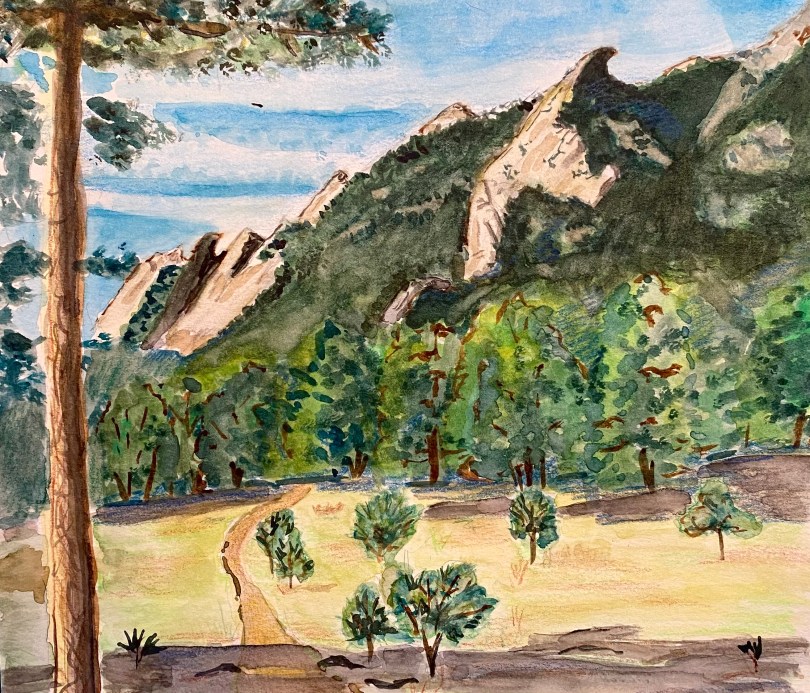
Turns out, painting is entirely different. I sketched out a landscape based on a photo and pulled out my watercolors before taking a troche.

I found the process of putting colors on the paper to be engrossing, and I think that since I was curious to see how it turned out, I wasn’t so worried about it looking “bad.”

By the time the ketamine had worn off, I had made it to this point:

It was unfinished, so the next day, I went back to it with all of my faculties and spruced it up. I still don’t love how it turned out, but I can label it a ketamine experiment and be content with that.

Other hobbies I’m attempting to resume include running, drawing, and volunteering. Each of them is in the tiny beginning stages, but I have to start somewhere.

My experiences with ketamine troches have been varied. Sometimes it hits me, and I decide that being horizontal is better than attempting to sit up, so I get in bed. I’ve definitely noticed that remaining still makes me less likely to get nauseated, but it also makes it harder to perceive the dissociative effects of ketamine. I frequently think that I’m past the dissociation and get up, intending to go walk the dog or clean the kitchen, only to realize upon standing that I most definitely am not ready to practice such advanced life skills.

Then again, sometimes it seems like nothing happens when I take a troche. This is somewhat disappointing, given how much mental preparation goes into overcoming the revolting medicinal flavor. I could just swallow the troche without letting it dissolve, except the edges of it are sharp. Believe me – I’ve tried. It’s painful. The best way I’ve found to take ketamine troches is to sip lukewarm tea while it’s dissolving in my mouth. It helps with the flavor, and the liquid speeds up the dissolving process.

My first few troches were more intense than subsequent ones, and overall, I’ve found that they produce much less absurdity in my mental images than ketamine infusions did. Troches tend to lead me down memory lane or explorations of personal questions rather than bizarre, imaginative storylines.

I think that because taking prescription ketamine at home still seems strange to me, I often ponder the question, “How did I get here?” My experience with mental illness started early, so naturally, my childhood comes to mind when I pose that question to myself. Sometimes, when the ketamine kicks in, I begin to review my life as if I were watching a movie, skipping ahead and replaying certain parts. It either leads to me feeling like perseverance is my path or just feeling utterly lost. When I separate from myself a little, it often just adds to my pre-existing sense of confusion and nonbelonging.

More often than not, I cry when the ketamine kicks in. I don’t know if that’s common or expected, but it’s definitely a pattern for me. And it’s interesting because I don’t cry with much regularity in my everyday life. I’m not sure why dissociating would make me feel my emotions more, but it seems to me like it does.

I do feel a bit better, but I’m not sure whether I should attribute that to being back on lithium, the ketamine, or the new medication I’m taking, Mirapex. Historically, lithium has been very helpful in tamping down my suicidal thoughts and allowing me to be more functional. It doesn’t usually do much about the anhedonia, which leaves me feeling the need to accomplish things but not getting much satisfaction from it.

I also started taking Mirapex a few weeks ago. It’s a dopamine agonist used for Parkinson’s disease, restless leg syndrome, and – off-label – depression. I’m in the middle of increasing the dose, and so far, I’m not sure whether it’s helping. It certainly could be part of the combination.

Purple neon lights in concentric triangle shapes

Familiar Themes: Ketamine Troches Part 2

Listening to music during ketamine infusions usually helped me generate a flow of images connected by associations that were often mysterious to me when the infusion was over. Sometimes, I would be faced with settings or items that had made recent appearances in my life, and other times, the things I saw seemed entirely random. It was always different.

However, there was one commonality between many of my infusions. I often felt as though I were sinking in deep water. It was peaceful but also evoked a feeling of hopelessness, which is what I wrote in my posts at the time. Some of those infusions gave me the sense that water held some significance to my subconscious. I tried to draw some meaning from it – to spin it in a positive way or discern some kind of symbolism. I could only guess that the unsteadiness the ketamine made me feel was connected to the sensation of being underwater, and that my day-to-day sense of hopelessness was intruding on me during my infusions. It made me feel like I was drifting down through a vast body of water, and there was nothing I could do about it.

At some point, the water-based visions stopped, only to be replaced by a similar experience in which I was buried in sand at the bottom of an empty well. I concluded at that time that “my perception of depression [was] manifesting itself as unbeatable natural forces in my ketamine infusions. In my visual experience of ketamine, depression feels like sinking alone in the dark, open ocean. It feels like being buried in sand at the bottom of a well while people far away can only watch.” I don’t know for sure why I had so many experiences like those, but I felt the comparison was apt; depression was pulling me down, and it would be easier to not resist.

I found myself in a similar place when I took the ketamine troche the other day. Deciding which playlist to start proved to be difficult, so I removed my earbuds for the first half and just listened to the sounds of the room around me. Allowing my thoughts to wander on their own without the influence of music might not be the best option for me. Although my mind touched on dark topics during infusions, the progression of one song to the next helped keep my thoughts moving, and frankly, the intensity of the ketamine made controlling my thoughts difficult. They floated from one image to the next automatically. With nothing to pull me along and just enough mental control of myself to not get distracted by random stimuli when I took the troche, I became stuck. Eventually, I found some music to listen to, but my mind was already trapped in a negative space and it seemed to be too late to change it.

I’m planning to find a guided meditation or an audiobook to listen to next time. Perhaps if I begin with a positive intention and impose a framework of some kind, I can herd my thoughts toward something more helpful.

So far, the dissociative effects of ketamine have been limited to a roughly one to two-hour window. Thankfully, it seems that the extended visual and auditory hallucinations that I experienced after a few infusions (notably, this one and this one) were due to the combination of ketamine and Emsam, which I’m no longer taking. I haven’t noticed any giddiness or restlessness after taking the troches, either, which troubled me toward the end of my time getting infusions. That may have also been because of Emsam.

The plan is to increase the dose and continue taking them twice a week. Hopefully I’ll start to notice something positive.

View of milky way in night sky

Renewing The Ketamine Chronicles: Troches Part 1

I wrote in my last post that my ill-advised attempt to get off my medications is not going well. Not much of a surprise, I suppose. My psychiatrist suggested I try an oral formulation of ketamine, known as troches (pronounced “tro-keys”). These are dissolvable tablets that you take home and administer to yourself on a schedule. I’m doing it twice a week for two weeks.

One of the main drawbacks of troches is that the ketamine is less bioavailable compared to IV ketamine, which makes precise dosing a challenge. The risk of addiction can be minimized by carefully monitoring patients’ responses and prescribing ketamine troches in small batches with limited or no refills. An Osmind article written by a physician notes that the ketamine doses that are commonly prescribed are much lower than typical recreational doses but that doctors should have carefully outlined plans for restricting use and halting patients’ access to ketamine troches if necessary.

I got ketamine infusions fairly regularly for two years and then stopped with no problem, so I’m not very concerned about my own risk of becoming addicted. However, a cautious approach seems prudent.

An article on RX Insider describes ketamine troches quite positively, saying that they are a more affordable option than infusions and that they offer relief for patients who may not have access to other forms of ketamine due to logistical constraints or COVID-19 safety concerns.

Even with the experience I have from ketamine infusions under my belt, I was nervous about trying troches. In general, I’m uncomfortable with the idea of not being in control of myself. I managed to let that go when I did ketamine infusions, but the medical monitoring involved in that alleviated some of my anxiety. The uncertainty about what to expect when taking ketamine at home put me on edge, but it has turned out to be fine so far.

What Do Ketamine Troches Feel Like?

I’ve tried two ketamine troches and had very different results each time. Having some idea of what to expect based on my experience with ketamine infusions, I tried to set myself up for a smooth ride. The dog had been walked, my curtains were closed, and I had no obligations waiting for me. I wore comfortable clothes, arranged my weighted blanket on my lap, and chose some gentle-but-compelling instrumental music to listen to.

The first time, I put the troche under my tongue, waited until it dissolved (about 10 minutes), and then waited about 5 more minutes before spitting it out. I may have felt something, but it passed quickly, and I felt completely normal about 5 minutes later. It was so mild that I wasn’t even sure whether I felt it because I expected to or because the ketamine actually had some effect on me. I’d been advised to spit the ketamine out to minimize nausea, but when I reported feeling pretty much nothing, my psychiatrist told me to wait ten minutes after it dissolved the next time and, if I still didn’t feel anything, I could try swallowing it the following time.

A few days later, I tried it for a second time and waited longer than recommended. I think the ketamine that was absorbed under my tongue gave me a very mild dissociative feeling, but it again passed very quickly. This time, I took notes on my phone so I could keep track of the timing. I started at 2:45 and didn’t feel anything until 3:04. I felt a very low level of spatial wobbliness – a lot like how I feel when I’m a little overwhelmed in a busy grocery store. It felt like things were getting a bit hard to track with my eyes, and I felt ever so slightly floaty. By 3:15, it seemed like the effect had already peaked in a mild way and worn off. I felt pretty normal, so I swallowed the ketamine, and a second wave came a few minutes later.

At 3:30, I noted that my fingers felt a little numb and that I was going to close my eyes. Seven minutes later, I wrote, “Music too intense. Felt like being carried on a river of sound.” What does that mean? I no longer know. You might think that I was completely zonked, based on that tidbit, but only one minute later, I held a brief conversation with my mom and managed to seem totally coherent. Compared to ketamine infusions, troches seemed to create a more fragile dissociative state. I was much more able to pull myself out of it when under the influence of troches than I was when I got infusions.

I think my anxiety about what would happen had me coming back to the room frequently, which resulted in a very fragmented experience. I would get sucked into a song for a couple minutes and then reorient myself and write a quick note on my phone about what was happening.

When I closed my eyes, my sense of where my body was and where certain parts of my body were in relation to each other was distorted. It’s a feeling I also tend to experience when I’m on the edge of sleep or when I sit still for too long. Sometimes, it’s only a small discrepancy, such as the difference between whether my hands are resting on my lap or next to me.

The sensation is cranked up on ketamine. This time, it resulted in me feeling like my head was somehow directly connected to my knees. I experienced this kind of bodily confusion frequently during ketamine infusions, so I knew it was nothing to be concerned about. I tried to let go of my desire to organize my body in a certain way and just float along in whatever form I had taken.

Every time I checked back in to the real world, I was surprised to find that only a few minutes had passed. It felt more like 20 or 30.

What I was seeing and feeling during those few minutes was nothing so detailed or bizarre as what ketamine infusions created, but I have the sense that if the experience had not been so fractured, I might have approached a similar level of immersion.

I remember one song evoking an image of the night sky as viewed from a very dark place, with the vast swath of the milky way stretching out overhead. Another song made me feel as though I were standing in my old house as it burned down, sparks and ashes falling around me. The wind had begun to howl outside in earnest, which makes me nervous these days.   

At 3:48, Stella decided to sit on the window seat. She found the break in the curtains and pushed her way through, light streaming in behind her. The light held my attention for a few minutes, but by 3:53, I wrote that I was feeling more normal but also rather sad. I had a bit of a cry, noticed that time was jumping ahead in small increments, and then got up to go to the bathroom at 4:10. Looking in the mirror was an unsettling experience, but I expected that, so it wasn’t too disturbing.

By 4:22, I felt like I was completely past the effects of the ketamine. So, all told, the entire process took about an hour and a half from the time I first noticed the ketamine affecting me.

I haven’t noticed any improvement from the ketamine, but I have two more to do before the end of my two weeks. In the meantime, I’ve decided to get back on lithium. It seems obvious that stopping it was a bad idea and that I’ve clung to the hope that I could make it work without it for too long. I’m trying to keep the perspective that my experiment was informative, and it’s good that lithium helps me. But to be honest, I just feel defeated. The better I feel, the easier I am on myself for needing medication, so hopefully, this ultra-critical side of myself will quiet down when the lithium starts working.