Anxiety and Doing New Things

In an attempt to fill my time with things that will keep me from slipping back into severe depression, I’ve started doing New Things. One is volunteering and the other is taking a neighbor/friend up on her offer to teach me how to ride horses.

I really want to quit and crawl back into my hermit cave. I am way outside of my comfort zone, which, for me, always leads to near-constant worrying and ruminating. I can’t help but laugh because when my new therapist asked if anxiety was also a problem for me in addition to depression, I said “hmm, no, not really.” She later disagreed, and the more I think about it, the more I realize that yes, yes it definitely is. Now that my depression is easing, I think that anxiety is coming to the surface. (Additionally, when I tell people about this anxiety realization, they look at me like “you…didn’t know that?” So, that’s cool. Everyone knows about this but me.)

When I’m really depressed, I’m so numb and slowed down that I don’t even worry about saying “yes” to new things; the answer is automatically “no”. But when the depression lifts, my natural tendency to overthink everything and fall face-first into crippling indecision has room to become obvious. Because I feel capable of doing more than I did while depressed, I feel like I should say “yes” to new opportunities, even if I’m on the fence.

Rather than deciding to just get out there and demolish the boundaries of my comfort zone, I get…stuck. Really stuck. I want to do new things in general, but when an opportunity comes along, my worry and fear keep me from making a confident decision. It’s tough for me to decipher whether I don’t want to do something because I’m feeling overwhelming New Thing-anxiety or because I won’t like it. And, since I know that this is a problem for me, if I think there’s a chance I might like it eventually, I tend to make myself push through and do it no matter what. Of course, I do that while also continuing to worry about whether or not that’s the right thing to do.

An additional layer of this terrible cake is that I do not like quitting, even if I really want to bail. And even if this hypothetical New Thing has very natural exits where I can decide it’s not for me and stop, it still feeeeels like quitting. This makes me even more indecisive because not only do I need to know if my anxiety is coming from a dislike of the Thing or not, but I also need to know if I can be committed to the entire Thing. No quitting. Approaching opportunities like this is not fun, and I do not recommend it. 0/10.

I imagine the goal is to take each new opportunity and be able to decide, quickly and simply, whether I want to do it or not. I just don’t know how to do that without taking all of the stuff above into account and getting hopelessly tangled up. I guess step one is to remind myself that I can say “no”, changing my mind is ok, and that in many cases, it’s not that big of a deal.

Much easier said than done.
 

Claude Monet: The Truth of Nature

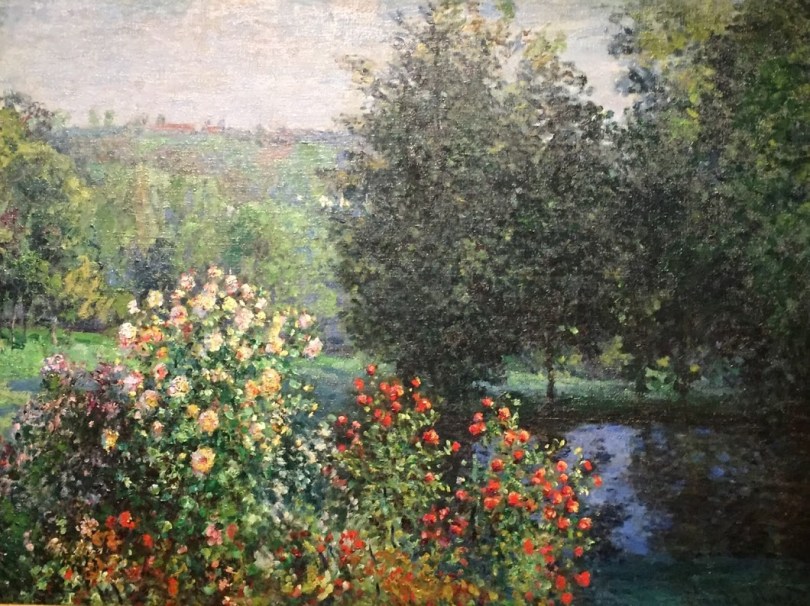
Two weeks ago, while trapped in the ill-fitting, damp denim jacket of depression, I slipped into the airy expanse of the Denver Art Museum. We were there to see a once-in-a-lifetime exhibit that is visiting nowhere else in the U.S. besides Denver. It’s called Claude Monet: The Truth of Nature. While an art exhibit is not enough to cure my mental malaise, it certainly helped.

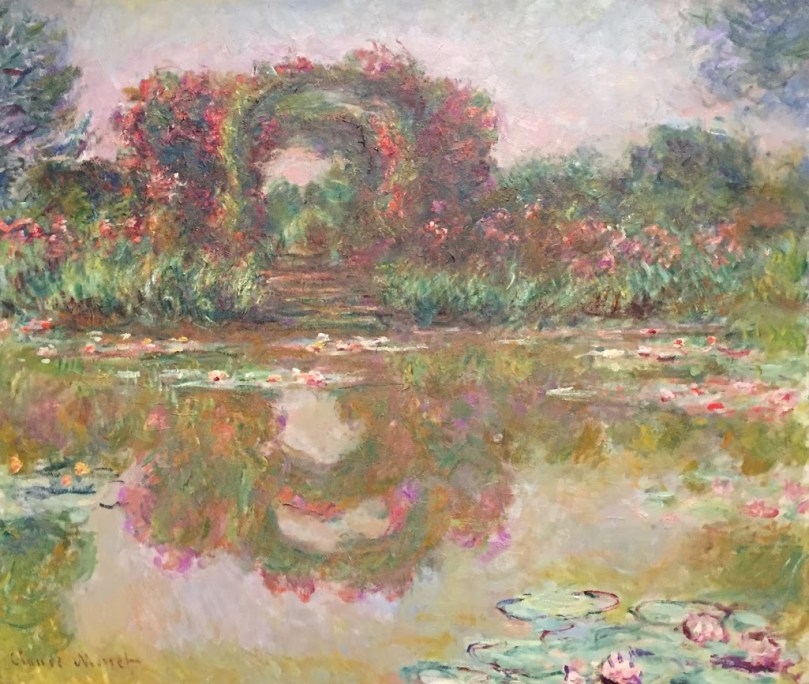
Monet’s art is just up my alley: nuanced, filled with light, and nature-focused. I could not choose a favorite if I tried. To some extent, each room was dedicated to a particular time period in Monet’s life. There were some parts that compared paintings of the same subject done at different times, but for the most part, the chronological organization helped show the progression of his style from something close to realism into distinctive impressionism. We saw the poplar trees, the haystacks, the waterlilies, and so much more. We saw the ice of the frozen Seine and the roses of his beloved garden. We saw the paintings up close, inspecting the details and sudden colors, and we saw them from far away, brushstrokes blending into a strikingly clear image.

monet roses

I was particularly taken with his ability to render water and reflections. At mid-distance, there is an overwhelming illusion of depth in the water he painted. It’s like you could just dive right in. Upon closer inspection, I marveled at the sheer number of colors and shades he used to achieve that effect, and the shapes that brought the water together. From a distance, I lost sight of the intricacies but was captivated by the image as a whole.

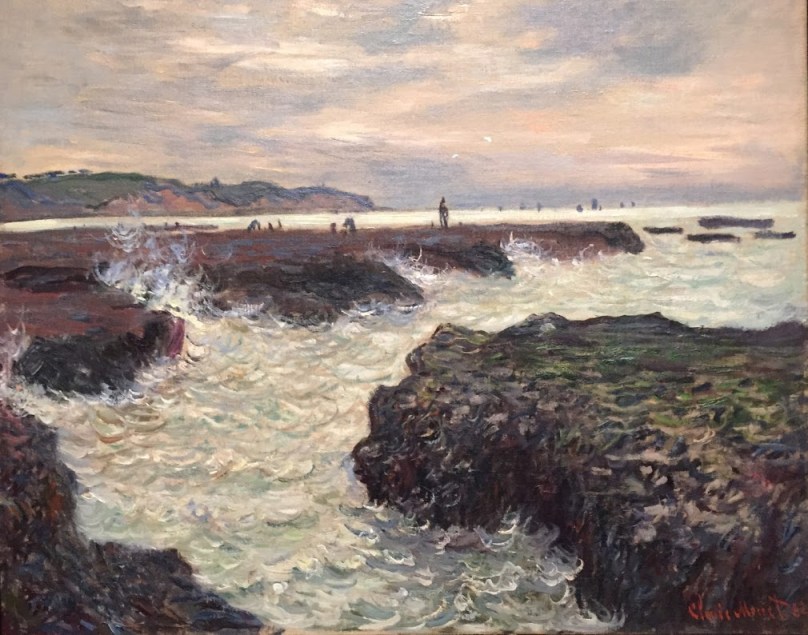
Monet was driven by a desire to capture specific moments in time, and to represent them as true to nature’s beauty as possible. Part of that beauty is how it looks, but part of it is how being in nature makes you feel. Monet’s art is about how afternoon light is different from morning light, and how the same scene makes you feel at different times. It’s about atmosphere: how ripples in water convey emotion, how cliff faces can be sinister, and how perspective changes everything.

waves

While in the exhibit, I overheard a mother and her young daughter discussing a painting. The daughter asked if there was glass covering it, to which her mother replied “No,” there wasn’t.

“Then why is it shining?”

“That’s just his painting.”


It was tiring but well worth it. I’m thankful that I got to immerse myself in this exhibit, and that my brain allowed me to enjoy Monet’s shining paintings.

lilypad


person-extending-hands-with-open-palms-in-stop-gesture-as-contamination-ocd-concept-in-black-and-white

An Encounter with Contamination OCD

I haven’t been consumed by OCD in several years, something I’m immensely grateful for. That particular kind of mental torture is truly awful and not something I would wish on anyone. One of the subsets of OCD that I had was contamination OCD. My body and belongings had to be whatever my disorder deemed to be “clean,” or else some unnamed disaster would occur. There were often no actual illnesses I was afraid I might contract – I was just terrified of potential contamination by unknown germs/viruses/entities.

The Endless Compulsions

Beyond the fear, maybe the worst part of contamination OCD was how time-consuming it was. If something was “dirty” and it touched something “clean,” or if I touched the dirty item and then the clean item, they were both dirty. I spent a lot of time planning out sequences of actions that would combine touching dirty items because otherwise, I would spend half the time washing my hands raw so as to not contaminate anything else. My hands were always painful. I scrubbed them under hot water until I’d stripped them of any moisture barrier. Any movement cracked and split the skin open, which, ironically, made my bleeding hands perfect entry points for bacteria and viruses. But, OCD is not swayed by reason and rationality. It creates doubt that can’t be rooted out with reassuring facts.

Contamination OCD After Recovery

For the most part, I don’t deal with OCD anymore, contamination OCD or otherwise. My day-to-day life is not consumed by it like it was before, but every once in a while, I encounter something that stirs those obsessions up. My perfectionism around self-harm is one, and tapeworms appear to be another.

Unexpected OCD Triggers

I’m not squeamish, despite what you might think after learning of my past with contamination OCD. Again, OCD is not rational. Parasites are fascinating and don’t bother me from afar, but when I found a tapeworm segment in my dog’s stool, I felt the familiar stomach twisting of contamination OCD.

Once the initial shock passed, I found myself thinking about all of the things I would have to clean. First and foremost, the hand that held the poo bag. I must not touch anything between there and home, not even to put my hand in my pocket. The bed in her crate would need to be washed, and all of my sheets and blankets because she often snoozes on my bed. Should I wash her leash and harness? Perhaps I should stop petting her– would that be going too far? On second thought, that would be impossible. I’ll just wash my hands every time I touch her. So, like, 80 billion times per day.

OCD is Irrational

Keep in mind that the most common species of tapeworm is passed to humans only when you ingest a flea that carries the tapeworm eggs. Not likely. There is also a species of tapeworm that can be passed from dog to human through ingested feces on unwashed hands, but it’s not common in the U.S., and I’m a frequent hand-washer as it is. In other words, it’s very unlikely that I would get tapeworms from Stella.

I Fell into Old Patterns

That night, I lay in bed, Stella at my feet, and tried to control my rising panic. The vet was closed for the holidays, so I had left a message. Having no idea when they would return my call, I did what any smartphone-wielding person would do; I looked it up. Unfortunately, Google played the role of the reassuring-but-clueless friend who says something terrifying right at the very end of the conversation.

“Oh, it’s very uncommon for people to get them? OH, you might not show signs until years after ingestion?!”

Not gonna lie, my concern for Stella was overshadowed by my selfish, irrational fear for myself. The thought of something living inside me usually doesn’t bother me. After all, we are made up of more bacterial cells than human cells. Maybe it’s an evolutionary adaptation to be totally wigged out at the thought of parasites taking up room in your gut.

Facing Contamination OCD with Exposures

The good news is, I realized that I was obsessing about this right before I returned to the scariest thought of them all: “What if I already have tapeworms?” This is good news because it really kicked me into the best way to face OCD thoughts, which is to say, “Yeah, and?”

In the dark in more ways than one, with my tapeworm-host dog not three feet from me, I had to say, “Maybe I do have tapeworms. What am I gonna do about it right now?” Just sitting with the uncertainty brings you to the stunning realization that there is absolutely nothing productive about rumination. So, with a little more deliberate relaxation, my hypothetical tapeworms and I went to sleep. Well, maybe not the tapeworms. Do tapeworms sleep?

Living with Uncertainty

I still don’t know if I have tapeworms, and it’s honestly probably something that I’ll worry about off and on for a while. I do know that I’m much better at squashing obsessions than I used to be, maybe because I know it’s something I’m prone to and can catch it early on. Stella is on a deworming medicine and continues to behave like a dog. That is to say, eats anything and everything with gusto and drinks water out of the Christmas tree stand when nobody’s looking.

A wide, leafy tree in a field filled with fog and one person walking.

Depressed Again Despite IV Ketamine Treatment: The Ketamine Chronicles (Part 10)

When I started this series, I promised to be as honest as possible for anyone looking for information about getting IV ketamine treatment for depression. So, what can I say? I’m depressed again.

I’m sluggish, I’m sad, and I’m hard on myself. I’m really struggling to get through work, to the point where I actually get pretty behind on some tasks. When that happens and I refuse to let myself nap in favor of catching up, I take frequent breaks. Want to know what those breaks consist of? Sitting with my eyes closed. Forcing myself to keep working is so draining that I have to just stop and close my eyes for a few minutes. And then I get frustrated because why can’t I just bang out this edit or work through the day like other people can? Because I’m depressed again.

To be honest, I’m finding this hard to write. Just from a purely functional level, gathering my thoughts is proving to be challenging. I have a sense of the kind of message I’m trying to convey, but the words for that are slow to appear.

Here’s what I’m thinking:

  • I really want to stress that this kind of decline in progress with ketamine for depression is not common. Don’t let my weird experience deter you. You deserve optimism.
  • Some words I want to include about how to treat yourself when you’re faced with a setback:
    patience, kindness, honesty, determination.
  • I feel the need to express that I’m kind of nervous about this post. I don’t want it to seem like as much of a failure as it feels like. I guess I should practice the previous bullet point.

My last ketamine treatment seemed no different from any other (in how it felt, at least), but hasn’t seemed to have much of an effect on me. In trying to figure out why, we considered whether any of these applied:

  • illness (like a cold or the flu)
  • not going to therapy
  • not sleeping enough
  • not exercising
  • life stresses
  • medication changes

It was this last one that checked a box. Initially, I said, “Nope, they’re all the same,” but we later remembered that I recently had an issue with my birth control and stopped taking it. (Sorry if this is a weird topic, but really, it shouldn’t be. No biggie.) Everything else seems like it’s been the same, so I guess that looks like the explanation.

I’m working on figuring out my prescription issue with my pharmacy, and I’m going to go in for a booster ketamine infusion sooner than we had scheduled. I didn’t want the Ketamine Chronicles post that will go with that infusion to be super long, so I thought I’d dedicate an extra one to explain myself.

So, that’s the update. I’m hoping that we figured it out and getting back on birth control will even things out. I’m also trying not to let my brain’s automatic thoughts bully me into believing that it’s my fault and that this is a repeat of all those medications that didn’t work out. Catastrophizing is not allowed, brain!

If you’d like to read more about my experience with ketamine for depression, start from the beginning of The Ketamine Chronicles or visit the archives. Click here for mobile-optimized archives of The Ketamine Chronicles.

woman running shoes running up concrete staircase

December Resolutions: Mid-Month Update

Last month, I decided I’d get a head start on my New Year’s resolutions by treating December as a sort of trial run. I set myself four goals:

  1. Start volunteering
  2. Run regularly
  3. Re-establish skincare routine
  4. Begin relearning German

We’re roughly halfway through December, so I thought I would check in with my progress. Currently, I give myself a 2.5/4. I have been running almost every day, persisting despite the weather. I think I’ve surpassed my goal of establishing enough endurance to (somewhat comfortably) go five miles, so maybe I should aim higher for the end of the month.

I’m diligently maintaining my skincare regimen with topical steroids, a giant light, and a lot of sarcastic jokes about how great I look in UV-protective goggles. I’m not seeing much benefit yet, but it’s not an instant fix.

My efforts to begin volunteering have been temporarily halted; it turns out the organization I was interested in has recently moved (still nearby) and stopped their volunteer orientations until mid-January. I am signed up for the first orientation in January, though, so I think that counts for at least half credit.

That brings us to number four: begin relearning German. I have not started this yet, and I’m trying to decide if I want to push forward with it and see where it takes me by the end of the month, or replace it with a different goal.

All in all, I’m feeling pretty satisfied with my December resolutions.


Anonymity and Mental Health Stigma

IMG_2405

When I started this blog, it was deliberately anonymous in an effort to avoid any mental health stigma from reaching my real life. I didn’t have my name anywhere on it and I made a conscious effort not to mention anything about my life outside the sphere of mental health. I don’t think I even told my immediate family about it until a few months in.

I liked the freedom of writing anything I wanted without overthinking it. Those fears of what will people think? were almost nonexistent because nobody knew who I was. Over time, I began sharing it with people I knew. My immediate family and friends, then my extended family, my therapist, and others involved in my treatment.

I know that putting my name on my blog doesn’t change much for you, the reader. It does, however, signify a big change for me in the context of internalized mental health stigma. I’m finally coming to terms with my diagnoses and feeling more comfortable talking and writing about them as myself, with my real name attached.

Everyone has their own reasons for keeping their online presence anonymous. My reason was rooted in shame. I was afraid that if people knew I was writing about topics like depression, self-harm, and suicidality, they would never again see me for the things that make me, me. The reality is that people I know tend to notice the things that shine through the overarching topics. They comment on my love of writing and my sense of humor before they mention the content of my posts. And when they do broach the subject of my blog, they express their happiness that I’m still working towards stability. It helps, of course, that my family and the people surrounding me are very understanding. Not everyone has that, and I’m so thankful that I do.

Anyway, there you have it. My name is Genevieve (Gen), I’m 23 years old, and I live in Colorado. I got my bachelor’s degree from the University of Michigan, where I studied Ecology and Evolutionary Biology as well as Evolutionary Anthropology. I work from home as an editor and freelance writer (not at all related to my degree, but whatever). On my blog, I write about my diagnoses of sensory processing disorder and major depressive disorder. I like reading, making art, and being in nature. This is starting to sound like a cross between a cover letter and a dating profile, so I’m going to wrap it up.

Lumpdates is still lumpdates, but I’m pretty dang proud of myself for standing up to mental health stigma by typing the nine letters of my name into my username settings.

Wishing you curly fries,

Genevieve