yearly calendar on table with cup of coffee and dish of paper clips

December Resolutions

The yearly frustration that most of us can likely relate to is that our New Year’s resolutions only last a few weeks, or at best, a few months, and yet we continue to make them. It’s relatable because change is hard, and the excitement of turning over a new leaf soon gives way to the stresses of normal life and the reality of breaking old habits. But there’s something so attractive about starting fresh; new calendar, new me.

Clearly, I like the idea of making a deliberate change on a specific date. Something about marking your resolution with an external, cyclical change makes it feel more decisive. Unfortunately, I am so put off by the pressure of an entire year ahead of my resolutions that I simply don’t make any. I’ve made New Year’s resolutions in the past but petered out before they really formed habits. Then, the internal shame of having failed a New Year’s resolution discourages me from trying again mid-year. Because really, why can’t I just resolve to change whenever I want? Because human brains like to impose order on things like arbitrary laps around the sun.

Instead of griping about the pitfalls of New Year’s resolutions and why I can never seem to make it work for me, I’m going to try something different.

~*~*~*~December Resolutions~*~*~*~

This sounds incredibly silly and I think that it’s a little bit sad that it’s come to this, but I think I need to trick myself into meeting my goals. Instead of making a list of resolutions and waiting until the new year to begin, I’m going to have a trial month for my new habits. December will be my 31-day behavior test, and if I hate the goals/habits I come up with, no big deal. I won’t feel bad about quitting because it’s only my December resolutions, not the monumentally more important New Year’s resolutions.

(Yeah. It’s exactly the same thing, but shhh, don’t tell my brain.)

Bonus, if I do like my resolutions and am happy to keep going with them, I won’t have to face the overwhelm of a brand new year stretching ahead of me. I’ll already have a whole month under my belt.

I really think this is going to work for me, at least better than the usual resolution schedule does. Here’s my list of December resolutions, but remember, it’s low-stress, low-commitment, so these can change without me feeling like a failure. At least, that’s the theory.

  1. ACTUALLY start volunteering. Somewhere. Anywhere. Don’t just think about it.
  2. Keep running regularly (yay, I’ve already started!) See if I can reach a comfortable 5 miles by January. I’m more than halfway there, so this seems very doable.
  3. Reestablish a skincare routine, aka get my psoriasis under👏 control👏.
  4. Welcome the hostile Duolingo owl back into my life and start re-learning German.

These seem reasonable to accomplish within a month. The one that I’m definitely most apprehensive about is volunteering. At this point, I’ve thought about it for so long and looked at opportunities in such detail that I really have to just go and do it, and try not to worry about all of the unknowns (thanks, SPD).

Ok, internet, hold me accountable.

Week 25 of Working on Us: Thankful and Grateful

Working on Us is a wonderful series over on Beckie’s Mental Mess, where each week has a new prompt meant to get people talking about mental health topics. Check out the original prompt for week 25 and click around to find participants of previous weeks’ topics!

This week, the prompt is loose; just write about something you’re thankful/grateful for.

I joke with my family that my life basically revolves around the dog park, and although it’s funny, it’s also kind of true. I adopted Stella when I was in a really tough place, mentally, and her sweetness, affection, and persistence are what have gotten me out of bed and outside over the last year.

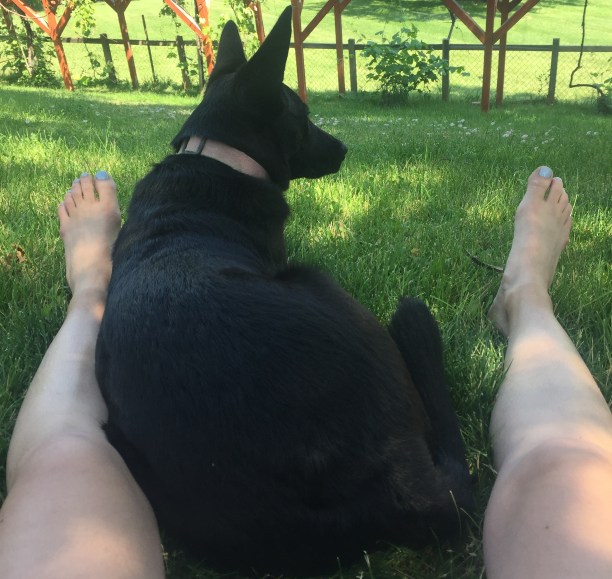
black dog with pointy ears laying in grass between person's outstretched bare legs

When I think about how grateful I am to have Stella, I also think about my family’s support and patience, and how willing they were to care for her when I was in the hospital. I’m thankful for the people I meet at the dog park, and the sense of community and routine I’ve found there. I think about the resources I have to be able to provide for Stella, and the fact that my body allows me to walk, run, and play with her.

IMG_4092black dog with pointed ears panting while lying in shade next to concrete structure

When I think about how grateful I am to call Stella mine, it ripples out to every aspect of my life with her. I think that’s a powerful quality of giving thanks; you cannot be thankful for one thing without also being thankful for what contributes to it and leads to it.

I’m also incredibly thankful for what comes from my responsibility for and love of Stella. I’m thankful for long walks with frequent sniff stops and short walks around the block. She gives me stories to tell and reasons to get out of my comfort zone. I’m grateful that she makes me laugh every day.

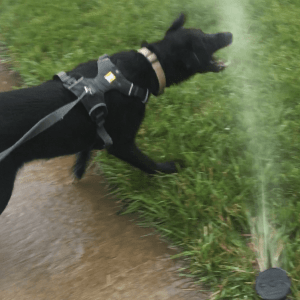
IMG_4489black dog biting stream of water from sprinkler

I’m thankful that she is instantly joyful when I buy her toys, but is also amused with a simple piece of cardboard. I’m thankful that I can tell when she’s tired because one ear flops over.

IMG_3028IMG_4011

I’m thankful for my pup because she makes my life more joyful, she connects me to other people, and she demands that I take care of her and in so doing, myself. I hope that everyone had a lovely Thanksgiving, and if you don’t celebrate Thanksgiving, I hope that you had a great week filled with all of the people, pets, and things you’re thankful for all year long.


A Poem About Being Tired

QUALITIES OF FATIGUE

head statue
Photo by Mika on Unsplash

My eyes are beginning to feel

Like peeled grapes, getting dry

This cannot be fixed

with one. slow. blink.

No, this requires something more

A seven-hour soak inside my orbits

Floating in dark saline dreams

Getting ready for the crack

Of eyelid curtains

And another day of dried-out vision

A Plains Poem

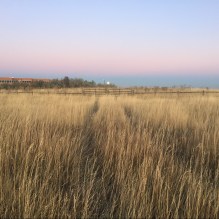
NOVEMBER SNOWtall, yellow grass with overgrown tire tracks and pink sunset

All summer, golden grasses swayed

Over prairie dog burrows in dry caked clay

Little sentries stood at attention

Through parched heat and months of baking sun.


rocky mountains under blue sky with clouds and snowy plains in front
Photos are my own

Now, November snow blankets the plains,

Flattens grasses and where it melts,

leaves golden cowlicks sticking up

at odd angles

A two-tier cake with decorative succulents, white roses, and blackberries arranged over white frosting

A Fish Wedding: The Ketamine Chronicles (Part 8)

It’s been two weeks since my last infusion of IV ketamine for treatment-resistant depression, and I’m still feeling much better than I did before I started. Minor setback due to my lithium experiment aside, it seems like the ketamine hadn’t started to wear off yet, meaning we could schedule the next one for three weeks out.

A Subtle Beginning

As they all are, this ketamine infusion was pretty…different. I popped my earbuds in and started a classical music playlist. Like last time, I closed my eyes and waited for it to begin. It was subtle, and when Dr. G asked me a few minutes later if I was feeling it yet, I opened my eyes and was met with a normal-looking world. “Not really,” I said. Of course, I was eating my words when, a couple of minutes later, I felt like my nose was sinking into my face. (It should be noted that none of this is ever scary for me. I had the sensation that my nose was sinking, but I was completely aware that it wasn’t.)

I thought that maybe I should say, “My nose is sinking into my face,” as Dr. G wanted to know when I felt it taking effect. Somehow, this got lost when I began seeing a whirlpool in a lake that turned into the eye of a storm, spiraling endlessly (song: Full Room Empty Space by Vincent & A Secret).

[I tried to remember which songs went with which images by taking screenshots of my lock screen. I’m finding it tough to remember the majority of this infusion, but I’ll do my best to match up the songs with what I saw.]

Music Influences My Ketamine Dreams

When I got home, I sat down with my laptop and my phone and began trying to recreate the images I saw by listening to the songs over again. Most of them only evoke general feelings and a vague memory of an image. For example, I remember that Prelude and Fugue in C by Bach produced a vision of bright red ink spreading on a ceiling of thick watercolor paper with a chandelier hanging down from the middle.

Concerto in D Minor by Handel gave me a feeling of very old royalty and led to images of stately, historic stone buildings.

At some point, there was a song – I think it was River Free by Boil the Ocean – that paired with images of vast open ocean and a whale shark swimming slowly near schools of fish. While most of these have faded in my memory and I have screenshots of more songs than I can remember images, there was one that stuck with me:

The Fish Wedding

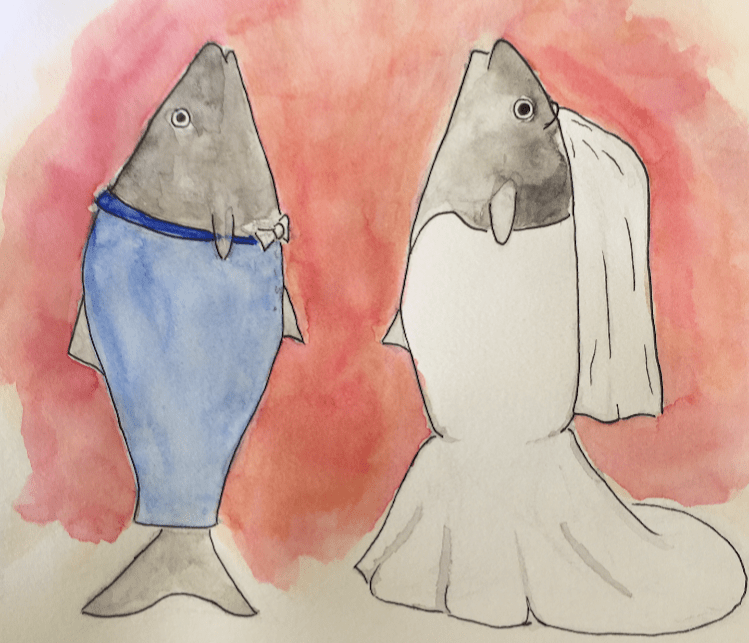
The song is “Songs My Mother Taught Me” by Dvorak. It begins with two fish tucked into a bed, the linens pulled neatly up to their fins. Then, the bed falls away, and the fish are dressed in wedding attire; tuxedo on one and dress and veil on the other.

Two grey fish standing upright on their back fins, one wearing a tuxedo and the other wearing a wedding dress.
My phenomenal attempt to depict the fish wedding.

The fish bride is moving down the aisle (conveniently, I can only see her top half. Not sure about the mechanism of movement, having no legs). There are rows of guests on either side, and I cannot figure out if they’re fish or human. Either way, they watch her breathlessly.

Now, we’re at the reception. The bride and groom are cutting the cake, fins gripping a large knife. As it cuts into the cake, the entire thing collapses in on itself, as if the cake were made of cardboard. The song ends, Allegri’s Miserere mei, Deus begins, and we return to the church with the fish bride.

And then it’s like my brain went, “Wait a minute – we can’t have an anthropomorphized fish in a wedding dress in here, at least not with THIS song,” and the entire feeling of the vision changed. If you can consider your brain to have “cinematography” in ketamine scenes, the images went from “Pride and Prejudice meets quirky, French cartoon,” to “emotional history documentary.” The fish disappeared, and it was just soaring views of an empty cathedral with light streaming in through stained glass windows.

A cathedral interior with sunlight on intricate stained glass windows.
Photo by Alexander Watts on Unsplash

Memories of Ketamine Dreams are Choppy

It’s mildly frustrating to remember thinking “Wow, this song goes perfectly with what I’m seeing,” and not being able to remember what it was that I saw. Sometimes patients will ask the doctor to write down things they think of while the ketamine infusion is going, thinking that it’s incredibly profound, only to read it later and either have no idea what it means or be entirely underwhelmed by its meaning. I imagine that’s what would happen if I could remember every image with its accompanying song. It probably wouldn’t be as perfect as I thought it was.

This was definitely an entertaining infusion, and when I came back to the room, I had no words to describe it other than to say, “There was a FISH. WEDDING.” And then laugh and shake my head.

What it Feels Like to Come Out of a Ketamine Infusion

The best way I can explain what it feels like right after a ketamine infusion is that it’s like waking up over and over again. You’re listening to someone talk, definitely paying attention, and then all of a sudden you feel like you just woke up again. The words you remember them speaking bounce around in your head for a minute- were they dreams? This happens several times, each coming a little further out than the last one. Eventually, you’re solidly awake and can go home to contemplate the love lives of fish.

If you’d like to read more about my experience with ketamine for depression, start from the beginning of The Ketamine Chronicles or visit the archives. Click here for mobile-optimized archives of The Ketamine Chronicles.

white sign with black capital letters reading "you are worthy of love" near telephone pole, green bush, and asphalt walkway

Considering Worth and Achievement

I’m going to therapy tomorrow morning. Last week, there was a moment when we were talking about my goals and I became very quiet. Something in my thoughts had made me feel emotional, but as I was enjoying having a normal conversation with my therapist, I pretended nothing happened. (Haha, nice try. I think she knew.) Now that I’ve had a week to think about it, I’m planning on bringing it up when I go to my appointment tomorrow.

Here’s the issue: there were parts of me that I had thought were stemming directly from my depression. Feeling worthless, after all, is a symptom of depression. But now that I’m feeling better, I find that I’m still thinking of myself as less valuable than other humans. Whether that’s a product of having been depressed for a while, or it was there all along, I’m not sure how to change it. Talking about my goals led me to this realization because I started thinking about the value of my accomplishments and the cost of my depression. Treatment for my depression has become expensive, and when I pondered that in therapy last week, I suddenly concluded internally: “I’m not worth that much.” Reaching my goals and accomplishing what I want to is, in my mind, the way for me to become “worth” the expense.

I don’t want to get too philosophical- that’s not my area- but I’m comfortable declaring all human life inherently valuable. Let’s exclude those variables like violent crime and abuse, and consider everyone without any actions in their past. John Locke considered the mind at birth a blank slate, which experience acts upon to form our beliefs and knowledge. This leaves us with two possible conclusions, I think. Either the “blank slate” of human life is worthless until some positive attributes or achievements earn that person value, or all people have innate value by virtue of simply existing with potential.

It’s clear to me, and to most people, I think, that human life is innately valuable. So, why am I so stumped when it comes to believing in my own value?

Sometimes, I try to trick myself by arguing that because I think I am fairly average, there is no reason that I would be special enough to be an exception to such a universal rule like “all people have value.” Then I reach some kind of does not compute error in my brain and start the whole thing over again.

Aaand this is probably the point where my therapist would tell me that I’m very cerebral and maybe should return to feeling feelings. Yeah. I get stuck in existential loops a lot.

Week 23 of Working on Us: Medications

Working on Us is a wonderful series over on Beckie’s Mental Mess, where each week has a new prompt meant to get people talking about mental health topics. Check out the original prompt for week 23 and click around to find participants of previous weeks’ topics!

mental health matters

When you first were diagnosed with your mental illness/disorder, did it take a while to get used to your medications that were prescribed to you?  If you answer the question, (YES), How did you feel initially?

It took me a while to get used to the idea of taking medications for my depression, but the first antidepressant I tried had very little effect on me. So, from a physiological perspective, no- nothing wild happened at first. But from a psychological perspective, it definitely took me a while to get used to it. I was a college student when I sought psychiatric help, and I had all kinds of negative beliefs about what it meant for me to be taking medication. It took me a while to accept that I was depressed, instead believing that I was simply not working hard enough. I even believed for a while that I was taking resources away from other students who really needed them by going to my appointments at the student health center. That’s a sad memory.

Depending on how long you have been on medication, how many times do you think it has been adjusted to make you feel stable?

Gosh, I don’t know. Dozens? Counting each medication I’ve tried, there’s been a lot of adjusting. Ketamine infusions have been the most effective treatment for me, but I still take my medications to keep me stable.

Have you ever had a bad reaction to medication?

Twice.

A couple of years ago, I started taking Wellbutrin and almost immediately felt my depression improve. Unfortunately, I also almost immediately had an allergic reaction and had to stop taking it. I developed an intensely itchy, blotchy rash on my chest that spread to my face, back, stomach, and eventually started to cover my arms.

Somewhat recently, I tried adding Abilify to my other medications. I didn’t notice any improvement to my mood, and it made me incredibly shaky. Going down stairs started to feel a little dangerous because my legs were like jelly!

Have you ever suffered withdrawals from a certain type of medication, and if so… What type was it?

No, I was worried about coming off of Effexor because I had heard it could be difficult, but I didn’t have any withdrawals from that or any other med I’ve stopped.

Do you work closely with your doctor in regards to your medication intake?  (In other words, do you have a good relationship with your doctor?)

Yes! Finding a provider I really like has helped enormously. I had such a hard time speaking openly about my symptoms with doctors, so the first year or so of my medication treatment was tough. Once I switched providers and found someone who helped me be honest and upfront, medications have been much less intimidating.

Since your diagnosis, have you ever tried to not take medication and see if you can handle your symptoms of mental illness/disorders on your own?  If so, how did that work out for you?

Nope. I recently tried to decrease my lithium dose and didn’t get the outcome I wanted. I think I’ll be leaving my meds alone for a while.

Tell us briefly how medication has affected your life?

While medications haven’t helped me nearly enough that I would consider myself fully functioning, they have helped me way more than I could do on my own with talk therapy. That is, they haven’t been wildly successful in treating my depression, but they have saved my life and continue to allow me to live with my symptoms and find other treatments.