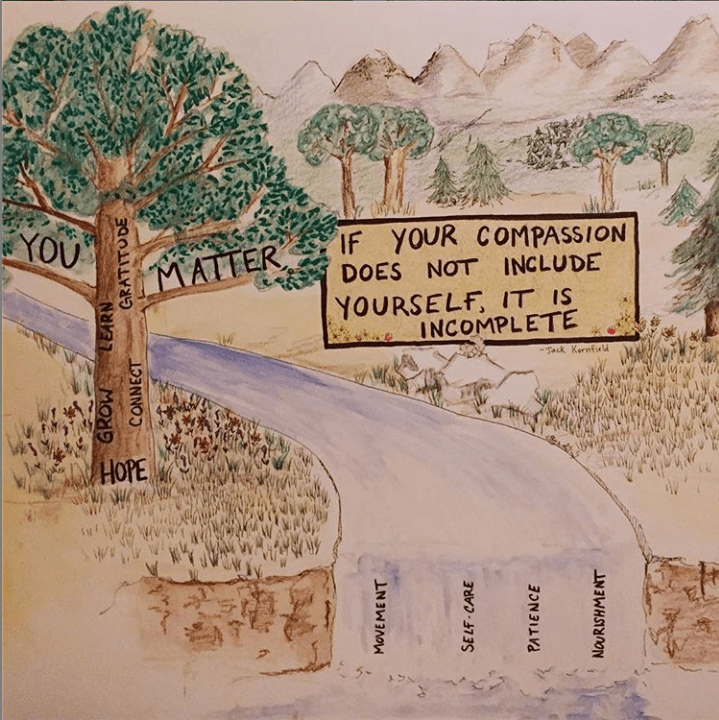
drawing of landscape with tree and river and words about self-compassion

Art for Mental Health Awareness Month

May is Mental Health Awareness Month, and Mental Health America has several initiatives to spread awareness during May. One of these is #mentalillnessfeelslike. Peruse different categories on their website, where MHA has compiled Instagram posts from people participating in the hashtag. It’s always comforting to find validation in others’ experiences.

The hashtag got me thinking about my own attempts to represent what mental illness feels like to me. This blog is mostly writings that describe my experiences with depression, anxiety, and their various treatments. So, for something different and a trip down memory lane, I thought I would take a jaunt through some of the art I’ve made on the topic of mental health/illness.

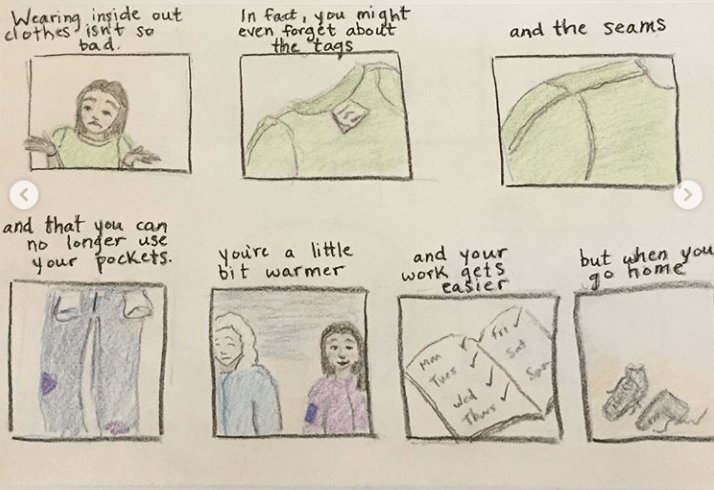
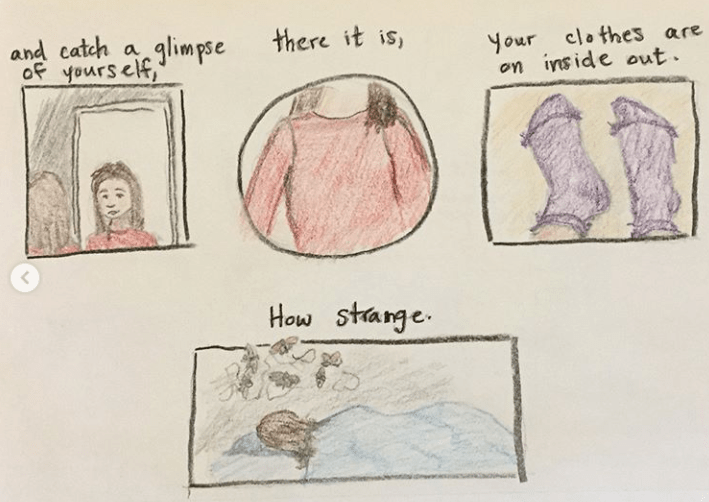
The following slideshow was my attempt to depict a strange sensation brought on by an antidepressant I no longer take. It left me feeling “better”, but in an artificial way, as if I could feel my depression just outside the boundaries of myself. It was sort of like being squeezed into a neutral mood that didn’t fit.
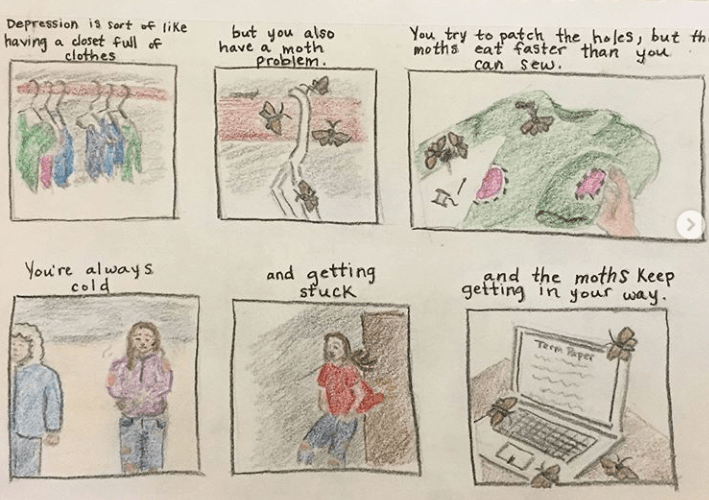
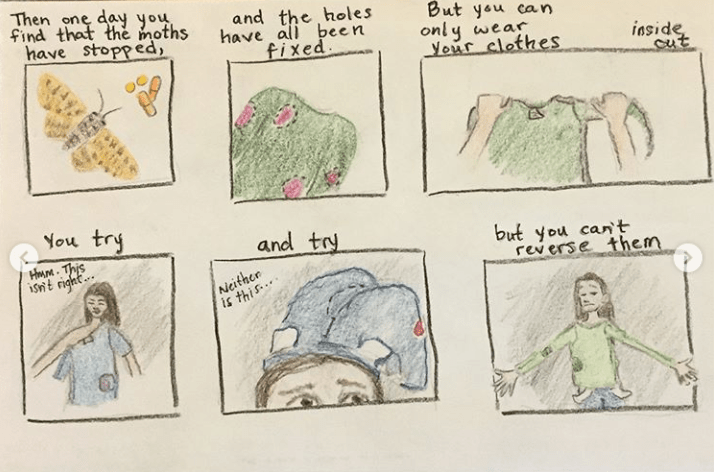
Depression 1Depression 2Depression 3Depression 4

And then we have The Potato Scale of Depression, born when I responded to “how are you” with “everything is mashed potatoes”. What I meant by that was that the world was dull, my senses felt mushy, and seeing past any of it felt impossible. The beauty of the potato scale is that it opens the door to describing your mood in a creative, silly way, while still communicating a serious topic. And, you get to have eye-opening conversations about how you and your conversation partner rank various types of fries. Of course, this is an abridged version of the scale; there’s a whole world of poorly-prepared potato dishes to choose from. (Soggy latkes, undercooked gnocci, etc.)
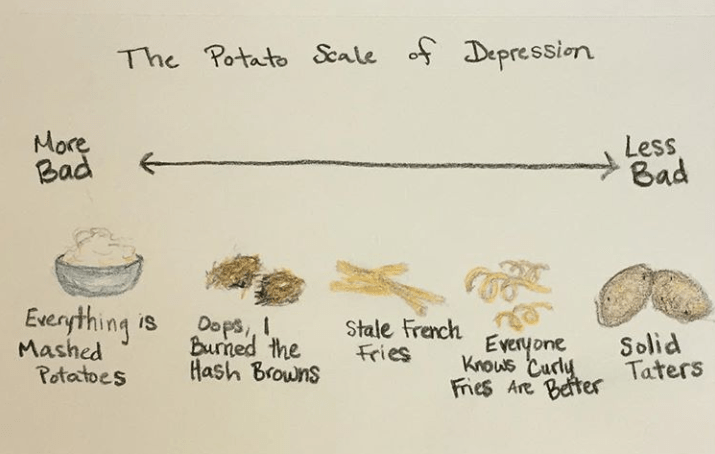
Potato Scale

Clearly, analogies are my favorite way to say how I feel. This next one is a good reminder for present me.
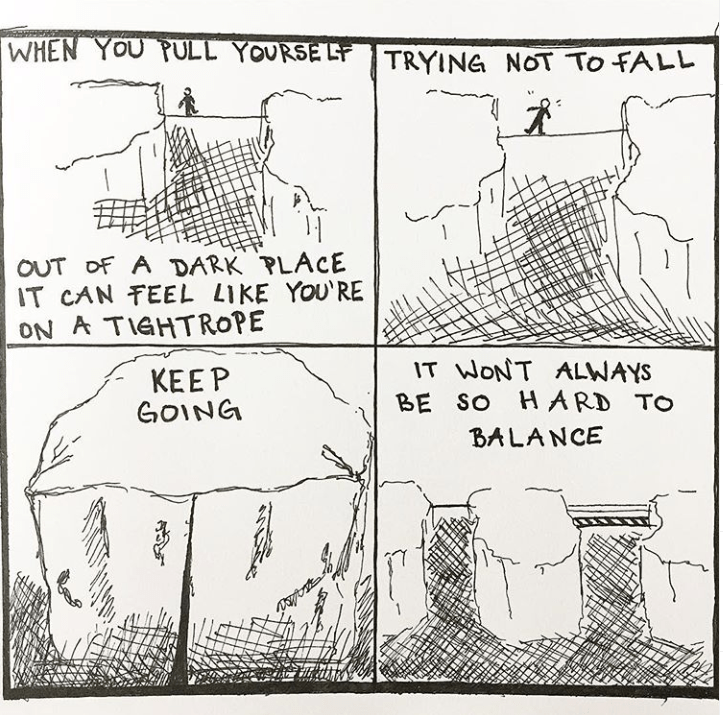
Balance

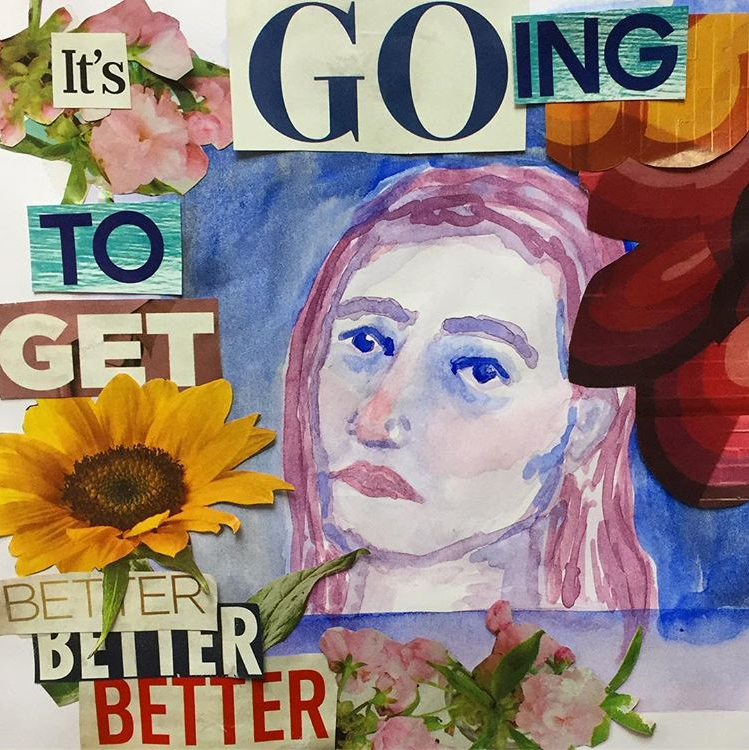
The rest are simply some depictions of what mental illness feels like to me.


collage-of-flowers-and-words-from-magazine-spelling-it's-going-to-get-better-with-watercolored-woman's-face


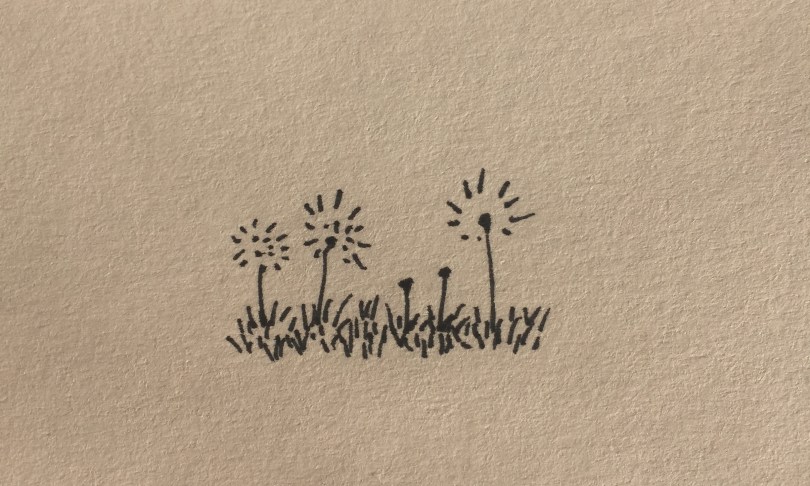
ink drawing of dandelion seed heads growing in grass

Observations From the Garden

I got up at 6 and walked through my routine because that’s what I always do, depressed or not. I fed the dog, made the coffee, poured a bowl of cereal, and then stared into it while the dog did her rounds in the yard. But by 8, I was beginning to wonder why I ever got up in the first place. So, back to bed with the window open and my blankets pulled up to my chin.

Lately, depression has overtaken my days with sleep and restless boredom. What time is it? Doesn’t matter; every day feels like a week. At night, the anxiety comes. I feel like I’m crawling out of my skin. Or like I want to reach inside my chest and pull out my lungs, let them spin out the twist in my trachea. Maybe then I could breathe.

To pass the time when the sun is up, I move between sleep and hobbies. Sitting outside in the backyard, my sketchpad page is still blank. Pen or pencil? I pick up the pen but am unable to draw more than a few dandelions from the scene I’m observing. A flock of house finches has found our backyard – it’s more dandelions than grass, and they’ve all gone to seed. The birds are foraging, bobbing their heads and moving among the unmown grass. One finch struts up to a tall dandelion, and, with an almost imperceptible flutter, attempts to perch on its vertical stem. The dandelion head begins to bow to the ground, and the finch rides the bending stem to meet the grass. Foot firmly planted to hold the flower down, the finch returns to bobbing and pecking.

There’s a sound behind me, and I turn to see a five-foot garter snake glide through the raspberry bushes, following a taste in the air. A busy robin chatters while it gathers last year’s grape leaves for nesting material. Stella digs a layer out of the hollow she’s claimed as hers, then situates herself in the cool dirt she’s uncovered. A hummingbird trill draws near, then it whizzes by on its frenetic journey. Everything around me moves, yet I feel like I’m in stasis. Animals and plants follow their daily rhythms, foraging, hunting, racing the sun to get enough calories, and I feel disrupted – out of sync.

I don’t know how to fix it. Usually, I keep up with my treatments — meds, therapy, ketamine — and simply wait for it to pass. I use what coping mechanisms I can—preferably the good ones, and let the turning of the Earth carry me from one day to the next. This time, I can’t help but feel the uncertainty of the time we’re living in. The disruption is not just to my mind, but to the world. When will this sense of weightlessness, of falling through empty space be soothed? When can we once again feel the ground beneath our feet, knowing by its predictability that it is moving us inexorably from today to tomorrow?

Connecting During the Pandemic

As a highly introverted person, I didn’t expect social distancing to have much of an effect on my mental health. After all, I don’t get out much to begin with. But what I’m finding, and what I’m hearing from others, is that the few social interactions we introverts had prior to pandemic life were more important than we realized.

I’m starting to really feel cooped up. I miss my library, my dog park, volunteering with other humans, and not sucking air through a mask while I run. My world, small as it was, has shrunk. But perhaps more than the social isolation, it’s the uncertainty about when it will end. Before, I might have chosen to stay in, but it was a choice. Now, this strange, lonely way of life stretches on indefinitely. I’m feeling restless, anxious, and sad. I sometimes joke that I’d like to go live on a mountain by myself, and while I’ve always known that wouldn’t actually be good for me, it still sounds tempting. But now, the social interaction that used to threaten to overwhelm me is in short supply, and I’m finding myself a little bit lost.

Luckily, we have options for connecting with others from a distance. I’ve been enjoying video calls with friends, yelling across the fence to my neighbors in their backyard, and texting extended family members. We have social media, phone calls, blog posts, any number of ways to get in touch with people who are far away. Even when digital methods fail, there are still connections to be made at home, and creativity goes a long way.

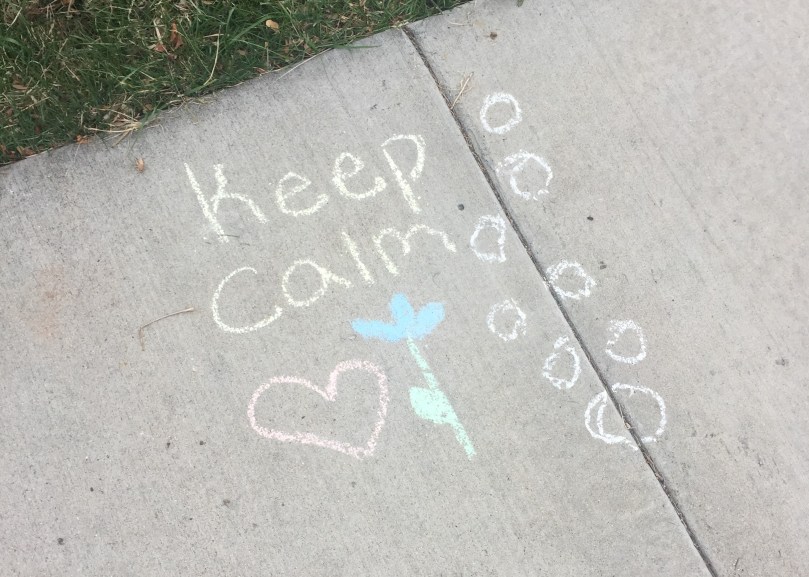
Towards the beginning of the pandemic’s reach in the U.S., when schools were closing and people started staying home from work, some kids in my neighborhood took it upon themselves to spread some positivity. I stepped out the door with Stella’s leash in hand and headed down the sidewalk for a quick walk around the block. At my mailbox, there was a message written on the sidewalk in chalk. It said “keep calm” and had a pink heart and a blue flower next to it. It made me smile and, frankly, gave me some warm fuzzies. All the way around the block, there were short messages encouraging everyone to stay safe and some adorable drawings of flowers and butterflies. It was a great reminder that we are all feeling the stress of the pandemic in our own ways and in our own homes, but we can still find ways to connect.

keep-calm-written-in-sidewalk-chalk-with-pink-heart-and-blue-flower

My MTHFR Gene is a Problem. Again.

You would think I had learned my lesson. Refilling my medicines is not something I find easy to do if a phone call is involved. I waited until the very end of my supply to refill my Deplin, and now, because of shipping delays, I’ve been without for several days. Deplin contains l-methylfolate, which fills a metabolic gap caused by a mutation in the MTHFR gene. Essentially, it helps my antidepressant work. Not taking my Deplin is what pushed my suicidality to new lows last year when I was hospitalized. It seems like I can feel my brain slowing down. I sleep all day like I’m hibernating in reverse by starting in spring. There is nothing to get me up except the dog, who stands by my bed and huffs at me, threatening to wake me with a full bark if I do not move. I accomplish the necessary and return to bed, already sinking into sleep. The occasional diversion brings some welcome entertainment, but it’s just a momentary distraction.

tired raccoon lying on platform with black container on its back and foliage in background
Me. It’s me. (Unsplash user @successfullycanadian)

I took some time off of work when my grandfather passed away last week, but then I decided it would be more helpful to have something to do. So, I went back to work (which I thankfully do from home under normal circumstances) on Monday. Unfortunately, it’s shaping up to be a slow week, anyway. I suppose I should turn to hobbies to fill my time. I’m partway through a drawing that I promised to someone, but like many of us judging ourselves for not utilizing all of this time to finish household projects or write a sonnet or whatever we think we should be doing, motivation eludes me.

My shipment of Deplin is finally at my local post office and should be delivered by the end of the day today. It couldn’t come too soon. I plan to rip it open right there at the mailbox and throw one down the hatch. Well, okay, maybe I’ll go inside for a glass of water.

blue and pink mountains illuminated by sunrise over snowy plains

Why Self-Care Can Be Hard For Me

Taking care of yourself comes in many forms, some easier than others and some more pleasant than others. Throughout my years of depression, self-care has meant several things to me. In times of severe symptoms, self-care focused on basic skills; eating, bathing, and taking my medications. When I’m doing better, self-care looked more like the conventional meaning of the term; taking time to relax, allowing myself tasty treats, watching a favorite show, etc. But no matter the state of my mood disorder, self-care has always included a mental component that can be particularly difficult: being nice to myself.

I know, that sounds so obvious it’s ridiculous, but you can absolutely do the actions of self-care without believing you deserve it. I run into this issue a lot; I spend an evening in sweatpants and a cozy sweater, absorbed in an episode of [insert ever-changing favorite show here]. Great self-care, right? Except I finish up the whole endeavor with terrible self-criticism for having let myself waste time and be lazy when I could have been getting work done. Somehow, it seems like that negates all the good that the action of self-care does for me.

Don’t get me wrong; I’m sure there are plenty of benefits of self-care even when you’re not feeling it. If you’re doing something essential to your survival, like eating food, of course that outweighs whether or not you think you should do it. Plus, there’s likely some neurological benefits of taking care of yourself- dopamine, less cortisol, heck, there’s probably benefit to just practicing those neural pathways and making them feel more natural. But it also seems logical that the benefit of self-care itself would be even better if you let yourself have it guilt-free.

Sometimes, the hardest part of self-care is believing that you deserve it. And that’s usually when I need it most urgently. It’s a work in progress, but I’m trying to be less critical of myself. Deliberately being nice to myself sometimes feels like a big lie, like I’m only humoring the part of me that thinks all my negative self-talk is pretty crappy. Living with depression makes it complicated because I know that I need to do things like exercise, take time to relax, and let myself say “no” to things. But the part of me that fights tooth and nail to appear “normal” resents the fact that if I’m not gentle with myself, I might end up debilitated by depression again. I don’t want to need anything, and certainly not anything pampering. I’m fine how I am.

“I’m fine,” she says stubbornly.

Sometimes you’re not fine, and that’s ok. And it doesn’t matter how long you’ve been not fine- you still deserve to take care of yourself. Sometimes I feel like having been depressed for a long time means that I’ve been indulgent in my sluggishness and I need to be hard on myself to get out of it. I would never tell someone else that. Be as kind to yourself as you would be to a friend in the same situation.

Stress and anxiety abound right now, so take care, stay busy, and get some fresh air when you can.

-G


Thoughts on Perspective and Depression

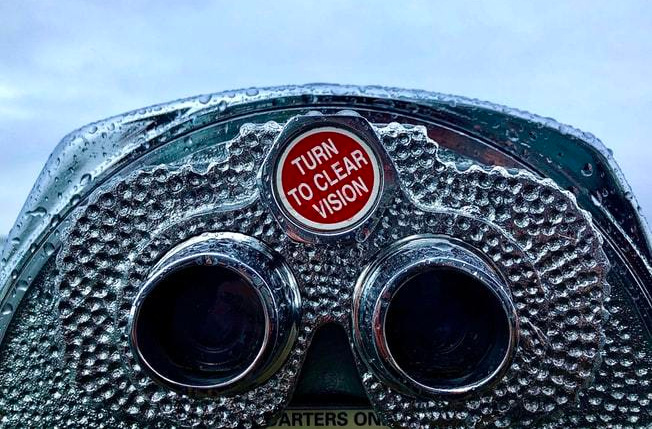
coin-operated-binoculars-with-raindrops-on-surface-and-red-knob-reading-turn-to-clear-vision
Photo by Chase Murphy on Unsplash

When I’m moving out of severe depression and into something closer to happiness, I’m intensely aware of the fact that I will soon forget what it felt like to be depressed. Not intellectually, of course. Having the experience of depression makes me forever able to empathize with others and remember, in objective terms, what it felt like. But the internal feelings– the heaviness, the soul numbness, the twisting slowness of being utterly squashed by life’s requirements- all of those will trickle away until I can only comprehend them from afar. Just as I can’t quite grasp the truth of happiness when I’m depressed, I can’t quite understand depression when I’m well.

It’s a problem I contemplate fairly often. Holding two perspectives at once isn’t fully possible, so I find myself slipping between two conclusions with different contexts. When I’m depressed, I vaguely remember feeling better. That memory, however, always pales in comparison to current pain. I eventually end up concluding that dragging myself back to mediocre happiness would not be worth the effort.

Inevitably, when the depression ends or at least improves, I understand how clouded my judgment was. Over time, I forget just how sharp and all-encompassing depression can be. I disregard its immediacy, letting healthy coping skills fall to the wayside. When I move beyond the basics– eating, bathing, stepping outside– to more advanced skills like socializing and nurturing my ambition, the basics are the first to go when stress hits. This is especially true when time has faded the memory of how quickly depression can return.

It scares me that depression so thoroughly warps my thinking, and recalling the cycle of depression and recovery makes me wonder if any number of episodes will teach me to ignore my depressed brain. It’s easier when each day is different; I can tell myself that this will pass– and I might believe it. But when I’m entrenched in depression, it stretches ahead of me until it’s all I can see. Then, the lies my brain tells me seem awfully convincing.

Right now, I’m going day by day. Things aren’t wonderful, but they’re not terrible, either. When I want to crawl back into bed in the middle of the day and not get up until tomorrow, I try to remember that I’ve been here before. I’ve been here before and I’ve done that before, and it never changes anything. Eventually, things will get better, and maybe I can get there faster if I make those hard but healthy choices. So, I’m back to the hardest self-care of all: doing what’s best for you even when it’s the last thing you want.

I Woke Up Cold: Thoughts From My Morning Coffee

I put on a scarf at 5:30 in the morning because I woke up cold. It seems that I’m always cold these days. Months remain before the crocuses poke through the soil and the robins start to chirp. Months of ice and salt, of bitter wind and cracked skin. Of waking up cold. I step lightly on the wood floor in the dark and flick on the kitchen lights. It’s time for coffee, so I follow the familiar steps: a new filter, two and a half scoops, and enough water for a full pot. I don’t mind waking up so early; it gives me time to start the day slowly. If I try, I can get another half hour before I’m rudely awakened by a paw to the face– Stella has limited patience. So in the end, 5:30 is peaceful and silent, and I can sit alone at the table with my coffee while Stella smells the early morning air through the crack between the sliding door and the frame.

This morning is grey; the trees are grey, the sky is grey, the grass looks nearly grey. I can already tell that today will be a sluggish one. There will probably be a long nap, and I will likely struggle through work, only to wander aimlessly from one uninteresting hobby to another. I wonder if the ketamine is wearing off, but it’s only been two weeks since my last infusion. I want to will myself into a longer interval between infusions because two weeks seems rather short. I argue with myself when it comes time to rate my mood for the day on a scale of one to ten. (I get an automated reminder text on my phone and send the number as a reply. The results create a graph that my doctor can see.) I have this urge to fib- to make it seem like I feel better than I do. It takes some effort to not lie, and I always get a small twist of disappointment and shame when I send anything below a five.

What will today be? A four? Maybe if I get moving, I can make it a five or even a six. But frankly, today is grey and cold, and I don’t feel like doing anything. My depression is not seasonal; it stays all year. I’ve noticed, however, that the quiet arrival of spring sometimes tows along my missing optimism. The return of new growth and green things makes me feel a little more ready to come out of my shell. Anticipation tinged with anxiety will begin to stir in me as winter comes to an end. Anxiety because there will be more to do, and I worry that I won’t be able to drag myself out of bed to do it. Anticipation because I desperately want to.

For now, I am lost in January. Sometimes, the best I can do is curl up in the cashmere blanket my mother made for me, still wearing my scarf, and sleep. And hope that I won’t wake up cold.