I’ve been taking Emsam, an MAOI antidepressant, for a few days now, and although I can’t say that I feel amazing, I think I do feel better than I did before I started. The two weeks between ending Wellbutrin and starting Emsam were a struggle, but hopefully will be worth it.
Emsam comes as a patch that you wear for 24 hours and then replace with a new one. It’s an adjustment to not just plop some additional pills into my organizer for the week. It’s ever-so-slightly more labor-intensive this way, but I think it has been easier for me to accept than previous medicine changes have been. I have some kind of hang-up about pills and how many I need, so adding a new one always upsets me. Even though Emsam is a new antidepressant for me, it seems to have bypassed my usual judgments by virtue of being a patch. Perhaps my inner critic is secretly a child placated by cool stickers.
I’m noticing some insomnia, but nothing horrible. In fact, the napping that had returned when I stopped Wellbutrin has been reduced again. Sometimes I still attempt to take a nap because, well, my napping problem is partly fatigue, partly escapism. So even though I still try to pass a few hours by sleeping, it hasn’t been working since the introduction of Emsam.
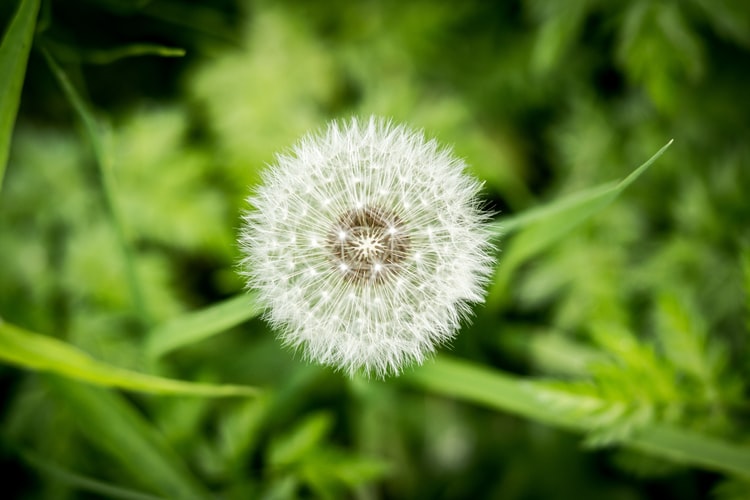
As a result, I’ve been doing a lot of yardwork. The dandelions are quickly taking over the backyard. Luckily, endlessly repetitive tasks are my jam. I’m digging them up one by one, a byproduct of which is some unintended soil aeration! I also took down all of the rabbit fencing that I used to make our backyard fence taller because Stella was jumping it last summer. That solution did not work for long.
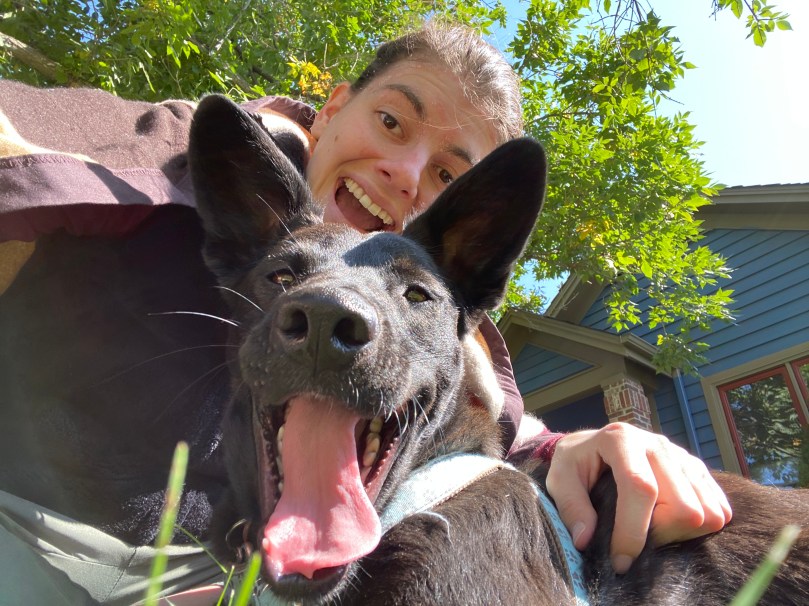
In fact, she jumped a six-foot-tall fence in pursuit of a squirrel the other day, so there really is no containing her unless she’s on a strong tether. Might as well get rid of the unsightly fence addition. She causes me so much anxiety sometimes, but she’s still a wonderful dog.
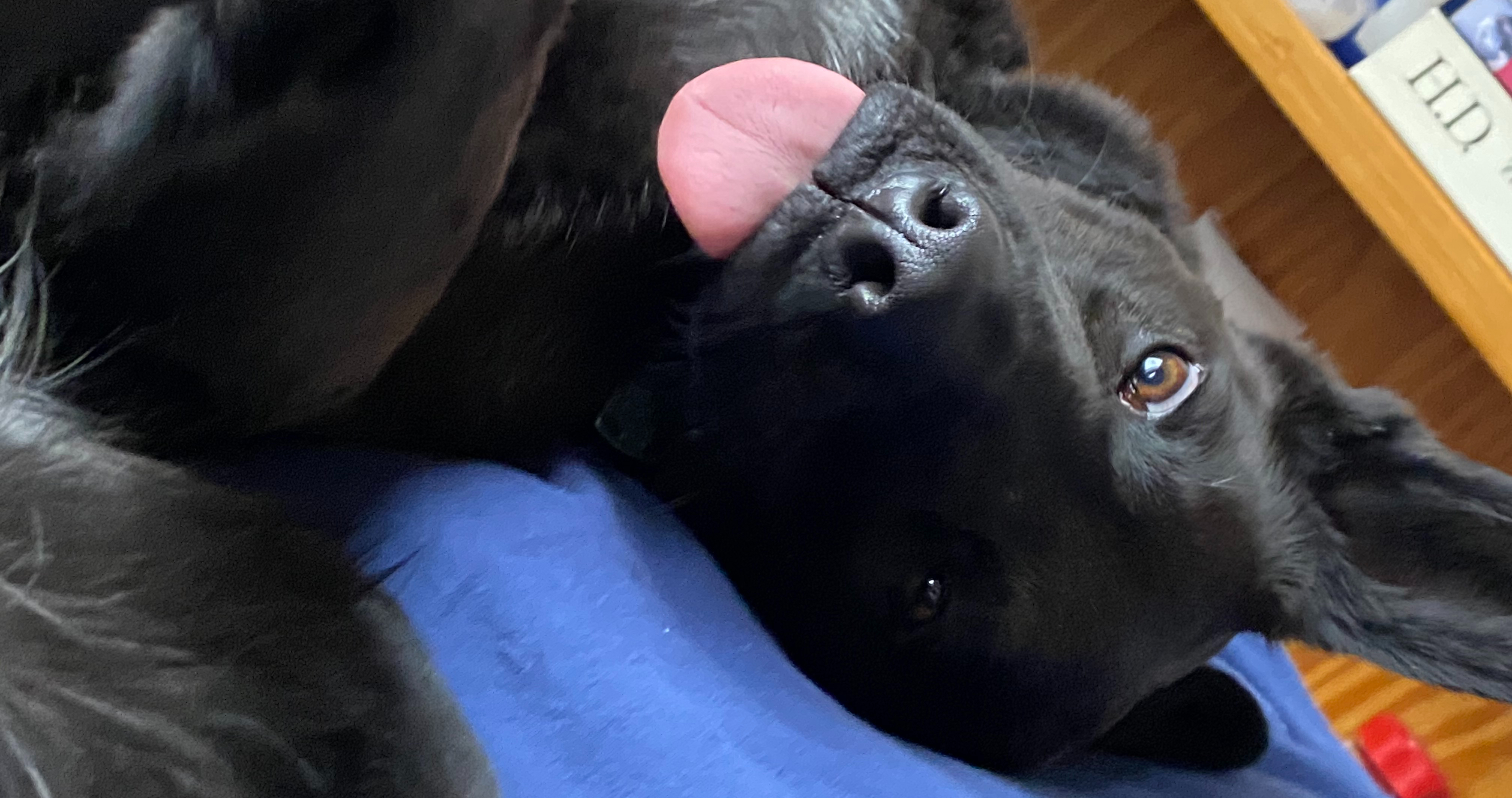
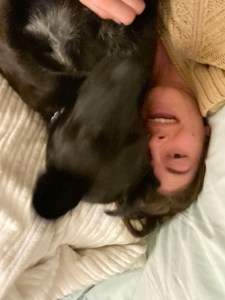
Blep
Historically, I’ve been mean to myself about napping because I tell myself I should be doing something productive with that time. Now that I’m not napping (pretty much), I have lots of time to get stuff done. And I’m still mean to myself. What a surprise.
In sporadic bursts, I’ve been searching for a new job for a while. I’ll get started on it, saving postings, updating things, applying to a few here and there, but not really dedicating myself to it because my current job is “ok.” I know that I’m avoiding it. It used to be that I’d be mad at myself for wasting time by napping. Now that I’m not napping, I’m mad at myself for STILL not tackling it, despite having plenty of time as a conscious person. Then again, it’s only been a few days since I started Emsam, and perhaps it will make things easier with some more time.
I’m attempting to heed my therapist’s advice about how a gentler approach is more effective and that no, you won’t become a stagnant blob of disappointment if you stop beating yourself up about your perceived lack of progress. I’m unconvinced, but I’m trying.
A week ago, I stopped taking Wellbutrin so that I can try Emsam, an MAOI. (I have to wait two weeks between ending Wellbutrin and beginning the MAOI.) I think it was good timing that my most recent ketamine infusion was around the same time I stopped taking Wellbutrin because I’m already feeling pretty terrible. I have the sense that without it, this change might have been even more abruptly bad. Maybe it’s a good setup for when Emsam just blows my mood out of the water, right? A nice contrast will really emphasize its effectiveness. One can hope.
It’s safe to say that Wellbutrin was holding my hypersomnia at bay, and now that I’m not taking it, I’m basically a koala. (They sleep 18-22 hours per day, and not because they’re high on eucalyptus – they’re just dedicating lots of energy to digestion.) It would be great if I could selectively dedicate all the energy I save by sleeping to something else, like hair growth. I could be a brunette Rapunzel in no time.
It is endlessly disappointing to me that I can’t seem to function very well without antidepressants. You’d think I would have accepted it by now. And yet, every single time I change one of my medications and experience a sudden worsening of my depression, I get all upset with myself for not being able to handle it.
I considered this move for a while. SSRIs and SNRIs haven’t helped me much, so branching out to an MAOI seems worth a try. Wellbutrin was clearly helping, particularly in the motivation department, but it was still less impactful than I had hoped. Eventually, I decided that giving up the motivation that Wellbutrin gives me in the hopes that Emsam will help me even more is worth it. It does kind of suck that I can’t go directly from one to the other, though. Two weeks sans antidepressant is proving to be challenging.
A big part of me wanted to just leave things the same and continue to try to build on the benefits of Wellbutrin through my own “natural” efforts. Something that I wrestle with constantly is my uncertainty around what I should expect of myself. It never seems right to say, “I can’t do X because of depression,” because it pains me to be limited by my own brain. So, I continue to struggle far below meeting my perfectionistic standards for myself and then am crushed when “I can’t do X because of depression” turns out to be somewhat true. I never allow myself any grace when depression slows me down.
So, in the end, I’m feebly trying to convince myself that trying yet another medication is fine because if I could have worked my way out of depression by now, I would have. It’s important to do the work I can do day-to-day. But, as anyone with depression knows, it’s tough to do the things that you know are good for your mental health when your mental illness won’t get out of your way. Not impossible! Don’t get me wrong, I’ve been exercising, keeping up with my job, trying to eat 3 meals a day – the works. But that can only get me so far, and most of it tends to fizzle out when I’m in a mental place like this.
I felt okay on Wellbutrin, but ideally, I don’t want to settle for okay. But if Emsam doesn’t work out, it is nice to know that Wellbutrin is something I could return to. For now, I’ll just keep working on my Rapunzel hair and waiting for Wednesday of next week, when I can begin my MAOI experiment.
My last ketamine infusion was much less trippy than the previous one, so I’m relieved to say that I remember absolutely none of it. Much less fun to describe, but also less persistently, somewhat threateningly bizarre. We skipped the magnesium this time, and I did not have any sudden, limb-jerking spasms. It’s good to know that was likely the culprit. When I can’t remember an infusion, I feel pretty curious about the off-putting gap in my memory. I always think it’s interesting to know what I experienced during a ketamine infusion, and when I can’t, I feel like I’m missing out on something that I just can’t access. Thankfully, the benefits of ketamine for treatment-resistant depression remain even when I can’t remember them.
Eating Food
I’ve been having some problems with nausea and appetite since starting Wellbutrin. They mimic what I feel when I’m really depressed, just amplified. Food is not appealing, neither in my imagination nor my mouth. When it’s time to eat, my goal is to find something that’s least unappetizing. Eating it is a strangely empty experience, as if I can recognize the flavors but can’t assemble them into something I like. The closest analogy I can think of is that it’s like the difference between sound and music. For a few days following a ketamine infusion, that problem is gone. It’s easy to pick something to eat, and not only does it register as, say, a grilled cheese sandwich, but my brain is also willing to exchange it for dopamine. Things taste like how food should taste, and it’s great.
Making Decisions
Ketamine makes the days following an infusion feel remarkably lighter. The difficulty I have with making even small decisions is much improved. I just go about my days without getting stuck at every turn. Speaking of turns, I’ve really been enjoying my morning walks with Stella. When we come to an intersection, I let her choose, and we amble around a ridiculously inefficient route that’s different each day. I am typically a very routine-driven person, so this microscopic spontaneity is a teeny, tiny sign that says “ketamine helped!” If the ketamine wears off or some other factor occurs and my depression gets worse, I tend to become more rigid in the route we take. I’m sure Stella prefers our ketamine-lightened walks, and so do I.
Thinking about the Future
The bigger benefits of ketamine for treatment-resistant depression, for me, are centered around my attitudes about the future. Depression makes me feel hopeless, and ketamine lifts that – sometimes just a little, but sometimes a lot. I’m not sure what determines the degree of helpfulness, but it’s always a welcome effect. It makes it easier to imagine myself making changes and taking big steps.
Other benefits of ketamine for treatment-resistant depression that I notice include:
Sleeping less
Feeling more social
Experiencing something called “fun”
Feeling satisfied about completing a task
Noticing little things that I appreciate or find interesting
Reduced suicidal thoughts (hasn’t been much of a problem recently, but I’ve definitely noticed that in the past)
Lately, I’ve noticed that the most noticeable changes stick around for a few days or a week, then things level off to a pretty neutral place where I’m neither jazzed about life nor am I in the pits of despair. By three weeks, I’m in something like the salt marshes of despondency; not inescapable, but pretty unpleasant.
That is a completely individualized timeline. Everyone is different, and I get the feeling from the forum I’m on that there are a lot of people who go much longer between needing ketamine infusions. I kind of try not to think about it because of what they say about comparison, I guess. (They = various quotes)
Musings about Medication
This was tagged “medication” on Unsplash, and I thought, “that’s a weird swap of the typical ‘pills aren’t candy, kids!’ warning.” (Photo credit: Sharon McCutcheon)
My medications may change again sometime soon, and although I just said that getting ketamine infusions for depression makes making decisions easier for me, I’m setting that choice aside for now. It’s harder to decide soon after an infusion because I feel like I don’t need to change anything. I feel better, therefore, I should keep things the same. But, ketamine wears off at some point, and even though I feel “better,” should I stop at that point? Maybe I only feel a fraction of my potential “better” but it seems like a lot because it’s better than abysmal. These choices are always hard. I don’t want to settle for just ok, but I worry that I’m expecting too much. Maybe this is exactly how happy people feel – they’re just more grateful for it.
But then a couple of weeks pass and I slowly start sliding backwards into napping and apathy and isolation, and I realize that there was no in-between. It was mildly happy and then increasingly depressed. There must be something more than that. I habitually blame myself for depression in the short term. A bad day or week makes me think that I let myself wallow and didn’t try to change things. I think that I’m lazy and burdensome and why can’t I just be cheerful? But when I look at the long-term – the years I’ve spent with depression – I feel kind of robbed. It’s easier to see the trends of it and the forks in the road where I didn’t pick the option the non-depressed me would have chosen. I may try to blame myself for all of that too, but the more reasonable answer is that depression has been in my way. Sometimes, that perspective makes me determined, and all of the other times, it makes me tired.
My last few months have been saturated with medication changes and mood fluctuations. I go up and down, up and down, and I’m thankful for the ups, but there’s something about the downs that feels so much more impactful. Despite the incremental progress I’m making after starting Wellbutrin, I feel completely insecure in that success, like it’s just visiting and will have to leave soon. A large part of me says that would be disastrous and I’ll just have to claw my way forward from here on out because losing ground would be unacceptable. I guess we’ll find out.
I’ve started bringing my dog to therapy. Does she sit with me and look patiently into my eyes while I cry? No, definitely not. She spends 10 minutes wandering around, smelling the smells of the week with great vigor. She pokes the diffuser with her nose, sticks her whole head in the trash can, and squeeeezes behind my therapist’s chair to not-so-sneakily smell her belongings. Then, she goes back and forth between the window and relaxing on the rug, ears perked up, listening for outside sounds. She comes over to me for pets and cookies every once in a while, but mostly, she’s just nice to have around as my unofficial therapy dog. She’s completely oblivious to my human problems. Looking at her blissful ignorance during therapy is like a brain palate cleanser.
You can’t help but wonder what she thinks of this development. Here we are, in this room we come to sometimes for no discernible reason. Pretty comfy. New smells since last week. 8/10. Would be better if I got second dinner. All that matters to her is that I feed her, walk her, and let her sleep at the foot of my bed. She’s a simple creature – intensely curious and frustratingly smart – but simple in that she really doesn’t need a lot to be happy.
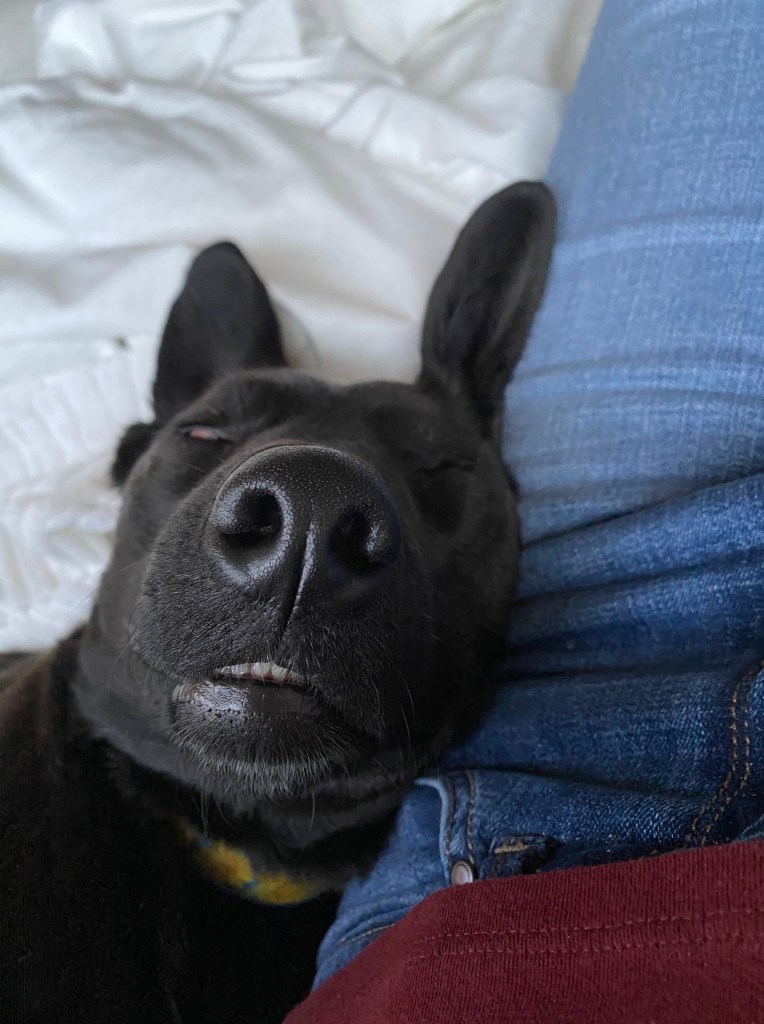
She shares some of that innocent joy with me. She makes me smile every single day. It doesn’t matter how depressed I am – she does something goofy or sweet and has no clue that I find her antics ridiculous. Like how she leads with her face when encountering snowdrifts, or her exasperation at me taking constant photos of her, or the many, many hilarious faces of Sleeping Stella.
Sometimes, when I try to change something in my treatment(s), my depression says, “No, thank you.” Changing my medications has not gone well for me in the past, but I continue to clutch my personal dream of reducing the number of things I pick up from the pharmacy. I recently added a drug which required me to get off of something else, which overall, does not seem to have gone well. The options now are complicated and I don’t particularly like any of them, but I still have Stella! The routine, obligatory outdoor time, and turbo-boosted zoomies have done me immeasurable good. She demands my attention and action, and there’s really no telling her to just go entertain herself. Our walks are sacrosanct to her. No replacements. And no skimping on length, either!
This was part of my goal in adopting her, and it worked in more ways than just the responsibility of it. I thought that it would be healthy for me to be forced to get out of bed and do things, but that the emotional reward of that would come during my good times. I wasn’t expecting my unofficial therapy dog to be able to careen through the fog of my depression and make me smile every single day. A smile or laugh every day certainly doesn’t fix everything, but it’s something to be thankful for.
My mental health has once again taken a turn in a not-fun direction, which I attribute to some recent medication changes. So, instead of sitting here thinking, I should write something. I can’t think of anything to write, and then putting down anything I do write as being the worst drivel ever to appear on my screen, I’m going to take you on a little diversion.
Did you know that an elephant’s sense of smell is twice as strong as that of a bloodhound’s? (C, that documentary led me astray. Google says twice, not four times.) This is what I said to my therapist the other day in one of my many futile attempts to distract from the topic at hand. We’ve also discussed, among other things, a documentary I watched called “Octopus Volcano,” how scallops have eyes, and what “horse” is in ASL. Usually, when I share a fun fact like this, there’s a brief exchange, and then she goes, “Well, that used up about a minute and a half.” And then we’re back where we started, just a little more entertained. This time, I think we probably used up, like, at least three minutes with the elephant fact. It may have been the most productive time-wasting fact I’ve ever pulled out of my sleeve. We got going on a train of thought that I think has some incredible real-world promise.
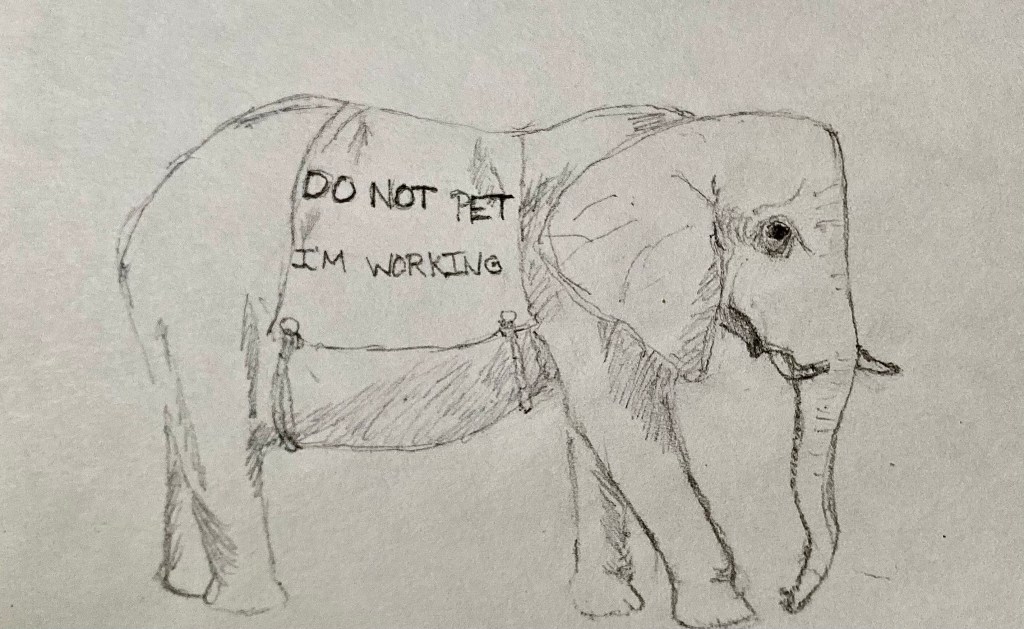
Just imagine: search and rescue ELEPHANTS. The police force brings out the specially trained sniffer elephants in super-wide trailers. They step down, decked out in vests that say “DO NOT PET. I’M WORKING,” but the vests are really just tarps secured around their bellies with bungee cords because the elephant service vest market just isn’t there yet. Soon, they’re working in airports, sniffing for bombs and drugs. All floors have widened stairs and elephant-safe ramps, and next to the dog relief areas are rooms with piles of dirt for the pachyderms to toss over their backs. Retired sniffer elephants spend their golden years relaxing with their family herd with frequent visits from their old handlers, revered as heroes for their invaluable contributions. I think we’re on to something, here.
“Sir? Sir! This is a service animal. Please don’t feed her the limp lettuce off your hamburger.”
Is this a breakthrough? Did I have a breakthrough in therapy?! Yeah, yeah, it’s not about me, but a striking realization is a striking realization. Elephants are the next sniffer dogs. Maybe they’re not as motivated to please humans, and they do need to eat a tremendous amount of foliage as they travel great distances throughout the day, but I think those problems could be overcome with some creativity. There really is no limit to what you can take away from therapy.
Non-sequitur segue! Other problems that can probably be overcome include my current difficulties with changing my clothes and eating and getting work done and my general depression problems. Titrating down on an antidepressant can be tricky. I’m trying to figure out whether this dip in my mood is because this antidepressant was helping me more than I thought it was, regular old withdrawal, ketamine wearing off, or any number of other variables. I suppose time will tell. Let’s persist in our efforts to overcome wacky, theoretical elephant scenarios and the challenges of living life.
P.S. Good luck to the Google algorithm in trying to figure out what the heck this post is about. 🙂
And I love it. Well, “love” is too strong, but I have distinctly positive feelings about this change in my depression. From the outside, it may sound amazing to take a four-hour nap every day. Living it is a different matter. When you’re absolutely exhausted all the time and you crawl into bed simply because you don’t want to exist as a conscious person anymore, it’s not rejuvenating. When you go to sleep because you just want the day to be over and at least that way, you won’t perceive the passage of time, it’s not indulgent self-care. Instead, it’s just a black hole siphoning days, weeks, months of your life away from you. So, when you suddenly have every precious second of the day to be awake, it’s wonderful – and a little bit uncomfortable.
Wellbutrin is what’s still making me anxious – a side effect that Google says goes away within a week or two. Not so, for me, although hopefully, for a more complex reason. When I started taking propranolol, a beta blocker, to counteract the anxiety and jitters, I hoped that I could start to really enjoy my improved motivation. I’ve been mostly feeling like it arose solely as a product of anxiety that propels me from distraction to distraction. Instead, I encountered a strange result. Two propranolol per day had minimal effect, but three made me so shaky that I struggled to type or to use a spoon. This is weird, and not at all what’s supposed to happen. Perhaps I had a paradoxical reaction to it, but it’s hard to say. As for the anxiety, my psychiatric nurse practitioner theorized that the addition of Wellbutrin made for three medications in my list that deal with norepinephrine. I was making too much of it, essentially leaving me constantly primed for fight or flight. I’m now tapering down on one of those meds in preparation to increase the Wellbutrin.
Although the anxiety is improving, it still keeps me from napping most days. It’s that odd combination of being tired and full of energy at the same time. I want to close my eyes and rest, but it kind of feels like my trachea is the size of a large straw, and I can feel my heartbeat in my ears. It’s a tug-of-war between depression, which still votes in favor of sleep, and anxiety, which votes for frantic activity. Consequently, many of my days feel much longer than they used to because I’m unable to sleep. I’m still not as interested in my, well, interests as I used to be, so although I have this itch to be active, nothing seems quite right. The anxiety is also not nice, but it is a novel experience to be conscious for an entire day. There are so many hours to pass!
In an example day, I’ve:
fixed my clogged bathroom sink
drawn some potted plants
accomplished my part-time work in one sitting
refilled the bird feeder
took the dog to the vet
*perused the web for “doggles”
went for a walk
There have been some recent days that included naps, but on the whole, I’m pleased with my daily awakeness. Now to try not to go too far in this direction and become more anxious that I’m only doing very minimal activity and it somehow feels like a lot to me. Don’t. Over. Think. It.
*Doggles, or dog goggles, are on my shopping list because my dog, Stella, habitually develops eye infections, likely in the course of her high-speed, full-contact dog park outings. The doggles are for her to wear while we play fetch, silly as that is. But hey – ten bucks for doggles, or $180 for each vet trip? They also look awesome.
It’s hard to get photos of dogs playing that don’t look terrifying, but I swear, this is Stella and Tugs having a great time. Imagine how cool they would look with doggles.
Being anxious and depressed at the same time feels like a mental contradiction. I feel mismatched, like my head and my body are going at different speeds. Many times during a day, depression tells me I’d like to sit and do nothing, but my body impolitely declines that option. I feel an almost constant low level of adrenaline, like someone jumps out of a closet and startles me 15 times a day.
Still, for me, this level of anxiety is vastly preferable to the hibernation I was doing before Wellbutrin. At least now, I have more motivation to stay out of bed and put my energy towards something productive. I feel more like a regular human who can get stuff done, as long as I can focus long enough to do it. I’ve decided to call this combination of symptoms “Depression on Fast-Forward”. If these were potatoes, they’d be hot potatoes, never in one hand for very long. Sometimes, they fall on the floor and split open, to later be relegated to the bin.
Distractions are helpful, as I wrote in my last post. My mom and I recently started cross-country skiing again, and wow, does it really shake your confidence in being proficient at standing upright. I fell five times on our first outing, and three times on our second outing, so I’m really improving on my wobbly wipeout score. That’s pretty good, I’d say.
I just recently figured out yet more issues with my pharmacy, so I’ll be able to try a beta blocker to help with the jitters. An added benefit of this is that it may help reduce my essential tremor. Upon hearing the news of my upcoming fine motor skills, my mom said, “You could do eye surgery!” And I said, “That is what’s holding me back from my love of eyeball operations.” My tremor has worsened in recent years, probably due to the lithium I take for depression, which is totally worth it, but still annoying. Sometimes, if I wake up very suddenly, I find my hands shaking so badly that I can’t unlock my phone. It’s somewhat disturbing, but again- worth it.
Depression on Fast-Forward is troublesome. I’m more active, but most of it is hollow. The bigger things I’m doing, like skiing with my mom, feel meaningful, but the rest of my time…not so much. Well, except for all of the puppies I’ve met lately. They were all amazingly, infectiously joyous creatures. That’s the solution – I need more puppies.









 Love, Your Brain