A view of green trees and shrubs on a mountainside

TMS, Seroquel, and Sudden Relief

Initially, my extended TMS course didn’t seem to have much of an effect on me, except perhaps to kick my insomnia into a higher gear. After much thought and discussion, I decided to stop TMS suddenly rather than taper my appointments.

Getting TMS treatments every day had begun to feel pointless. We’d tried several adjustments and protocols, remeasured my motor threshold, and extended my treatments beyond the planned schedule, but none of it made me feel any different.

At this point, I’ve tried what feels like an exhaustive list of medications. Combine that with my lengthy treatment with ketamine infusions, years of therapy, and now TMS, and I can’t help but see a hopeless picture. I know I’m not out of options, but the pattern leads me to conclude that any further effort to get better will result in the same outcome: more depression.

However, I know that’s a logical fallacy. Just because many treatments didn’t work does not mean that the next one won’t work. It’s hard to grasp that when you’re deep in depression, though. I left the TMS clinic feeling hopeless. It’s indescribably discouraging to try treatment after treatment, clinging to a tiny scrap of hope that just gets smaller and smaller as you go.

I sometimes feel as though I’m trapped inside myself, carried along by my depressed body like a prisoner. I’m in here — I’m just unable to break through the impenetrable walls around me no matter how hard I try. At other times, I feel as though depression has eroded my mind, letting the essence of me wash away. The “me” I am when I am not depressed seems to be gone. The movement stops, the lights go out, and I wait in internal darkness for some motivation to stir in my mind. The little scrap of hope flutters somewhere out of reach.

The second version is how I felt when I stopped TMS.

Ending TMS meant that I needed to consider my next steps. ECT is one option, and I’m interested in doing a consultation, but the thought of actually starting that process is daunting. I had increased my dose of Emsam, the MAOI I take, and figured I would wait a little while before doing anything. In the meantime, I wanted to get a handle on my insomnia.

Sleep Meds

I did not sleep more than five or six hours a night in the last two months, so that’s been a barrier to my mental health, too.

Temazepam

Increasing my usual sleep medication helped but then plateaued, so eventually, I decided to try Temazepam. I was a little nervous about taking it because I don’t like feeling impaired, especially if I’m uncertain of how it will feel. But alas, I was tired. I read the medication info sheet front to back because that’s the kind of person I am, took the pill, and prepared for a blissful night of uninterrupted sleep.

Yeah, right. It was one of the most unpleasant nights I’ve ever had. I was unbelievably restless – not just my legs but my whole self. I didn’t stop moving for hours. I was too hot, so I moved downstairs to the couch, but then I could feel my heart beating, and the sound of my breathing was grating in my ears. Sometime around 4 AM, I fell asleep, only for the sun to come up two hours later.

Some people (but not many) have paradoxical reactions to benzodiazepines. I now know that Temazepam is not for me. It was a learning experience.

Seroquel

One category of medications that I had not tried before now is the atypical antipsychotic class. Seroquel is a drug in this category. It’s used as an off-label treatment for depression, and it is also sometimes prescribed for insomnia due to its sedating effects.

I decided to switch from Trazodone to Seroquel, and overall, it’s been a positive change. I started with too high of a dose and had an unpleasant day afterward, but I quickly adjusted. As long as I give myself enough time to sleep it off, I no longer feel sluggish and half-asleep when I start my day.

I’ve managed to increase my sleep to six or seven hours a night. Although it’s not an enormous difference in terms of hours, I feel like the quality of my sleep is better. I no longer wake up during the night, and I feel slightly more rested overall.

It probably helps that I reduced my lithium dose a little and don’t wake up feeling like a dried-out sponge several times a night. I keep my ridiculous 64-oz. water bottle by my bed for easy middle-of-the-night hydration. My psychiatric np finally told me so many times to drink more water that I stepped up my efforts and bought it. It’s so big that it’s basically an insulated bucket with a lid, and I love it. I don’t have to deal with the extra step of refilling a glass or smaller bottle frequently. It’s a silly reason to not drink water, but when I don’t care about myself enough to keep up with hygiene or eating, refilling a glass of water is surprisingly challenging.

Restarting TMS

But, I digress. After a few days of no TMS, I found myself feeling – impossibly – worse than before. Whether that was because TMS was helping in small ways or I was simply despondent after giving up on another treatment, I still don’t know. I decided to pick up with TMS where I left off.

The timing makes it difficult to determine which factor caused what result, but after restarting TMS, sticking with the increased Emsam dose, and adding Seroquel, I suddenly felt dramatically better for a few days. I found myself walking Stella with a decidedly peppy step instead of my usual brick-like feet. I suddenly wanted to go places and do things, which is the complete opposite of how I felt before. I actually felt like I could feel the dopamine I had missed so much. I felt happy about nothing in particular.

A closeup of a black dog with pointy ears panting while sitting in the forest.

I always marvel at how impossible it is for me to imagine how it feels to be less depressed. I know it sounds odd, but every time I get some relief from my symptoms, I find that the sun feels warmer, the breeze feels more refreshing, and colors seem more vibrant. I feel like I’ve been released from a state of deadened perception and pushed into a shockingly bright, intense world.

Despite experiencing such improvement before, I’m always taken aback to realize that I could not grasp how distant I felt while depressed. The memory of what improvement feels like disappears when depression returns, and the only way to understand it again is to experience it.

A closeup of the center of a yellow flower outside

The Current State of Affairs

I don’t currently feel as amazing as I did for that brief time, but I do think that I’ve maintained some improvement. I still feel considerably more energetic, and although my mood has embarked on a journey of hills and valleys, it’s nice that there are still hills.

I’m not sure where this will leave me. I’m planning to do three more TMS treatments and then stop. I don’t feel nearly as desperate as I did when I stopped TMS the first time, but I am concerned that some symptoms seem to have worsened slightly since my sudden improvement.

Part of me thinks that now would be a good time to look into eventually making more treatment changes, whether that’s ECT or something else, since I’m still relatively motivated. The other part of me thinks that I should just focus on adding habits and activities to my life that could help me hold on to the improvement, and see where that takes me. I guess I have some decisions to make.
Illustration of a brain outline with colorful shapes connected by lines depicting neural network

TMS Update

I’ve been getting TMS treatments for the last several weeks. So far, it has not been helpful for me, and it seems to have worsened my insomnia. I’m extending my treatment past the planned-for 36 sessions in case I’m just a late responder, but I’m struggling to be optimistic.

I mentioned in my first post about what TMS is like that I’m doing the 10 Hz protocol. Seeing no improvement after a few weeks of treatment, we added a priming protocol called intermittent theta-burst stimulation (iTBS) to my usual treatment. This means that the coil is placed in the same spot as it normally is for me, and pulses are delivered at a different frequency and pattern for 2 minutes prior to my usual treatment.

The idea (as much as I understand it) is that the priming pulses enhance my neurons’ response to rTMS, either by preparing postsynaptic neurons to fire by affecting voltage-gated ion channels or lowering the activation threshold at which a signal can be passed on to the next neuron.

It feels very different; the 10 Hz pulses feel like a woodpecker drilling into my head, but the priming pulses (which are delivered at a lower intensity than the regular pulses) remind me of how those springy door stops fly back and forth when you pull them to the side and let go. In the beginning, it feels more like having a rubber band snapped on my head many times per second than being pecked by a woodpecker. As it increases in intensity, it loses some of its sting and becomes more similar to the dull-but-concentrated knocking that rTMS creates.

Overall, I find that iTBS feels more robotic than rTMS, probably because the pulses are delivered in multiple bursts per second. I think the rhythm of it seems less natural than a single burst pattern. Unfortunately, I haven’t noticed much difference with the priming protocol in place.

Next, we added a right-sided protocol. Treating both sides of the head may or may not improve TMS outcomes, but we figured why not try it if the left side alone wasn’t working? The pulses are delivered in the same place as they are in my usual left-sided treatments but on the other side of my head. It’s slow – only 1 Hz, meaning there is one pulse per second. The treatment goes for 15 minutes.

It reminds me of a metronome, and it can become mesmerizing if the conversation in the room stops. There is a light on the TV across from the chair that blinks at a rate slightly slower than the TMS pulses, which is somewhat maddening. Why would TV manufacturers not ensure that their lights blink exactly once per second? Couldn’t they have foreseen that a minuscule proportion of their products’ users would be in precisely my situation? Big oversight on their part not to consider this incredibly niche but potentially loyal corner of the market.

It’s interesting how accustomed I’ve gotten to the treatments on the left side of my head. Adding the right-sided treatment was surprisingly uncomfortable, even at a much lower intensity than my left-sided treatments. Just like with my usual treatments, we increase the intensity of the right-sided pulses within a certain range each time, so it starts out easy and becomes more uncomfortable as we go. That said, it’s gotten less painful with each appointment, and I can always opt to stay at a lower intensity if it’s too much.

I’m still feeling discouraged, but I decided to do some extra treatments to make sure I’m giving it as much of a chance to work as possible. I am, however, concerned about how I’ll feel if I have to accept that it didn’t work for me. Around 30% of people don’t respond to rTMS, which is slightly comforting. At least I can be pretty sure it’s not something I did wrong.

A white bottle of white pills spilled out on a black background

Feeling Shame about Psychiatric Medication

The first time I experienced shame related to mental illness, I was 11 years old and caught in the torturous intrusive thoughts and compulsive behaviors of OCD. Therapy did not go well because I found it nearly impossible to overcome my shame and embarrassment enough to participate. There were times when I was so appalled at myself for having intrusive thoughts that I genuinely feared my parents might stop loving me if they knew what I was struggling with.

The shame about mental illness started early, and the shame about taking psychiatric medication soon followed. Therapy was not going to work, so when I was 13, I agreed to start taking Zoloft. I remember leaving my psychiatrist’s office with my mom after that appointment and just sobbing in the middle of the parking lot. I felt so broken in such horrifying ways, and I thought that taking the medicine meant I was failing to fix myself.

Where My Pill Shame About Psych Meds Started

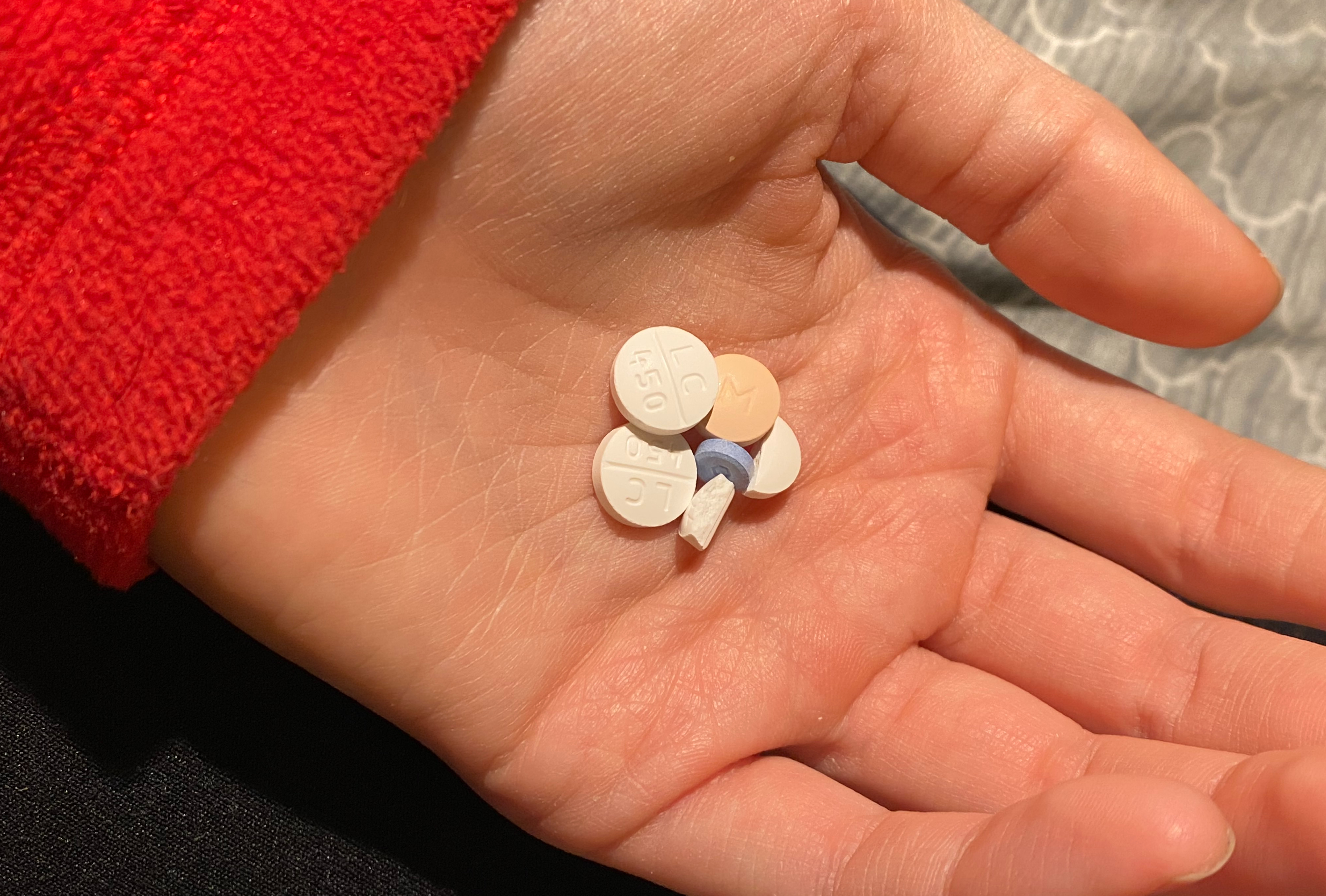
It felt like a very adult thing, taking medication. I’d carefully dole the pills out into their respective days in my weekly organizer. When I took them, I’d count them over and over and over – One, two. One, two. One, two. Sometimes, I would ask my mom, “Is this two?” and point to the pills in my palm. The root of that counting compulsion was the fear that I might accidentally take more than I was supposed to and overdose. OCD had such a hold on me that I doubted my ability to count to two.

Zoloft completely changed my life. Once I reached 200 mg, it was like my brain had been rebooted and all the bugs were gone. It was amazing. I took it for a few years and then came off it. Although I slip into old patterns sometimes, the OCD never returned in anywhere near full force.

Self-Criticism about Depression Medication in Adulthood

As an adult with treatment-resistant depression, I have mixed feelings about psychiatric medication. The Zoloft helped when I was a kid, but it was still something I considered to be shameful – something to be hidden. Whether that pill shame stems more from my own insecurities, my family’s attitudes, or societal messages, who’s to say? All I know is that I’ve never been able to shake that feeling, despite years of therapy and much contemplation on the irrationality of my beliefs.

I’m always hesitant to write about this. I want to emphasize that I know the way I think about psychiatric medication is unhealthy, and I don’t think anyone else should feel the way I do. It’s odd that being aware of that doesn’t seem to change my thoughts about myself. So, I guess this is a “don’t do what I do, but if you do, you’re not the only one” kind of a post.

A hand holding several pills of different sizes and colors in its palm.

Sometimes, I accept that taking psychiatric medication for my depression is the right choice for me. It keeps me safe-ish and mostly functioning, so I try to appreciate the benefits and set aside my gripes on the subject. When my depression worsens, though, all of that goes out the window. I start thinking that I’m lazy and selfish and a horrible burden on my loved ones. Much like when I was younger, I tend to view my psych meds as daily reminders of my inability to fix myself through force of will.

Psych meds help me attain the activation energy needed to use healthy coping skills, but I also know that making behavioral changes can improve depression on its own. In my brain, if I’m not “better” yet, I must be doing therapy wrong or not trying hard enough to implement new practices.

But, Do I Need Psychiatric Medication?

I’m so tied to ideas of independence and self-sufficiency that benefiting from my depression medication feels wrong. It almost feels like cheating. I tend to think that if I make progress while taking meds, I didn’t really earn it.

Whenever I try to change the medications I take and my depression gets worse, it seems like proof that the work I was doing to help myself wasn’t enough to even make an impact. If a change in my medication sends me tumbling back down the mountain, was I supporting myself at all with other strategies? It’s a discouraging thought that leaves me teetering between believing that I need to try harder and nothing I do will make a difference.

You would think that the solution to that would just be to stay on my meds, but my mind is a convoluted mess, so it’s not that simple.

Is the Improvement from Psychiatric Medication Real?

I try to remember that during the times when my depression has been much better, I don’t feel so strongly about how medication helped me get there. That suggests that I’m not seeing things clearly when I’m depressed.

Photo by Anna Shvets: https://www.pexels.com/photo/pills-fixed-as-question-mark-sign-3683053/

Then again, maybe I don’t care about it when I’m better because the medication is influencing me in such a way that I forget about the beliefs I held before. Maybe I’m seeing the truth about myself and the pointlessness of life more clearly when I’m depressed, and that perspective is covered up by my medication when I’m feeling better. I know that sounds wild, but sometimes I’m moderately convinced by this weird logic.

Self-Compassion and Treatment-Resistant Depression

I’ve spent years trying to learn how to be kind to myself and accept that my mental illness is not my fault. I know that I’ve made progress, but sometimes, it just falls apart. It’s like I’m climbing a flimsy ladder, and every once in a while, I slip and go crashing through the rungs below me. And then I’m in an undignified heap on the ground, berating myself for not accomplishing my goals and using medication when I shouldn’t need to.

I don’t give myself any space to accept that there’s something not right in my brain, and it’s okay if I can’t fix it by myself. I know this cognitively, and yet I can never seem to fully convince myself of its validity.

Do you relate to any of what I wrote in this post? Do you see your medication differently? I’d love to know.

A body of water with four white pelicans on an overcast day

Insomnia and Seeing Spiders

I have not been sleeping well lately. TMS seems to have worsened my insomnia such that I’ve slept five hours a night, give or take an hour, for the last few weeks. It’s not so little that I was dramatically impacted right away, but the cumulative effects are becoming apparent.

For one thing, if I stray below 5 hours of sleep at this point, everything looks like spiders. Little clumps of dirt, loose threads on a napkin, you name it – if it’s small, dark, and in my vicinity, I think it’s a spider. It startles me, I flinch away from it, and then I feel stupid when I realize it’s just a particularly grainy spot on my wooden desk or some other innocuous thing.

Anything in my peripheral vision that seems at all unusual catches my attention. I was sitting at my desk on Friday, trying to work when I got this feeling that someone was standing in the hallway to my left. I looked – nothing there. It happened again, so I looked again – nothing there. I think I was seeing the hinge on my glasses against the empty hallway. The dark spot somehow got turned into a vaguely person-shaped image in my mind, and it unsettled me. Information coming in through my senses feels chaotic, and I find myself being jumpy and on edge.

Trazodone helps me fall asleep, but I continue to wake up after 4 or 5, sometimes 6, hours of sleep. Five hours is unpleasant, but the world looks mostly normal. Four is when things get wacky, and six seems to restore my sanity somewhat. I’ve definitely gone long periods of time on 6 hours a night before and been free of spiders and other illusions, so I guess five hours most nights with occasional dips below that is my limit.

I think it’s interesting that creepy crawly-related hallucinations/illusions/perceptual mixups are so common. Some of my ketamine infusions resulted in hallucinations of insects when I went home. (It is not supposed to do that.) One time, I was transfixed by some bug-inhabited cobwebs that weren’t real, and another time, I mysteriously hallucinated for three days. Small, black bugs scurried from one side of my visual field to the other and sometimes took up residence on tangible objects. I slept about two hours a night and found myself unreasonably motivated to complete tedious jobs like pruning our overgrown grapevines and reorganizing the hall closet.

That incident happened after I had been taking 12 mg of Emsam for a few weeks. My post-ketamine experiences started to become more and more bizarre and culminated in the three-day…whatever that was. I decreased the Emsam back to 9 mg, and my ketamine infusions went back to how they used to be.

Months later, I ran out of 9 mg patches and decided to use leftover 12 mg patches until I could get my prescription refilled. It was an informative experiment. I had horrible insomnia and felt similar to how I feel now. Inanimate objects started to sway back and forth in my peripheral vision, white noise sounded like music, and small, bug-like dots explored the world to my left and right until I looked at them directly. Then, they would disappear.

However, all of those incidents were different in that the insects were completely fabricated; my current spiders are actual things in the real world that my brain is transforming into momentary terrors. Thanks, brain.

I haven’t noticed any benefit from TMS yet, but we’re adding an off-label priming protocol to my regular treatments. Maybe I’ll just be a late responder. I’m trying not to feel discouraged, as I know it’s not a helpful state of mind. I’ve been feeling worse the last few days, which isn’t making it easier to be optimistic about TMS. I suppose I’ll just keep at it.

An outstretched hand holding an outline illustration of a brain against a grey background

What My Initial TMS Appointment Was Like

I recently started TMS for treatment-resistant depression. My first appointment was an interesting process. Regular visits are fairly straightforward, but there are a lot of steps to complete in a first TMS appointment that set you up for the rest of your treatment. Here’s how mine went.

I arrived at the clinic at my appointment time and went into a room containing a large machine with a digital readout connected to a tube with a peculiar-looking black attachment at the end. The room looks rather like what you’d expect if a therapist with a special interest in neurology suddenly switched fields and became a dentist. There’s a painting with uplifting words and two matching prints of the human brain on the walls, a mechanical reclining chair complete with a little paper bib over the pillow, and a desk with a computer and monitor. The walls are a relaxing shade of dark teal, and there’s a TV mounted at eye-level across from the chair.

TMS Mapping

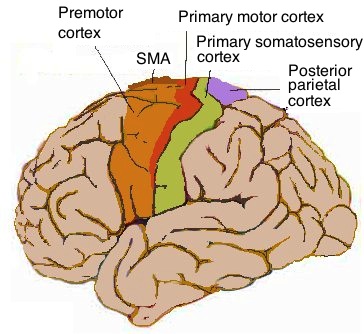
The psychiatrist and two technicians were present, and they began by explaining what would happen. The first portion of the appointment would be dedicated to “mapping.” First, they would place a white cap on my head and take lots of measurements that would be used to mark the location of a couple parts of my brain. Then, I was to sit with my right forearm resting on a pillow on my lap while they held the magnetic coil (the black attachment at the end of the tube) up to the left side of my head and delivered pulses of varying intensity into my motor cortex.

Cortex sensorimoteur1.jpg: Pancratderivative work: Iamozy, CC BY-SA 3.0 https://creativecommons.org/licenses/by-sa/3.0, via Wikimedia Commons

The purpose of this part of the process is to determine the lowest intensity that causes the patient’s thumb to twitch involuntarily. That intensity is known as the motor threshold. Mapping allows providers to tailor the patient’s treatment to specific parameters – the exact spot where the coil should be placed and the intensity of magnetic pulses that is most effective for that person.

What Does the Mapping Process Feel Like?

I found this part of my initial TMS appointment to be fascinating and a bit intimidating. As someone who hates being the center of attention, having three (very nice) people hovering over me, touching the cap, and stretching a tape measure over and around my head was uncomfortable. You only do it once, though, so that cap is now used for all of my treatments.

Determining my motor threshold was the fascinating part. I sat with my elbow bent and my forearm on my lap, oriented with my palm slightly up so that my thumb was visible and unhindered. The team placed sticky electrodes on and around my thumb and connected them to a machine next to me. I was asked to relax my arm as much as possible. The coil was held in contact with the cap. It produced a clicking sound and a small tap on the side of my head when pulses were administered. As they worked, the psychiatrist and technicians watched my thumb for movement and checked the readout on the machine for spikes in electrical activity.

Although it was bizarre to feel my hand moving without my conscious direction, nothing about the process was painful. It’s like when you develop a temporary eyelid twitch; it’s maybe a little disconcerting, but that’s about it. Subsequent pulses became less intense and had mixed results. A slightly different spot on my head would cause all of my fingers or even my wrist to move. Eventually, we landed on my motor threshold, and the electrodes were removed from my thumb.

The First TMS Treatment

At this point, I think I put earplugs in, but I might have done that earlier. Once I was tilted back in the chair, the pillow was adjusted, and someone held the sides of it up by my face. The air in the pillow was then vacuumed out, leaving a stiff, shell-like nest for my head to rest in. It feels a bit weird, but it helps keep your head still.

The coil was then attached to a mount connected to the chair. The mount is a mobile arm that allows the coil to be positioned on the patient’s head. Positioning the coil is a delicate business, so the techs did a lot of adjusting, locking it into place, and walking in front of me to look intently at my head from different angles before walking back and adjusting it some more.

There is a paucity of royalty-free TMS images online, and this is one of the only ones that show anything resembling the position of the coil. This image cracks me up. Is it the inexplicable lack of a shirt? Is it the arms held out to the sides? The coil descending from the heavens on a pole? I don’t know, but I love it.

(MistyHora at the English Wikipedia, CC BY-SA 3.0 http://creativecommons.org/licenses/by-sa/3.0/, via Wikimedia Commons)

What is “Intensity” in TMS Treatment?

We started at an intensity below that of my motor threshold. Intensity is measured in terms of relative percentages. When mapping, intensity is expressed as a percentage of the total output the particular brand of TMS machine you’re using is capable of producing. The motor threshold exists at some level of intensity, which means that it is also expressed as a percentage. For instance, mine is 32% of the TMS machine’s total power.

As the appointments progress, the intensity of the treatments increases. The easiest way to think of this part is to consider the treatment intensity as a percentage of the motor threshold. So, my motor threshold of 32 is the new 100%, and each treatment is set to an intensity that’s described in relation to my motor threshold. We started at 60% of my motor threshold (19 or so on the machine) and bumped it up a few times during that treatment, reaching about 70% by the time it was over.

What Does TMS Feel Like?

I knew that there would be a series of sounds and accompanying taps on my head, followed by a period of a few seconds of nothing, then more taps, and that would repeat. My insurance will cover the “10 Hz” protocol (10 Hz refers to the frequency of magnetic pulses), which follows a 75-repetition pattern of four seconds of pulses (known as trains) and 11 seconds between trains. A frequency of 10 Hz means that there are 10 pulses per second (and 40 pulses per train). 40 pulses times 75 repetitions equals 3,000 pulses per treatment. Each treatment under this protocol lasts 18 minutes and 26 seconds.

Initially, the “taps” didn’t feel much like taps at all. It was like drops of cold water were falling from a great height into a small hole in my head. The sensation would spread out from the center, although it remained restricted to a very small area. When each train ended, so did the sensations.

Every few minutes, someone would ask me if they could turn the intensity up a notch. As the intensity went up, the pulses felt more like tapping. I found it uncomfortable but not painful at that level.

A woodpecker makes for a good analogy when describing how it feels. At lower intensities, it’s like a small bird — maybe a downy woodpecker — that’s persistently curious about the acoustic properties of your skull. The higher intensities I’ve reached in subsequent appointments have replaced the little woodpecker with a much larger one, like a northern flicker.

Speaking as someone who has been licked on the forehead by a flicker and had one land on the top of their head (I worked at a wildlife rehab center), I can say that, like a TMS machine, they make a lot of noise and have incredible persistence. Thankfully, unlike flickers, TMS machines do not scream, and you can stop them whenever you want.

The machine is pretty loud — both the beeps it emits and the clicking pulses — but the earplugs help muffle the sound. The coil is heavy, and I was very aware of it resting on the side of my head. It did help me remember to stay still, though. Talking was a bit challenging, as I’m used to relying on nodding and shaking my head to supplement my conversational skills. I felt rather stunted without it, but we muddled through.

After that, my first TMS appointment was over. I had been a little apprehensive about it, but it turned out just fine. In fact, it was reassuring to know what it felt like and what I could expect going forward. Sometimes, the best way to handle uncertainty is just to jump in and get started.

a black and white illustration of a woman standing in front of a window in a dark room at night

Shifting My Depression Treatment from Ketamine to TMS

Unfortunately, ketamine is not helping me much anymore. The infusion before last gave me a small boost, and I remember feeling good for about five days following my appointment. Some of the other benefits I get from ketamine, including improved appetite, fewer thoughts about self-harm and suicide, and more energy, still seemed to extend for a week or so post-infusion. On the whole, though, I wasn’t feeling encouraged.

My most recent ketamine infusion came just a few days before I started transcranial magnetic stimulation (TMS) treatments. I have almost no memory of that infusion. The day after the infusion did seem better, and I had the sense that things around me seemed a bit brighter or more colorful. I hate to say it, but aside from that mild improvement on that particular day, I don’t think the infusion did much of anything for me.

So, I’ve decided to stop getting ketamine infusions for the foreseeable future. It’s unclear why they stopped helping me, so I’m not opposed to keeping the option of restarting them in my back pocket. Right now, though, I don’t think that continuing them is providing much, if any, benefit to me.

Lithium and My Poor Kidneys

I’m disappointed that I’ve come to this conclusion about ketamine, but I’m also in a slightly delicate spot, and something needs to change.

Image by chenspec on Pixabay

I increased my lithium dose in March because my mental health was deteriorating. Lithium is probably the medication that I have the most conflicted relationship with. Taking such a high dose is effective at reducing my suicidal thoughts, but it’s not ideal for my poor kidneys. And when my kidneys can’t keep up, my lithium levels begin to inch toward toxic.

My lithium level as of a few weeks ago was slightly above the upper limit of “therapeutic.” It’s back in range now because I’ve been working on doing that human thing where you drink water, but I’d still rather not take this dose of lithium for very long.

Deciding to Try TMS

It’s the combination of ketamine’s waning efficacy and lithium’s waxing toxicity that led me to TMS. I’m not in a good place, and I need a different solution. TMS is mostly covered by my insurance, there’s a clinic I like close to where I live, and the downsides of trying it are very few.

Initially, I considered continuing ketamine while doing TMS, as one could receive both treatments concurrently. I’ve opted to do TMS alone because ketamine is not offering me relief and no longer seems worth the expense. However, it’s possible that ketamine is helping me more than I realize, and stopping infusions might worsen my depression. I’ll just have to see how it goes.

I also considered ECT because of how severe my depression was before I increased my lithium dose, but I think it makes sense to try TMS first.

I’ve done a few TMS treatments so far, and they were strange and interesting experiences, but I think I’ll save my descriptions for another post.

Setting Ketamine Infusions Aside

It makes me rather sad to think that this part of my life is over. I’ll miss the wonderful people at my ketamine clinic, and I’ll miss writing about my experiences there. I’m glad I documented my ketamine dreams, which I will remember with equal measures bemusement and fascination.

I’m also upset that I’ve “failed” yet another treatment. It’s a discouraging development that leads me down well-worn paths of self-criticism and frustration.

That said, I’m incredibly grateful for the improvements I gained from ketamine. There was a while there where it was really turning my life around. I started volunteering, I was happier, I felt excited about life, and then the pandemic hit, and a series of stressors undid all the positive progress I’d made. (My therapist would remind me that not all of my progress was lost. That’s just my brain lying to me again.)

Although I won’t be getting infusions, I would love to keep up with the research and continue sharing information about ketamine. I would especially like to see what data exists on the long-term efficacy of ketamine and whether my experience of it is represented in the literature. A quick search shows tons of studies published in 2021 and 2022, so there’s certainly new information out there. My brain power is lacking, though, so I’ll have to save that for another time as well.

Photo by Brad Christian on Unsplash (@y_barron)

I still believe that it’s important to raise awareness of ketamine treatment for depression and reduce the stigma associated with it. It may not be working for me right now, but it’s still a valuable option that people with treatment-resistant depression should be aware of.

So, I’ll leave the door open for further posts in The Ketamine Chronicles. I still want the series to be a resource for people who are considering IV ketamine infusions and find first-person accounts helpful or reassuring. I hope I’ve accomplished that to some degree in this phase of the series. If you’ve been reading for a while or just started, thank you for clicking and scrolling and reading about my bizarre, profound, and nonsensical ketamine dreams.

How I Track Mental Health Symptoms

My therapist has been encouraging me to track my depression and various contributing factors for years. I’ve tried several apps, journals, and charts, but I always drop the practice after a little while. Eventually, I identified why those tools never worked for me and used that information to make my own system.

Why Motivational Journals and Apps Don’t Work for Me

I understand why a system with lots of elements appeals to some people, but I tend to find them discouraging – the opposite of their intended effect.

My Depression vs. Positivity

Whenever I tried an inspirational/motivational journal, I quickly lost interest. I’d open it up to mark down that I felt like a person-shaped vat of cold, unsalted mashed potatoes. The list of weekly goals I hadn’t met would be staring up at me. Some inspirational quotes would arrive in my brain through the filter of my depression, limp and meaningless. Over time, I began to avoid them, knowing that the initial excitement of setting up a shiny new tracking system would sour.

Apps Aren’t It, Either

Apps have the advantage of offering daily reminders, but if the app is structured like the previously discussed journals, a cheery notification that it’s time to check in only distances me further. I really wanted apps to work for me, and I’ve been consistent with them for two or three weeks at a time, but I always abandon them eventually. They’re too complex, they ask me too many questions, or they document more than what I want to track.

Mood Scales and My Problem with Numbers

Number-based tracking scales usually include too much choice for me and don’t allow for flexible indecisiveness. A 1-to-5 scale just paralyzes me. What if I say “3,” but I’m really a “2?” That would be catastrophic, obviously.

Perfectionism

Maybe it’s a vestige of perfectionistic test anxiety, like I have to choose the “right” answer and be consistent in my interpretation of the scale or else anyone who looks at my data will get an inaccurate sense of my mental health. So instead, I just stop using them. When there’s no data to look at, I didn’t do it wrong!

So in the end, I decided to go with what my therapist suggested in the first place (I must be exasperating when it comes to tracking), and just made my own system to track my mental health.

My Method for Tracking Mental Health Symptoms

I wanted something straightforward, easy to use, and without the frills of a motivational journal. I got a completely blank, unruled journal and a set of stencils. I found these stencils online by searching something like “bullet journal stencils.”

The Mood Tracker

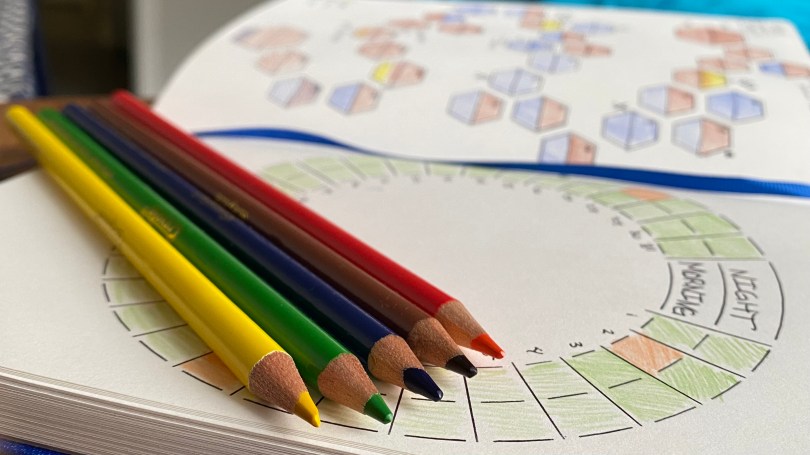
Each hexagon represents a day, which I’ve drawn a line through to depict AM on the top and PM on the bottom. I chose three colors to be “good,” “blah,” and “bad.” This way, I only need to pick a color and fill in the shape. If I can’t decide on a color, I can mix two of them together or shade the shape according to how the day progressed.

I also write small notes every now and then for medication changes, ketamine appointments, and other factors. I like that the bare minimum for this system feels doable for me but isn’t so scant that it’s uninformative.

The Medication Tracker

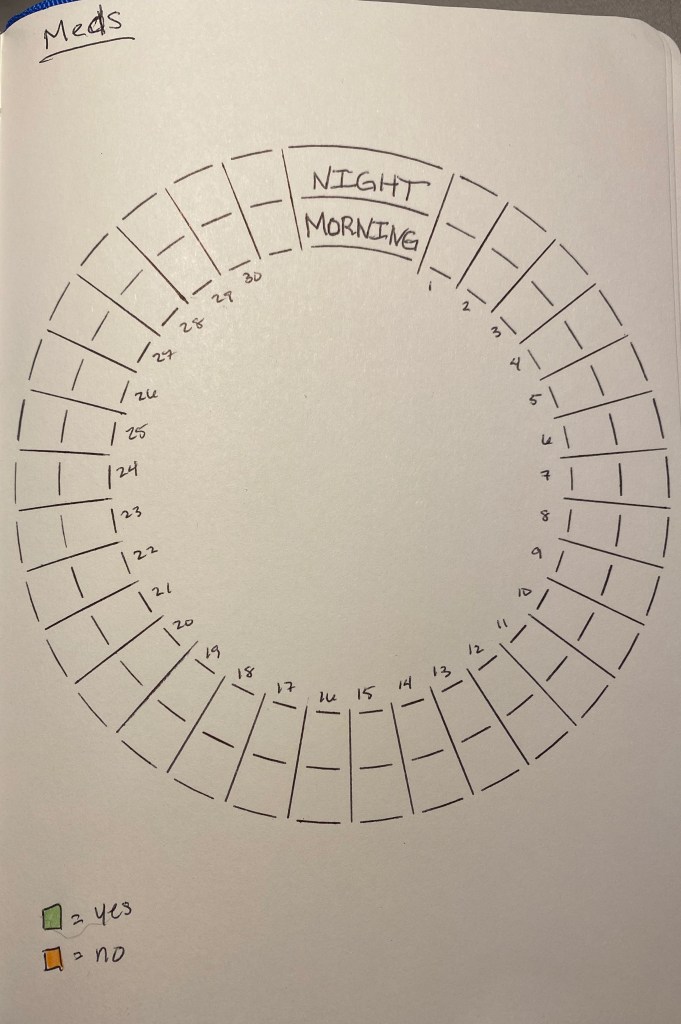
The medication tracker is similar to the mood tracker in that each section represents a day of a month. The inner row is morning and the outer circle is night. I picked a color for “Yes, I took my meds” and a color for “No, I didn’t take them.” It does help me to see how frequently I’ve missed doses, partly because the perfectionist in me hates to see too much orange.

I keep the journal and the colored pencils in my nightstand so they’re easy to get to and I don’t have the excuse of already being in bed when I remember to track.

How It’s Going

I’ve been consistent with this method for a little over two months, which is probably the longest stretch I’ve ever gone with tracking mental health symptoms. I can’t say that anything groundbreaking has come of it yet, but it is interesting to confirm some of my expectations.

I’ve tried and abandoned so many methods that I don’t think I showed my therapist my journal until I had been using it for a month. I didn’t want it to be yet another dud in a long line of tracking tools. So, I kept it to myself for a little while and am only just starting to assess its usefulness.

Just like with any mental health-tracking method, there are gaps in the data that become evident over time. I’ve been adding symbols to my mood tracker for things like self harm and my period. It’s becoming more complex, but I think the fact that I decide when to add those symbols rather than having a dedicated section for them works well for me.

That said, I’m considering adding a way to track more factors, such as appetite, sleep, and exercise. I don’t want to make it too complex, but I might have the habit established enough to expand my system without abandoning it.

There are tons of ways to track mental health symptoms and factors, and you can find many of them detailed online. What way works best for you?