Two Poems, One Year Apart

I. 2018

How long can I hold my breath

in this murky, underwater state?


Life moves in slow motion.

Here, strange fish glide past-

feathers mark them as birds

in a different world.

There, tall grass sways

in the current.


My lungs are screaming-

-breathe in

-breathe in

it’s only air.


II. 2019

Finally-

my head above water,

I begin to swim

towards shore.


I get fatigued-

my body’s heavy,

still waterlogged,

and yet-


Clear air

and sunshine-

kiss my face

each day.


mountains

I was recently flipping through a journal and came across the first poem. I remember writing it. I was sitting on a bench outside, feeling utterly defeated by depression. I had gone for a walk on a trail I’d paced a hundred times, but felt foreign on the path and in my own body. Everything heavy, I sat on a bench and looked numbly at the world around me. All the parts of being outside that I love the most- the sun, the animals, the plants- seemed wrong. The sunlight was flat, the grasses moved unnaturally, and the birds seemed oblivious to my presence- as if I had already faded away.

These days, I still walk the same trail. Sometimes it feels like a chore, and sometimes it feels just right. I listen to the meadowlarks sing and the prairie dogs yip, and moving forward is easy. One foot in front of the other, I let the motion of my legs carry me without a thought. Other days, the weight of depression demands my attention. When that happens, and I’m overwhelmed by the sense that I shouldn’t be here- I shouldn’t be anywhere- all I can do is breathe, and wait for another good day.

Love,

Your brain

Time-lapse photography in black and white of stars appearing to rotate in the sky over silhouetted trees

Overcoming Depression’s Inertia

It seems that every stage of depression recovery comes with its own tortuous fear.

I’m depressed, and I’m afraid I’ll feel like this forever.

I’m depressed and can see recovery in the distance, but I’m afraid I won’t be able to handle it. What if I don’t even know who I am anymore?

I’m less depressed, and I’m afraid that if I give myself a break, everything will fall apart again. 

I feel good, but I’m afraid that my depression will come back at any time.

I’m less depressed, and I’m getting out of the house and going for runs and doing yoga and going for hikes and doing the shopping and talking to neighbors and making appointments and I’m terrified. I’m terrified that if I stop even for a second, everything will fall apart. I’ll be right back where I started, in the deep nothingness of depression.

I wish it were easy to maintain balance; add a sprinkle of joy on this side, toss in a handful of rationality over here. But entropy won’t allow it, and neither will the laws of inertia. If an object at rest stays at rest, I must keep moving.

Except- there are outside forces acting on this object. I cannot keep moving indefinitely. Eventually, I must rest. Then, when I’ve replenished my energy, I’ll move again, each time becoming more and more balanced.

Love,

Your brain

Depression Limbo

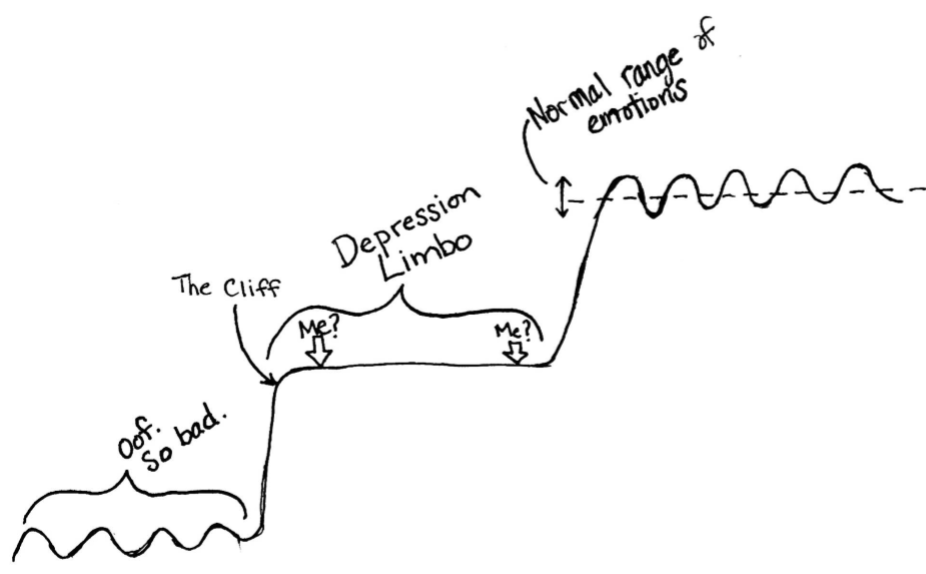
There’s a plateau that I always seem to hit in my recovery from a bout of depression. Since the first time I became depressed, I don’t think I’ve ever gotten past the plateau. I call it “Depression Limbo”. Here’s what I mean:

graph-of-depression-limbo-concept

Depression Limbo is an in-between place where things aren’t terrible, but they’re not great, either. Because you’re not in the pit of darkness, it’s easy to think you’re doing alright; and you are- comparatively. Things aren’t great, but they are ok. This makes it hard to find the motivation to pull yourself out of Depression Limbo. You think “this isn’t so bad. I can settle for this.” And that’s where it gets dangerous. Depression Limbo is flat, so you have no idea how close you are to the cliff and, therefore, to crisis. You could be anywhere along the plateau, but it all looks the same.

I’m in Depression Limbo. It’s a familiar place; I’ve been here several times before. I can laugh again. I’m enjoying my hobbies. I’m exercising again. I’m tempted to say it’s good enough, but I know that that’s risky. I’m tired all the time, I don’t really want to eat, and I tend to be trapped in my routine. This time, I won’t be settling for “good enough”. I’m going all the way to the top.

There is Always a Choice

TW: self-harm and suicide

I wrote this in my hospital journal towards the end of my stay. A few days ago, I published a post about self-compassion. The two seem to go together, in my mind.

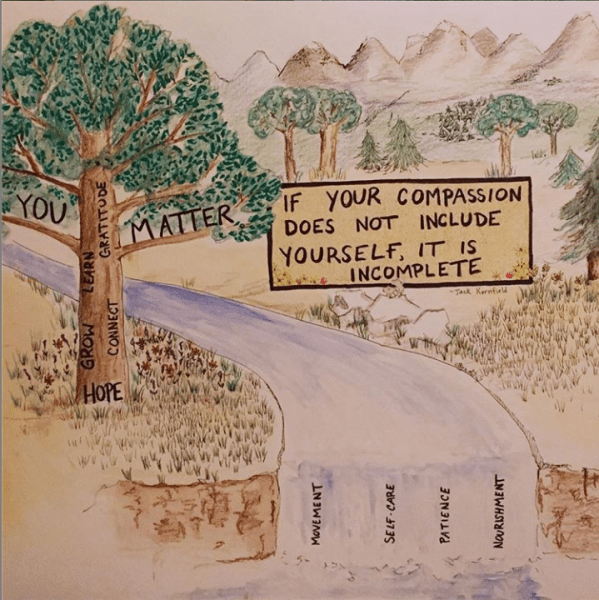
drawing of landscape with tree and river and words about self-compassionThere is always a choice. Two therapists have told me this independently. It took a little while for the meaning to sink in after the first therapist said it. I had gone a few weeks without self-harm at that point, and I still felt utterly controlled by it. The question of whether to do it or not didn’t seem like a choice; it seemed like an inevitability. Over time, the less trapped by it I felt, and the more sense that statement made. Although the choice of whether to self-harm might have been stacked in favor of doing it, the choice to take steps to change that was still mine.

I relapsed and eventually ended up here, in the hospital. On the surface, I’m likely to view all of that as a failure. However, I didn’t make the wrong choice. I experienced the symptoms of wanting to self-harm and having suicidal thoughts. I made the choice to be honest and to go to the hospital. I’m making choices every day to participate in groups and to work towards stability.

Was cutting a choice? Yes, but it’s about more than that. It’s about larger choices. When my disorder makes resisting those urges and thoughts too difficult, agency over my life as a whole is still mine. I can decide to work towards taking back control in all areas, however slowly I have to do that. It’s about the choices I make to be honest with my loved ones, to go to therapy, and to take my medication, that will affect my recovery from an illness that makes me want to hurt myself, that makes me want to disappear, that tells me that I don’t matter.

I do matter. I choose to work towards self-love.

There is always a choice.

Love,

Your brain

Acceptance, Self-Compassion, and Growth

The other day, my therapist gave me a handout on self-compassion. My “assignment” is to read through it and make some notes on what stands out to me. Since she reads my blog, (Hi, J!) why not expand my notes into an entire post?

A Definition of Self-Compassion

Self-compassion has to do with accepting that we are not infallible and treating ourselves gently when we’re suffering. Just like you’d extend understanding and compassionate support to someone else, we can strive to do the same for ourselves. As humans, we’re going to make mistakes; our imperfections are not only part of what make us unique, but their existence is also a common element shared among all humans. The handout encourages readers to stop fighting against the reality that we are imperfect beings.

Here’s my initial reaction to that bit of advice: but if I stop fighting it, I’ll stop improving. 

Growth

drawing of woman surrounded by plant growth

I worry that if I stop fighting the reality that I’m going to make mistakes, I’ll end up stagnating. If you also hold this belief, I wonder if we can change it by convincing ourselves that the components of success don’t necessarily include criticism and harsh judgment. You can like yourself and still be motivated to grow and improve. (This is what the Dialectics in DBT is all about; two seemingly opposed things can be valid at the same time. It’s about finding the middle ground.) Not to mention, you don’t need to beat yourself up for your mistakes in order to learn from them.

Acceptance vs. Resignation

At the heart of it lies another DBT concept, the difference between acceptance and resignation. Acceptance is the ability to recognize and come to terms with the reality of a situation. It leaves room for you to change it. Resignation doesn’t. When you’re resigned to something, it’s like putting blinders on. You see the reality of what’s in front of you, but not the opportunities to your left and right. With acceptance, you can understand that something is the way it is and still take steps to change it.

Depression’s Symptoms

Here’s where I run into trouble. Depression comes with behavioral symptoms that can get in the way of my productivity. When I sleep too much, for example, it somehow feels easier to be hard on myself than to accept that my illness causes these symptoms. Why? Probably because it gives me a sense of control. If I take responsibility for things that are out of my control, I don’t have to face that they are, in fact, out of my control. It scares me to feel like a victim of my illness. I’d rather be hard on myself for something that’s not my fault than relinquish my (false) sense of control over my actions. I think the key issue is that I’m not distinguishing between acceptance and resignation. I can accept that depression causes me to experience symptoms. If I accept that (not resign myself to it), then there are actions I can take to combat those symptoms, and practicing self-compassion will be easier.

Keep in mind I said “easier“. I’ll be honest, self-compassion is something I’m really struggling with. How can I hold myself accountable for working to get better without being judgmental when it’s not going to plan? It seems like a delicate balance, but my current strategy is not serving me in the way that I’d like. I guess it’s time to invest in a tightrope.

Are there times when you struggle with self-compassion? How do you remedy it? Share your tips in the comments!


Art as an Expression of Mental Health

I’ve loved making art for as long as I can remember. I used to draw the same picture of a dog on different pieces of paper and leave them scattered around the house as a not-so-subtle hint to my parents that their 5-year-old really wanted a puppy. I like to draw images that I want to remember; memories of pleasant things and places. But I also use art as an expression of mental health.

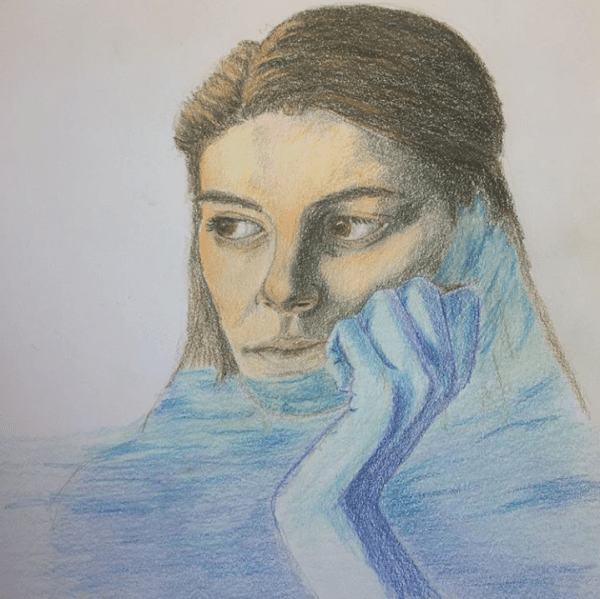
self portrait

Feelings are hard to articulate, but colors, shapes, and textures can carry meaning without the structural constraints of sentences. Creating an image can be a cathartic way to express feelings that also lets other people in on the experience. When I don’t know exactly what to make but I have an urge to make something, I start with choosing materials and just let my hand move freely. Something usually takes shape, but even if it doesn’t, I can always just scrap it and start over.

Part of what I love about art as a way to express mental health is that everyone can interpret it in their own way. As the artist, there’s something that it means to you, but you don’t even have to share that meaning with the people who see your art. And even if you do share it, people will still have an immediate reaction based on their own life circumstances and interpretation style.

The therapist I saw in college believed that there were no accidents in art, and would analyze my sketchbook while sitting next to me. While I’m sure there are some elements of my art that come from my subconscious, I don’t usually see the “accidental” parts of my art as meaningful.

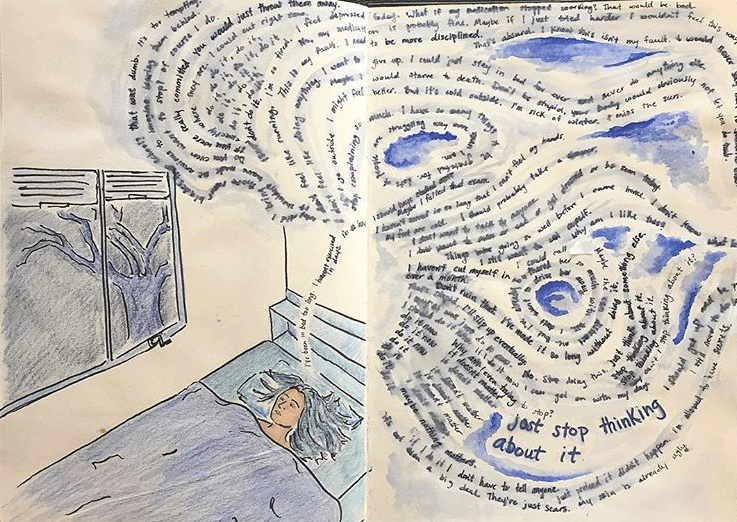
That said, there were always parts of my art that my therapist pointed out as meaningful that I hadn’t noticed before. I could always come away with a better understanding of myself, or at least something new to think about. For example, the window mechanism in this piece is very detailed.

Thoughts

She suggested that detail might be an indicator that there was some hope of freedom or escape from the thoughts in the drawing. Whether that’s something that ended up in the drawing because some part of me believed there was hope, I’m not sure. But I can certainly take that sense of hope away from it, into my normal life. 

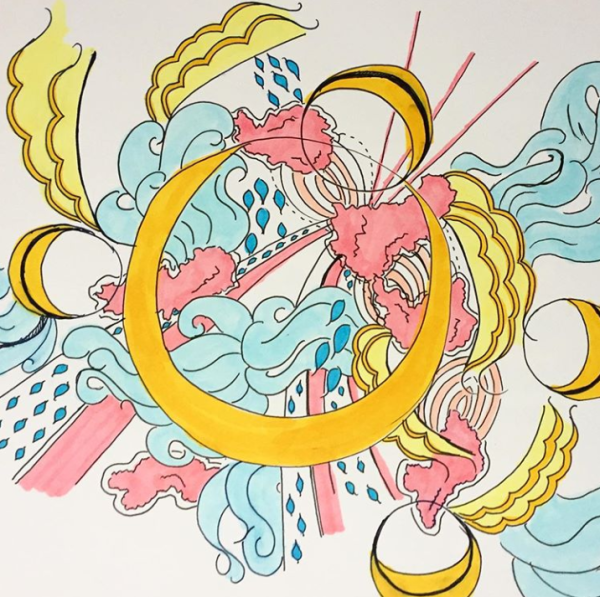
Art about mental health is not just an excellent way to express feelings, but it also starts a conversation. It can make people feel less alone in their experience, and it can help your loved ones understand your symptoms and how you feel. Sometimes, it even helps me understand where I’m at in regards to my own outlook. Sometimes a piece of art will take me by surprise at its dark overtones when I thought I was feeling ok. Other times, I’m pleasantly surprised to find that drawing a whimsical picture is exactly what I want to do.

whimsical-drawing-of-yellow-blue-and-pink-shapes

If you’re interested, you can follow my art Instagram @lumpdates

Medicine

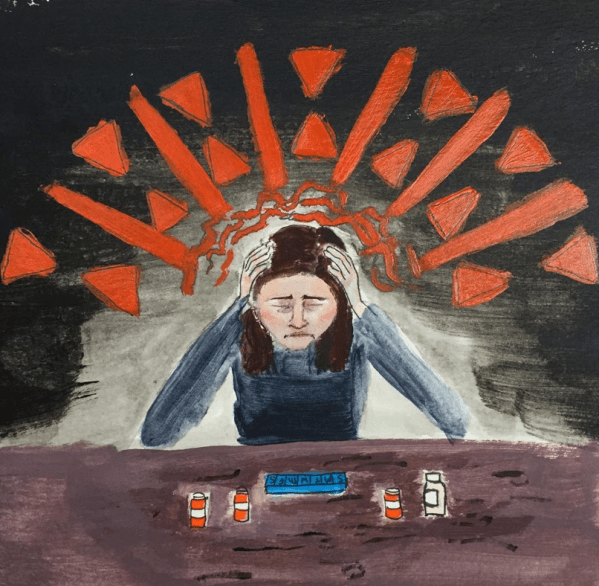
medicineIt’s nothing to be ashamed of I tell myself twice daily. What day is it? They all blend together. I open the third compartment, pour the pills into my palm, wait for a moment. Maybe this day will be the day. Maybe if I give the medicine a moment of silence; infuse it with my desperation before I let it fall down the dark well of my esophagus.

How many have I tried? Not enough that all hope is lost. How many have I tried? Enough that they call it “treatment resistant” depression. I call it drowning by degrees. Later, I open the third compartment, pour the pills into my palm, and wait a moment.

It’s nothing to be ashamed of.

Love,

Your brain