Over the last couple of months, I’ve noticed a decline in my mood. I’m not sure why this is happening. Maybe it was stopping the ketamine, or maybe it’s the seasons changing. Or maybe it’s just the cycle my depression has taken. It was so subtle at first that I questioned whether I was imagining it. Fortunately/unfortunately, my extensive experience with being depressed has taught me to look out for several signs that my mood is trending in a concerning direction.
First, I start dreading and putting off my daily walks with Stella. When I do walk her, I get frustrated and impatient, often cutting the walk short so that I can get back inside. This sign is so consistently an indicator that my mood is slipping that I’ve learned to pay attention to it even before I notice any other symptoms of depression.
I also start crying more, which is extremely uncomfortable for me. Displays of emotion make me feel entirely too self-conscious, and crying in front of people is about seven steps too far. I dislike the feeling of losing control of myself. When I start crying at mildly poignant YouTube ads and any time I try to verbally express a slightly negative feeling, I know something’s up.
When I’m depressed, my PMS symptoms are monumentally more disruptive. The aforementioned tearfulness is elevated, my desire to do anything social disappears, and I often start to have urges to harm myself. It’s not a fun time.
Having trouble keeping up with self-care is a classic depression sign, and it’s definitely one I experience. When I start sleeping in my clothes because I just can’t be bothered to change into pajamas — even if it’s just one night — I try to pay attention. It’s easy to put off self-care tasks without realizing that I’m depressed, so sometimes I miss the significance of it. Certainly when it becomes a pattern, though, I know I’m in trouble.
Routine in general is very supportive for me. When I feel good, I adhere to my routine easily, and I feel that it helps me maintain my good mental health. But when I’m depressed, I forget to water my plants, I fall behind on laundry, and I don’t get dressed until the afternoon (when the dreaded walk with Stella becomes unavoidable).
Knowing my signs of depression is vital for combatting the slide into poor mental health, but it’s only part of the process. By the time I notice and accept that I’m becoming depressed, it’s already difficult to pull myself out of it. I’m considering reintroducing Lamictal to my list of medications, but I’m struggling with the concept of it. Being reluctant to take my medication is another unfortunate sign that my depression is worsening. I’m working on just being consistent with the ones I already take.
Seeing as tomorrow is Thanksgiving here in the U.S., I’ll end this post with some positive thoughts. I have a new job, which I really enjoy so far. I’m fortunate to be in a relationship with a wonderfully empathetic, intelligent person, and I’m looking forward to spending time with my family and friends tomorrow. My mental health may not be exactly where I want it to be, but my outlook is still largely positive, and my life is objectively amazing. Wishing you all comfort and happiness on whichever day of the year you read this.
Life has been good lately. I’ve been taking Mirapex for a few months, and it’s turned out to be very helpful for me. My depression has improved dramatically. I’m more social, more interested in doing things, and more positive in my everyday life. I’m still taking lithium, Seroquel, and Deplin, which I’ve found through trial and very painful error to be completely necessary. All in all, I’m fairly content to continue my current medication regimen — with some minor adjustments.
Balancing Side Effects and Improvement
While Mirapex has proven to be effective at improving my mood, it has also had an effect on my appetite. I struggle with low appetite as a result of my depression anyway, so being even less inclined to eat has become a problem. I’m significantly underweight and struggling to gain. I tried reducing my Mirapex dose in the hopes that it would help my appetite and decrease my anxiety, but it wasn’t a very impactful change in those departments. I also started to notice some worsening depression symptoms, so I returned to the slightly higher dose.
Recognizing Depression Symptoms
I’m glad that at this point, I can put my extensive experience being depressed to good use in recognizing when symptoms are returning. I’m always very aware of how much I’m sleeping during the day. Napping tends to be a reliable indicator that my mood is declining. It’s both a result of the fatigue depression brings as well as a good old-fashioned escape mechanism. When I lose interest in doing anything, sleep seems like a great way to pass the time I don’t want to be conscious for anyway.
I also get this aimless, melancholy feeling that accompanies the anhedonia. I feel like I should be doing something, but I don’t know what, so I move from activity to activity, room to room, feeling lost. When I finally just sit down and embrace the lack of productivity, I feel a sinking, hopeless feeling in my chest.
Dealing with Anxiety
Seesawing between depression and anxiety is an unfortunate pattern for me. Mirapex helps lift my depression, which naturally ushers in the anxiety. The anxiety is augmented by the Mirapex, which tends to make me feel more awake and energized. I feel generally more tightly wound lately. Driving seems to set the anxiety off — to the point of crying, shaking, hyperventilating panic attacks on a few occasions. Even when nothing anxiety-inducing is happening, I find myself feeling restless and tense.
I struggled with debilitating OCD and generalized anxiety as a child and teenager, and I fear going back to that. When I start to get anxious now, as an adult, it feels horribly familiar. So, I try my hardest to combat it. If it’s an intrusive thought that feels like OCD, I do whatever the anxiety tells me not to do. In some ways, the idea of giving in and avoiding the thing makes me more anxious than doing it because I have such a fear of slipping back into old patterns.
Even though I’m fairly good at doing exposures and keeping the OCD in check, being anxious about being anxious is tough to get out of.
Adding Another Medication
In an effort to try to reduce the anxiety, I’m starting to take pregabalin, which is Lyrica. It’s more accurate to say that I’m re-re-restarting Lyrica. I have a really hard time adding medications because of my deeply seated issue with “needing” them. I have this belief that I should be able to fix my psychological problems on my own. Even though, intellectually, I know there’s nothing wrong with taking medications, I still fight with myself over it. At this point, it’s a habit for me to resist any new medications. I’ve “started taking Lyrica” several times now and haven’t continued long enough to get anywhere near an effective dose. This time, though, I’m actually doing it. The balance between anxieties — the general one and the one about taking a new medication — is shifting, and I’m inclined to do something about the everyday anxiety.
For now, I’m just taking a basically homeopathic dose while I get used to having a new pill in my organizer. I’m easing myself into it.
Ketamine Troches
Taking ketamine troches has continued to be somewhat helpful. I definitely notice a decline in my mood when I don’t take them, so I suppose they’re doing something.
My experiences with them are wildly varied, ranging from being trapped on the bathroom floor for an hour while time warped around me to contentedly eating pizza while scrolling the internet. Sometimes, I feel it intensely and dissociate for an hour, and other times, I barely notice anything at all.
I have discovered that on the occasions when I feel the ketamine a lot, it’s important that I not eat too much before bed because if not, I will wake up several times to go vomit.
Moving House
I moved again a few months ago, and aside from the conveniences of living in a house vs an apartment or a townhouse, living in the house has been an interesting transition.
For a while, it just felt like we moved again – this one makes four times in a year and a half if you count “moving” to the hotel after the fire. The significance of having a house after losing the old one sometimes slips by me, and I feel a numbness that I don’t like. I also feel strangely unattached to my new belongings now. I know they’re mine, but they just feel bland and unimportant. If they were damaged or I lost them, I wouldn’t be upset. Perhaps that’s healthy. I don’t know.
On the positive side, Stella has a yard again, which is a major improvement compared to our last place. Of course, she has found ways to crawl under the low deck in search of rabbits, and she’s dug little dirt beds into the two shady spots. Dog-proofing aside, I’m just glad she likes it.
My recent experiment, in which I got off all of my medications and became horribly depressed, taught me that I do not do well without lithium and that lithium alone is not enough. This information wasn’t surprising, but I was hoping for a different outcome. I was really hoping. I was hoping that I could exercise, socialize, and exert enough effort to work my way to a healthy mind. By the time I realized I was losing weight and struggling to brush my teeth every day, those options felt out of reach.
The more depressed I became, the less I wanted to give up on my experiment. Some of it was a sunk cost fallacy, but some of it was my clouded thinking. I saw medication as an outside force that would influence my thoughts and distort reality. I felt suspicious of it. Looking back, I can see that I was not thinking clearly. I’m much more in control of myself now that I’ve been back on medication for a couple months.
Not only am I keeping up with hygiene and sleep, but I’m capable of appreciating the sensations of life outside my bedroom – a flock of house finches chirping in a bush, the sun on my eyelids, Stella’s wet nose against my hand. I no longer go to bed immediately after work, and I also don’t sit on my bed at night, staring into space in an apathetic stupor. I’m getting out and meeting people, running errands, and picking up my hobbies again.
I don’t feel good every day right now, but I feel capable enough to put the usual lifestyle tactics to use. My situation feels more manageable. These developments are partly thanks to therapy and my efforts outside of it, but I think they’re mostly due to medication.
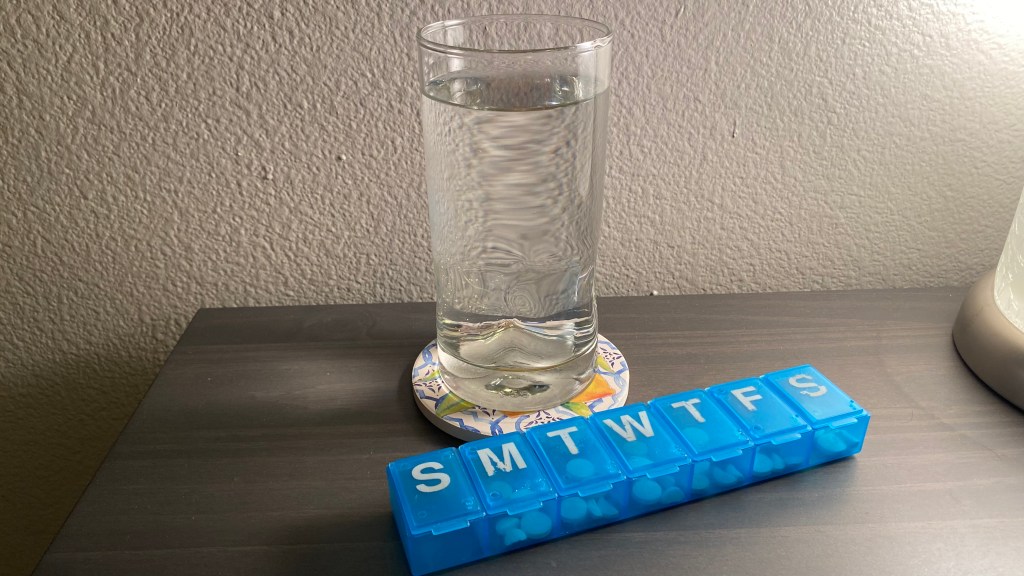
So, I know very well that medication helps me, and I’m working on accepting that. I don’t have any desire to stop taking them, which is a step forward for me. But an internal conflict still exists within myself. I certainly still have some shame about it. I was uncomfortable when I was asked to list my medications at my recent dental appointment, knowing another patient was right behind the curtain. I feel reminded of my mental illness every time I pick my meds up at the pharmacy. I struggle when I pour them into my palm at night, and I see a number of pills that exceeds my mind’s arbitrary “acceptable” number.
Most of my difficulty with medication is eased when my mood improves, but the remnants come from my perfectionism. I want to be able to get better on my own, and I have a tendency to tell myself that it’s not that bad.
Despite the background beliefs that are tough to get rid of, I feel like my perspective on medication has shifted compared to a few months ago. I’m happy that my medications are working. I’m no longer uncomfortable with the idea of them affecting my mind.
It’s strange to look back on what I was thinking when my depression was worse. I had this idea that if I relied on medication to function, I wouldn’t really have earned that improvement. It would mean I wasn’t in control of myself enough to pull myself out of depression on my own. It’s a horrible thought that nobody else should ever believe about themselves. I shouldn’t believe it, either.
I was also very preoccupied with the idea that lithium prevented me from thinking about suicide in the same way as I did without it. Even though I knew that was the point, it made me very uneasy. I thought that I was seeing the situation more clearly than I did when I was less depressed and on medication. Part of me knew that was absurd, but part of me was sure it wasn’t.
Once it was long past obvious that getting off lithium was not going well, I really struggled to come around to the idea of restarting it. When you can’t trust your own logic, having people around you to tell you how they see things is very helpful. Still, for weeks after I restarted lithium, my evenings were spent arguing with myself about which side was right and whether I should take it or not. I think the combination of ketamine and Mirapex has improved my mood enough that I’m not concerned with it anymore.
There have been a few times in my history with depression when I found a treatment that worked but only briefly. Either I’d start to feel better and then something would go wrong, it just would stop working, or it would affect me too much, and I’d fly into an uncomfortable, sleepless state of heightened perception. After which, I’d descend back into depression, sometimes worse than before the improvement. This time feels different.
I think the last time I felt this positive about my improvement was in 2020, when I was getting ketamine infusions and they had started to work. I remember feeling amazed by how much easier life was and how motivated I felt to accomplish my goals. I feel a similar sense of improvement now. It is, as usual, accompanied by increased anxiety, but overall, my mood seems fairly stable in its new, elevated position.
It bothers me periodically that I’ve lost interest in my hobbies. I used to enjoy going to the library, but I don’t read anymore. I try every once in a while to draw something or start an embroidery project, but I usually just end up staring at the materials for a while and then giving up. Art has always been something I do sporadically. I have periods of inspiration and periods in which I set it aside, but I always cycle back through. Not lately. I feel like I’ve lost all motivation to create anything – even in writing. My drive to write on my blog has been exceptionally low, even though I maintain a desire to keep up with it. It’s a frustrating space to be in.
Part of my problem with visual art is that I get too caught up in making it match my mental image. It leads me to give up or not start at all. It occurred to me that it might be easier to get started if I tried to make something after taking a ketamine troche. I have tried writing while dissociating on ketamine, but something about articulating my thoughts in full sentences proves to be very difficult, and I usually abandon it.
Turns out, painting is entirely different. I sketched out a landscape based on a photo and pulled out my watercolors before taking a troche.
I found the process of putting colors on the paper to be engrossing, and I think that since I was curious to see how it turned out, I wasn’t so worried about it looking “bad.”
By the time the ketamine had worn off, I had made it to this point:
It was unfinished, so the next day, I went back to it with all of my faculties and spruced it up. I still don’t love how it turned out, but I can label it a ketamine experiment and be content with that.
Other hobbies I’m attempting to resume include running, drawing, and volunteering. Each of them is in the tiny beginning stages, but I have to start somewhere.
My experiences with ketamine troches have been varied. Sometimes it hits me, and I decide that being horizontal is better than attempting to sit up, so I get in bed. I’ve definitely noticed that remaining still makes me less likely to get nauseated, but it also makes it harder to perceive the dissociative effects of ketamine. I frequently think that I’m past the dissociation and get up, intending to go walk the dog or clean the kitchen, only to realize upon standing that I most definitely am not ready to practice such advanced life skills.
Then again, sometimes it seems like nothing happens when I take a troche. This is somewhat disappointing, given how much mental preparation goes into overcoming the revolting medicinal flavor. I could just swallow the troche without letting it dissolve, except the edges of it are sharp. Believe me – I’ve tried. It’s painful. The best way I’ve found to take ketamine troches is to sip lukewarm tea while it’s dissolving in my mouth. It helps with the flavor, and the liquid speeds up the dissolving process.
My first few troches were more intense than subsequent ones, and overall, I’ve found that they produce much less absurdity in my mental images than ketamine infusions did. Troches tend to lead me down memory lane or explorations of personal questions rather than bizarre, imaginative storylines.
I think that because taking prescription ketamine at home still seems strange to me, I often ponder the question, “How did I get here?” My experience with mental illness started early, so naturally, my childhood comes to mind when I pose that question to myself. Sometimes, when the ketamine kicks in, I begin to review my life as if I were watching a movie, skipping ahead and replaying certain parts. It either leads to me feeling like perseverance is my path or just feeling utterly lost. When I separate from myself a little, it often just adds to my pre-existing sense of confusion and nonbelonging.
More often than not, I cry when the ketamine kicks in. I don’t know if that’s common or expected, but it’s definitely a pattern for me. And it’s interesting because I don’t cry with much regularity in my everyday life. I’m not sure why dissociating would make me feel my emotions more, but it seems to me like it does.
I do feel a bit better, but I’m not sure whether I should attribute that to being back on lithium, the ketamine, or the new medication I’m taking, Mirapex. Historically, lithium has been very helpful in tamping down my suicidal thoughts and allowing me to be more functional. It doesn’t usually do much about the anhedonia, which leaves me feeling the need to accomplish things but not getting much satisfaction from it.
I also started taking Mirapex a few weeks ago. It’s a dopamine agonist used for Parkinson’s disease, restless leg syndrome, and – off-label – depression. I’m in the middle of increasing the dose, and so far, I’m not sure whether it’s helping. It certainly could be part of the combination.
When some questions about my diagnosis arose a couple months ago, I realized that my medications made it difficult to determine which symptoms were side effects and which were stemming from me. I’ve wanted to get off my meds for a long time, partly because I have an unhealthy tendency to blame myself for my illness and expect myself to fix it through willpower. But that’s a whole separate issue. Don’t do as I do in that regard.
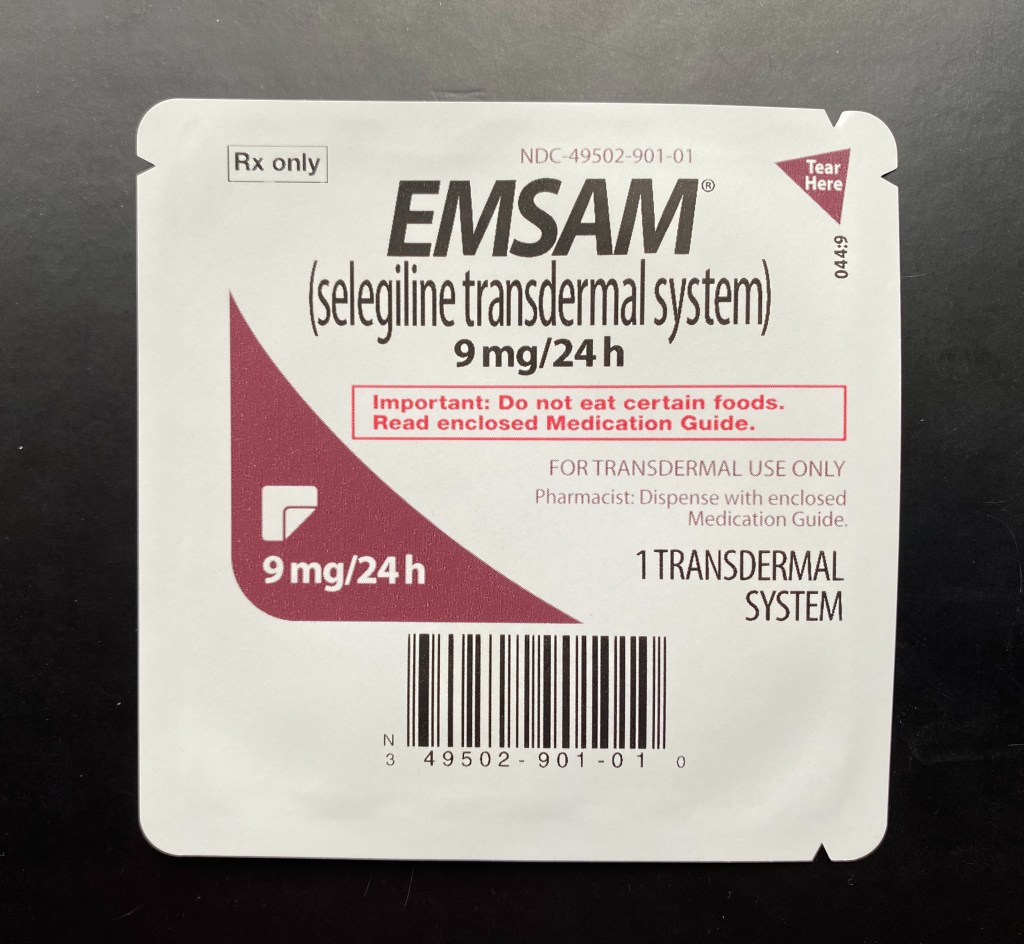
I decided to get off Emsam first, as I suspected that was the main culprit when it came to the occasional hallucinations and sudden mood shifts I was experiencing. Decreasing my dose was difficult, but when I stopped taking it completely, I felt better. Not by a lot, but it was noticeable.
The next step was to decrease my lithium dose. That process has progressed in the reverse of how Emsam went. Lowering it was mostly fine until I got to 300 mg. I started to feel worse, but I hoped that if I stayed at that dose for a while, my mood would even out. I started napping again. If I have nothing scheduled in the afternoon, I spend it sleeping. Walking Stella was one of the only activities I was enjoying before I started changing my meds, and now I don’t even want to do that. I still take her on at least one long walk a day because she needs it, but I find myself getting irritated and impatient the farther we get from home. Sometimes we go to the dog park so I can stand in one place and throw a ball for ten minutes before we leave. It’s a good thing she likes fetch.
I stopped taking lithium over a month ago, and I’m still on the fence about it. I’ve definitely crossed into not-okay territory, but I’m stubbornly refusing to reverse my plan. Part of me thinks this is a bad idea and I should go back on lithium, but part of me wants so badly for it to work out that I’m willing to give it more time.
My determination to get off my medication, even though it has a slightly positive influence, seems confusing on the surface, and I struggle to articulate my reasoning for it. I always think that I’m not doing enough to help myself, and I have a long history of feeling ashamed of my reliance on medication. I think the most succinct way I can describe it is that I’d rather believe I’m failing at doing something possible than accept that it’s impossible. Truly accepting that I need medication in order to function would require me to admit that I don’t have full control over myself, and that’s a frustrating and scary thought for a perfectionist.
I’ve mentioned this in previous posts, but to be clear: I don’t feel this way about anyone else. It’s a bizarre thought distortion that makes me feel as though everyone else is perfectly justified in taking medication, but I am not. The more depressed I get, the harder it is to see the irrationality of that.
I’m trying to push myself to do things and go places because I want to support my mental health as much as possible while I make these medication changes. It’s hard, though. The holiday season is upon us, and the twinkling lights and pine-bough wreaths on nearby homes are making me sad. I automatically think about all of our holiday decorations burning up in the fire five days after Christmas last year. I felt like I was moving on during the summer, but the cold weather has caused a resurgence of painful memories. It’s probably not the best time for me to be messing with my brain chemistry, but here we are.
I’m just so frustrated with medications. The possibility that I have bipolar disorder offers a nice, neat explanation for why I’ve had such sporadic and limited success with antidepressants. Getting off everything so that I can tell where my baseline is (and whether I eventually cycle back into hypomania without the influence of mood stabilizers) might make a difference in my plan going forward. The diagnosis is arguably not as important as figuring out what helps me, but since I tend to spiral into believing I’m not actually ill but rather just low in the willpower department, having a name for what I’m experiencing would be helpful. I’m just not sure if it’s worth the difficulty of achieving confidence in one diagnosis over the other, and it’s obviously not going great so far.
In fact, my mood has sunk so low that I agreed to retry ketamine – but in a different format this time. My psychiatrist prescribed ketamine troches, which dissolve under your tongue. This formulation of ketamine can be taken at home, which would be new for me. I’m nervous about it – for one thing, it’s much less controlled, in the sense that an IV ketamine infusion can be stopped suddenly; once I take the troche, I’ll just have to wait out the whole dose. I started to really dislike the feeling of ketamine toward the end of my time getting infusions, and although I don’t think troches will feel as intense, the uncertainty is making me anxious.
I am, however, passively suicidal and having trouble keeping up with self-care. I frequently sleep in my clothes and re-wear them the next day, and my hair keeps developing hidden matted sections because I can’t bring myself to brush it. So, perhaps something like a short burst of at-home ketamine would help me get myself into a better routine.
My depression brain is yelling about how I got myself into this mess by stopping my meds, so I don’t deserve help getting out of it. But that’s not healthy at all, so I’m going to try to resist it. I’d like to do some research on ketamine troches tonight so that I know more about what to expect, and then I’ll try to pick them up from the compounding pharmacy tomorrow. Ketamine seemed to stop working for me after a while, so I’m interested to see whether taking a break has impacted its efficacy.
Writing has always been helpful for me, but I’m finding the motivation to do it hard to come by. When I was more actively questioning my diagnosis, having a written record of my symptoms and how different treatments have affected me was incredibly useful in trying to piece together a timeline, so I’m going to renew my efforts to keep up with my blog. It might come in handy later.
In late summer of last year, I increased my antidepressant, Emsam, from 9 to 12 mg. I was staying in a hotel at the time, and something odd began to happen. I started to hear music when the AC was running.
It is normal for people to hear tunes in the mechanical background noise of fans. It is not a psychotic illness – merely an odd perceptual idiosyncrasy. However, what I experienced was much more complex than any small, lilting buzz I’ve ever heard in a fan before.
The Musical Phenomenon and A Shift in My Mood
I was hearing soundtracks. Vocalists, instruments, the whole nine yards. I couldn’t decipher any lyrics, but there were distinct genres that ranged from pop to broadway to country. It sounded as if the music were coming from a different room, and for a while, I believed it was. But eventually, I began to get suspicious.
I walked around the hotel room, putting my ear to the walls, listening for a change in volume. I opened the door and poked my head into the hallway. I stood on the bed and listened to the ceiling. It was always the same volume. When the AC shut off, so did the song. A different song would start up after a few minutes of the AC running again. Sometimes, a sudden shift in my attention would cause the music to stop, even when the AC continued to run. It became clear to me that what I was hearing was not real, and it disturbed me.
A Mountain Escape
I was about to go to a new location – a trip with my mom to a small, mountain town for some wilderness relaxation. We planned to hike up to a lodge at 11,000 ft above sea level and stay for a few days. The hike up was arduous; it was the hardest hike I’ve ever completed, despite being shorter and with less elevation gain than other hikes I’ve done.
I remember that I wasn’t sleeping well, and my body just refused to cooperate as I forced myself up the trail. I had to stop frequently and lean on my pole, taking gasping breaths. At the lodge that night, I heard phantom hummingbirds zipping all around me as I lay in bed. In the morning, the sound was gone. I was unsettled, but I tried to put the experience out of my mind.
I was testy on that trip. My head was not in a good place, and my mind was filled with overwhelming irritation. I cried a lot. Neither my mom nor I were having a good time, so we left early and headed down the mountain to get a hotel room.
Upon reaching the hotel, a minuscule setback occurred, and it sent me over the edge. In a second, I went from chill to overwhelming, roiling anger. It was like calm seas to tsunami in the blink of an eye. I contained most of this energy, but some escaped in the form of expletives, fist clenching, and undignified, hurried marching on my way to our hotel room.
I am typically a very levelheaded, patient person. I strongly dislike being angry, and when I am, I make every effort not to show it. (Is that unhealthy? Yes.) In that moment at the hotel, I felt completely unhinged.
My dog had never seen me in such a state, so she hid under the table. The sight of her filled me with guilt and self-loathing. I immediately dissolved into dramatic, uncontrollable sobbing, which only frightened my dog even more. I was convinced that she would be afraid of me forever, a consequence for which I wholeheartedly believed I would never forgive myself.
Luckily, dogs are good creatures, and Stella came around once I had composed myself. Composure took a while to reach, but a hot shower helped.
Looking back, I feel like I was not myself from the very start of that trip. The rest of it passed fairly uneventfully, but I continued to hear sounds and music that were not real until a few days after returning home.
She forgave me quickly ❤
I’ve gone back and forth between 9 and 12 mg of Emsam since then, and the musical illusions occur sometimes when I take 12 mg. Sometimes it’s music, an incessant buzzing, or the murmuring sound of a group of people talking far away. Sometimes I can identify the background noise that accompanies it, and other times, it seems to happen on its own.
The Ketamine Incident
A couple weeks after returning from our mountain trip, I had a ketamine infusion that resulted in a bizarre, seemingly manic few days. I wrote a post shortly afterward that described my experience. I slept a couple hours each night but was compelled to keep moving. I worked on various projects for hours at a time, periodically bothered by the sight of small, insect-like dots scurrying across my visual field. I felt restless, productive, and somehow rather pressurized from the inside. I was also unsettled by dissociative spells in which I’d suddenly feel as though I were wearing my body, but it wasn’t really mine. Or, I’d walk by a mirror and be disturbed by my own face, which seemed unfamiliar.
When the strange symptoms ended, I plummeted back into depression.
I decreased my Emsam dose and my ketamine dose and had much more typical ketamine experiences, although I still found myself unbearably restless after infusions. The incident was strange, but since it didn’t happen again to the same degree, we carried on with treatment for a few more months.
Do I Have Bipolar Disorder?
I explained some of these experiences to a psychiatrist recently. I was being evaluated for ECT, although I’m not yet sure whether I want to do it.
The doctor interviewed me thoughtfully and asked a lot of questions about my symptoms. When we reached the end of the evaluation part of the appointment, he said that I might have been misdiagnosed with major depressive disorder, when really my depression is of the bipolar type.
It’s just a theory, but this would explain why antidepressants haven’t worked very well for me, or at least not for very long. The antidepressants actually seem to trigger these odd experiences.
There have been other times when my mood suspiciously shifted, like the first time I took Wellbutrin. A day or two after starting it, I felt dramatically better. I was motivated, energetic, and utterly thrilled with how well it was working. Of course, then I developed a rash and had to stop taking it, at which point, I spiraled in the other direction.
The second time I tried Wellbutrin (the brand-name instead of generic), I wrote a post titled “Depression on Fast-Forward.” Wellbutrin didn’t make me happier that time, but it did make me anxious, jittery, and restless. I wrote about feeling “an almost constant low level of adrenaline” and feeling mismatched, like I wanted to sleep but was unable to. Was this just a side effect, or something more? Was taking lithium what made the second trial less happiness-inducing than the first?
The Antidepressant/Bipolar Controversy
These and the other incidents I can identify always happen in response to something, usually a medication change. The question of whether antidepressant-associated hypomania (AAH), also called treatment-emergent affective switch, or TEAS, indicates an underlying bipolar disorder is a controversial one.
Some people think that you can have unipolar depression and be reversibly pushed into hypomania by antidepressants, while others believe that switch indicates the existence of an underlying bipolar disorder or a shift from unipolar to bipolar illness. It has also been suggested that AAH should form the basis of a new diagnostic label, “bipolar III.”
I have experienced multiple incidents in the last few years that felt like a dramatic change, complete with insomnia, high productivity, perceptual disturbances, and euphoria or irritability. And yet, I find it difficult to verbally describe these events in a way that emphasizes the aspects I think are important. I habitually understate the severity of my symptoms, which doesn’t serve me when I really need help but can’t communicate accurately.
I’ve sought a few opinions from professionals on this matter, and I’m having trouble just reaching a consensus on whether my experiences count as AAH or were simply improvements in my depression with some side effects sprinkled in.
Even when I make a concerted effort to be more emphatic, the theory sometimes gets dismissed because the episodes I describe are too short by DSM standards to be mania, and I didn’t have racing thoughts, go out and spend all my money, take unreasonable risks, or have grandiose plans. These are all excellent points, so I’m really not sure what to think.
The DSM has strict criteria defining bipolar I and II, but that’s not the only way people conceptualize the condition. Some experts believe bipolarity exists on a spectrum, and that viewing antidepressant-associated hypomania as part of unipolar depression contributes to an overdiagnosis of MDD and an underdiagnosis of bipolar II.
On the other hand, some authors argue that bipolar disorder is overdiagnosed due to inflation of the diagnostic criteria, making the concept of bipolar disorder too vague.
Stopping My Antidepressant
Given the number of conflicting theories out there, it seems unlikely that I’ll get a solid answer about my own experiences at this point. One way to clarify the picture is to gradually get off my antidepressant and see what happens.
I thought for sure I’d go back to the excessive sleeping I was doing before I started taking it, but so far, that hasn’t happened. I’ve been off Emsam for a couple of days, and the insomnia continues to plague me.
It’s troubling to look back at the last few years and imagine that there may have been a process occurring outside of my awareness. At the same time, I’m ever so slightly encouraged to have a different direction to go in. It could offer an explanation for some mysterious things and provide me with more effective treatments. Then again, maybe I have major depressive disorder, and I’m looking into a problem that doesn’t exist for me. Regardless of how it turns out diagnostically, I’m relieved to be connecting some dots.
Initially, my extended TMS course didn’t seem to have much of an effect on me, except perhaps to kick my insomnia into a higher gear. After much thought and discussion, I decided to stop TMS suddenly rather than taper my appointments.
Getting TMS treatments every day had begun to feel pointless. We’d tried several adjustments and protocols, remeasured my motor threshold, and extended my treatments beyond the planned schedule, but none of it made me feel any different.
At this point, I’ve tried what feels like an exhaustive list of medications. Combine that with my lengthy treatment with ketamine infusions, years of therapy, and now TMS, and I can’t help but see a hopeless picture. I know I’m not out of options, but the pattern leads me to conclude that any further effort to get better will result in the same outcome: more depression.
However, I know that’s a logical fallacy. Just because many treatments didn’t work does not mean that the next one won’t work. It’s hard to grasp that when you’re deep in depression, though. I left the TMS clinic feeling hopeless. It’s indescribably discouraging to try treatment after treatment, clinging to a tiny scrap of hope that just gets smaller and smaller as you go.
I sometimes feel as though I’m trapped inside myself, carried along by my depressed body like a prisoner. I’m in here — I’m just unable to break through the impenetrable walls around me no matter how hard I try. At other times, I feel as though depression has eroded my mind, letting the essence of me wash away. The “me” I am when I am not depressed seems to be gone. The movement stops, the lights go out, and I wait in internal darkness for some motivation to stir in my mind. The little scrap of hope flutters somewhere out of reach.
The second version is how I felt when I stopped TMS.
Ending TMS meant that I needed to consider my next steps. ECT is one option, and I’m interested in doing a consultation, but the thought of actually starting that process is daunting. I had increased my dose of Emsam, the MAOI I take, and figured I would wait a little while before doing anything. In the meantime, I wanted to get a handle on my insomnia.
Sleep Meds
I did not sleep more than five or six hours a night in the last two months, so that’s been a barrier to my mental health, too.
Temazepam
Increasing my usual sleep medication helped but then plateaued, so eventually, I decided to try Temazepam. I was a little nervous about taking it because I don’t like feeling impaired, especially if I’m uncertain of how it will feel. But alas, I was tired. I read the medication info sheet front to back because that’s the kind of person I am, took the pill, and prepared for a blissful night of uninterrupted sleep.
Yeah, right. It was one of the most unpleasant nights I’ve ever had. I was unbelievably restless – not just my legs but my whole self. I didn’t stop moving for hours. I was too hot, so I moved downstairs to the couch, but then I could feel my heart beating, and the sound of my breathing was grating in my ears. Sometime around 4 AM, I fell asleep, only for the sun to come up two hours later.
One category of medications that I had not tried before now is the atypical antipsychotic class. Seroquel is a drug in this category. It’s used as an off-label treatment for depression, and it is also sometimes prescribed for insomnia due to its sedating effects.
I decided to switch from Trazodone to Seroquel, and overall, it’s been a positive change. I started with too high of a dose and had an unpleasant day afterward, but I quickly adjusted. As long as I give myself enough time to sleep it off, I no longer feel sluggish and half-asleep when I start my day.
I’ve managed to increase my sleep to six or seven hours a night. Although it’s not an enormous difference in terms of hours, I feel like the quality of my sleep is better. I no longer wake up during the night, and I feel slightly more rested overall.
It probably helps that I reduced my lithium dose a little and don’t wake up feeling like a dried-out sponge several times a night. I keep my ridiculous 64-oz. water bottle by my bed for easy middle-of-the-night hydration. My psychiatric np finally told me so many times to drink more water that I stepped up my efforts and bought it. It’s so big that it’s basically an insulated bucket with a lid, and I love it. I don’t have to deal with the extra step of refilling a glass or smaller bottle frequently. It’s a silly reason to not drink water, but when I don’t care about myself enough to keep up with hygiene or eating, refilling a glass of water is surprisingly challenging.
Restarting TMS
But, I digress. After a few days of no TMS, I found myself feeling – impossibly – worse than before. Whether that was because TMS was helping in small ways or I was simply despondent after giving up on another treatment, I still don’t know. I decided to pick up with TMS where I left off.
The timing makes it difficult to determine which factor caused what result, but after restarting TMS, sticking with the increased Emsam dose, and adding Seroquel, I suddenly felt dramatically better for a few days. I found myself walking Stella with a decidedly peppy step instead of my usual brick-like feet. I suddenly wanted to go places and do things, which is the complete opposite of how I felt before. I actually felt like I could feel the dopamine I had missed so much. I felt happy about nothing in particular.
I always marvel at how impossible it is for me to imagine how it feels to be less depressed. I know it sounds odd, but every time I get some relief from my symptoms, I find that the sun feels warmer, the breeze feels more refreshing, and colors seem more vibrant. I feel like I’ve been released from a state of deadened perception and pushed into a shockingly bright, intense world.
Despite experiencing such improvement before, I’m always taken aback to realize that I could not grasp how distant I felt while depressed. The memory of what improvement feels like disappears when depression returns, and the only way to understand it again is to experience it.
The Current State of Affairs
I don’t currently feel as amazing as I did for that brief time, but I do think that I’ve maintained some improvement. I still feel considerably more energetic, and although my mood has embarked on a journey of hills and valleys, it’s nice that there are still hills.
I’m not sure where this will leave me. I’m planning to do three more TMS treatments and then stop. I don’t feel nearly as desperate as I did when I stopped TMS the first time, but I am concerned that some symptoms seem to have worsened slightly since my sudden improvement.
Part of me thinks that now would be a good time to look into eventually making more treatment changes, whether that’s ECT or something else, since I’m still relatively motivated. The other part of me thinks that I should just focus on adding habits and activities to my life that could help me hold on to the improvement, and see where that takes me. I guess I have some decisions to make.