person-extending-hands-with-open-palms-in-stop-gesture-as-contamination-ocd-concept-in-black-and-white

An Encounter with Contamination OCD

I haven’t been consumed by OCD in several years, something I’m immensely grateful for. That particular kind of mental torture is truly awful and not something I would wish on anyone. One of the subsets of OCD that I had was contamination OCD. My body and belongings had to be whatever my disorder deemed to be “clean,” or else some unnamed disaster would occur. There were often no actual illnesses I was afraid I might contract – I was just terrified of potential contamination by unknown germs/viruses/entities.

The Endless Compulsions

Beyond the fear, maybe the worst part of contamination OCD was how time-consuming it was. If something was “dirty” and it touched something “clean,” or if I touched the dirty item and then the clean item, they were both dirty. I spent a lot of time planning out sequences of actions that would combine touching dirty items because otherwise, I would spend half the time washing my hands raw so as to not contaminate anything else. My hands were always painful. I scrubbed them under hot water until I’d stripped them of any moisture barrier. Any movement cracked and split the skin open, which, ironically, made my bleeding hands perfect entry points for bacteria and viruses. But, OCD is not swayed by reason and rationality. It creates doubt that can’t be rooted out with reassuring facts.

Contamination OCD After Recovery

For the most part, I don’t deal with OCD anymore, contamination OCD or otherwise. My day-to-day life is not consumed by it like it was before, but every once in a while, I encounter something that stirs those obsessions up. My perfectionism around self-harm is one, and tapeworms appear to be another.

Unexpected OCD Triggers

I’m not squeamish, despite what you might think after learning of my past with contamination OCD. Again, OCD is not rational. Parasites are fascinating and don’t bother me from afar, but when I found a tapeworm segment in my dog’s stool, I felt the familiar stomach twisting of contamination OCD.

Once the initial shock passed, I found myself thinking about all of the things I would have to clean. First and foremost, the hand that held the poo bag. I must not touch anything between there and home, not even to put my hand in my pocket. The bed in her crate would need to be washed, and all of my sheets and blankets because she often snoozes on my bed. Should I wash her leash and harness? Perhaps I should stop petting her– would that be going too far? On second thought, that would be impossible. I’ll just wash my hands every time I touch her. So, like, 80 billion times per day.

OCD is Irrational

Keep in mind that the most common species of tapeworm is passed to humans only when you ingest a flea that carries the tapeworm eggs. Not likely. There is also a species of tapeworm that can be passed from dog to human through ingested feces on unwashed hands, but it’s not common in the U.S., and I’m a frequent hand-washer as it is. In other words, it’s very unlikely that I would get tapeworms from Stella.

I Fell into Old Patterns

That night, I lay in bed, Stella at my feet, and tried to control my rising panic. The vet was closed for the holidays, so I had left a message. Having no idea when they would return my call, I did what any smartphone-wielding person would do; I looked it up. Unfortunately, Google played the role of the reassuring-but-clueless friend who says something terrifying right at the very end of the conversation.

“Oh, it’s very uncommon for people to get them? OH, you might not show signs until years after ingestion?!”

Not gonna lie, my concern for Stella was overshadowed by my selfish, irrational fear for myself. The thought of something living inside me usually doesn’t bother me. After all, we are made up of more bacterial cells than human cells. Maybe it’s an evolutionary adaptation to be totally wigged out at the thought of parasites taking up room in your gut.

Facing Contamination OCD with Exposures

The good news is, I realized that I was obsessing about this right before I returned to the scariest thought of them all: “What if I already have tapeworms?” This is good news because it really kicked me into the best way to face OCD thoughts, which is to say, “Yeah, and?”

In the dark in more ways than one, with my tapeworm-host dog not three feet from me, I had to say, “Maybe I do have tapeworms. What am I gonna do about it right now?” Just sitting with the uncertainty brings you to the stunning realization that there is absolutely nothing productive about rumination. So, with a little more deliberate relaxation, my hypothetical tapeworms and I went to sleep. Well, maybe not the tapeworms. Do tapeworms sleep?

Living with Uncertainty

I still don’t know if I have tapeworms, and it’s honestly probably something that I’ll worry about off and on for a while. I do know that I’m much better at squashing obsessions than I used to be, maybe because I know it’s something I’m prone to and can catch it early on. Stella is on a deworming medicine and continues to behave like a dog. That is to say, eats anything and everything with gusto and drinks water out of the Christmas tree stand when nobody’s looking.

Anonymity and Mental Health Stigma

IMG_2405

When I started this blog, it was deliberately anonymous in an effort to avoid any mental health stigma from reaching my real life. I didn’t have my name anywhere on it and I made a conscious effort not to mention anything about my life outside the sphere of mental health. I don’t think I even told my immediate family about it until a few months in.

I liked the freedom of writing anything I wanted without overthinking it. Those fears of what will people think? were almost nonexistent because nobody knew who I was. Over time, I began sharing it with people I knew. My immediate family and friends, then my extended family, my therapist, and others involved in my treatment.

I know that putting my name on my blog doesn’t change much for you, the reader. It does, however, signify a big change for me in the context of internalized mental health stigma. I’m finally coming to terms with my diagnoses and feeling more comfortable talking and writing about them as myself, with my real name attached.

Everyone has their own reasons for keeping their online presence anonymous. My reason was rooted in shame. I was afraid that if people knew I was writing about topics like depression, self-harm, and suicidality, they would never again see me for the things that make me, me. The reality is that people I know tend to notice the things that shine through the overarching topics. They comment on my love of writing and my sense of humor before they mention the content of my posts. And when they do broach the subject of my blog, they express their happiness that I’m still working towards stability. It helps, of course, that my family and the people surrounding me are very understanding. Not everyone has that, and I’m so thankful that I do.

Anyway, there you have it. My name is Genevieve (Gen), I’m 23 years old, and I live in Colorado. I got my bachelor’s degree from the University of Michigan, where I studied Ecology and Evolutionary Biology as well as Evolutionary Anthropology. I work from home as an editor and freelance writer (not at all related to my degree, but whatever). On my blog, I write about my diagnoses of sensory processing disorder and major depressive disorder. I like reading, making art, and being in nature. This is starting to sound like a cross between a cover letter and a dating profile, so I’m going to wrap it up.

Lumpdates is still lumpdates, but I’m pretty dang proud of myself for standing up to mental health stigma by typing the nine letters of my name into my username settings.

Wishing you curly fries,

Genevieve

woman in orange jacket holding flowers in front of face

5 Tips for Therapy Clients Who Don’t Like Talking About Themselves

If you ever feel like a deer in headlights when asked to talk about yourself, I empathize. Whether it’s one of those dreaded get-to-know-you icebreakers or your therapist asking you a question, having to talk about yourself is uncomfortable for many people. By now, I’ve been in mental health treatment for several years, and I have a few tips for therapy I’d like to offer.

When I first sought therapy for myself, I found it extremely difficult to engage with it fully. If you don’t like being the center of attention, beginning therapy can be overwhelming. After all, the entire point of it is to focus on you. Early on, talking about myself in therapy felt, at times, nearly unbearable. Too many questions too fast made me shut down, and too loose of a structure lead to lots of awkward silences, both of us waiting for the other to say something. Over time, however, I’ve gotten much better at it. Here are some of the ways I’ve found to help me feel more comfortable about talking about myself in therapy.

The essentials

Any list of tips for therapy wouldn’t be complete without a soapbox moment about the therapeutic relationship. It doesn’t matter if you’re just starting therapy or you’ve been in it for a while; it’s vital that you like your therapist. The struggle of talking about yourself will be even worse if you don’t feel understood or accepted in therapy. In fact, research shows that therapy is much more effective when you and your therapist click. Don’t feel bad about shopping around or about switching therapists if it’s just not working out.

Secondly, remember that therapy sessions are for you. Push yourself out of your comfort zone, but go at your own pace. Therapy is your time to do with it what you will.

Communicate what you want to get from sessions

This is a tough one. There’s a lot that falls under this umbrella, but mostly what I mean by it is: tell your therapist if you would like to direct the topic of each session or be given more structure. Maybe it’s hard to talk about yourself because answering questions feels too probative, and you’d rather start off with a narrative. I prefer to have more structured questions because if I’m given free rein, I go blank and have absolutely nothing to say. Regardless of which end of the spectrum you’re on, your therapist is always there to help direct you and keep you on track.

Practice saying how you feel

I struggle hardcore with identifying how I feel. Maybe it’s sensory processing disorder, maybe it’s Maybelline. Sensory discrimination issues have extended into the emotional realm and mean that I often don’t know how I feel about something. If you have a hard time verbalizing how you feel, my advice is to practice. It sounds silly, but just as if you were a little kid, practice saying “I feel ____” and then fill in the blank with something more specific than “okay” or “fine.” Even on your own, check in with yourself; am I feeling excited? Lethargic? Irritated? It really does start to feel more natural over time.

I also find that using metaphors breaks the tension and allows me to communicate more comfortably. For example, my therapist and I talk about “clams” instead of “goals” because the very mention of goals used to make me a sweaty, anxious tear factory. The Potato Scale of Depression is another way that I like to remove a little of the scrutiny from myself and package it up in a statement about mashed potatos or soggy gnocci. There are many ways to get used to talking about your feelings!

Make the Space Comfortable

Of course, it’s not your office. You can’t go swapping out furniture and changing the overhead lights. But you can do some things to make the space more comfortable for you. A therapist I saw in college noticed that I have a very wide bubble of personal space and offered to move her chair a little further away from me. You can ask to close the blinds if it’s too bright for you, bring a small blanket to help you feel cozy, and be sure to wear comfortable clothing.

Stay (Mildly) Busy

Something that I learned in occupational therapy but haven’t put into practice (maybe I should!) is that talking about difficult things is often easier when your hands are busy. Bring a coloring book, a fidget toy, or a craft- if you’re a knitter, crocheter, or have some other portable project. Of course, this is one of my tips for therapy clients that is only good advice as long as your therapist doesn’t need you to be completely present during your work together. It doesn’t hurt to ask.

For us reticent folks, therapy can be scary even just to think about. But, like so many things in life, working on what’s difficult often leads to the best outcomes. With time and practice, talking about yourself in therapy gets easier, especially if you find what will support you and then advocate for yourself.

black-and-white-photo-of-people-sitting-and-standing-at-airport-gate-B30

Traveling with Sensory Processing Disorder

I’ve been traveling a lot lately, and I’m worn out. While waiting to board my latest flight home, I pretty much sat at the gate in a sensory stupor while the gate agents droned on the speaker about checking your carry-on bag. Because I have Sensory Processing Disorder, I needed an afternoon (or more) to reset my nervous system and return to the real world as a functioning human being. Unfortunately, airports have very few places in which to hide from the noise, movement, and general chaos of airport activity. (But for help finding those rare spots, check out sleepinginairports.net)

Dyspraxia, SPD, and Airports

And, it’s not just the crowds of people that are overstimulating- it’s also the tasks you have to do in order to get onto your flight. These tasks fall under the concept of praxis. In the context of Sensory Processing Disorder, dyspraxia refers to difficulty with planning complex movements and tasks. It falls under the Sensory-Based Motor Disorder subtype of Sensory Processing Disorder.

Tackling Motor Planning Challenges

I have symptoms of dyspraxia, so encountering uncertain situations can be stressful and draining for me. Standing in lines is okay for me; it’s ordered, it’s neat, and the most difficult part for me is identifying which kiosk just opened up (might take me a little longer, but I’ll get it eventually). Security is a mess. People crossing from the main line to a security line across the room, the choices involved in preparing your things to go through the imaging machine (should I take off my shoes first? What about my belt?), and then all of a sudden the line has moved ahead and I’m the dam holding back a flood of grumpy people trying to catch their flights. At least, that’s what I always worry will happen. In reality, it usually goes more smoothly than I expect, and I imagine we look more like ants, focused on our own tasks with occasional hiccups but somehow hurrying around one another to reach our destinations without incident.

Airports Have All the Sensory Stimuli

Airports are visually busy, and with loudspeaker announcements, children crying, businessmen talking shop on their cell phones; it’s a barrage of auditory assaults for people with sensitive nervous systems. Not to mention the vestibular hurdles- the moving walkways clogged with people, the escalator that somehow jostles you up and down while also transporting you diagonally to the next floor. Too much of this, and I begin to get vertigo, letting me know that I’m nearing my limit.

Tips for Traveling with Sensory Processing Disorder

Airports are challenging places to navigate for people with Sensory Processing Disorder. Luckily, there are strategies you can use to make your airport experience less stressful.

  • Get organized the night before to set yourself up for success.
    • Print your ticket.
    • Organize your belongings so that essential items are easy to grab.
    • Double check your arrangements for transportation. Have parking, shuttle busses, or your ride from a friend figured out in advance.
    • Consider writing down important information in one easily accessible place. Having your terminal, gate, airline, flight times and numbers, and your itinerary at the ready can help you feel prepared.
    • Wear clothing that makes getting through security simple.
  • Bring things that ground you.
    • Mints, hard candy, gum.
    • Strong smells such as in diffuser jewelry or a travel deodorant.
    • Weighted lap pad, compression socks, hats, and other clothing that calms you.
    • Headphones and a supply of music or your favorite content.
  • Give yourself time to recover after your flight.
  • Be patient with yourself and others.
  • Take care of the needs you can control.
    • Food and water.
    • Wear layers.
    • Bring travel toiletries.
    • Try to be rested before your adventure!

Traveling with Sensory Processing Disorder may take a little more planning and some extra self-care, but with any luck, you’ll get to your destination as cool and self-regulated as possible.

Art as an Expression of Mental Health

I’ve loved making art for as long as I can remember. I used to draw the same picture of a dog on different pieces of paper and leave them scattered around the house as a not-so-subtle hint to my parents that their 5-year-old really wanted a puppy. I like to draw images that I want to remember; memories of pleasant things and places. But I also use art as an expression of mental health.

self portrait

Feelings are hard to articulate, but colors, shapes, and textures can carry meaning without the structural constraints of sentences. Creating an image can be a cathartic way to express feelings that also lets other people in on the experience. When I don’t know exactly what to make but I have an urge to make something, I start with choosing materials and just let my hand move freely. Something usually takes shape, but even if it doesn’t, I can always just scrap it and start over.

Part of what I love about art as a way to express mental health is that everyone can interpret it in their own way. As the artist, there’s something that it means to you, but you don’t even have to share that meaning with the people who see your art. And even if you do share it, people will still have an immediate reaction based on their own life circumstances and interpretation style.

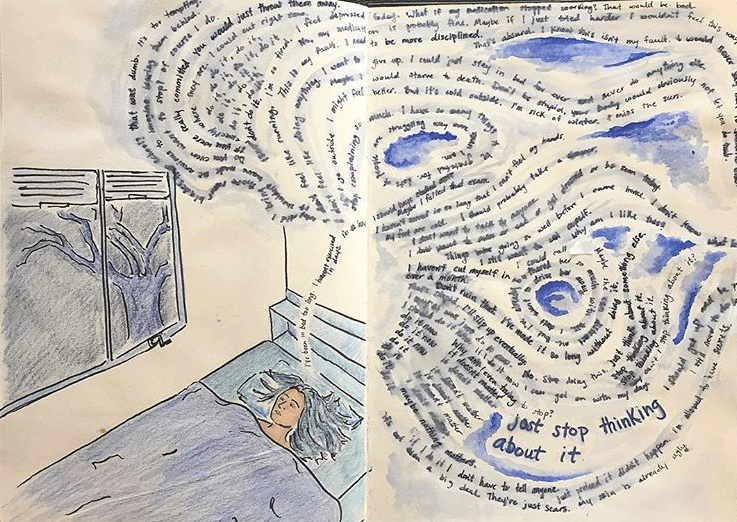
The therapist I saw in college believed that there were no accidents in art, and would analyze my sketchbook while sitting next to me. While I’m sure there are some elements of my art that come from my subconscious, I don’t usually see the “accidental” parts of my art as meaningful.

That said, there were always parts of my art that my therapist pointed out as meaningful that I hadn’t noticed before. I could always come away with a better understanding of myself, or at least something new to think about. For example, the window mechanism in this piece is very detailed.

Thoughts

She suggested that detail might be an indicator that there was some hope of freedom or escape from the thoughts in the drawing. Whether that’s something that ended up in the drawing because some part of me believed there was hope, I’m not sure. But I can certainly take that sense of hope away from it, into my normal life. 

Art about mental health is not just an excellent way to express feelings, but it also starts a conversation. It can make people feel less alone in their experience, and it can help your loved ones understand your symptoms and how you feel. Sometimes, it even helps me understand where I’m at in regards to my own outlook. Sometimes a piece of art will take me by surprise at its dark overtones when I thought I was feeling ok. Other times, I’m pleasantly surprised to find that drawing a whimsical picture is exactly what I want to do.

whimsical-drawing-of-yellow-blue-and-pink-shapes

If you’re interested, you can follow my art Instagram @lumpdates

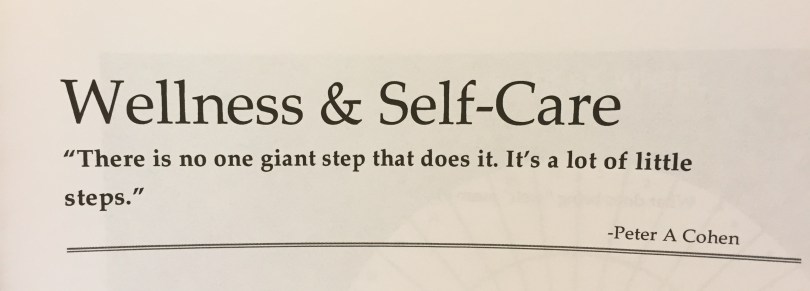
peter-cohen-quote-wellness-and-self-care

Levels of Mental Health Care

In light of my recent posts, I thought it might be useful to elaborate on the levels of mental health care you can find in a hospital setting (at least in the US). What are the differences between them, and what can you expect from each?

Inpatient Treatment

Entering a hospital as an inpatient for mental health care can be incredibly nerve-wracking. If you don’t know what to expect, the experience is overwhelming. The important thing to remember is that the system is designed to keep you and the other patients safe.

In an inpatient setting, you sleep at the hospital and spend your days on the unit. You might have a roommate; they’re probably just as overwhelmed as you are. The staff will likely elaborate on the expectations for patients, but you may be expected to spend the majority of your time in a common area, interacting with other patients and staff. Your nurses and doctors will want to see that you’re participating in group therapy, willingly spending time outside of your room, and eating meals with the unit. You’ll meet with your doctor and a social worker, and have a chance to discuss your treatment goals and any concerns you have. Different hospitals have different timeframes for this; you could meet with your doctor as often as every day, although it may happen less frequently.

Before you’re discharged, the staff will probably want to be sure that you have a support system, safety plan, and aftercare set up. Continuing mental health care might look like a partial hospitalization program, intensive outpatient program, or outpatient therapy with your own mental health counselor.

Partial Hospitalization Program (PHP)

The next level down from inpatient care is a partial hospitalization program. In a PHP, patients typically attend therapy for most of the day, sleep at home, then return for the next day of programming. For example, the PHP I did was from 9 am to 3 pm, Monday through Friday for ten days.

Programming usually focuses on teaching skills and information you can use to manage your illness. The PHP I was in took content mainly from DBT, although we also touched on ACT and CBT. You’ll meet with a psychiatrist and your case manager, who is usually one of the therapists who leads group discussions and teaches content. Your case manager will probably set up a treatment plan with you, and meet with you periodically to check in on your progress.

Many people come to a PHP through inpatient hospitalization. After spending time isolated from your normal, day-to-day life, it can be overwhelming to be tossed back into it. A PHP can serve as a helpful step-down to ease you back into your routine. Other people come straight from their outpatient treatment. They may not need the level of mental health care you get with inpatient treatment, but the support of a PHP can give them the structure they need to stay safe.

Intensive Outpatient Program (IOP)

In the same way that a PHP offers a transition from inpatient back into your normal life, an IOP does the same. It’s the next level down from a PHP, but is still, well, intensive. An IOP is similar to a PHP in the content that’s taught, but you meet less frequently and for a shorter amount of time each session, but for a longer overall duration. Many IOPs meet three times per week for three hours. The program might run for as many as eight weeks. The IOP at the hospital where I did my partial hospitalization had a more independent treatment; you didn’t get to meet with a psychiatrist or a case manager. That meant you would need to have outside medication management set up for your time in the IOP.

Many people go straight from inpatient treatment to an IOP, although others may need the structure of a PHP. Some people continue on from partial hospitalization to intensive outpatient, but sometimes that’s not feasible with work or family obligations. I decided not to do an IOP, but rather to return to my regular schedule and leave IOP as an option should I need more intensive mental health care down the road. It’s all very individual, and which program you choose depends on your specific needs and constraints.

Why I Sometimes Call Self-Care “Corporeal Maintenance”

Sometimes I wish someone would just roll me into the literal body shop and get me a self-care tune-up. Alas, it doesn’t work that way.

I’ve stopped using the term “self-care” to describe a lot of the things I do for myself. Hear me out, though. It’s not because there’s anything wrong with calling it self-care; it’s just that a lot of self-care tasks are not as flowery and gentle as the term implies. Sometimes you have to buckle up and make that phone call you’ve been avoiding so that your dentist doesn’t think you dropped off the face of the planet. (And so that you can get your teeth cleaned, I guess.)

I’ve found that reframing some self-care tasks as “corporeal maintenance” helps me tackle them with less procrastination. Something about approaching these tasks as simply maintenance and upkeep feels less daunting.
Here are some examples:

“Oh, my ‘check hydration tank’ light is on. Better go drink some water.”
Or
“Didn’t I just go grocery shopping, like…oh, yeah, I guess it’s been a while. I should probably get some fuel for this week.”

If I call it “self-care,” I’m likely to not do it – either because I don’t care, or because I don’t feel worthy of being cared for. But, if you want to keep driving to the things you do care about, you have to get the oil changed every once in a while.

There’s a lot of talk about self-care these days; some criticize it and some embrace it whole-heartedly. There tends to be an atmosphere of self-indulgence when we discuss it; as if every act of caring for ourselves is rooted in all-encompassing positivity. And yes, self-care can be self-indulgent and rooted in self-love. Those things are necessary. But self-care is also doing the things that aren’t very fun but are kind of non-negotiable when it comes to being healthy.

It may very well be the case that you do complete these tasks out of self-love, and I think that’s great. In fact, that seems like a wonderful goal to work towards. But if you’re not there yet, and calling those unpleasant/boring tasks “self-care” feels insincere, go ahead and call them something else. Whatever floats your goat.

Love, 

Your Brain