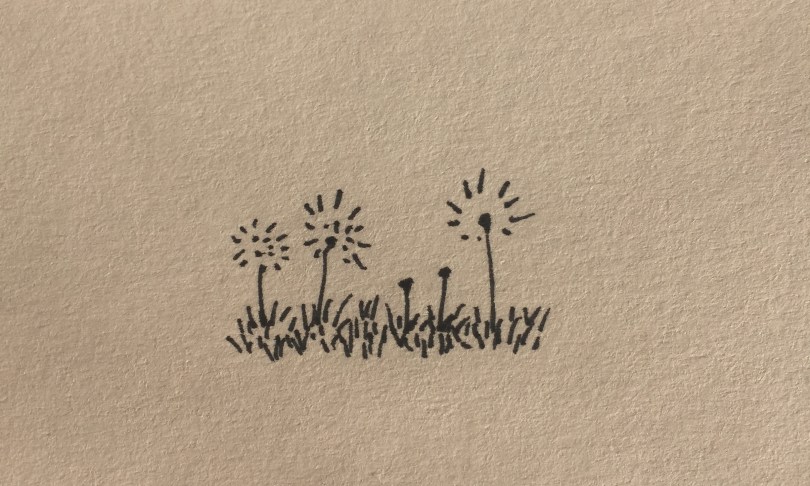
ink drawing of dandelion seed heads growing in grass

Observations From the Garden

I got up at 6 and walked through my routine because that’s what I always do, depressed or not. I fed the dog, made the coffee, poured a bowl of cereal, and then stared into it while the dog did her rounds in the yard. But by 8, I was beginning to wonder why I ever got up in the first place. So, back to bed with the window open and my blankets pulled up to my chin.

Lately, depression has overtaken my days with sleep and restless boredom. What time is it? Doesn’t matter; every day feels like a week. At night, the anxiety comes. I feel like I’m crawling out of my skin. Or like I want to reach inside my chest and pull out my lungs, let them spin out the twist in my trachea. Maybe then I could breathe.

To pass the time when the sun is up, I move between sleep and hobbies. Sitting outside in the backyard, my sketchpad page is still blank. Pen or pencil? I pick up the pen but am unable to draw more than a few dandelions from the scene I’m observing. A flock of house finches has found our backyard – it’s more dandelions than grass, and they’ve all gone to seed. The birds are foraging, bobbing their heads and moving among the unmown grass. One finch struts up to a tall dandelion, and, with an almost imperceptible flutter, attempts to perch on its vertical stem. The dandelion head begins to bow to the ground, and the finch rides the bending stem to meet the grass. Foot firmly planted to hold the flower down, the finch returns to bobbing and pecking.

There’s a sound behind me, and I turn to see a five-foot garter snake glide through the raspberry bushes, following a taste in the air. A busy robin chatters while it gathers last year’s grape leaves for nesting material. Stella digs a layer out of the hollow she’s claimed as hers, then situates herself in the cool dirt she’s uncovered. A hummingbird trill draws near, then it whizzes by on its frenetic journey. Everything around me moves, yet I feel like I’m in stasis. Animals and plants follow their daily rhythms, foraging, hunting, racing the sun to get enough calories, and I feel disrupted – out of sync.

I don’t know how to fix it. Usually, I keep up with my treatments — meds, therapy, ketamine — and simply wait for it to pass. I use what coping mechanisms I can—preferably the good ones, and let the turning of the Earth carry me from one day to the next. This time, I can’t help but feel the uncertainty of the time we’re living in. The disruption is not just to my mind, but to the world. When will this sense of weightlessness, of falling through empty space be soothed? When can we once again feel the ground beneath our feet, knowing by its predictability that it is moving us inexorably from today to tomorrow?

Connecting During the Pandemic

As a highly introverted person, I didn’t expect social distancing to have much of an effect on my mental health. After all, I don’t get out much to begin with. But what I’m finding, and what I’m hearing from others, is that the few social interactions we introverts had prior to pandemic life were more important than we realized.

I’m starting to really feel cooped up. I miss my library, my dog park, volunteering with other humans, and not sucking air through a mask while I run. My world, small as it was, has shrunk. But perhaps more than the social isolation, it’s the uncertainty about when it will end. Before, I might have chosen to stay in, but it was a choice. Now, this strange, lonely way of life stretches on indefinitely. I’m feeling restless, anxious, and sad. I sometimes joke that I’d like to go live on a mountain by myself, and while I’ve always known that wouldn’t actually be good for me, it still sounds tempting. But now, the social interaction that used to threaten to overwhelm me is in short supply, and I’m finding myself a little bit lost.

Luckily, we have options for connecting with others from a distance. I’ve been enjoying video calls with friends, yelling across the fence to my neighbors in their backyard, and texting extended family members. We have social media, phone calls, blog posts, any number of ways to get in touch with people who are far away. Even when digital methods fail, there are still connections to be made at home, and creativity goes a long way.

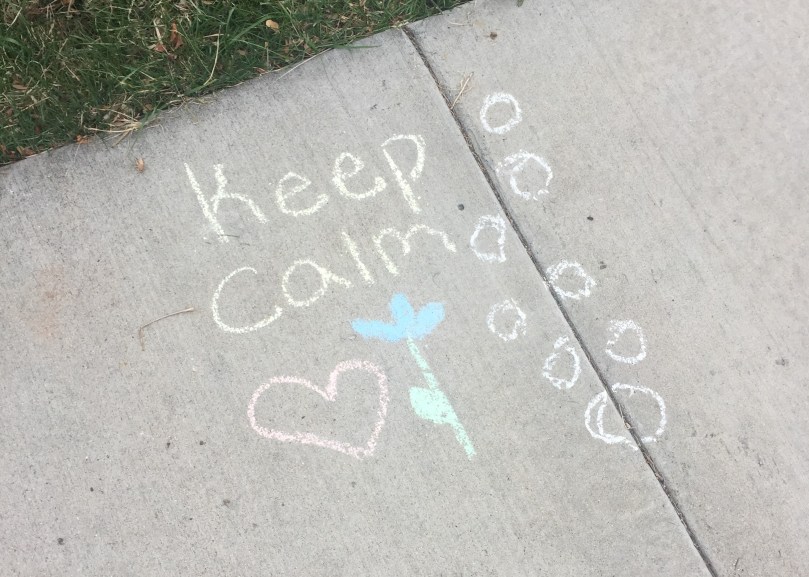
Towards the beginning of the pandemic’s reach in the U.S., when schools were closing and people started staying home from work, some kids in my neighborhood took it upon themselves to spread some positivity. I stepped out the door with Stella’s leash in hand and headed down the sidewalk for a quick walk around the block. At my mailbox, there was a message written on the sidewalk in chalk. It said “keep calm” and had a pink heart and a blue flower next to it. It made me smile and, frankly, gave me some warm fuzzies. All the way around the block, there were short messages encouraging everyone to stay safe and some adorable drawings of flowers and butterflies. It was a great reminder that we are all feeling the stress of the pandemic in our own ways and in our own homes, but we can still find ways to connect.

keep-calm-written-in-sidewalk-chalk-with-pink-heart-and-blue-flower

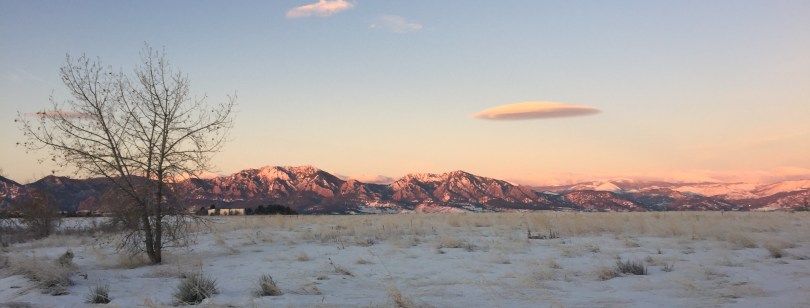
blue and pink mountains illuminated by sunrise over snowy plains

Why Self-Care Can Be Hard For Me

Taking care of yourself comes in many forms, some easier than others and some more pleasant than others. Throughout my years of depression, self-care has meant several things to me. In times of severe symptoms, self-care focused on basic skills; eating, bathing, and taking my medications. When I’m doing better, self-care looked more like the conventional meaning of the term; taking time to relax, allowing myself tasty treats, watching a favorite show, etc. But no matter the state of my mood disorder, self-care has always included a mental component that can be particularly difficult: being nice to myself.

I know, that sounds so obvious it’s ridiculous, but you can absolutely do the actions of self-care without believing you deserve it. I run into this issue a lot; I spend an evening in sweatpants and a cozy sweater, absorbed in an episode of [insert ever-changing favorite show here]. Great self-care, right? Except I finish up the whole endeavor with terrible self-criticism for having let myself waste time and be lazy when I could have been getting work done. Somehow, it seems like that negates all the good that the action of self-care does for me.

Don’t get me wrong; I’m sure there are plenty of benefits of self-care even when you’re not feeling it. If you’re doing something essential to your survival, like eating food, of course that outweighs whether or not you think you should do it. Plus, there’s likely some neurological benefits of taking care of yourself- dopamine, less cortisol, heck, there’s probably benefit to just practicing those neural pathways and making them feel more natural. But it also seems logical that the benefit of self-care itself would be even better if you let yourself have it guilt-free.

Sometimes, the hardest part of self-care is believing that you deserve it. And that’s usually when I need it most urgently. It’s a work in progress, but I’m trying to be less critical of myself. Deliberately being nice to myself sometimes feels like a big lie, like I’m only humoring the part of me that thinks all my negative self-talk is pretty crappy. Living with depression makes it complicated because I know that I need to do things like exercise, take time to relax, and let myself say “no” to things. But the part of me that fights tooth and nail to appear “normal” resents the fact that if I’m not gentle with myself, I might end up debilitated by depression again. I don’t want to need anything, and certainly not anything pampering. I’m fine how I am.

“I’m fine,” she says stubbornly.

Sometimes you’re not fine, and that’s ok. And it doesn’t matter how long you’ve been not fine- you still deserve to take care of yourself. Sometimes I feel like having been depressed for a long time means that I’ve been indulgent in my sluggishness and I need to be hard on myself to get out of it. I would never tell someone else that. Be as kind to yourself as you would be to a friend in the same situation.

Stress and anxiety abound right now, so take care, stay busy, and get some fresh air when you can.

-G


extended-hand-holding-soap-bubbles-with-beige-background

COVID-19 and Anxiety: Caution vs Compulsion

Yesterday, my city declared a local disaster emergency. A growing number of presumptive cases of COVID-19 in my county have led officials to close all city facilities. This has given me pause when it comes to the complexities of COVID-19 and anxiety.

I was diagnosed with obsessive-compulsive disorder when I was about 11, and I dealt with many different obsessions over the years. Perhaps the longest-lasting obsession I had revolved around contamination and germs. For the last several years, I’ve been blessedly free of OCD, and when an old obsession pokes its head out, I’m fairly quick to oppose it by doing an exposure. Since the start of the media coverage of COVID-19 in Wuhan, I actively tried not to let it worry me too much. I could feel the pull of anxiety, coaxing me into watching the news coverage and letting it take over my life. Of course, I stayed informed but did my best to not obsess.

Now, my own city is seeing dramatic effects of the virus, both in increasing cases and in the social results of widespread, repetitive media coverage. Many of our city facilities were closed several days ago, and our city council has decided today to close them all. This afternoon, I finally made the trip to my pharmacy, located in a grocery store, to pick up my medications. The sight of so many empty shelves was unnerving. The only fresh vegetable remaining was lettuce. The bread aisle was sparsely populated with hamburger buns and a few loaves of whole wheat. A man asked the pharmacist where the thermometers were and was told there were none left.

I bought my items and went home, then washed my hands several times between unloading groceries, putting them away, and cleaning the counter they sat on. I’ve been cleaning my phone case, our door handles, and even my sunglasses after touching them while out. Am I simply being cautious, or have I crossed the line into compulsions?

For people with anxiety disorders, dealing with COVID-19 and anxiety during the pandemic puts them in a confusing position. People are being encouraged to be extra careful about handwashing and touching potentially dirty items. Events have been canceled and gatherings are recommended to be limited, making it easy to justify complete isolation due to anxiety. So when the behaviors that normally indicate a disorder are socially sanctioned, what do you do?

I can tell that going to the pharmacy triggered something, and where before I was simply careful, I’m now afraid of things in my own house because they came from outside, and I haven’t cleaned them. This alarms me because it’s exactly how I used to feel in the grips of contamination OCD. It’s overwhelming to suddenly feel like nothing around you is safe to touch.

This coronavirus could live on surfaces for two to three days, so maybe constant cleaning and disinfecting are completely warranted. I imagine many people are feeling this despite never experiencing feelings like it before. Nobody really knows how much is too much, and this is exactly why OCD is so tricky. In non-pandemic times, contamination-focused OCD is fed by a seed of doubt (indeed, every kind of OCD is fed by doubt). It can feel shameful because you know that your compulsions are irrational. Now, it’s unclear what rises to the level of irrationality. Maybe the compulsions I usually try to avoid are precisely what I should be doing.

There is no blueprint for handling COVID-19 and anxiety. I think it’s reasonable to increase your awareness of surfaces you might normally touch and to wash your hands more frequently. However, I know that for me, allowing myself to engage in my old compulsions is a slippery slope. It might be acceptable to do right now, but it will be harder to stop the longer I let it go on. It’s a balancing act, and I have to decide how much my anxiety is serving a purpose now versus how detrimental it is and could be in the future.

I’m certainly not going to tell anyone how to keep themselves safe. I am, however, going to tell myself to be cautious about being too cautious. As long as I can leave the compulsions behind again when life approaches normal, I’ll be okay.

Stay safe,

Genevieve

How Perfectionism Can Block Creativity

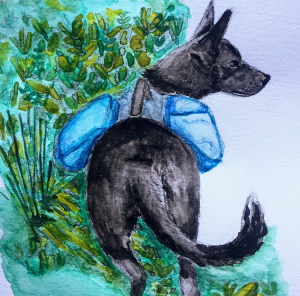
Over the years, I’ve made deliberate efforts to reduce my perfectionism surrounding my artwork. I think I’ve made some good progress. When I’m in the groove of regular artwork production, I can sit down with a blank page and some materials and just… start. With minimal agonizing, I can just start to put lines or colors on the page and see where it goes. But, when I stop making art for a while, the barrier of perfectionism returns. It always leaves me overthinking and judging myself harshly for my attempts to get started again. I haven’t been making anything in the last couple of months, and it took me some serious intention to pull out my watercolors and paint this.

IMG_5516

Rationally, I know that it doesn’t matter if I make something and rip it up, or if I make something and let people see it even if I’m not proud of it. But the perfectionist in me thinks I need to have a piece planned out and executed perfectly. I do think that there is some value in this trait. It can give you the patience to get something “just right,” or to sketch your concept with different angles or color schemes and figure out what you like the best. But then again, art never turns out exactly how you imagine it, and there’s rarely a point where you know for sure that it’s done. While perfectionism can help you get closer to your mental vision, it can also keep you from getting started at all– and that’s paralyzing.

In my experience, perfectionism and creative block go hand in hand. You can’t figure out what to make because none of your ideas are good enough; your attempts don’t look like you imagined them, so you scrap the whole thing; the longer you go without making something you like, the higher your expectations and the harder it is to get started. My approach to getting through this is to pick something that I like looking at and just start drawing/painting it. I don’t try to come up with a completely original idea yet- just pick a reference and get started. Sometimes this is enough to jumpstart my inspiration, and at the very least, it usually gets me excited about creating more things– whether from imagination or reference.

That painting I showed earlier– I don’t like it much. It’s based on a photo of Stella that I absolutely love, and my painting doesn’t come close to giving me that feeling. So, I don’t like it much, but I like that I made it. I like the feeling of seeing something coming together, even if it doesn’t match my expectations. I’ve been trying for weeks to get over the funk of creative block, and I think this painting may have helped.

Fighting perfectionism takes practice, and for me, it seems to take deliberate consistency. Letting my practice collect dust makes it harder to pick back up later. But no matter how long it’s been, I know that the more willing I am to make mistakes and to take risks, the more satisfied I am with the results.

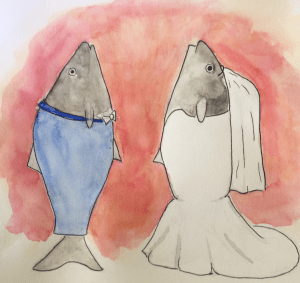
As a bonus, here’s my attempt at depicting the fish wedding from one of my ketamine infusions (part 8). It looked pretty much like this:

fish wedding

Yup. Pretty weird.


Tracking My Anxiety

The anxiety began when I was eating lunch and scrolling through youtube, trying to find something interesting to watch. I scrolled faster, considering each thumbnail more and more briefly as the tightness in my chest increased. “Hold up,” I thought. “I’m supposed to be tracking my anxiety for my appointment next week. Let me write this down.”

Here’s how to overthink your anxiety record: First, I spent several minutes considering the medium I should use to document my anxiety; paper and pen seemed reasonable, but what kind of format? List? Table? Stream of consciousness essay? I also considered the kind of paper I’d use, be it sticky notes, that half-used legal pad in my bookcase, small notebook–ugh. Too many choices. Let’s go digital. Thank goodness the Notes app is pretty minimal, or I’d still be waffling on what kind of font to use. (Speaking of “stream of consciousness”, I just realized that I could totally make a PowerPoint presentation, complete with awesome clip art and slide transitions. That would really prove my therapist right when she said I’d probably find a way to make it complicated because I’m an overachiever. Challenge accepted.)

So far, I have written down everyday things like realizing I wasn’t sure if someone introduced themselves as Janice or Janet and imagining the obviously catastrophic embarrassment when I inevitably pick the wrong one. I also have bigger things like my unknown life plans, noticing that Stella had put her sneaky paws on the counter and eaten chunks of chocolate cookies out of the pan (she’s fine), and also seemingly random anxiety with no discernable cause. Some of the “random” anxiety is probably due to sensory processing disorder and my tendency to steamroll over discomfort rather than make adjustments for my nervous system. It’s a work in progress.

I think I’ve spent a long time telling myself that anxiety isn’t an issue for me, which makes it a challenge to be mindful of it. After the OCD mostly disappeared, I guess I went “Well, that’s done. I don’t have anxiety anymore.” If only it worked like that. I keep having to reassess my understanding of what’s a normal amount of anxiety and in what contexts it’s normal. Seriously, I have no idea at this point. Do other people feel anxious when they have to walk by the check-out lanes on their way to somewhere else in the grocery store because they can feel people looking at them? No? What kind of lie have I been living?! I guess I knew that some of my anxiety was unreasonable, but convinced myself that it was minor enough that it didn’t need to be addressed. Now I’m just not sure what should be on my list of concerns. Time to go put “worrying about the amount I worry” on my list.

In case my therapist reads this: don’t worry, I will not be showing up with a PowerPoint detailing my anxiety, although that would be hilarious and probably a new one for you.


What to Consider When Switching Therapists

There are lots of reasons you might go from one therapist to another. You might be moving, looking for another perspective, or simply feel ready for a change. Or, it could be that your therapist is leaving; career change, maternity leave, any number of scenarios in which you must decide what to do with your treatment. And, pretty much no matter what, switching therapists is hard.

I’m in this boat right now, and I’m finding it more tricky than I expected. For one thing, I’ve had the same therapist for almost two years. We’ve gotten to know each other (in a heavily one-sided way), and when I’m not completely shut down with depression, I really enjoy her company. It takes me a minute to be comfortable with someone, so the thought of switching therapists and beginning that process again is daunting.

Online Research

When I began my search for a new therapist, I started with Psychology Today’s therapist directory. You can filter it by issue, insurance, gender, and other factors that might help you narrow it down. I also tried googling a combination of “therapist” with “depression” and my area.

Contact Method

Some therapists provide an email address with their contact information. Text, be it emails or SMS, is BY FAR my favorite way to communicate. Making phone calls is an arduous process, what with the scripting and practicing and heavy sweating. But, leaving a message on an answering machine is, in my experience, more likely to get you a speedy reply. [Pro tip: if you approach phone calls the same way I do, keep a list of potential therapists and the status of your contact. I can just imagine leaving the exact same scripted message for the same person twice and being mortified enough to cut contact entirely.]

Make Appointments with Multiple Therapists

I highly, highly, highly recommend that you make appointments or consultations with multiple people. It’s way more time-consuming, and I’m finding it difficult to tell my story again at each new appointment, but it’s the best way to find a therapist that you like. Your current therapist might give you a list of people to call, you can search the web, and if you meet with someone and it doesn’t work out, ask them if they have any colleagues they can recommend.

Therapists Understand that Switching Therapists is Hard

Switching therapists is an interesting process to go through after being in therapy for a while and having done the search a few times before because I feel much more sure of myself. I know what kinds of approaches I’m looking for and I know roughly what to expect at an initial appointment. But, I also have more of a history within the mental health treatment sphere to explain in a coherent manner. The sequence of events is too long to describe in detail at a first meeting, so I have to decide how to summarize in a way that gets everything across. I don’t always succeed, and then we’re left filling in important gaps that I forgot about. Fortunately, therapists understand that the transition can be a difficult process.

It can be hard to leave a therapist who has helped you through really tough times. They’ve supported you and listened to you, and it’s natural to be sad that your time with them is over. But, it’s not meant to be a relationship that lasts forever. I’m going to miss my current therapist, but I’m also looking forward to getting a new perspective. It might be just what I need to put all the pieces of my recovery together.