Selective Mutism in Therapy

The therapist I saw in college, having found me to be reticent on nearly every topic, encouraged me to express myself through visual art. She didn’t often give me assignments but instead preferred to let me draw what I wanted and bring my sketchbook to her each week. We’d talk about my creations and what emotions they evoked, and if we both were lucky, I’d expand on the state of my depression and suicidal thoughts. It was a fairly effective way to bypass my verbal barrier, as long as I felt confident in my artistic creations.

One week, while I was showing her my sketchbook, she exclaimed softly in reaction to one of the pages. It was just a little, “Oh!” but it triggered an avalanche of anxiety inside me that blocked off my ability to speak. I started to cry and hid my face with my hands. She asked me what was wrong, but I couldn’t answer. It was like I was trapped inside myself, all my words perfectly accessible in my mind — but incapable of being moved across my lips.

My therapist’s exclamation called attention to a drawing I was already anxious about revealing. It was a simple drawing of the materials I used to harm myself. I had found it nearly impossible to talk about my struggle with self harm, but it was an issue I wanted to work on, so I tried to initiate the discussion with a drawing. It backfired tremendously.

I felt strange – like everything was unreal and far away. I wanted to tell my therapist that I was trying to start a conversation with the drawing – even just to say I felt anxious – but I couldn’t. I felt acutely separated from everything around me and yet intensely aware of my therapist’s attention. I could feel her gaze on me, as if it were exerting physical pressure that made me want to crawl behind the couch and disappear.

My therapist sat with me for quite a while until I regained the ability to speak. I remember commenting on how strange that little episode was, saying that I wasn’t sure what had just happened. She agreed, perhaps not wanting to poke at me when I’d only just returned to verbal communication.

In hindsight, I was new to therapy and didn’t yet have the words to describe my intense anxiety, and I didn’t have the insight to trace incidents like that all the way back to my earliest memories. I’ve always had a problem with being put on the spot and asked to speak in front of people, but I’d minimized that issue in my mind.

I’ve since done a lot more therapy and introspection and am learning to connect the dots. A separate, more recent incident in which I found myself unable to speak led me to do a Google search for “inability to speak under pressure.” That Google search and a conversation with my current therapist have led me to believe that the likely explanation is selective mutism, an anxiety disorder characterized by silence in certain situations that trigger intense social anxiety.

The Beginnings of Selective Mutism

When I was very young, I remember feeling like being silent was the safest action, and if I could just outlast whoever was trying to interact with me, they’d give up and go away – and they usually did. I don’t think my silence was ever a choice, but it aligned more closely with what I wanted when I was young. It was like the expectation of speech created a vacuum around me that was impossible to fight. So I embraced it as a strategy for dealing with painful self-consciousness. I simply shut down.

But as I grew older, I became frustrated with my mental barrier. I recognized that speaking would make the painful attention go away faster – that being silent was attracting more scrutiny and prolonging the anxiety. But I couldn’t seem to break through when I wanted to. I could speak at home, and I could speak to my friends. But around strangers or when put on the spot, my words were locked away.

I’m not sure how, but I made progress. Perhaps I grew out of it to some degree. I got better at tolerating being the center of attention. For the most part, I function just fine now. I can even give presentations without shutting down. What seems to trigger selective mutism in my adulthood is the combination of being the center of attention and feeling shame or embarrassment. If I feel like I’ve done something wrong in my place at the center of attention, either by making a mistake or making a scene, I reach a level of social anxiety that punches me into my own little void.

Present-Day Therapy

Therapy is one arena where shame and embarrassment often come up, and as the client, you’re almost always the center of attention. I’ve practiced talking about the things that make me feel vulnerable and self-conscious enough that for the most part, I do okay now. I talk for most of my sessions, which is a huge improvement. But I had many sessions where I’d reach my limit and stop talking or we’d stumble into a topic that suddenly silenced me. It was very distressing. I’d be thinking a million things at once, trying to get myself to just spit out one of them. Sometimes, my therapist would rescue me and fill the silence. Other times, she would wait.

I would go home and write down everything I couldn’t say out loud and send it to her in an email. Two years ago, I wrote to her about therapy, saying, “…when I get there, I lose the ability to speak. It’s like every week, I have these big hopes that I’ll just sit down and say things and it’ll be easier. And then I sit down and remember I’m me. I have made progress, but the worse I feel, the harder it is to override my silence. […] It feels like I’m just incapable of speaking openly, like I send the words out from my brain and they hit some kind of barrier at my mouth. I don’t know how to fix it, but I’d like to.”

At some point, I figured out that I could break through with a fun fact. My intention was to distract and bamboozle with a stunning tidbit about the biology of scallop eyes or some other interesting concept. It never worked, but I did discover that I could say something when I felt like I couldn’t. There was potential. The longer I go in silence, the harder it is to speak. If I can say something – anything – I sort of reset the clock, and it’s easier for me to get subsequent words out.

Introversion and Selective Mutism

I’m glad that somewhere along the way, I learned how to get my words out in therapy and in life, but I wish I’d known that there’s a term for what I was experiencing. It’s comforting to be able to recognize and label an issue I’d never understood as selective mutism. I’ve always chalked my general quietness up to extreme introversion, but that label never seemed to explain my occasional inability to speak. Now that I know about selective mutism, I think I’ll be a bit gentler with myself when social anxiety crops up.

Somehow, the fact that I experience social anxiety has been quite a recent realization. I knew I was very shy as a child, but I thought that I magically overcame that. Maybe it was wishful thinking. I’ve always worried that my quietness might be interpreted as aloofness, and I’ve been told I’m quiet so often that I’ve developed a little shame pearl – layers of practice to cover up the sharp edges of my grain of silence. Talking is expected, and if I don’t meet that expectation, I feel guilty. As if my lack of social grace might make someone else uncomfortable or ruin their time in some way.

I think I’ve learned to operate in social situations so seamlessly that I forget how much effort I’m putting into them. I feel somewhat adept at socializing, but only because I’m constantly monitoring my own facial expressions and trying to match others’ body language so that I appear comfortable. The rules of conversation – the progression of topics and little linguistic customs – are old hat to me now.

I still default to quietness, which frustrates me sometimes. I’ve often wished I were outgoing and talkative and tried to will myself to be different. I didn’t recognize the legitimacy of what I experienced as a kid or that I’ve been working against it this whole time. I thought I was fighting what I saw as a flaw in my personality. It seemed the introversion was to blame and that if I could just overcome that, navigating the social landscape would be easy and enjoyable. I’ve come to realize that, while I am highly introverted (and it’s not something to be overcome), there’s an additional factor in the form of social anxiety.

Teasing apart introversion and social anxiety is sometimes difficult, so knowing when to let myself hang back and when to challenge myself isn’t always clear. I push myself to talk and engage in conversation, but I’m also working on accepting and appreciating my quiet nature.

My Mental Health Has Been Good

Life has been good lately. I’ve been taking Mirapex for a few months, and it’s turned out to be very helpful for me. My depression has improved dramatically. I’m more social, more interested in doing things, and more positive in my everyday life. I’m still taking lithium, Seroquel, and Deplin, which I’ve found through trial and very painful error to be completely necessary. All in all, I’m fairly content to continue my current medication regimen — with some minor adjustments.

Balancing Side Effects and Improvement

While Mirapex has proven to be effective at improving my mood, it has also had an effect on my appetite. I struggle with low appetite as a result of my depression anyway, so being even less inclined to eat has become a problem. I’m significantly underweight and struggling to gain. I tried reducing my Mirapex dose in the hopes that it would help my appetite and decrease my anxiety, but it wasn’t a very impactful change in those departments. I also started to notice some worsening depression symptoms, so I returned to the slightly higher dose.

Recognizing Depression Symptoms

I’m glad that at this point, I can put my extensive experience being depressed to good use in recognizing when symptoms are returning. I’m always very aware of how much I’m sleeping during the day. Napping tends to be a reliable indicator that my mood is declining. It’s both a result of the fatigue depression brings as well as a good old-fashioned escape mechanism. When I lose interest in doing anything, sleep seems like a great way to pass the time I don’t want to be conscious for anyway.

I also get this aimless, melancholy feeling that accompanies the anhedonia. I feel like I should be doing something, but I don’t know what, so I move from activity to activity, room to room, feeling lost. When I finally just sit down and embrace the lack of productivity, I feel a sinking, hopeless feeling in my chest.

Dealing with Anxiety

Seesawing between depression and anxiety is an unfortunate pattern for me. Mirapex helps lift my depression, which naturally ushers in the anxiety. The anxiety is augmented by the Mirapex, which tends to make me feel more awake and energized. I feel generally more tightly wound lately. Driving seems to set the anxiety off — to the point of crying, shaking, hyperventilating panic attacks on a few occasions. Even when nothing anxiety-inducing is happening, I find myself feeling restless and tense.

I struggled with debilitating OCD and generalized anxiety as a child and teenager, and I fear going back to that. When I start to get anxious now, as an adult, it feels horribly familiar. So, I try my hardest to combat it. If it’s an intrusive thought that feels like OCD, I do whatever the anxiety tells me not to do. In some ways, the idea of giving in and avoiding the thing makes me more anxious than doing it because I have such a fear of slipping back into old patterns.

Even though I’m fairly good at doing exposures and keeping the OCD in check, being anxious about being anxious is tough to get out of.

Adding Another Medication

In an effort to try to reduce the anxiety, I’m starting to take pregabalin, which is Lyrica. It’s more accurate to say that I’m re-re-restarting Lyrica. I have a really hard time adding medications because of my deeply seated issue with “needing” them. I have this belief that I should be able to fix my psychological problems on my own. Even though, intellectually, I know there’s nothing wrong with taking medications, I still fight with myself over it. At this point, it’s a habit for me to resist any new medications. I’ve “started taking Lyrica” several times now and haven’t continued long enough to get anywhere near an effective dose. This time, though, I’m actually doing it. The balance between anxieties — the general one and the one about taking a new medication — is shifting, and I’m inclined to do something about the everyday anxiety.

For now, I’m just taking a basically homeopathic dose while I get used to having a new pill in my organizer. I’m easing myself into it.

Ketamine Troches

Taking ketamine troches has continued to be somewhat helpful. I definitely notice a decline in my mood when I don’t take them, so I suppose they’re doing something.

My experiences with them are wildly varied, ranging from being trapped on the bathroom floor for an hour while time warped around me to contentedly eating pizza while scrolling the internet. Sometimes, I feel it intensely and dissociate for an hour, and other times, I barely notice anything at all.

I have discovered that on the occasions when I feel the ketamine a lot, it’s important that I not eat too much before bed because if not, I will wake up several times to go vomit.

Moving House

I moved again a few months ago, and aside from the conveniences of living in a house vs an apartment or a townhouse, living in the house has been an interesting transition.

For a while, it just felt like we moved again – this one makes four times in a year and a half if you count “moving” to the hotel after the fire. The significance of having a house after losing the old one sometimes slips by me, and I feel a numbness that I don’t like. I also feel strangely unattached to my new belongings now. I know they’re mine, but they just feel bland and unimportant. If they were damaged or I lost them, I wouldn’t be upset. Perhaps that’s healthy. I don’t know.

On the positive side, Stella has a yard again, which is a major improvement compared to our last place. Of course, she has found ways to crawl under the low deck in search of rabbits, and she’s dug little dirt beds into the two shady spots. Dog-proofing aside, I’m just glad she likes it.

Tangled tree roots

Overthinking and Decision Root Balls

I have a tendency to move my decisions from nice, logical decision trees into an underground network of convoluted root balls. Aboveground, choices are determined based on simple, bifurcating factors. Underground, no such rules exist.

Sometimes my decision root balls are so confusing that they’re also wrapped up in other trees’ roots. Those aren’t even my trees! When this happens, it feels like there’s just so much to think about that I can’t consider all of it at once. I’m left with a horribly overwhelming feeling that makes me want to say “no” to everything. It’s like going a million miles an hour and coming to a sudden stop, somehow at the same time.

Overthinking Decisions

I’m a habitual overthinker. I feel compelled to organize all possible plans and outcomes before even considering making a choice. The anxiety stems from the powerful feeling that I have to make the “right” decision, or else. The “or else” is vague and in most cases, probably entirely fictional.

And yet, often, I don’t have a specific worst-case scenario in mind. It’s just a sudden feeling of doom. Once I get myself to slow down and think through the choice in actual words, the real overthinking happens. The pros and cons of each choice are easier to hold onto, but they go straight into the center of a decision root ball. Then they get tumbled around for a while before I get frustrated enough to make the decision.

Untangling a Decision Root Ball

I’m learning that, for slightly longer-term choices, I do better when I force myself to not try to make a decision right away, but to instead let it sit for a day or two so as to avoid my immediate reaction. Of course, I can’t always stop myself from thinking about it all the time and being anxious, but I can reduce the pressure a little.

When I succeed at this strategy for overthinking, I’m much better at choosing the option that’s scary but leads to more growth. The positives start to outweigh the anxiety. The decision root ball starts to become a little less constricted.

For shorter-term decisions, I’ve found that I have to do the opposite of the long-term strategy. If I let myself waffle too much, I become paralyzed and am overwhelmingly likely to pick whichever option involves the least uncertainty.

To illustrate this with a mundane example, imagine me considering the benefits and drawbacks of various food court establishments. If I’m overwhelmed by attempting to balance the benefits and drawbacks, I will pick the option with the least uncertainty and go home empty-handed. And by benefits and drawbacks, I mean things like the length of the line, how harried the employees look, the likelihood that I’ll have to shout to be heard, and how chaotic the space around the line is. I mean, seriously. Sometimes, I’m deterred by not knowing what sizing system they use for their cups. It’s a wonder I can function at all.

Maybe someday I’ll progress to making decisions on the spot with minimal anxiety, but that sounds like an expert-level endeavor. For now, I’ll stick to gradually pruning my decision root balls and trying to say “yes” to some things.

Black tiles with white letters spelling therapy on a blank background

Why Anxiety About Therapy Isn’t a Bad Sign

Having anxiety about therapy doesn’t mean that therapy isn’t “for” you or that you can’t benefit from it. Instead, it might be a fear you can change by adjusting the way you approach your sessions.

We often focus on the role of the therapist and how well we connect with them when talking about how to feel comfortable opening up in therapy, but we don’t often examine our expectations of ourselves. Self-criticism and high expectations had me feeling anxious about therapy until I changed the way I thought about myself as a client.

When I decided to start going to therapy in college, I was apprehensive about having to do the classic back-and-forth discussion with my chosen therapist. In fact, I’m still not always keen on it. But the expectation that I held for myself – that I would sit down and spill my guts and cry and reach some kind of catharsis every week – did not pan out. The more accurate picture was (and sometimes still is) one of me sitting down, saying I’m okay, shrugging a lot, and forcing my therapist to sit in silence with me while I wrestle with my thoughts.

I thought for a long time that I was bad at therapy. I was very critical of myself for inadvertently shutting down. Sometimes, I still feel guilty because I perceive my excruciating quietness as a waste of my therapist’s time.

Shifting My Perspective on Myself in Therapy

The longer I’ve stuck with it, the more I can see that this perspective of myself as something like a student who is expected to achieve success is preventing me from recognizing the progress I’ve made. As a perfectionist, I’m prone to thinking that no amount of improvement is good enough, and if I’m not meeting my own expectations, I must be failing. Perhaps even more importantly, my anxiety about therapy gets in the way of me focusing on what I can get out of the process despite and because of my difficulty with certain topics.

Image by Stefan Schweihofer from Pixabay

I have been trying to shift my perspective on my role in therapy to be more like that of an explorer or some kind of self-ethnographer. I go to therapy, I do my best to talk, and I observe whatever happens. I’m there to be curious, and if talking about something is suddenly challenging, that in itself is interesting information.

Why Go to Therapy if It’s So Uncomfortable?

I learned early on in my experience with therapy that although talking about myself is deeply uncomfortable, it feels worthwhile. I have always been quiet and reserved, and I tell myself that it’s a preference. But, finding myself unable to answer personal questions in therapy taught me that I have less control over it than I wanted to believe.

To Challenge Myself

When pushed to discuss something I’m uncomfortable talking about, I simply clam up. It frustrates me because it does not feel like a voluntary reaction. Obviously, I go to therapy to talk about myself – why can’t I override my tendency to shut down? It’s like a drawbridge lifts in front of me, and I can no longer get my words across the gulf between myself and my therapist.

To Practice Being Vulnerable

Ultimately, therapy led me to the realization that while staying quiet is comfortable for me, it is also lonely. I don’t intend to change my natural tendency to be reserved, but I do hope that by practicing being open about difficult things, I can allow my reservation to be a choice, not a barrier.  

Photo by Shane on Unsplash

Everyone has secrets, and it’s perfectly okay to keep them private. But there are times when it’s good to share personal information, especially if it’s going to help you overcome a challenge in your life. Holding secrets out of an inability to put them down can be a deeply isolating experience.

Finding Ways Around My Anxiety About Therapy

I’ve gotten better at talking about myself in therapy, but it’s still hard. I still have sessions where I can’t seem to find the lever to lower the drawbridge and let the words out, and that’s okay. My therapist knows that I stay quiet not out of disinterest in the process but because it’s hard for me to engage in it.

On days when I don’t say much, I go home and write her an email with all of the words I couldn’t set free. It gives us somewhere to start the next time and lets me communicate in a way that’s easier for me. I still challenge myself to talk, but I know that I have a backup line of communication if I need it.

Whether I choose to discuss something or not is up to me, of course. My therapist is there to guide me, even push me a little, but ultimately, I decide what to talk about or not. If I want to set aside a more difficult subject in favor of discussing something easier but still meaningful, I can do that.

Considering the Therapeutic Relationship

I have found that for me, viewing a therapist’s role as that of a knowledgeable partner rather than an authority figure helps me stay intrinsically motivated and makes me more willing to push myself. We’re exploring my brain together, and I know that if I don’t accomplish something I set out to do, I won’t be “in trouble” with my therapist the way I would think I were if our relationship were less equal.

Photo by Jess Bailey Designs: https://www.pexels.com/photo/pen-and-notebook-1119792/

It’s a strange relationship to navigate — one that is inherently unequal in more than one way. You go to a therapist for help because they have knowledge and a perspective you don’t. You pay them, and you probably defer to their expertise. They are in a position to set expectations and try to interpret the implications of what you say or don’t say. It’s easy to start seeing your therapist as someone to impress, especially if, like me, you’re a chronic people-pleaser.

At the same time, clients have the option to stop going, the freedom to ask for adjustments in their treatment, and the potential to view themselves as indispensable experts on their own experiences. It can be motivating to think of therapy as something you get to take part in with your therapist rather than something you have to go to. Ultimately, I think the dynamic of a partnership makes me less likely to fear that my therapist might disapprove of or be disappointed in me for not achieving something or even for not talking enough.

I’m still trying to let go of my self-imposed pressure to be a wonderfully verbose client. I go to therapy to work on my depression and anxiety, and part of that involves being less critical of myself. I used to think I was a bad client because of my anxiety about therapy. Now, I think I struggle to talk about myself, and that’s part of why I’m in therapy.

A white bottle of white pills spilled out on a black background

Feeling Shame about Psychiatric Medication

The first time I experienced shame related to mental illness, I was 11 years old and caught in the torturous intrusive thoughts and compulsive behaviors of OCD. Therapy did not go well because I found it nearly impossible to overcome my shame and embarrassment enough to participate. There were times when I was so appalled at myself for having intrusive thoughts that I genuinely feared my parents might stop loving me if they knew what I was struggling with.

The shame about mental illness started early, and the shame about taking psychiatric medication soon followed. Therapy was not going to work, so when I was 13, I agreed to start taking Zoloft. I remember leaving my psychiatrist’s office with my mom after that appointment and just sobbing in the middle of the parking lot. I felt so broken in such horrifying ways, and I thought that taking the medicine meant I was failing to fix myself.

Where My Pill Shame About Psych Meds Started

It felt like a very adult thing, taking medication. I’d carefully dole the pills out into their respective days in my weekly organizer. When I took them, I’d count them over and over and over – One, two. One, two. One, two. Sometimes, I would ask my mom, “Is this two?” and point to the pills in my palm. The root of that counting compulsion was the fear that I might accidentally take more than I was supposed to and overdose. OCD had such a hold on me that I doubted my ability to count to two.

Zoloft completely changed my life. Once I reached 200 mg, it was like my brain had been rebooted and all the bugs were gone. It was amazing. I took it for a few years and then came off it. Although I slip into old patterns sometimes, the OCD never returned in anywhere near full force.

Self-Criticism about Depression Medication in Adulthood

As an adult with treatment-resistant depression, I have mixed feelings about psychiatric medication. The Zoloft helped when I was a kid, but it was still something I considered to be shameful – something to be hidden. Whether that pill shame stems more from my own insecurities, my family’s attitudes, or societal messages, who’s to say? All I know is that I’ve never been able to shake that feeling, despite years of therapy and much contemplation on the irrationality of my beliefs.

I’m always hesitant to write about this. I want to emphasize that I know the way I think about psychiatric medication is unhealthy, and I don’t think anyone else should feel the way I do. It’s odd that being aware of that doesn’t seem to change my thoughts about myself. So, I guess this is a “don’t do what I do, but if you do, you’re not the only one” kind of a post.

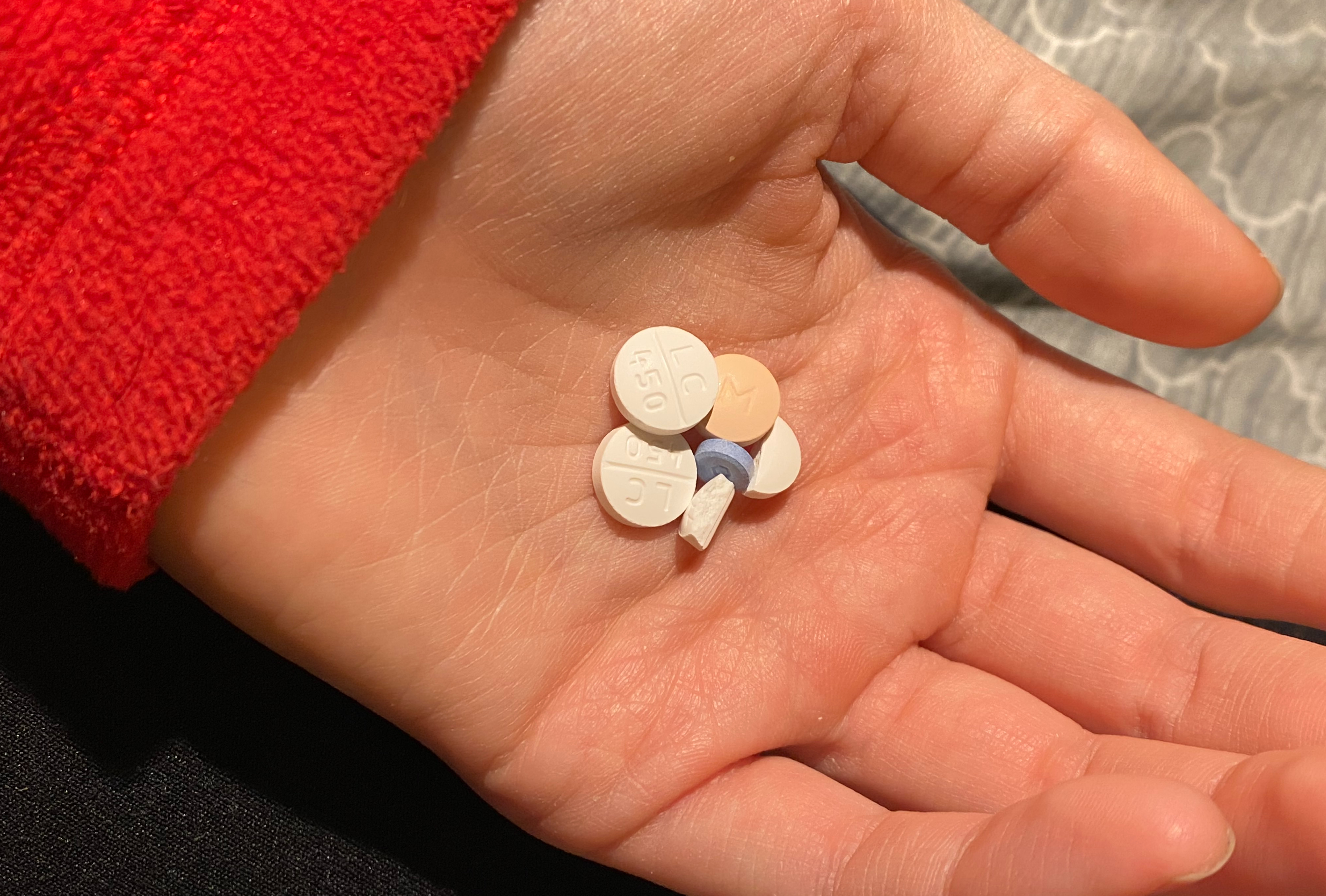
A hand holding several pills of different sizes and colors in its palm.

Sometimes, I accept that taking psychiatric medication for my depression is the right choice for me. It keeps me safe-ish and mostly functioning, so I try to appreciate the benefits and set aside my gripes on the subject. When my depression worsens, though, all of that goes out the window. I start thinking that I’m lazy and selfish and a horrible burden on my loved ones. Much like when I was younger, I tend to view my psych meds as daily reminders of my inability to fix myself through force of will.

Psych meds help me attain the activation energy needed to use healthy coping skills, but I also know that making behavioral changes can improve depression on its own. In my brain, if I’m not “better” yet, I must be doing therapy wrong or not trying hard enough to implement new practices.

But, Do I Need Psychiatric Medication?

I’m so tied to ideas of independence and self-sufficiency that benefiting from my depression medication feels wrong. It almost feels like cheating. I tend to think that if I make progress while taking meds, I didn’t really earn it.

Whenever I try to change the medications I take and my depression gets worse, it seems like proof that the work I was doing to help myself wasn’t enough to even make an impact. If a change in my medication sends me tumbling back down the mountain, was I supporting myself at all with other strategies? It’s a discouraging thought that leaves me teetering between believing that I need to try harder and nothing I do will make a difference.

You would think that the solution to that would just be to stay on my meds, but my mind is a convoluted mess, so it’s not that simple.

Is the Improvement from Psychiatric Medication Real?

I try to remember that during the times when my depression has been much better, I don’t feel so strongly about how medication helped me get there. That suggests that I’m not seeing things clearly when I’m depressed.

Photo by Anna Shvets: https://www.pexels.com/photo/pills-fixed-as-question-mark-sign-3683053/

Then again, maybe I don’t care about it when I’m better because the medication is influencing me in such a way that I forget about the beliefs I held before. Maybe I’m seeing the truth about myself and the pointlessness of life more clearly when I’m depressed, and that perspective is covered up by my medication when I’m feeling better. I know that sounds wild, but sometimes I’m moderately convinced by this weird logic.

Self-Compassion and Treatment-Resistant Depression

I’ve spent years trying to learn how to be kind to myself and accept that my mental illness is not my fault. I know that I’ve made progress, but sometimes, it just falls apart. It’s like I’m climbing a flimsy ladder, and every once in a while, I slip and go crashing through the rungs below me. And then I’m in an undignified heap on the ground, berating myself for not accomplishing my goals and using medication when I shouldn’t need to.

I don’t give myself any space to accept that there’s something not right in my brain, and it’s okay if I can’t fix it by myself. I know this cognitively, and yet I can never seem to fully convince myself of its validity.

Do you relate to any of what I wrote in this post? Do you see your medication differently? I’d love to know.

How I Track Mental Health Symptoms

My therapist has been encouraging me to track my depression and various contributing factors for years. I’ve tried several apps, journals, and charts, but I always drop the practice after a little while. Eventually, I identified why those tools never worked for me and used that information to make my own system.

Why Motivational Journals and Apps Don’t Work for Me

I understand why a system with lots of elements appeals to some people, but I tend to find them discouraging – the opposite of their intended effect.

My Depression vs. Positivity

Whenever I tried an inspirational/motivational journal, I quickly lost interest. I’d open it up to mark down that I felt like a person-shaped vat of cold, unsalted mashed potatoes. The list of weekly goals I hadn’t met would be staring up at me. Some inspirational quotes would arrive in my brain through the filter of my depression, limp and meaningless. Over time, I began to avoid them, knowing that the initial excitement of setting up a shiny new tracking system would sour.

Apps Aren’t It, Either

Apps have the advantage of offering daily reminders, but if the app is structured like the previously discussed journals, a cheery notification that it’s time to check in only distances me further. I really wanted apps to work for me, and I’ve been consistent with them for two or three weeks at a time, but I always abandon them eventually. They’re too complex, they ask me too many questions, or they document more than what I want to track.

Mood Scales and My Problem with Numbers

Number-based tracking scales usually include too much choice for me and don’t allow for flexible indecisiveness. A 1-to-5 scale just paralyzes me. What if I say “3,” but I’m really a “2?” That would be catastrophic, obviously.

Perfectionism

Maybe it’s a vestige of perfectionistic test anxiety, like I have to choose the “right” answer and be consistent in my interpretation of the scale or else anyone who looks at my data will get an inaccurate sense of my mental health. So instead, I just stop using them. When there’s no data to look at, I didn’t do it wrong!

So in the end, I decided to go with what my therapist suggested in the first place (I must be exasperating when it comes to tracking), and just made my own system to track my mental health.

My Method for Tracking Mental Health Symptoms

I wanted something straightforward, easy to use, and without the frills of a motivational journal. I got a completely blank, unruled journal and a set of stencils. I found these stencils online by searching something like “bullet journal stencils.”

The Mood Tracker

Each hexagon represents a day, which I’ve drawn a line through to depict AM on the top and PM on the bottom. I chose three colors to be “good,” “blah,” and “bad.” This way, I only need to pick a color and fill in the shape. If I can’t decide on a color, I can mix two of them together or shade the shape according to how the day progressed.

I also write small notes every now and then for medication changes, ketamine appointments, and other factors. I like that the bare minimum for this system feels doable for me but isn’t so scant that it’s uninformative.

The Medication Tracker

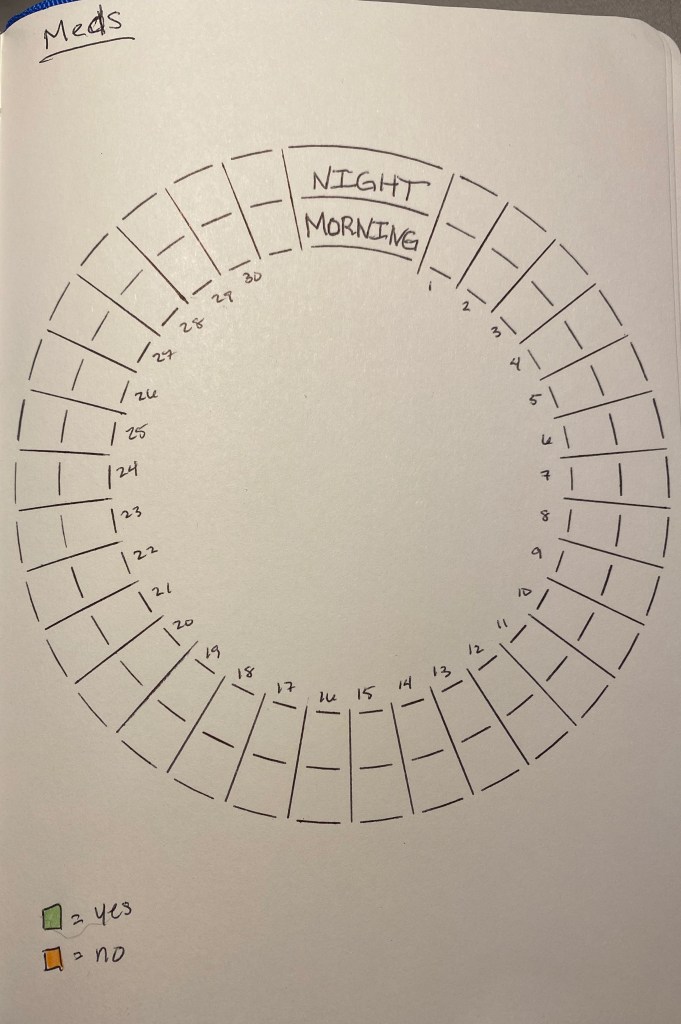
The medication tracker is similar to the mood tracker in that each section represents a day of a month. The inner row is morning and the outer circle is night. I picked a color for “Yes, I took my meds” and a color for “No, I didn’t take them.” It does help me to see how frequently I’ve missed doses, partly because the perfectionist in me hates to see too much orange.

I keep the journal and the colored pencils in my nightstand so they’re easy to get to and I don’t have the excuse of already being in bed when I remember to track.

How It’s Going

I’ve been consistent with this method for a little over two months, which is probably the longest stretch I’ve ever gone with tracking mental health symptoms. I can’t say that anything groundbreaking has come of it yet, but it is interesting to confirm some of my expectations.

I’ve tried and abandoned so many methods that I don’t think I showed my therapist my journal until I had been using it for a month. I didn’t want it to be yet another dud in a long line of tracking tools. So, I kept it to myself for a little while and am only just starting to assess its usefulness.

Just like with any mental health-tracking method, there are gaps in the data that become evident over time. I’ve been adding symbols to my mood tracker for things like self harm and my period. It’s becoming more complex, but I think the fact that I decide when to add those symbols rather than having a dedicated section for them works well for me.

That said, I’m considering adding a way to track more factors, such as appetite, sleep, and exercise. I don’t want to make it too complex, but I might have the habit established enough to expand my system without abandoning it.

There are tons of ways to track mental health symptoms and factors, and you can find many of them detailed online. What way works best for you?

A network of raised ice patterns on concrete

Thoughts on Depression, Trauma, and Change

My depression has not been great lately, and I’ve let my blog go wild in my absence. The longer I go without posting, the harder it is to pick up again. I have to think back to where I left off and decide how to begin.

After the Disaster

Last I wrote, I was wrestling with the loss of our house and belongings after a grassfire destroyed them. Life has gone on, as it tends to do. I’ve been back to the house a few more times, but only to look at it – not to search for anything. Yesterday, I parked by the trails near my neighborhood (when do I start calling it “my old neighborhood?”) and got out to look at the mesa. Green grass was growing like stubble over the burned landscape. I don’t know why I was surprised to see it that way. I knew the mesa would recover quickly. I suppose it was just more painful than I expected to notice the passage of time after a disaster.

A flat landscape with mountains in the background and partially destroyed wooden fences in the foreground

It’s not prominent in national news anymore, displaced people have scattered and settled, and we’ve acquired all the things we need in our new place. The wider community is moving on, as is reasonable and expected. And yet, it still feels so immediate and all-encompassing to me.

The Day-to-Day Stress

Wind, for instance, makes me feel a horrible sense of dread. It reminds me of walking Stella by the houses across the street that morning, several hours before the fire. Snapshots of it come back to me: a woman in her pajamas, rushing to pick up trash from her capsized bin; a full recycling can skidding across the street at high velocity; picking up crumpled, Christmas-themed debris and hearing someone remind me that wrapping paper can’t be recycled.

Most viscerally, though, wind reminds me of stumbling to a fencepost on the mesa, my hair whipping around my face in the deafening howl of near hurricane-force wind. It reminds me of standing there in disbelief, watching the wall of smoke move closer.

I was driving during a high wind advisory the other day, and all I could think about was my dog, Stella, alone in the apartment. I wanted to get back there as soon as possible in case a fire broke out. I couldn’t help but imagine the terrible possibilities. What if the road to the gate was clogged with cars? Could I park on the sidewalk and climb the fence? How would I transport Stella and our things to the car? What would I take? I imagined myself climbing the fence and running to our apartment, only to realize that imaginary me had left the garage door opener in the car, and I would need it to get inside. Should I break a window or run back to the car?

Suddenly, my GPS told me to get off at the next exit, so I took a deep breath and reminded myself that it was windy. That was it. No emergency.

The slightest thing will make me think of the fire. A wooden bowl in a craft store brought me to tears the other day. The realization that it’s spring and I don’t have any warm-weather clothes is disheartening. Then again, I don’t think about it all the time, and in some ways, I’m settling into our new place and getting used to my new routine. When I try to notice when things don’t suck, I can identify things about the apartment that I like. It’s sunny, conveniently located, and it has walking paths nearby. I like my room, which feels bigger than my old one. My new plants are doing well. It’s a nice place to live, and we’re fortunate to have it.

Depression is Stubborn

Despite the positive developments, my mental health has been declining for a while. Well, it’s on a low plateau, like one of those deep-sea shelves. Even before the fire, things were trending downward, so all the upheaval hasn’t helped my depression.

I’m having a hard time pulling myself out of the hopelessness. Whenever my depression worsens, I struggle to see things positively, and not just about the fire. The future is hard to imagine. Depression seems to stretch on infinitely. I can go out and do things and even enjoy them on some level, but underneath the top layers, any kind of meaningful goal or long-term ambition feels like too much effort and utterly out of reach.

Depending on when I finish working for the day, I either take a nap or go for a walk with Stella. My afternoon walks feel long and exhausting, but Stella doesn’t mind if I walk slowly and stop a lot. I let her point us down a new street the other day, and I ended up getting completely turned around. I had to use Google Maps to get back. Small hiccups like that make me irritable when my mental health is poor, so I put Stella on a short leash for the rest of the walk. She eats goose poop, rolls on damp dirt, and forgets she’s on a leash when she takes off in pursuit of squirrels. It’s better if she walks right next to me.

A black dog with pointy ears sitting on dirt while looking up at camera and panting

I know that I’m very isolated. It’s somehow overwhelming to talk to friends or even make a blog post. I worry that if I go do something social, I’ll run out of energy and won’t be able to muster up any enthusiasm. Usually, it’s fine, but the thought of it is so exhausting that I’d rather be alone. I’m more comfortable alone, but I know it’s not good for me.

I don’t like abandoning my blog for long periods of time. Depressed me struggles to create an entire post that follows a cohesive story or structure. When I do write something, I usually convince myself that it needs more work before I can post it. I let it languish in my drafts folder until I eventually return to it, read it, and wonder why I thought it was so bad. This post, for instance, is a conglomeration of several drafts I wrote over the last few weeks.

The combination of depression and perfectionism is a strange mix. When it comes to things like showering and eating, I’m apathetic. But, when I’m writing a blog post, an email, or even a text, I have to edit obsessively. That is, until depression fills me up with apathy like sand in an hourglass, and I decide to set aside my writing.

Let’s see how long it takes me to write the next one. I’m setting that clam for one week. Maybe two.